@KhoaVuUmn When I learned to use Stata, I was told to always do "m:m" merges to avoid error messages. To be fair, it did get rid of all error messages.
What does the total fertility rate mean?
It's a common misconception to think the TFR is a prediction of the average number of children women will have over their lifetimes. But it's not. 🧵
"The largest popular vote defeat for an incumbent since 1992 was, nevertheless, an election Biden came less than 50,000 votes away from losing."
Trump was also the only incumbent to lose the popular vote since 1992, so this means nothing. @NateSilver538
@TheZvi@MTabarrok This scenario would hold as long as there are no indispensable factors of production that only AI users can acquire – e.g. land, oxygen, atoms more generally
@TheZvi@MTabarrok [3/4] However, human labor would still be valuable to other humans, who have nothing to trade for AI-produced goods. They could then form a separate economy of their own, effectively independent of AI.
I've been critical of the lazy "we're all getting screwed" economic cynicism coupled with the "let's see what this button does" calls for wildly destructive economic policies.
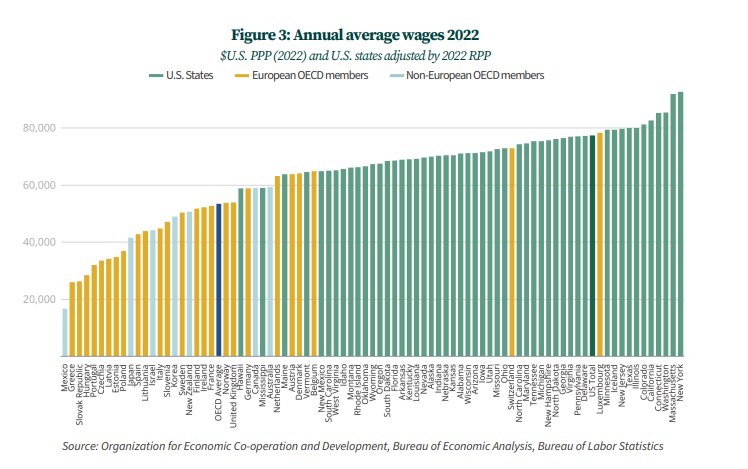
So this chart is great - its annual wages with U.S. states in green and OECD nations in yellow/blue (all adjusted for purchasing power parity for those who'll complain that U.S. wages don't go as far as Europe's)
As you can see, the U.S. economic model still does pretty damn well. Yes, we work a lot of hours and people wish for more benefits. But our poorest states still outearn many of Europe's richest countries, and we take for granted a lot of items (bigger houses, more cars, better technology) that other nations lack.
We're not perfect, but really, our system does quite well. And be careful with some of the crazy econ ideas, because economies are fragile.
Chart source: https://t.co/wz9AXs75Aa
H/T - @AlanMCole
Of course the stereotype was that these protests were concentrated at expensive elite colleges but I didn't realize the rather extreme extent to which that's actually true.
@tracewoodgrains@phokarlsson The most famous novel of the 1830s, Oliver Twist, was published as a serial in Bentley's Miscellanea which had a run of ~10,000. (Source: https://t.co/kMSomypZUx)
Hi @nfergus! I'm a big fan of our work. I've just finished reading William Manchester's biography on Churchill and it left me wanting to learn more about British history. Do you have any recommendations for the post-war period?