Binance has announced the delisting of Syscoin.
It’s disappointing, no question about it. A lot of you are probably feeling pretty frustrated right now, and we get it.
But this doesn’t change what Syscoin is or where we’re headed.
We’ve been building for over 11 years , we were here before Binance, we kept building through everything with them, and we’ll still be building long after they’re gone. When the Monitoring Tag first hit, we reached out to them multiple times asking for clear, straight up feedback on what needed fixing. We never got any real answers.
So we didn’t just sit and wait. We took matters into our own hands, we talked with top market makers like Amber and GSR about strengthening liquidity, we pushed hard on our own to support the market, and we kept moving the project forward in good faith.
Here’s the truth: Syscoin is way bigger than any one exchange.
We’ve watched this space change over and over. Big platforms that used to dominate are long gone. Exchanges rise and fall, markets shift, but we’ve lived through every cycle and kept building. SYS is still trading on five of the top ten exchanges. The network is solid, the tech keeps moving forward, the ecosystem is alive, and this community hasn’t lost an ounce of strength.
We’ve come out tougher after every challenge before. This time won’t be any different.
We’re still here. Still shipping. Still improving.
A huge thank you to every single one of you who builds, trades, mines, validates, develops, and believes in Syscoin. You’re what makes this real.
The best chapters are still ahead.
Onward together.
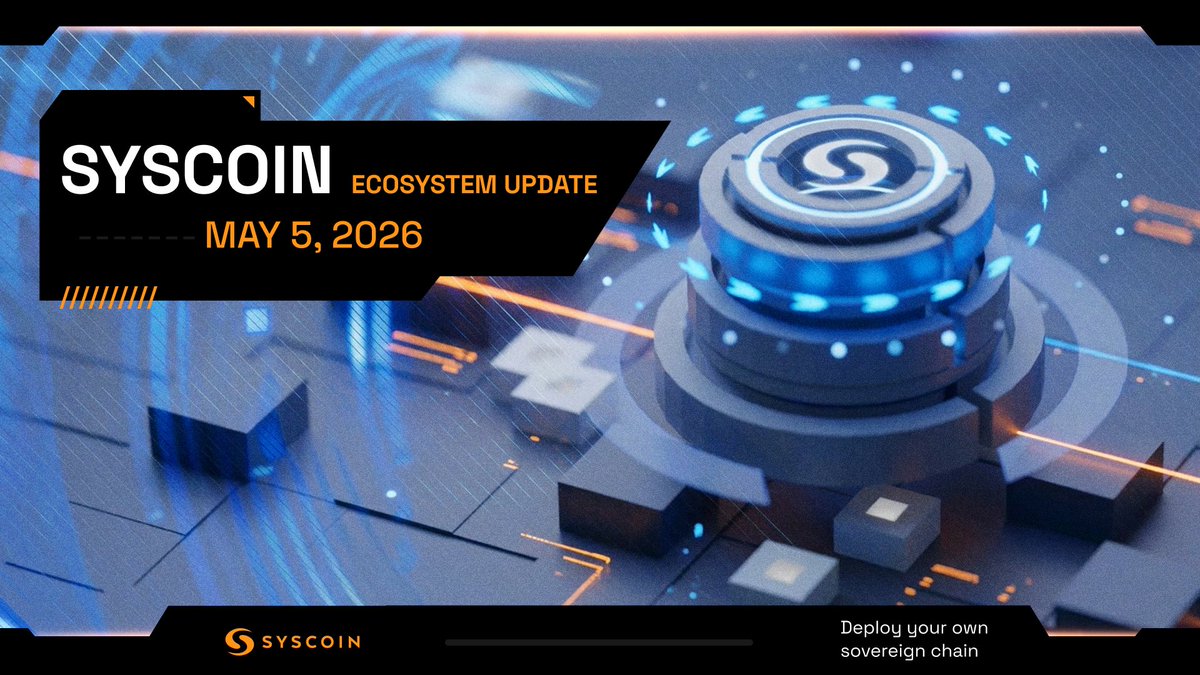
New Syscoin Ecosystem Update is live + AMA alert 📢
Following the zkSYS Public Testnet launch, this edition brings what's new in infrastructure, research, and ecosystem work moving Syscoin’s modular ZK roadmap forward.
🔗 https://t.co/tNt7U5bE3n
🛰️ NEW: Sysnode, the official Sentry Node dashboard + governance tooling
⚡ zkSYS bridge: advanced internal testing
🧩 Modular ZK roadmap: proving economics, DA + based bridging
🌎 DevRel: Proof of Builders V reaches 800 builders in LATAM
🎒 @PaliWallet: V4 rollout + community bounty
☂️ @LunosDAO: Month 3 report + Asset Manager QA
🧑🚀 @SuperDappAI: infrastructure migration, Base bridge work + AI Agent testing
✅ Upcoming: set your reminders for an AMA with the Syscoin Core Team, this Thursday (May 7th) at 16:00 UTC, covering all recent updates 👇
Set reminders: https://t.co/mlm3n61JVr 📅
To the Lunos Community,
Following our recent announcement about the $UNO delisting, we want to share a direct and honest update on where Lunos stands and what comes next.
Lunos is entering a pause period.
This is not a decision taken lightly, but under the current circumstances it is the responsible and most constructive path forward.
Why this is happening:
Lunos launched in 2021 with initial investment that provided runway for the project’s early years. Since late 2025, after the project had not yet reached product-market fit, our operations, infrastructure, liquidity support, and small payroll have been supported through @Syscoin governance proposals.
That support allowed us to keep the project alive, preserve the technology, and continue building through extremely difficult market conditions.
At the same time, Syscoin is now facing its own funding pressures. The Syscoin team has informed us that they intend to submit a governance proposal focused on market-making support for $SYS. This means any new Lunos governance proposal would likely compete directly with a core Syscoin funding proposal at a time when available governance funding is already limited.
Given that reality, and without new external capital secured yet, we do not believe it would be responsible to continue active development right now.
There is also a timing factor: The next phase of Lunos depends heavily on the broader @Syscoin ecosystem roadmap, especially zkSYS going live. Since the new Lunos direction cannot properly launch before that foundation is live anyway, pausing now allows us to preserve resources and avoid forcing development before the infrastructure is ready.
What this means:
All R&D completed so far on our pivot the KYC and compliance-native blockchain for institutional use cases and RWA brokerage is preserved and remains valid. None of that work is lost.
New development work is being halted for now.
Marketing channels and official accounts will remain active, but no new initiatives will be launched during this pause.
Liquidity for $UNO will continue to be supported on both @Uniswap, through UNO/ETH, and @PancakeSwap, through UNO/WBNB.
⚠️ The https://t.co/QI9ox5eBb1 delisting timeline announced previously still stands. Please withdraw your $UNO from https://t.co/QI9ox5eBb1 as soon as possible.
What happens next:
This is a pause, not a closure.
Efforts to attract external funding are still ongoing. If external investment is secured, work may resume sooner. If Syscoin market conditions improve and the $SYS price allows it, a new governance proposal can also be made in the future to continue the work.
The important point is that Lunos is not starting from zero. The technical foundation, research, compliance architecture, and strategic direction remain intact. The work completed so far gives us a strong base to resume from when funding, timing, and ecosystem readiness are aligned.
To everyone who has held, contributed, built alongside us, and continued to believe in what Lunos can become: thank you.
Your support through a brutal market cycle means a lot. It is also a major reason why we are choosing to preserve the work, keep the door open, and position Lunos for a possible continuation rather than shutting the project down.
We will remain reachable through official channels for any questions, and we will communicate clearly if and when the situation changes.
- The Lunos Team.
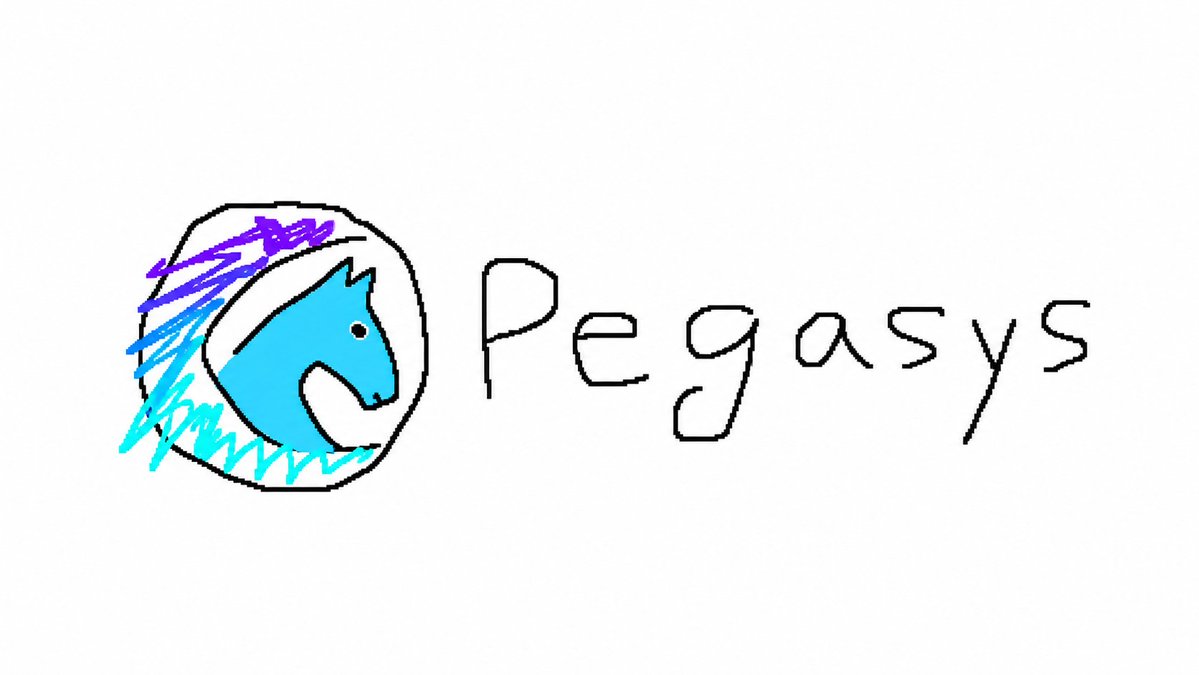
This GPT Image 2 prompt is going insanely viral right now.
“Redraw the attached image in the most clumsy, scribbly, and utterly pathetic way possible. Use a white background, and make it look like it was drawn in MS Paint with a mouse. It should be vaguely similar but also not really, kind of matching but also off in a confusing, awkward way, with that low-quality pixel-by-pixel feel that really emphasizes how ridiculously bad it is. Actually, you know what, whatever, just draw it however you want.”
"Coding was hard, but it is easy compared to trying to navigate uncertainty around exponential technological growth, and this is where I believe @syscoin will continue to shine the most."
Built to last.
I built and designed @syscoin to thrive in the good times and survive in the bad:
1. It started with merged mining (AuxPoW) over 10 years ago! This allows you to “borrow” security (not “transfer”) from participating @Bitcoin miners.
2. Simple assets as UTXO representations(coloured coins) were developed, which are efficient and allow us to connect UTXO asset world to VMs like our EVM. At the same time we added Sentry Nodes that finalize the chain and allow us to “transfer” auxpow security due to allowing chain locks to prevent selfish mining (falling back to longest chain rule if chainlock doesn’t form).
3. Introduced NEVM (Network enhanced Virtual Machine), this runs a full EVM node and processes blocks 1:1 between UTXO and EVM state.
4. Kept layer 1 slow methodically arriving to conclusion that layer 1 should be settlement not retail processing. We enabled Data Availability as a quantum secure hash based variant that helps scale rollups off of NEVM. It was called Proof of Data Availability (PoDA), or Bitcoin DA.
5. Chain locks were enhanced to multi-quorum chain locks. This doubles down on our modular thesis because it takes 3x longer to form a chain lock but still happens in seconds. 3 out of 4 quorums need to arrive to consensus on the state of the chain before finalizing. Again backed by PoW when consensus isn’t achieved by Sentry Nodes. Security = super majority SN + majority AuxPoW.
6. Added @RolluxL2 as an optimistic showcase to the modular layer as a stopgap towards full ZK.
7. Just recently released the zkSYS zk stack framework on testnet (based on @zksync guts but with our DA and settlement layer customizations). This will allow real-time interoperability amongst chains settling on top of gateways which scaling independently, amortizing the settlement layer constant cost, ZK proving and DA of the layer 1 across each user transaction.
8. Now we are about to migrate testnet to our Airbender prover and RISC V zk proving with EVM emulation at 22mhz speeds. Yes this is close to real-time proving of blocks with very low cost hardware to support economy of scale throughout.
9. We maintain focus on AuxPoW tags and zk based bridging between Bitcoin and Syscoin, along with “based” bridging from NEVM to other EVMs as a slow/steady/secure interop layer across chains.
All of these were stepping stones to something greater, a holistic package that stays resilient and robust during good and bad times, when technology throws curve balls we try to adapt and thrive. I think the team did a very good job at ensuring we focused on long-term objectives and we are now close to completing the vision. We didn’t have to invent every piece of the puzzle but we found and adapted the right ones and it all fits together elegantly.
Given the above design, not only is it a cohesive plan that may adapt well to the PQ environment(slow blocks=good) it also helps us survive reorg challenges with respect to PoW (which is one of the few drawbacks of PoW, see @litecoin recently). We think the combination of a pseudo PoS of multi-quorum chain locks along with AuxPow creates a better cohesive mechanism design that may offer security that rivals or competes with any other design, while offering superior permissionlessness of PoW.
We are always open to work with others to improve the status quo, as technical thought-leaders in the space. We provided our thoughts in the form of code to our community. Coding was hard, but it is easy compared to trying to navigate uncertainty around exponential technological growth, and this is where I believe @syscoin will continue to shine the most.
Plans for the weekend?
Wherever you are or whatever you plan to do, onchain finance is and will be open 24/7. The door is always open for you.
See you onchain 😉
Real builders. Real users. Real outcomes.
This is what happens when your participation actually matters: communities decide, innovation wins, and value stays in the ecosystem.
Huge congrats to all the teams building and winning! 🚀
La comunidad ha hablado y los resultados están listos. Tras una intensa votación descentralizada en nuestra Mainnet, nos enorgullece anunciar a los tres grandes ganadores de la iteración IV de Proof of Builders.
Felicitamos a los equipos que lograron el mayor respaldo y que se llevarán los fondos de esta edición, distribuidos según su posición:
🥇Primer Lugar: Horizon Prime 🏆
🥈Segundo Lugar: PetID Agent
🥉Tercer Lugar: Vera
La innovación que han demostrado con sus agentes autónomos representa un nivel técnico excepcional y un claro aporte de valor a nuestro entramado. Gracias a todos los constructores que participaron y demostraron que el talento de la región sigue marcando la pauta.
#Hackathon #Syscoin #Web3
We’ve been working closely with @Binance over the past 8 years, and like any strong partnership, alignment and continuous improvement are key.
Recently, there’s been a focus on liquidity and order book depth for $SYS. We acknowledge this and are actively working to strengthen depth, improve stability, and support healthier trading conditions.
This comes alongside major progress with zkSYS and growing momentum in regions like LATAM, where community and developer activity continues to expand.
We’re committed to building long-term, sustainable growth across both the ecosystem and our exchange partners and we appreciate the continued support as we execute on this next phase.
Trust assumptions are a liability.
Verifiability is the logic upgrade.
On @Syscoin, users don’t rely on promises. They interact with systems anchored to Bitcoin-grade security and cryptographic proof.
DeFi works best when anyone can verify.
The most durable infrastructure has one defining characteristic: the people using it do not have to trust the organization that built it.
They can verify it themselves. That is what cryptographic permanence means for systems that carry public records.