The thing of beauty is, all you need to assemble all of music from first principles is:
ONE STRING─The Pythagorean Monochord. The instrument Pythagoras himself used to derive the entirety of his mathematics. Like gravity, acoustics is unescapable: a fact of the world itself.
Same as for any other time signature.
Learn to count.
Learn to count as you play, that is.
Easier said than done. THEN you internalize it as FEEL and you don’t need to count consciously any more. Simple 👊
There's two kinds of improvisation.
One kind is like the Blues. You know the form, you know the chords, you know the scales and the licks and the phrasings─then you 'reshuffle the deck' in real time.
The other kind is more like creating a new kind of music from scratch.
Funny thing is—wasn’t even crazy intervals.
Not only was it nothing out of the ordinary.
It was plain old C major—C D E F G A B that got me there.
Only goes to show, there’s always more to the simple things in music, if you know where to look.
THE HUMAN HEARING APPARATUS, THE COCHLEA
Every major breakthrough I have ever had vis-a-vis my so called 'inner hearing,' the coveted ability to 'visualize' sounds in one's mind's eye, has been linked to direct experience of and with the Harmonic Series.
THREAD 🧵
Chinese tuning A D E A behaves just like guitar.
Fourths, with a 'different interval disjunction.'
Been playing with it for a few days.
Happy to report that I've mapped it completely:
5 pentatonic modes × 12 keys = 60
7 diatonic modes × 12 keys = 84
Total modes: 144 = 12²
This is not, by the way, 'microtonal.' At all.
This is semitones, just like a regular guitar.
Semitones through and through.
12 + 12 + 7 frets.
I love the idea of an 'extended range' instrument like this 🎸
The year is 1588. Ming prince Zhu Zaiyu has cracked it.
After decades of extraction of cubic roots on this gargantuan 81 rod abacus, the mathematics of fret placement are finally solved 🧮🎸
Using an electronic tuner is equivalent in this sense to fret + open string. Electronic tuners are calibrated to the same mathematics well placed frets are 🧮🎸
This here 'Lyre Guitar' from 1789
(Pierre-Charles Mareschal, Paris)
Oldest European instrument I have found
with fret markers: (0) 5 9 (10) 12
1801 chart confirms tuning: E A D G B E
Easiest way to understand these modes, and how they work: take the 5 notes of the pentatonic scale, in C.
Each note is the starting note for one mode. Simple.
The first mode is the C major pentatonic scale; the last is the A minor pentatonic. The rest are probably new to you.
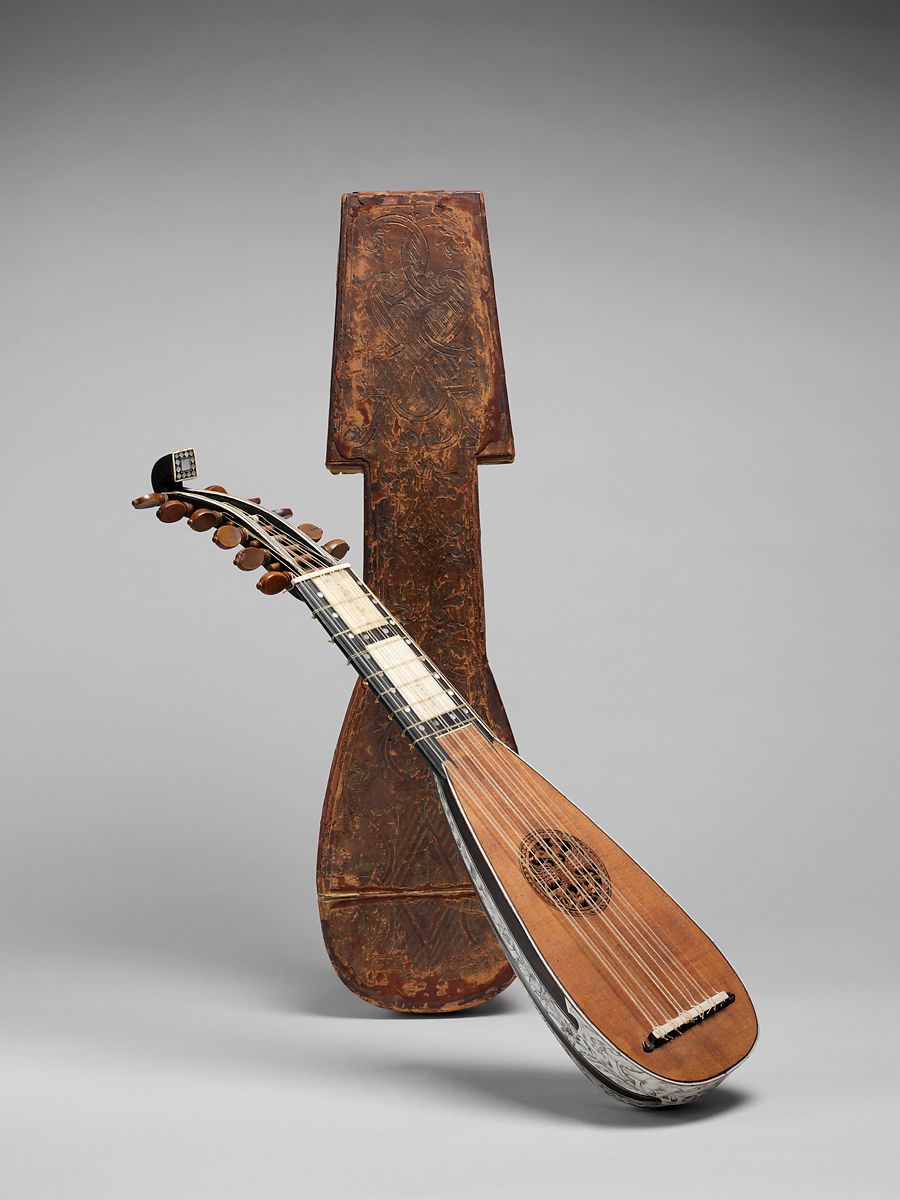
Before the guitar, came the Genoese Mandolin, on the right: E A D G B E.
Silk Strings. Just like the Chinese Lute.
Headstock just like the Chinese Lute.
Some had scalloped frets, just like the Chinese Lute.
Genoa & Venice had been 'hanging out' in China for a very long time.
So much for the ‘Western 12-tone System.’
The Chinese have had the concept of 12 key modulation—5 pentatonic modes X 12 keys = 60 modes total—since at least 300 BC, and the mathematics of ‘equal temperament’ (fret placement) before ‘we’ did too.
The Idiot's Hallmark™️ is instant resentment of intellectual challenge. Any intellectual challenge.
In fact, the idiot will organize his entire existence so as never to face any. And so, the idiot remains an idiot.