Had to start working on a Macbook for the first time, and it's been incredibly frustrating. So what does a developer do in these situations? Write an app! Dock Window Preview, an open-source alternative to HyperDock. Very early still, but it's a start! https://t.co/ehUKg0iwoN
@Alberta_Balsalm Hmm. I'm not sure what's happening. :( I suspect it's due to the lack of a certificate to sign the application with, but I have no way of knowing or reproducing this. :( Might be worth trying this: https://t.co/r2j6y7hyno
@Alberta_Balsalm Going to work on a proper fix for the quick setup script. 🙂 No problem at all, always happy to help people! Thanks for bringing it to my attention!
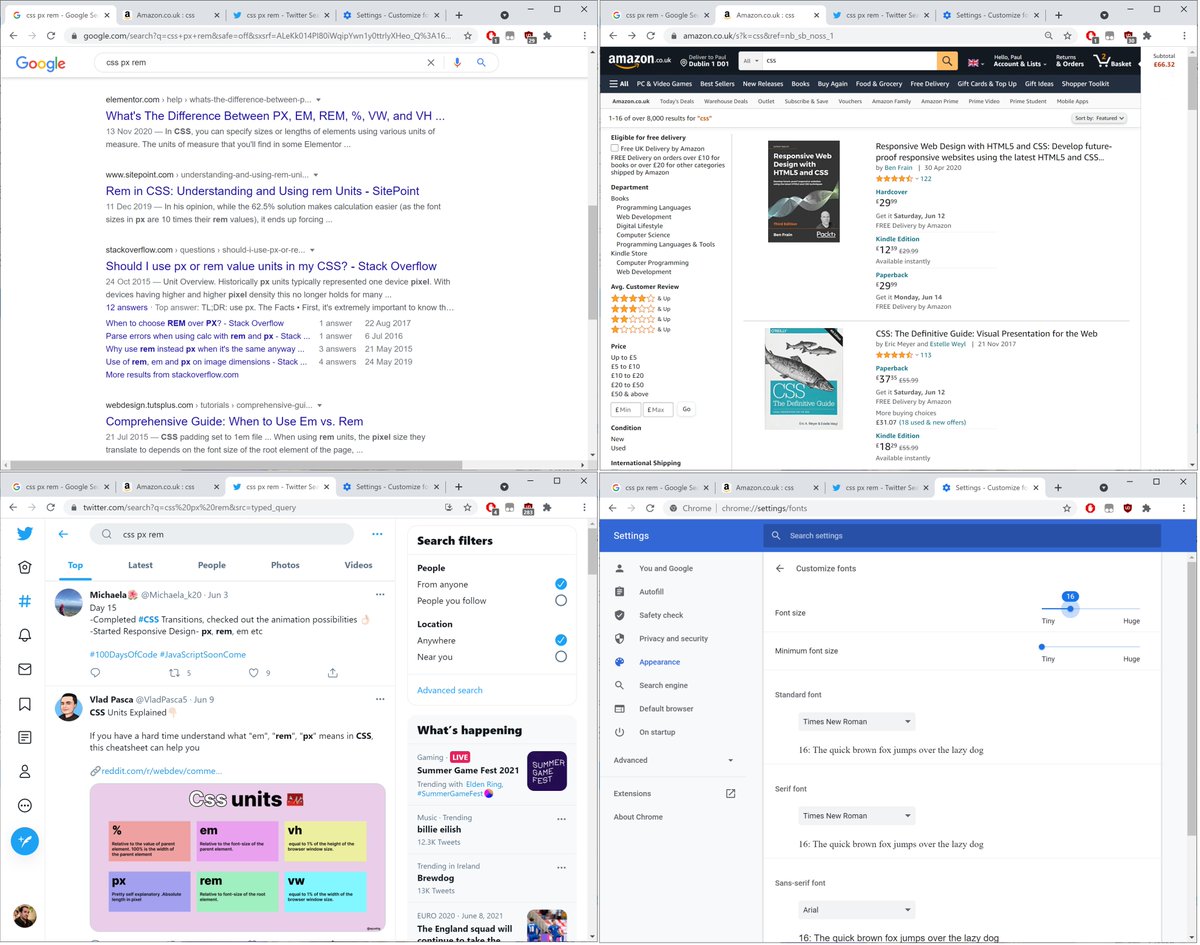
So while it's good in theory, in my opinion, it's not worth the additional cost that can go into other accessibility features. Text can already be made larger thanks to zoom. If a site doesn't support rem, the user will immediately zoom if they haven't set it globally already.
To explain what is happening: Each major company here is practically ignoring the setting entirely, instead using fixed size to maintain a consistent user experience. With massive user bases, it's reasonable to assume not using rem, does not result in major accessibility issues.
Majority of time I see rem used, it's often used with good intent, but ends up broken when you actually change the font size due to mixtures of units. And with third party libs, you often can't control what units they use, therefore more issues.
@DanielBrierton It's not about the large fonts. It's more to do with the fact it's ignored entirely and can result in layout breakage regardless of size. And if you get the same result, the effort and the confusion with designers is really not worth it cost wise.
I really can't understand why people like to use CSS frameworks. Constantly finding myself fighting against them because they're limited, and if they want to be flexible, they have to effectively reimplement CSS. CSS is not that hard to use, it's often just not taught properly.
Also it doesn't matter when the function or class declarations are exported, as long as they're exported, they're made available first before the rest of the code is evaluated.
I've been trying to wrap my head around ESM circular dependencies and how they're resolved. I'm probably late to realising this, but I just learned that export declarations are evaluated before the module itself is evaluated. Makes so much more sense now.