This is one of the key factor contributing to the persistence of banditry, terrorism, and the displacement of native populations in the northern part of the contraption called Nigeria .
This is one of the numerous gold mine in the Mayo-Kam region of Taraba State, where people both foreigners and locals mine gold illegally,both politicians and military officers are participating in these unlawful activities .
Nevertheless, the gold in the north is owned by the northerners, whereas the oil in the south is owned by the Nigerians . Folks have you Consider who gains from this illegal gold mining; keep in mind that Sudan is currently in conflict over control of the gold mines, with the UAE being accused of backing the Sudanese Rapid Forces.
With all these , restoration of peace and controls of insecurity in the northern Nigeria is unattainable.
@real_IpobDOS@radiobiafralive@NGRSenate@HouseNGR@AnambraNewMedia@nnpclimited
#DivideNigerianowtosavelives
Good evening Biafrans, friends of Biafra and Lovers of freedom!
We are set to bring you Live Updates from today's Radio Biafra Live Broadcast
Featuring: Mazi Chikadibia Edoziem (IPOB Head of Directorate of State (HDOS))
Host: Mazi Alozie
Invite all your Biafran friends and lovers of freedom.
Powered by the DOS.
Please join us.
Subscribe to our Telegram Channel for regular updates on Biafran news and more..
https://t.co/ReaBY0xDHS
Family Writers Press International
IPOB Unveils Historic Global Institutional Overhaul Today: New Structure, Oath of Allegiance Signal Bold Leap Toward International Recognition of Biafra’s Self-Determination Quest
Today marks a pivotal moment that could reshape the landscape of African self-determination.
IPOB Unveils Historic Global Institutional Overhaul Today: New Structure, Oath of Allegiance Signal Bold Leap Toward International Recognition of Biafra’s Self-Determination Quest
Today marks a pivotal moment that could reshape the landscape of African self-determination movements. The Indigenous People of Biafra (IPOB) leadership is set to formally unveil its long awaited new institutional structure, paired with a renewed oath of allegiance to a constitution and policies designed to pilot IPOB’s global self-determination agenda. At the center of this announcement is Chikadibia Edoziem, IPOB’s global head of the Directorate of States, who will take to the airwaves to present a historic pivot toward rebuilding the movement to meet global standards and norms.
This is no ordinary internal reorganization. Experts frame it as the institutionalization of a decade’s long struggle for Biafran self-determination, transforming a grassroots agitation into a structured entity aligned with international expectations for legitimacy, transparency, and governance. By adopting formalized directorates, policy frameworks, and an explicit oath to constitutional principles, IPOB aims to position itself as a credible actor on the world stage, capable of engaging governments, diaspora networks, human rights bodies, and multilateral institutions.
The timing is deliberate and sensational in its implications. In an era when self-determination claims from Catalonia to Kurdistan, from Western Sahara to indigenous nations worldwide, continue to test the boundaries of the post-colonial international order, IPOB’s move seeks to insert the Biafran question firmly into that global conversation. Institutionalization, complete with hierarchical directorates, standardized policies, and public oaths of allegiance is presented as the pathway from protest to proto-state architecture. IPOB argue this elevates the quest beyond regional activism into a sustained campaign that demands international attention, diplomatic scrutiny, and accountability under universal norms of peoplehood and self-rule.
Chikadibia Edoziem’s address is expected to detail the new architecture: clearer global coordination mechanisms, policy platforms oriented toward reconstruction and self-determination, and an oath binding members to these frameworks. The emphasis on “global standard and norms” is the rhetorical corean explicit invitation for the world to judge the movement by institutional metrics rather than solely by the intensity of its rhetoric or the Nigerian government’s designations.
What is clear today is the ambition: to institutionalize the Biafran quest so that it can no longer be dismissed as fringe agitation but must be engaged as a structured demand for self-determination in the 21st century.
The eyes of Biafran diaspora and international analysts will be fixed on the broadcast. History rarely pivots on a single announcement but institutional milestones have a way of forcing the world to take notice.
Family Writers Press International.
BREAKING :
Fulani herdsmen and jihadist terrorists attack a community in Edo State, report has that many were killed and they abducted men and many young girls as villagers flee into bushes and unknown destination.
@radiobiafralive@AnambraNewMedia
Suspected Fulani jihadist terrorist invade Catholic Church in Enugu, abduct seminarian and others
The armed men are said to have invaded St. Joseph Catholic Church, Inoyi, in Affa, Udi Local Government Area of Enugu State, this morning, August 2.
Speaking in a video, locals said it was raining when people began going to church.
However, those on the way to the church saw a crowd running out of church and they told them that at least seven armed men had invaded their church and kidnapped some members, including the seminarian.
The locals said they chased after the kidnappers but there was not much they could do since they are not armed and the suspected Fulani kidnappers are well armed.
The locals said they are willing and able to protect themselves and go into bushes to fish out the kidnappers. However, they asked how they would do that without weapons. They said even their local security agents do not have arms.
They called on the government to intervene and keep them safe or give them arms to secure themselves.
They lamented that one of those kidnapped is an indigene who returned to bury his father.
Me - Our people in Enugu are taking this issues of jihadist terrorist lightly and they’re waiting for government to come and rescue them .
@radiobiafralive@real_DOS_Press@real_IpobDOS
IPOB Unveils Historic Global Institutional Overhaul Today: New Structure, Oath of Allegiance Signal Bold Leap Toward International Recognition of Biafra’s Self-Determination Quest
Today marks a pivotal moment that could reshape the landscape of African self-determination movements. The Indigenous People of Biafra (IPOB) leadership is set to formally unveil its long awaited new institutional structure, paired with a renewed oath of allegiance to a constitution and policies designed to pilot IPOB’s global self-determination agenda. At the center of this announcement is Chikadibia Edoziem, IPOB’s global head of the Directorate of States, who will take to the airwaves to present a historic pivot toward rebuilding the movement to meet global standards and norms.
This is no ordinary internal reorganization. Experts frame it as the institutionalization of a decade’s long struggle for Biafran self-determination, transforming a grassroots agitation into a structured entity aligned with international expectations for legitimacy, transparency, and governance. By adopting formalized directorates, policy frameworks, and an explicit oath to constitutional principles, IPOB aims to position itself as a credible actor on the world stage, capable of engaging governments, diaspora networks, human rights bodies, and multilateral institutions.
The timing is deliberate and sensational in its implications. In an era when self-determination claims from Catalonia to Kurdistan, from Western Sahara to indigenous nations worldwide, continue to test the boundaries of the post-colonial international order, IPOB’s move seeks to insert the Biafran question firmly into that global conversation. Institutionalization, complete with hierarchical directorates, standardized policies, and public oaths of allegiance is presented as the pathway from protest to proto-state architecture. IPOB argue this elevates the quest beyond regional activism into a sustained campaign that demands international attention, diplomatic scrutiny, and accountability under universal norms of peoplehood and self-rule.
Chikadibia Edoziem’s address is expected to detail the new architecture: clearer global coordination mechanisms, policy platforms oriented toward reconstruction and self-determination, and an oath binding members to these frameworks. The emphasis on “global standard and norms” is the rhetorical corean explicit invitation for the world to judge the movement by institutional metrics rather than solely by the intensity of its rhetoric or the Nigerian government’s designations.
What is clear today is the ambition: to institutionalize the Biafran quest so that it can no longer be dismissed as fringe agitation but must be engaged as a structured demand for self-determination in the 21st century.
The eyes of Biafran diaspora and international analysts will be fixed on the broadcast. History rarely pivots on a single announcement but institutional milestones have a way of forcing the world to take notice.
Family Writers Press International.
IPOB Unveils Historic Global Institutional Overhaul Today: New Structure, Oath of Allegiance Signal Bold Leap Toward International Recognition of Biafra’s Self-Determination Quest
Today marks a pivotal moment that could reshape the landscape of African self-determination movements. The Indigenous People of Biafra (IPOB) leadership is set to formally unveil its long awaited new institutional structure, paired with a renewed oath of allegiance to a constitution and policies designed to pilot IPOB’s global self-determination agenda. At the center of this announcement is Chikadibia Edoziem, IPOB’s global head of the Directorate of States, who will take to the airwaves to present a historic pivot toward rebuilding the movement to meet global standards and norms.
This is no ordinary internal reorganization. Experts frame it as the institutionalization of a decade’s long struggle for Biafran self-determination, transforming a grassroots agitation into a structured entity aligned with international expectations for legitimacy, transparency, and governance. By adopting formalized directorates, policy frameworks, and an explicit oath to constitutional principles, IPOB aims to position itself as a credible actor on the world stage, capable of engaging governments, diaspora networks, human rights bodies, and multilateral institutions.
The timing is deliberate and sensational in its implications. In an era when self-determination claims from Catalonia to Kurdistan, from Western Sahara to indigenous nations worldwide, continue to test the boundaries of the post-colonial international order, IPOB’s move seeks to insert the Biafran question firmly into that global conversation. Institutionalization, complete with hierarchical directorates, standardized policies, and public oaths of allegiance is presented as the pathway from protest to proto-state architecture. IPOB argue this elevates the quest beyond regional activism into a sustained campaign that demands international attention, diplomatic scrutiny, and accountability under universal norms of peoplehood and self-rule.
Chikadibia Edoziem’s address is expected to detail the new architecture: clearer global coordination mechanisms, policy platforms oriented toward reconstruction and self-determination, and an oath binding members to these frameworks. The emphasis on “global standard and norms” is the rhetorical corean explicit invitation for the world to judge the movement by institutional metrics rather than solely by the intensity of its rhetoric or the Nigerian government’s designations.
What is clear today is the ambition: to institutionalize the Biafran quest so that it can no longer be dismissed as fringe agitation but must be engaged as a structured demand for self-determination in the 21st century.
The eyes of Biafran diaspora and international analysts will be fixed on the broadcast. History rarely pivots on a single announcement but institutional milestones have a way of forcing the world to take notice.
Family Writers Press International.
@radiobiafralive@real_DOS_Press@real_IpobDOS
16 Villages Sacked by Fulani Herdsmen in Enugu State
We have reached a point where the media are warned not to report the atrocities of Fulani terrorist criminals.
This happened in 4 years of Peter Mbah and the media is silent on this.
All I can say is that Igbos should be vigilant and ready to strike accordingly because we cannot let Fulani do this rubbish in Igbo land and go free. - DJ Spoiltkid
@PH_Socials He should have come privately you say? For real?! After embarrassing him in public, he should come to you in private to resolve your dispute? Wonders' they said shall never end.
Hope men out there have learnt some lessons with this? Investing on a woman is as good as betting.
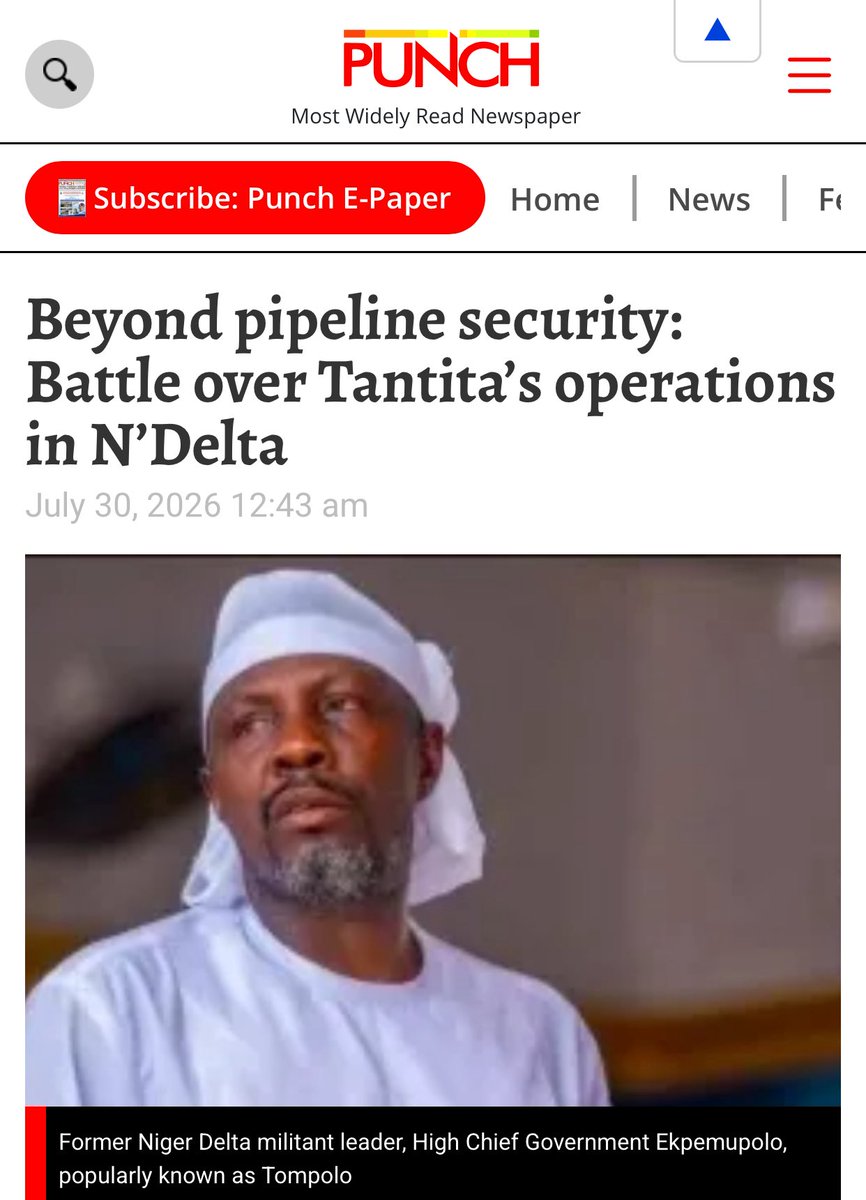
A fresh controversy has erupted over the operations of Tantita Security Services Nigeria Limited, the private pipeline surveillance firm linked to former Niger Delta militant leader, High Chief Government Ekpemupolo, popularly known as Tompolo, following allegations by a Niger Delta human rights advocate that the company operates illegal detention facilities and subjects critics to unlawful arrests, torture and intimidation.
The allegations, contained in a petition addressed to President Bola Ahmed Tinubu by Apostle Perela Ezekiel, have intensified scrutiny of Tantita’s operations in the oil-rich Niger Delta. While Ezekiel urged the Federal Government to investigate the claims and dismantle the alleged detention centres, Tantita, community leaders, security agencies and civil society groups have strongly denied the allegations, insisting there is no evidence to support them and calling for an independent investigation.
Ezekiel, a Niger Delta-based human rights advocate, has been at loggerheads with Tantita over its pipeline surveillance operations and what he described as the alleged harassment and intimidation of critics and residents. Tantita, owned by Tompolo, is contracted by the Federal Government to protect critical oil infrastructure from vandalism and crude oil theft.
The rights advocate alleged that Tompolo was using the Federal Government’s pipeline surveillance contract to settle personal scores and oppress people in the Niger Delta. He subsequently petitioned President Tinubu, accusing the former militant leader of operating private detention facilities in Oporoza, headquarters of Gbaramatu Kingdom in Warri South West Local Government Area of Delta State.
https://t.co/dynCJvyNBH