We’re currently supporting founders at different points in their journey to build businesses that are properly structured for growth and investor readiness.
From early formation decisions to scaling and expansion structures.
Because building a business is one thing.
But building one that is structurally ready for what comes next is different.
🔷 The kind of support we provide includes:
•Business formation and structuring guidance
•Ownership and partnership clarity
•Investor-ready setup alignment
•Foreign partnership structuring support
•Regulatory and compliance readiness positioning
As businesses evolve, the questions become more serious:
•Is the structure supporting where this is going?
•Will this hold up during due diligence?
•Are we positioned properly for partnerships or funding?
•Is compliance aligned with growth direction?
These are the moments where structure matters most.
Not just at the beginning— but whenever the business starts to move toward scale.
Recent outcomes from our work:
We’ve helped founders:
•avoid unnecessary complex setup paths
•structure ownership properly for partnerships
•save over ₦2M+ in avoidable compliance costs
•position businesses for expansion and investor conversations
If you’re building something and want to ensure your structure supports where you’re going, this is the right time to get clarity.
👉 Comment READY or send a DM with STRUCTURE
We’ll guide you on the best setup for your business.
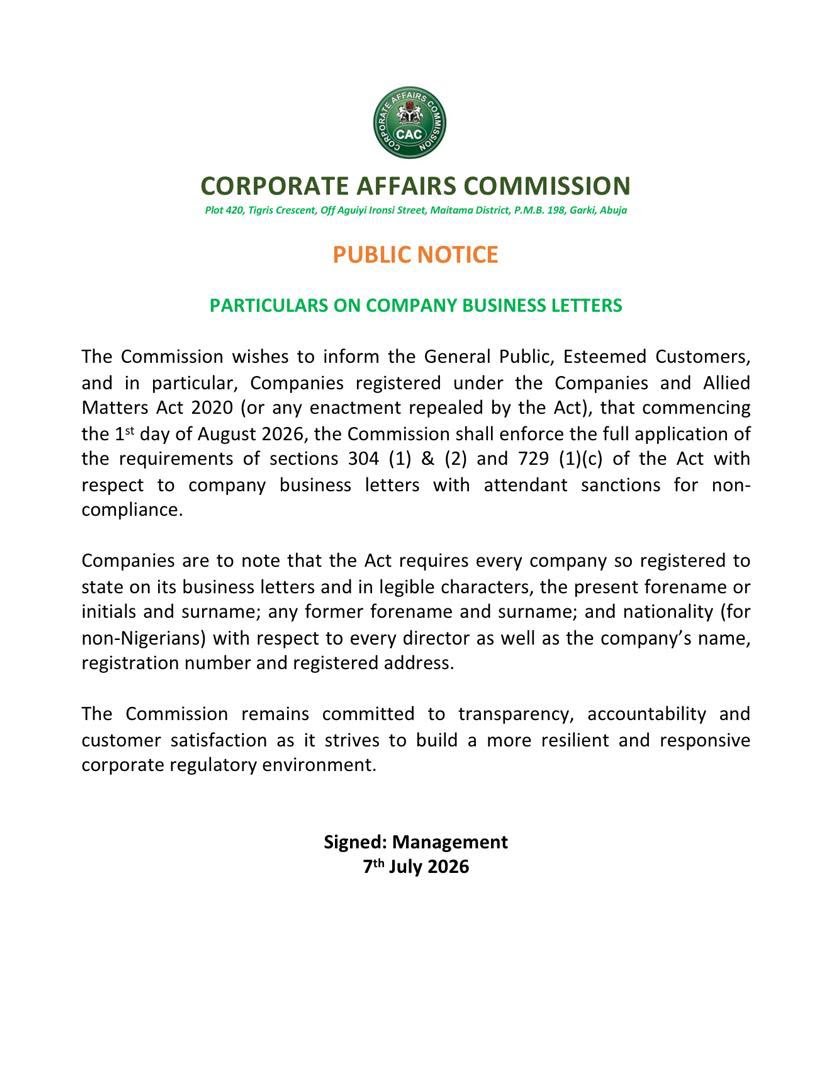
PUBLIC NOTICE
PARTICULARS ON COMPANY BUSINESS LETTERS
The Commission wishes to inform the General Public, Esteemed Customers, and in particular, Companies registered under the Companies and Allied Matters Act 2020 (or any enactment repealed by the Act), that commencing the 1s* day of August 2026, the Commission shall enforce the full application of the requirements of sections 304(1) & (2) and 729 (1)(c) of the Act with respect to company business letters with attendant sanctions for non-compliance.
Companies are to note that the Act requires every company so registered to state on its business letters and in legible characters, the present forename or initials and surname; any former forename and surname; and nationality (for non-Nigerians) with respect to every director as well as the company's name, registration number and registered address.
The Commission remains committed to transparency, accountability and customer satisfaction as it strives to build a more resilient and responsive corporate regulatory environment.
Signed: Management
7th July 2026
COMPLIANCE MYTHS vs FACTS
Registered = Licensed?
Short answer?
No.
A thread 🧵
❌ MYTH 1
“If my business is registered, I’m good.”
✅ FACT
Registration means your business exists.
Licensing means your business has permission to do certain work.
Big difference.
❌ MYTH 2
“Licences are for big companies.”
✅ FACT
Usually, regulators care about activity, not size.
Food business? Permits.
Fintech? Approvals.
Healthcare? Licences.
❌ MYTH 3
“I’ll sort it later.”
✅ FACT
Later can be expensive.
By the time opportunity comes…
documentation may already be required.
❌ MYTH 4
“If nobody asked, it doesn’t matter.”
✅ FACT
Regulatory gaps stay hidden…
until growth exposes them.
Founder, ask yourself:
Is your business just registered…
Or properly licensed?
COMPLIANCE MYTHS vs FACTS
Registered = Licensed?
Short answer?
No.
A thread 🧵
❌ MYTH 1
“If my business is registered, I’m good.”
✅ FACT
Registration means your business exists.
Licensing means your business has permission to do certain work.
Big difference.
❌ MYTH 2
“Licences are for big companies.”
✅ FACT
Usually, regulators care about activity, not size.
Food business? Permits.
Fintech? Approvals.
Healthcare? Licences.
❌ MYTH 3
“I’ll sort it later.”
✅ FACT
Later can be expensive.
By the time opportunity comes…
documentation may already be required.
❌ MYTH 4
“If nobody asked, it doesn’t matter.”
✅ FACT
Regulatory gaps stay hidden…
until growth exposes them.
Founder, ask yourself:
Is your business just registered…
Or properly licensed?
COMPLIANCE MYTHS vs FACTS
Registered = Licensed?
Short answer?
No.
A thread 🧵
❌ MYTH 1
“If my business is registered, I’m good.”
✅ FACT
Registration means your business exists.
Licensing means your business has permission to do certain work.
Big difference.
❌ MYTH 2
“Licences are for big companies.”
✅ FACT
Usually, regulators care about activity, not size.
Food business? Permits.
Fintech? Approvals.
Healthcare? Licences.
❌ MYTH 3
“I’ll sort it later.”
✅ FACT
Later can be expensive.
By the time opportunity comes…
documentation may already be required.
❌ MYTH 4
“If nobody asked, it doesn’t matter.”
✅ FACT
Regulatory gaps stay hidden…
until growth exposes them.
Founder, ask yourself:
Is your business just registered…
Or properly licensed?
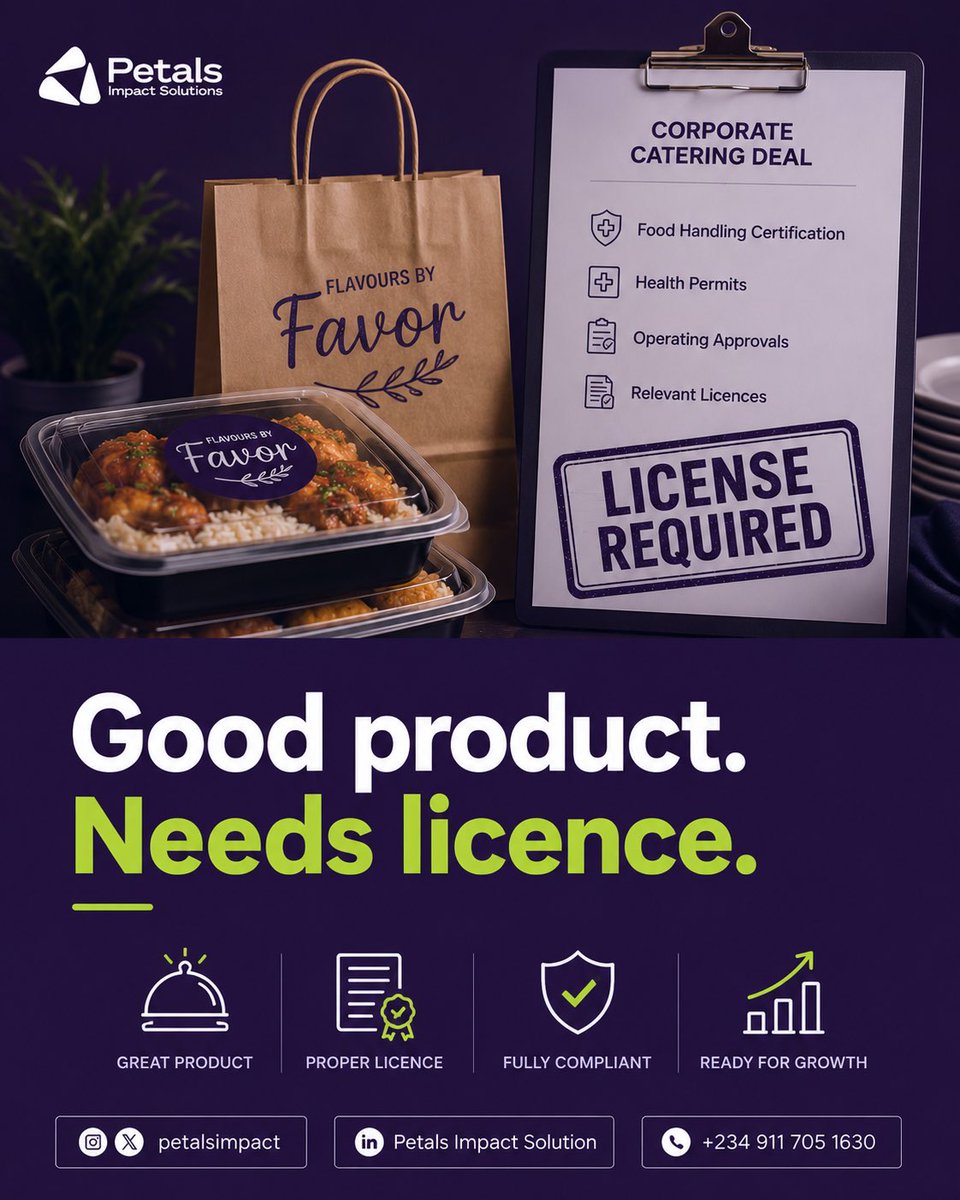
Favor runs a food business.
She’s good.
Really good.
Orders kept growing.
Referrals kept coming.
Then a big opportunity landed.
A thread 🧵
A corporate catering deal.
The kind that could change everything.
She was excited.
Until they asked for documents.
• food permits
• health approvals
• operating licences
Silence.
Favor had registered her business.
But she wasn’t properly licensed.
That changed everything.
And this is where many founders get caught.
They think:
Registered = Ready
Not always.
Registration means your business legally exists.
Licensing means your business has permission to perform certain regulated activities.
Big difference.
And it’s not just food.
Fintech? Licensing.
Healthcare? Licensing.
Logistics? Licensing.
Energy? Licensing.
Education? Often licensing.
Favor didn’t have a food problem.
She had a licensing gap.
Registration got her into business.
Licensing determined how far she could go.
Founder, quick question:
Is your business just registered…
Or truly ready for scale?
Favor runs a food business.
She’s good.
Really good.
Orders kept growing.
Referrals kept coming.
Then a big opportunity landed.
A thread 🧵
A corporate catering deal.
The kind that could change everything.
She was excited.
Until they asked for documents.
• food permits
• health approvals
• operating licences
Silence.
Favor had registered her business.
But she wasn’t properly licensed.
That changed everything.
And this is where many founders get caught.
They think:
Registered = Ready
Not always.
Registration means your business legally exists.
Licensing means your business has permission to perform certain regulated activities.
Big difference.
And it’s not just food.
Fintech? Licensing.
Healthcare? Licensing.
Logistics? Licensing.
Energy? Licensing.
Education? Often licensing.
Favor didn’t have a food problem.
She had a licensing gap.
Registration got her into business.
Licensing determined how far she could go.
Founder, quick question:
Is your business just registered…
Or truly ready for scale?
Favor runs a food business.
She’s good.
Really good.
Orders kept growing.
Referrals kept coming.
Then a big opportunity landed.
A thread 🧵
A corporate catering deal.
The kind that could change everything.
She was excited.
Until they asked for documents.
• food permits
• health approvals
• operating licences
Silence.
Favor had registered her business.
But she wasn’t properly licensed.
That changed everything.
And this is where many founders get caught.
They think:
Registered = Ready
Not always.
Registration means your business legally exists.
Licensing means your business has permission to perform certain regulated activities.
Big difference.
And it’s not just food.
Fintech? Licensing.
Healthcare? Licensing.
Logistics? Licensing.
Energy? Licensing.
Education? Often licensing.
Favor didn’t have a food problem.
She had a licensing gap.
Registration got her into business.
Licensing determined how far she could go.
Founder, quick question:
Is your business just registered…
Or truly ready for scale?
KNOW THE DIFFERENCE
Incorporation vs Licensing
Founder, I’m about to positively attack you 😄
If you think registering your business means you’re fully good to operate…
This is for you.
A thread 🧵
Let’s make this ridiculously simple.
Incorporation is like giving your business a birth certificate.
Licensing is like giving it permission to do certain work.
Not the same thing.
Incorporation answers:
“Does this business legally exist?”
Licensing answers:
“Can this business legally do this?”
Big difference.
Example.
You open a restaurant.
Business incorporated? ✅
Can you start serving food immediately?
Maybe not.
You may still need:
• health permits
• safety approvals
• operating licences
Another example.
You incorporate a fintech.
Nice.
Can you now collect deposits or move money?
No.
You may need regulatory approval first.
This is where founders get caught.
They think:
Registered = Approved
Wrong.
Very wrong.
Your business can exist legally…
…and still lack permission to perform certain activities.
That’s the licensing gap.
So founder, quick question:
Is your business just incorporated…
Or properly licensed too? 👀
KNOW THE DIFFERENCE
Incorporation vs Licensing
Founder, I’m about to positively attack you 😄
If you think registering your business means you’re fully good to operate…
This is for you.
A thread 🧵
Let’s make this ridiculously simple.
Incorporation is like giving your business a birth certificate.
Licensing is like giving it permission to do certain work.
Not the same thing.
Incorporation answers:
“Does this business legally exist?”
Licensing answers:
“Can this business legally do this?”
Big difference.
Example.
You open a restaurant.
Business incorporated? ✅
Can you start serving food immediately?
Maybe not.
You may still need:
• health permits
• safety approvals
• operating licences
Another example.
You incorporate a fintech.
Nice.
Can you now collect deposits or move money?
No.
You may need regulatory approval first.
This is where founders get caught.
They think:
Registered = Approved
Wrong.
Very wrong.
Your business can exist legally…
…and still lack permission to perform certain activities.
That’s the licensing gap.
So founder, quick question:
Is your business just incorporated…
Or properly licensed too? 👀
KNOW THE DIFFERENCE
Incorporation vs Licensing
Founder, I’m about to positively attack you 😄
If you think registering your business means you’re fully good to operate…
This is for you.
A thread 🧵
Let’s make this ridiculously simple.
Incorporation is like giving your business a birth certificate.
Licensing is like giving it permission to do certain work.
Not the same thing.
Incorporation answers:
“Does this business legally exist?”
Licensing answers:
“Can this business legally do this?”
Big difference.
Example.
You open a restaurant.
Business incorporated? ✅
Can you start serving food immediately?
Maybe not.
You may still need:
• health permits
• safety approvals
• operating licences
Another example.
You incorporate a fintech.
Nice.
Can you now collect deposits or move money?
No.
You may need regulatory approval first.
This is where founders get caught.
They think:
Registered = Approved
Wrong.
Very wrong.
Your business can exist legally…
…and still lack permission to perform certain activities.
That’s the licensing gap.
So founder, quick question:
Is your business just incorporated…
Or properly licensed too? 👀
Nobody admires a foundation.
A thread 🧵
When people see a beautiful building, they notice the glass.
The paint.
The finishing.
The architecture.
Nobody says:
“Wow, look at that foundation.”
Because foundations are buried.
Invisible.
Unsexy.
Easy to ignore.
Until something goes wrong.
Then suddenly…
nothing matters more.
A crack in the foundation can bring the entire building down.
Business is no different.
Most people admire the visible parts.
Revenue.
Clients.
Branding.
Marketing.
Growth.
Fundraising.
Expansion.
But beneath every sustainable business is something most founders don’t talk about enough:
Compliance.
Yes, compliance.
Not sexy.
Not flashy.
Not Instagram-worthy.
But foundational.
Because compliance is what quietly carries the weight of growth.
Think about it.
You build a profitable business…
…but never properly register the right structure.
One big investor conversation later, you discover the structure cannot support the deal.
Crack in the foundation.
You grow revenue for years…
…but ignore Annual Returns.
Then a major contract opportunity comes, and your business shows up as non-compliant.
Crack in the foundation.
Cash is flowing…
…but taxes are neglected.
Then penalties, audits or sanctions hit.
Crack in the foundation.
Your brand becomes known…
…but you never protected your IP.
Then someone trademarks your name first.
Now you’re fighting for what you built.
Crack in the foundation.
This is the danger of compliance negligence.
It rarely hurts immediately.
That’s what makes it deceptive.
Foundations don’t fail loudly at first.
They weaken quietly.
Until one day…
the weight becomes too much.
At Petals, we believe compliance is not about bureaucracy.
It is about foundation.
Because growth without structure is pressure on weak concrete.
And no matter how beautiful the building looks above ground…
A weak foundation always gets exposed.
Build beautifully.
But build wisely too.
Nobody admires a foundation.
A thread 🧵
When people see a beautiful building, they notice the glass.
The paint.
The finishing.
The architecture.
Nobody says:
“Wow, look at that foundation.”
Because foundations are buried.
Invisible.
Unsexy.
Easy to ignore.
Until something goes wrong.
Then suddenly…
nothing matters more.
A crack in the foundation can bring the entire building down.
Business is no different.
Most people admire the visible parts.
Revenue.
Clients.
Branding.
Marketing.
Growth.
Fundraising.
Expansion.
But beneath every sustainable business is something most founders don’t talk about enough:
Compliance.
Yes, compliance.
Not sexy.
Not flashy.
Not Instagram-worthy.
But foundational.
Because compliance is what quietly carries the weight of growth.
Think about it.
You build a profitable business…
…but never properly register the right structure.
One big investor conversation later, you discover the structure cannot support the deal.
Crack in the foundation.
You grow revenue for years…
…but ignore Annual Returns.
Then a major contract opportunity comes, and your business shows up as non-compliant.
Crack in the foundation.
Cash is flowing…
…but taxes are neglected.
Then penalties, audits or sanctions hit.
Crack in the foundation.
Your brand becomes known…
…but you never protected your IP.
Then someone trademarks your name first.
Now you’re fighting for what you built.
Crack in the foundation.
This is the danger of compliance negligence.
It rarely hurts immediately.
That’s what makes it deceptive.
Foundations don’t fail loudly at first.
They weaken quietly.
Until one day…
the weight becomes too much.
At Petals, we believe compliance is not about bureaucracy.
It is about foundation.
Because growth without structure is pressure on weak concrete.
And no matter how beautiful the building looks above ground…
A weak foundation always gets exposed.
Build beautifully.
But build wisely too.
Nobody admires a foundation.
A thread 🧵
When people see a beautiful building, they notice the glass.
The paint.
The finishing.
The architecture.
Nobody says:
“Wow, look at that foundation.”
Because foundations are buried.
Invisible.
Unsexy.
Easy to ignore.
Until something goes wrong.
Then suddenly…
nothing matters more.
A crack in the foundation can bring the entire building down.
Business is no different.
Most people admire the visible parts.
Revenue.
Clients.
Branding.
Marketing.
Growth.
Fundraising.
Expansion.
But beneath every sustainable business is something most founders don’t talk about enough:
Compliance.
Yes, compliance.
Not sexy.
Not flashy.
Not Instagram-worthy.
But foundational.
Because compliance is what quietly carries the weight of growth.
Think about it.
You build a profitable business…
…but never properly register the right structure.
One big investor conversation later, you discover the structure cannot support the deal.
Crack in the foundation.
You grow revenue for years…
…but ignore Annual Returns.
Then a major contract opportunity comes, and your business shows up as non-compliant.
Crack in the foundation.
Cash is flowing…
…but taxes are neglected.
Then penalties, audits or sanctions hit.
Crack in the foundation.
Your brand becomes known…
…but you never protected your IP.
Then someone trademarks your name first.
Now you’re fighting for what you built.
Crack in the foundation.
This is the danger of compliance negligence.
It rarely hurts immediately.
That’s what makes it deceptive.
Foundations don’t fail loudly at first.
They weaken quietly.
Until one day…
the weight becomes too much.
At Petals, we believe compliance is not about bureaucracy.
It is about foundation.
Because growth without structure is pressure on weak concrete.
And no matter how beautiful the building looks above ground…
A weak foundation always gets exposed.
Build beautifully.
But build wisely too.
Miller was successful.
That was the problem.
A thread 🧵
He had clients.
Good clients.
The kind many freelancers dream about.
His work was solid.
His reputation was growing.
Money was coming in.
From the outside, everything looked great.
People said:
“You’re doing well.”
And they were right.
Miller was doing well.
But something bothered him.
Something most people couldn’t see.
He realized a hard truth.
If he stopped working tomorrow…
everything stopped.
The calls would stop.
The projects would pause.
The money would slow.
The business would freeze.
That troubled him.
Because Miller no longer wanted to just make money.
He wanted more.
Not just bigger projects.
Not just better clients.
Not just higher rates.
He wanted to build something bigger than himself.
Something that could outlive his daily effort.
Something structured.
Something valuable.
Something scalable.
So he came to us.
And we had an honest conversation.
Not about design.
Not about branding.
About the future.
We asked him one question:
“Miller… what exactly are you building?”
Silence.
Then clarity.
He wasn’t trying to remain a freelancer.
He was trying to build an empire.
That changed everything.
We helped him formalize the business.
Choose the right structure.
Protect his brand.
Strengthen credibility.
Build a foundation.
But what impressed us most wasn’t what he did.
It was what he kept asking after.
“What comes next?”
That question told us everything.
Most founders stop after registration.
Miller didn’t.
He asked about compliance.
Annual filings.
Tax obligations.
Industry requirements.
Governance.
Risk.
He understood something many founders learn too late.
Registration starts a business.
Compliance sustains it.
Today, Miller is no longer hustling.
He is building leverage.
Building systems.
Building enterprise value.
Building something investors can trust.
Something opportunities can find ready.
Some people build careers.
Some build businesses.
The rare ones build institutions.
Be like Miller.
Miller was successful.
That was the problem.
A thread 🧵
He had clients.
Good clients.
The kind many freelancers dream about.
His work was solid.
His reputation was growing.
Money was coming in.
From the outside, everything looked great.
People said:
“You’re doing well.”
And they were right.
Miller was doing well.
But something bothered him.
Something most people couldn’t see.
He realized a hard truth.
If he stopped working tomorrow…
everything stopped.
The calls would stop.
The projects would pause.
The money would slow.
The business would freeze.
That troubled him.
Because Miller no longer wanted to just make money.
He wanted more.
Not just bigger projects.
Not just better clients.
Not just higher rates.
He wanted to build something bigger than himself.
Something that could outlive his daily effort.
Something structured.
Something valuable.
Something scalable.
So he came to us.
And we had an honest conversation.
Not about design.
Not about branding.
About the future.
We asked him one question:
“Miller… what exactly are you building?”
Silence.
Then clarity.
He wasn’t trying to remain a freelancer.
He was trying to build an empire.
That changed everything.
We helped him formalize the business.
Choose the right structure.
Protect his brand.
Strengthen credibility.
Build a foundation.
But what impressed us most wasn’t what he did.
It was what he kept asking after.
“What comes next?”
That question told us everything.
Most founders stop after registration.
Miller didn’t.
He asked about compliance.
Annual filings.
Tax obligations.
Industry requirements.
Governance.
Risk.
He understood something many founders learn too late.
Registration starts a business.
Compliance sustains it.
Today, Miller is no longer hustling.
He is building leverage.
Building systems.
Building enterprise value.
Building something investors can trust.
Something opportunities can find ready.
Some people build careers.
Some build businesses.
The rare ones build institutions.
Be like Miller.
Miller was successful.
That was the problem.
A thread 🧵
He had clients.
Good clients.
The kind many freelancers dream about.
His work was solid.
His reputation was growing.
Money was coming in.
From the outside, everything looked great.
People said:
“You’re doing well.”
And they were right.
Miller was doing well.
But something bothered him.
Something most people couldn’t see.
He realized a hard truth.
If he stopped working tomorrow…
everything stopped.
The calls would stop.
The projects would pause.
The money would slow.
The business would freeze.
That troubled him.
Because Miller no longer wanted to just make money.
He wanted more.
Not just bigger projects.
Not just better clients.
Not just higher rates.
He wanted to build something bigger than himself.
Something that could outlive his daily effort.
Something structured.
Something valuable.
Something scalable.
So he came to us.
And we had an honest conversation.
Not about design.
Not about branding.
About the future.
We asked him one question:
“Miller… what exactly are you building?”
Silence.
Then clarity.
He wasn’t trying to remain a freelancer.
He was trying to build an empire.
That changed everything.
We helped him formalize the business.
Choose the right structure.
Protect his brand.
Strengthen credibility.
Build a foundation.
But what impressed us most wasn’t what he did.
It was what he kept asking after.
“What comes next?”
That question told us everything.
Most founders stop after registration.
Miller didn’t.
He asked about compliance.
Annual filings.
Tax obligations.
Industry requirements.
Governance.
Risk.
He understood something many founders learn too late.
Registration starts a business.
Compliance sustains it.
Today, Miller is no longer hustling.
He is building leverage.
Building systems.
Building enterprise value.
Building something investors can trust.
Something opportunities can find ready.
Some people build careers.
Some build businesses.
The rare ones build institutions.
Be like Miller.
KNOW THE DIFFERENCE
Company Limited by Shares vs Private Unlimited Company
Here’s something that surprises many founders:
Not every company protects its owners from business debt.
Yes, some companies leave owners fully exposed.
Why would anyone choose that?
A thread 🧵
When choosing a company structure, most founders focus on one thing:
Registration.
Smart founders focus on something deeper:
Risk.
Control.
Growth.
Liability.
Let’s break this down simply.
Company Limited by Shares (Ltd)
This is the structure most startups and businesses choose.
Here, shareholders’ liability is limited to the amount unpaid on their shares.
Simple example:
You invest $10,000 in a company.
The business later owes $1 million.
In most cases, your personal assets are protected.
You may lose your investment.
But creditors typically cannot come after your house, car or personal savings.
That is why it is called limited liability.
This structure is popular because it gives founders protection.
Best suited for:
• startups
• SMEs
• tech companies
• family businesses
• businesses raising capital
Why founders love it:
✓ personal asset protection
✓ easier fundraising
✓ investor-friendly
✓ lower personal risk
✓ credibility with partners
Now let’s look at the less popular one.
Private Unlimited Company
This structure is very different.
Here, shareholders have unlimited liability.
Read that again.
Unlimited.
That means if the company cannot pay its debts, shareholders may be personally responsible.
Yes, personal assets may be at risk.
So why choose this?
Good question.
Because some businesses value:
• privacy
• flexibility
• internal control
• special tax/legal planning (depending on jurisdiction)
This structure may work for:
• closely held family enterprises
• special purpose entities
• professional firms
• businesses with unusual ownership strategies
But for most founders?
This is rarely the first choice.
Simple way to think about it:
Limited by Shares asks:
“How do we protect owners while growing?”
Unlimited Company asks:
“How much risk are owners willing to personally carry?”
So which fits your business?
Choose Limited by Shares if you want:
��� protection
✓ scalability
✓ investors
✓ safer growth
Consider Private Unlimited only if you have a very specific strategic reason and proper professional advice.
Because structure is not just about registration.
It shapes risk, growth and survival.
KNOW THE DIFFERENCE
Company Limited by Shares vs Private Unlimited Company
Here’s something that surprises many founders:
Not every company protects its owners from business debt.
Yes, some companies leave owners fully exposed.
Why would anyone choose that?
A thread 🧵
When choosing a company structure, most founders focus on one thing:
Registration.
Smart founders focus on something deeper:
Risk.
Control.
Growth.
Liability.
Let’s break this down simply.
Company Limited by Shares (Ltd)
This is the structure most startups and businesses choose.
Here, shareholders’ liability is limited to the amount unpaid on their shares.
Simple example:
You invest $10,000 in a company.
The business later owes $1 million.
In most cases, your personal assets are protected.
You may lose your investment.
But creditors typically cannot come after your house, car or personal savings.
That is why it is called limited liability.
This structure is popular because it gives founders protection.
Best suited for:
• startups
• SMEs
• tech companies
• family businesses
• businesses raising capital
Why founders love it:
✓ personal asset protection
✓ easier fundraising
✓ investor-friendly
✓ lower personal risk
✓ credibility with partners
Now let’s look at the less popular one.
Private Unlimited Company
This structure is very different.
Here, shareholders have unlimited liability.
Read that again.
Unlimited.
That means if the company cannot pay its debts, shareholders may be personally responsible.
Yes, personal assets may be at risk.
So why choose this?
Good question.
Because some businesses value:
• privacy
• flexibility
• internal control
• special tax/legal planning (depending on jurisdiction)
This structure may work for:
• closely held family enterprises
• special purpose entities
• professional firms
• businesses with unusual ownership strategies
But for most founders?
This is rarely the first choice.
Simple way to think about it:
Limited by Shares asks:
“How do we protect owners while growing?”
Unlimited Company asks:
“How much risk are owners willing to personally carry?”
So which fits your business?
Choose Limited by Shares if you want:
✓ protection
✓ scalability
✓ investors
✓ safer growth
Consider Private Unlimited only if you have a very specific strategic reason and proper professional advice.
Because structure is not just about registration.
It shapes risk, growth and survival.
KNOW THE DIFFERENCE
Company Limited by Shares vs Private Unlimited Company
Here’s something that surprises many founders:
Not every company protects its owners from business debt.
Yes, some companies leave owners fully exposed.
Why would anyone choose that?
A thread 🧵
When choosing a company structure, most founders focus on one thing:
Registration.
Smart founders focus on something deeper:
Risk.
Control.
Growth.
Liability.
Let’s break this down simply.
Company Limited by Shares (Ltd)
This is the structure most startups and businesses choose.
Here, shareholders’ liability is limited to the amount unpaid on their shares.
Simple example:
You invest $10,000 in a company.
The business later owes $1 million.
In most cases, your personal assets are protected.
You may lose your investment.
But creditors typically cannot come after your house, car or personal savings.
That is why it is called limited liability.
This structure is popular because it gives founders protection.
Best suited for:
• startups
• SMEs
• tech companies
• family businesses
• businesses raising capital
Why founders love it:
✓ personal asset protection
✓ easier fundraising
✓ investor-friendly
✓ lower personal risk
✓ credibility with partners
Now let’s look at the less popular one.
Private Unlimited Company
This structure is very different.
Here, shareholders have unlimited liability.
Read that again.
Unlimited.
That means if the company cannot pay its debts, shareholders may be personally responsible.
Yes, personal assets may be at risk.
So why choose this?
Good question.
Because some businesses value:
• privacy
• flexibility
• internal control
• special tax/legal planning (depending on jurisdiction)
This structure may work for:
• closely held family enterprises
• special purpose entities
• professional firms
• businesses with unusual ownership strategies
But for most founders?
This is rarely the first choice.
Simple way to think about it:
Limited by Shares asks:
“How do we protect owners while growing?”
Unlimited Company asks:
“How much risk are owners willing to personally carry?”
So which fits your business?
Choose Limited by Shares if you want:
✓ protection
✓ scalability
✓ investors
✓ safer growth
Consider Private Unlimited only if you have a very specific strategic reason and proper professional advice.
Because structure is not just about registration.
It shapes risk, growth and survival.
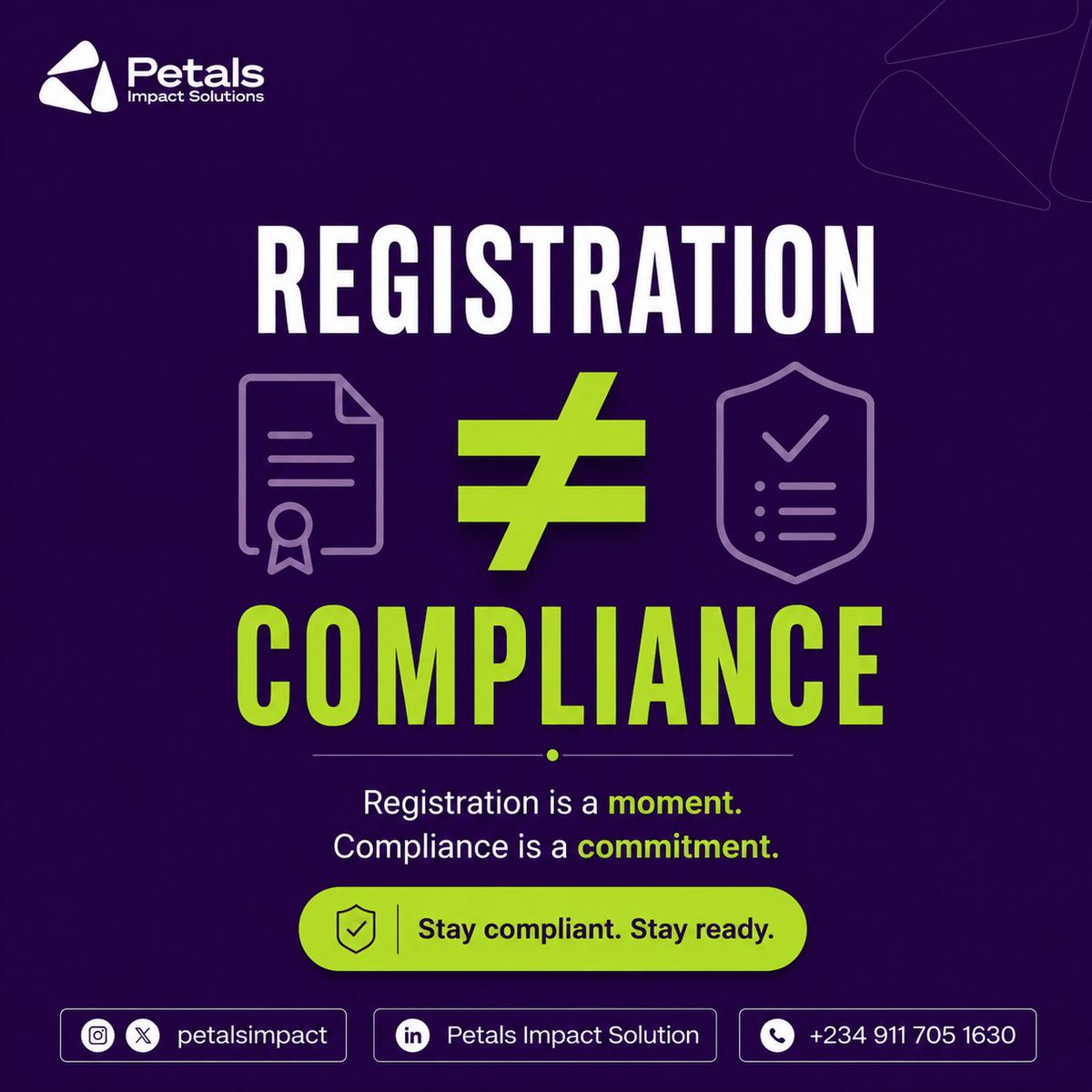
Registration is a moment.
Compliance is a commitment.
Many founders don’t realize there’s a difference.
A thread 🧵
One of the most common assumptions we see is this:
“Our business is registered, so we’re fine.”
We understand why that feels true.
You completed the registration.
Your business legally exists.
You’re operational.
Clients are coming in.
Naturally, it feels like the hard part is over.
But registration is only the beginning.
Registration is an event.
Compliance is what happens after.
And unlike registration, compliance is ongoing.
It requires attention.
Structure.
Consistency.
After registration, responsibilities begin.
Things like:
• annual filings
• tax obligations
• statutory record keeping
• regulatory updates
• licence renewals
• governance documentation
This is where many businesses get caught off guard.
Not because they’re irresponsible.
Usually, they’re just busy building.
Busy selling.
Busy hiring.
Busy serving customers.
And compliance quietly becomes:
“We’ll sort that later.”
Until later becomes expensive.
An investor asks questions.
A bank requests documents.
A partner begins due diligence.
A regulator raises concerns.
And suddenly, founders realize something important:
Being registered does not automatically mean being compliant.
This is why businesses need more than someone who helps them register.
They need a partner who helps them stay compliant.
Because the goal is not just to start a business.
It’s to build one that can grow, survive scrutiny, and last.