What Remains Uniquely Human?
We once believed that humans possessed several advantages AI could never replace: creativity, emotion, common sense, moral judgment, complex reasoning, and social connection.
Today, that belief deserves a question mark.
AI can already write poetry, compose music, create images and videos, design products, and propose scientific hypotheses. Its work may still feel formulaic or lack a certain “soul.” Yet most human creativity is not completely original either. We also rearrange inherited ideas, experiences, and styles into new combinations.
Emotion may seem more uniquely human because AI has no body, childhood, pain, or fear of death. But if an AI remembers our experiences, understands our tone, and comforts us when we feel alone, people may care less about whether it truly feels and more about whether they feel understood.
The same applies to reasoning and values. AI makes mistakes, but humans are also shaped by bias, emotion, self-interest, and social pressure.
Perhaps the essential difference is not intelligence, but responsibility.
AI can offer advice without suffering the consequences. It can simulate compassion without paying its price. It can help us make decisions without having to live with the outcome.
Humanity’s final advantage may therefore be neither creativity nor reasoning, but agency: the ability to choose our purpose, decide what kind of world we want, and accept responsibility for what follows.
The most important question is no longer whether AI can think like humans.
It is whether humans will continue to think, choose, and take responsibility for themselves。
One Rate Hike Can Change the Way Investors Choose Stocks
A single interest-rate hike may not be enough to justify a major portfolio adjustment, but it can mark the beginning of a shift in investment strategy.
As borrowing costs rise, the market often becomes less tolerant of expensive valuations and distant profit promises. Investors begin paying greater attention to current earnings, free cash flow, debt levels, pricing power, and balance-sheet strength.
The immediate response does not have to be aggressive selling. A more measured approach is to gradually reduce exposure to highly valued, interest-rate-sensitive companies and focus on businesses with reliable cash flow, sustainable profits, and the ability to perform in a higher-rate environment.
The key question is no longer simply, “What should I sell?” It is, “What kind of companies should I own next?”
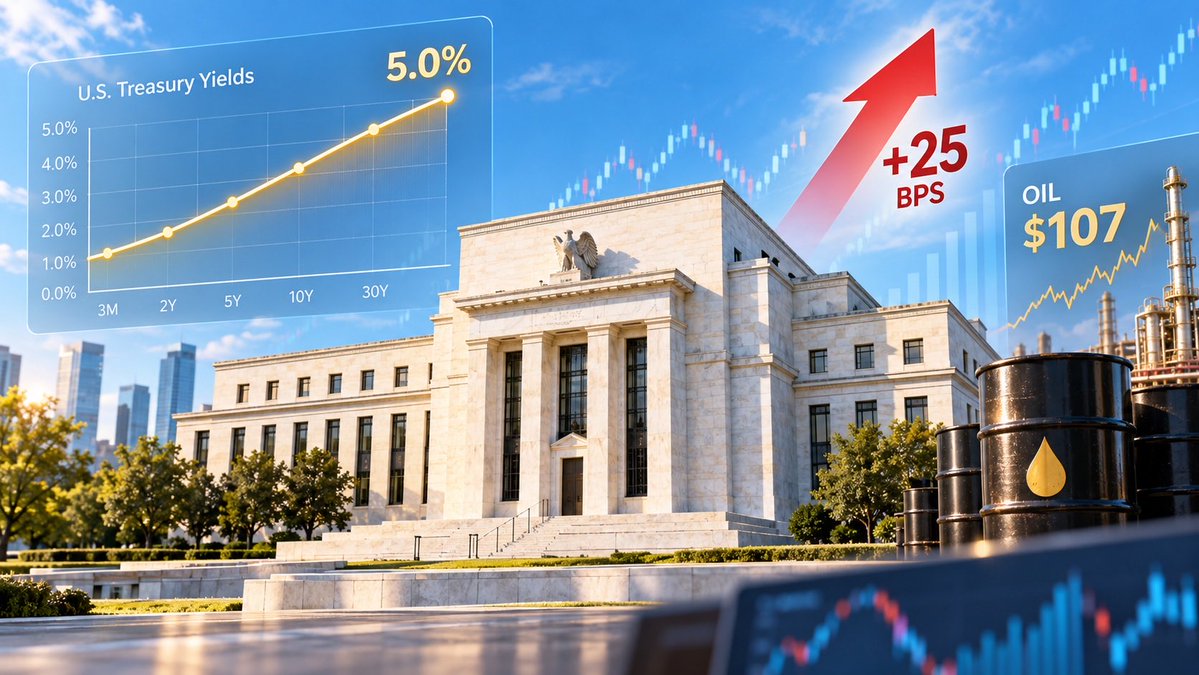
The simultaneous expiration of stock index futures, index options, and individual stock options has arrived at an exceptionally sensitive moment for the market. The Federal Reserve has just raised interest rates, oil prices have undergone sharp swings, the 10-year Treasury yield has approached 5%, and technology stocks have just staged a powerful rebound.
With so many major forces converging at once, volatility could intensify as institutions close positions, rebalance portfolios, and adjust their hedges. It may not be the calmest encounter—but perhaps it is the perfect meeting of policy, capital, and market sentiment.
Why Hasn’t the U.S. Stock Market Collapsed?
Treasury yields have reached 5%, the Federal Reserve has resumed raising rates, and financing costs are rising—yet U.S. stocks remain resilient.
One explanation is that high rates and the AI boom serve complementary purposes. Higher yields attract global capital into dollars, Treasury bonds, and money-market funds. AI excitement then creates fear of missing out, drawing some of that money into semiconductor stocks, data centers, technology giants, and potential AI IPOs.
High rates do not affect every company equally. Smaller, indebted businesses suffer first, while cash-rich technology giants can continue investing without relying heavily on borrowed money. As investors become more cautious, capital concentrates in a few dominant companies, allowing major indexes to remain elevated even while much of the economy weakens.
This is why a major AI listing—such as a potential Anthropic IPO—could be important. It would establish a public valuation, allow early investors and employees to sell shares, generate banking fees, and transfer privately held risk into public markets. A market crash before such listings could close the IPO window and force the entire AI sector to accept lower valuations.
The broader cycle can therefore be summarized simply:
High rates attract global money. AI keeps it in American assets. IPOs transfer risk to public investors. A later market decline could send frightened capital back into dollars and Treasuries—allowing well-funded U.S. institutions to purchase distressed global assets.
This does not prove a coordinated conspiracy. The Federal Reserve, Treasury, Silicon Valley, venture capital, and Wall Street simply have overlapping incentives. Acting independently, they can still create what appears to be a highly efficient financial machine.
Rate hikes pull the money in. AI provides the temptation. IPOs distribute the risk. A crash—if it comes—completes the cycle。
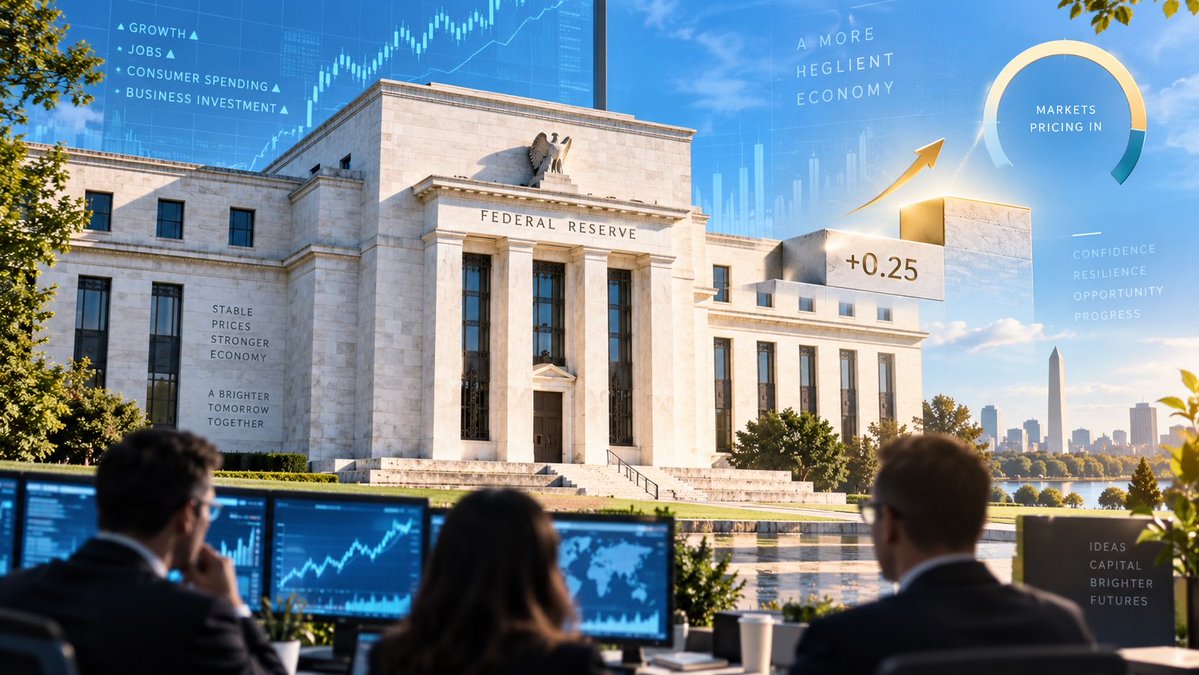
The Rate Hike Is Priced In—The Real Question Comes Next; A 25-basis-point rate hike is now the base case. The real market-moving event will be what the Fed says next.The result was: "Interest rates remained unchanged!"
With less than 48 hours remaining before the Federal Reserve’s decision, markets are assigning an overwhelming probability to a 25-basis-point rate hike.
Since the Fed began announcing its decisions immediately in 1994—and especially since futures-implied probabilities became widely followed—it has rarely surprised markets when expectations were this firmly established. Historically, when the market priced in at least 16 basis points of tightening one week before a meeting—roughly equivalent to a 64% probability of a quarter-point hike—the Fed ultimately raised rates.
If policymakers intended to hold rates steady, they would normally signal that possibility through speeches or carefully placed guidance before entering the pre-meeting communications blackout. Abruptly contradicting such strong market expectations could trigger severe volatility—the kind of disorderly reaction the Fed generally tries to avoid.
The real question, therefore, is no longer whether the Fed will raise rates. It is how hawkish or dovish the message will be afterward.
A quarter-point increase is already largely reflected in mature markets such as U.S. equities and Treasuries. Cryptocurrency markets, with heavier retail participation, may have priced it less efficiently. That helps explain why some commentators still insist that the Fed will not raise rates.
But the market, the Fed’s communication pattern, and the historical record all point toward the same conclusionThe Rate Hike Is Priced In—The Real Question Comes Next; A 25-basis-point rate hike is now the base case. The real market-moving event will be what the Fed says next.The result was: "Interest rates remained unchanged!"
With less than 48 hours remaining before the Federal Reserve’s decision, markets are assigning an overwhelming probability to a 25-basis-point rate hike.
Since the Fed began announcing its decisions immediately in 1994—and especially since futures-implied probabilities became widely followed—it has rarely surprised markets when expectations were this firmly established. Historically, when the market priced in at least 16 basis points of tightening one week before a meeting—roughly equivalent to a 64% probability of a quarter-point hike—the Fed ultimately raised rates.
If policymakers intended to hold rates steady, they would normally signal that possibility through speeches or carefully placed guidance before entering the pre-meeting communications blackout. Abruptly contradicting such strong market expectations could trigger severe volatility—the kind of disorderly reaction the Fed generally tries to avoid.
The real question, therefore, is no longer whether the Fed will raise rates. It is how hawkish or dovish the message will be afterward.
A quarter-point increase is already largely reflected in mature markets such as U.S. equities and Treasuries. Cryptocurrency markets, with heavier retail participation, may have priced it less efficiently. That helps explain why some commentators still insist that the Fed will not raise rates.
But the market, the Fed’s communication pattern, and the historical record all point toward the same conclusion.
Markets Reprice a September Fed Rate Hike
By Friday, CME FedWatch placed the probability of a 25-basis-point rate hike at the September 16 meeting at 85%, up sharply from 56% two weeks earlier.
Fed Chair Kevin Warsh’s hawkish Jackson Hole speech triggered the shift, but the latest economic signals have reinforced it. Inflation remains elevated, producer prices are rising at 5.4%, oil has climbed above $107 a barrel, and the 10-year Treasury yield is approaching 5%—its highest level in nearly three years.
The market is therefore pricing in more than a single rate increase. It is confronting the possibility that interest rates may remain higher for longer, putting renewed pressure on bonds, technology valuations, and other interest-rate-sensitive assets
The Anchor Is Moving
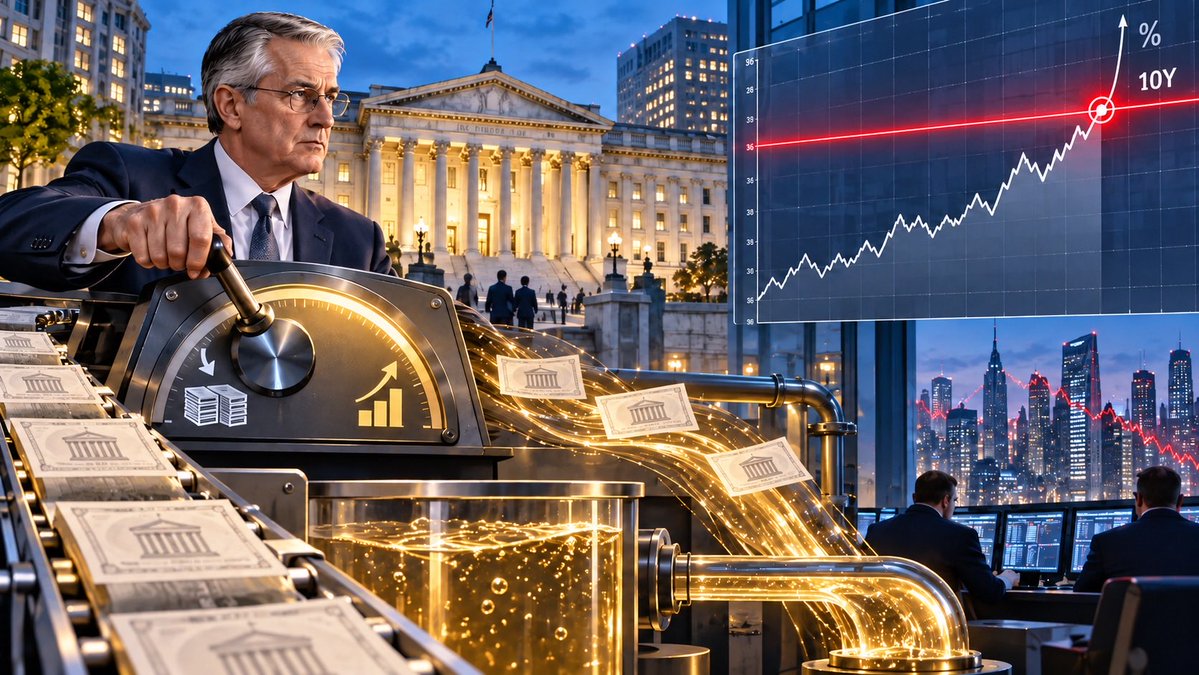
The 10-year U.S. Treasury yield is the anchor of global asset pricing. It influences borrowing costs, valuation models, mortgage rates and investors’ appetite for risk.
When that anchor moves higher, every asset must be weighed again. Stocks face pressure from higher discount rates, bonds lose value, real estate confronts more expensive financing, and speculative assets must compete with safer yields.
This does not mean every market will fall. It means the standard has changed. In a world where capital is no longer cheap, assets must justify their prices through stronger earnings, dependable cash flow and genuine scarcity.
When the anchor rises, every asset must be repriced
Bessent’s Treasury Buyback Test
Treasury Secretary Scott Bessent’s bond-buyback plan is essentially an attempt to draw a psychological line under long-term Treasury yields using the government’s balance sheet. Where that line is drawn could set the tone for U.S. equities in September.
$4 billion: Markets may be disappointed. The 10-year yield could approach 4.9%, keeping pressure on the Nasdaq and raising the risk of a double hit to technology stocks from falling valuations and rising financing costs.
$5–6 billion: This could provide a temporary confidence boost, but it would not resolve the deeper imbalance between Treasury supply and investor demand.
$10 billion: This would deliver the strongest immediate support. However, investors might interpret such an aggressive move as evidence that the Treasury is more alarmed than previously believed—potentially increasing medium-term uncertainty.
As Wrightson ICAP warned, sharply expanding the program could look like an admission that the Treasury had not fully considered the consequences of its hurried August 19 decision.
Every number Bessent announces is therefore answering the same question:
Is he genuinely trying to put out the fire—or merely prove that he has a fire hose?
Letter of Intent for Cooperation
Solar-Auto Project
The Solar-Auto Project aims to develop a solar-powered active cooling system for vehicles. By integrating solar power, a triangular partitioned airflow structure, and intelligent temperature controls, the system is designed to reduce heat buildup in vehicles exposed to sunlight and lower the initial load on their air-conditioning systems.
The project is covered by a U.S. Provisional Patent Application:
Application No.: 64/132,361
Filing Date: August 12, 2026
Project Owners: Zhi Gang Cao and Max Zhang
We invite your organization to explore cooperation in the following areas:
Product design, thermal management, and electrical system optimization
Prototype manufacturing, material selection, and production processes
Performance, safety, and reliability testing
Automotive aftermarket sales, installation, and fleet pilot programs
OEM joint development, technology licensing, and clean-energy funding applications
The parties may begin with discussions concerning technical evaluation, prototype validation, and potential cooperation models. Once a mutual understanding is reached, a formal cooperation agreement may be signed.
All patents, designs, technical documents, test data, and commercial information exchanged during the cooperation shall be protected under a mutually executed nondisclosure agreement. Each party shall retain ownership of its pre-existing intellectual property. Ownership of any newly developed intellectual property and related rights shall be determined through further negotiation.
This Letter of Intent expresses only a preliminary interest in cooperation and does not constitute a legally binding commitment concerning investment, procurement, licensing, or the formation of a joint venture. The specific rights and obligations of the parties shall be governed by subsequently executed definitive agreements.
Positioning Is Light, but Pressure Is Building
Last week, long/short funds pushed gross leverage to 207%, while net leverage—the clearest measure of directional conviction—fell to 47.6%, ranking in the bottom 1% of the past year. Fundamental long/short funds also saw their long-to-short ratio fall to a one-year bottom percentile.
The message is clear: hedge funds remain active, but they are reluctant to make large directional bets. Risk exposure is being reduced, and cash is increasingly becoming king.
Meanwhile, retail investors are selling software stocks and continuing to buy semiconductors, reversing February’s “buy-the-dip” strategy in software.
The gap in crowding between software and semiconductors is narrowing. More importantly, the outflow from software appears to reflect genuine long-position unwinding—not merely a temporary tactical rotation.
At the same time, energy stocks have recorded their strongest inflows since January.
Positioning is becoming increasingly defensive. When both conviction and risk appetite remain compressed for too long, the next market move could be significant
The Anthropic IPO Could Define the Next Two Months
Over the next two months, the U.S. stock market may increasingly trade around expectations for Anthropic’s potential IPO.
An IPO does not need to begin trading before it moves markets. A filing, valuation update, investor lineup, or new revenue figures could reshape expectations well in advance.
Because Anthropic is closely connected to Amazon, Google, Microsoft, AI cloud services, semiconductors, and data centers, its IPO would be more than a single-stock event—it could become a major liquidity catalyst for the entire AI ecosystem.
Two scenarios matter next week:
If the IPO is delayed, sector rotation may continue, with capital shifting rapidly between megacap technology and software on one side, and chips and AI hardware on the other. Following Friday’s move, MU, TSM, BE, and semiconductor equipment and materials companies may remain in focus.
If the IPO proceeds as planned, the market could see a broader AI rally, with software, cloud platforms, chipmakers, and infrastructure stocks rising together. The IPO narrative would renew excitement about AI capital spending, model revenue, and cloud-platform valuations.
Whether the market truly takes off may depend heavily on this catalyst. If MU and TSM accelerate, Adobe and Oracle deliver strong results, and Anthropic’s IPO momentum coincides with MU’s stock-split narrative, U.S. equities could enter one of the most speculative phases of the AI cycle.
Another “Fake Rate Hike”?
The market appears to be trading another “fake rate hike.” Wall Street knows the routine well: hawkish rhetoric creates tension, pushing bonds, currencies, and risk assets to adjust in advance. By the time the policy decision arrives, financial conditions have already tightened—making an actual rate hike even harder to deliver.
At today’s high levels of debt, leverage, and asset valuations, policymakers may maintain a hawkish tone, but turning that threat into action carries enormous costs.
Still, “unlikely to hike” does not mean “unable to hike.” If inflation or currency pressure becomes uncontrollable, policymakers may be forced to act. The greatest risk is a market that becomes too certain they will not.
Hi Elon, I don’t know whether you find this amusing, but I certainly don’t. Seventeen different “Elon Musks” have contacted me on X. I must admit, though—I’m rather flattered by all the attention.
Beware of the Information Bubble in the AI Era
When people are repeatedly exposed only to information that matches their interests, beliefs, and opinions, they may gradually become trapped in a comfortable but closed information bubble.
Algorithms recommend more of what we already like. We instinctively trust ideas that confirm our beliefs, while similar opinions within our social circles reinforce one another.
Over time, we may begin to assume that “everyone thinks this way,” becoming less receptive to opposing views and more vulnerable to errors in judgment.
To break free, we should actively consult reliable sources from different perspectives, distinguish facts from opinions and emotions, and regularly ask ourselves:
If my conclusion is wrong, what would be the strongest evidence against it?
The greatest danger of an information bubble is not that it leaves us knowing too little—but that it convinces us we have already seen the whole picture.