Ross was just granted a FULL AND UNCONDITIONAL PARDON by @realDonaldTrump. Words cannot express how grateful we are.
President Trump is a man of his word and he just saved Ross's life. ROSS IS A FREE MAN!!!!!
KYC is the real terror
The erosion of our freedoms and rights is on the rise due to KYC and AML regulations. What is the origin of these rules and to what extent are they effective?
It has become increasingly evident that our financial system has started undermine our constitutionally guaranteed freedoms and rights. Payment giants like PayPal, Mastercard, and Visa sometimes block the ability to donate money. Individuals, companies, and associations lose bank accounts — or struggle to open new ones. In bank offices, people nowadays risk undergoing something resembling being cross-examined. The regulations are becoming so cumbersome that their mere presence risks tarnishing banks' reputation.
The rules are so complex that even within the same bank, different compliance officers can provide different answers to the same question! There are even departments where some of the compliance officers are reluctant to provide written responses and prefer to answer questions over an unrecorded phone call. A corporate lawyer in Sweden recently complained about troublesome bureaucracy, and that was from the perspective of a very large corporation. We may not even fathom how smaller businesses — the keys to a nation's prosperity — experience it.
Where do all these rules come from?
Where do all these rules come from, and how well do they work? Today's regulations on money laundering (AML) and customer due diligence (KYC - know your customer) primarily originate from a G7 meeting in the summer of 1989. (The G7 comprises the seven advanced economies: the USA, Canada, the UK, Germany, France, Italy, and Japan, along with the EU.) During that meeting, the intergovernmental organization FATF (Financial Action Task Force) was established with the aim of combating organized crime, especially drug trafficking. Since then, its mandate has expanded to include fighting money laundering, terrorist financing, and the financing of the proliferation of weapons of mass destruction(!). One might envisage the rules soon being aimed against proliferation of GPUs (Graphics Processing Units used for AI/ML). FATF, dominated by the USA, provides frameworks and recommendations for countries to follow. Despite its influence, the organization often goes unnoticed. Had you heard of it?
FATF offered countries "a deal they couldn't refuse"
On the advice of the USA and G7 countries, the organization decided to begin grading countries in "blacklists" and "grey lists" in 2000, naming countries that did not comply with its recommendations. The purpose was to apply "pressure" to these countries if they wanted to "retain their position in the global economy." The countries were offered a deal they couldn't refuse, and the number of member countries rapidly increased. Threatening with financial sanctions in this manner has even been referred to as "extraterritorial bullying." Some at the time even argued that the process violated international law.
If your local Financial Supervisory Authority (FSA) were to fail in enforcing compliance with FATF's many checklists among financial institutions, the risk of your country and its banks being barred from the US-dominated financial markets would loom large. This could have disastrous consequences.
A cost-benefit analysis of AML and KYC regulations
Economists typically use cost-benefit analysis to determine whether an action or a policy is successful. Let's see what such an analysis reveals.
What are the benefits (or revenues) after almost 35 years of more and more rules and regulations? The United Nations Office on Drugs and Crime estimated that only 0.2% of criminal proceeds are confiscated. Other estimates suggest a success rate from such anti-money laundering rules of 0.07%— a rounding error for organized crime. Europol expects to recover 1.2 billion euros annually, equivalent to about 1% of the revenue generated in the European drug market (110 billion euros). However, the percentage may be considerably lower, as the size of the drug market is likely underestimated. Moreover, there are many more "criminal industries" than just the drug trade; human trafficking is one example - there are many more. In other words, criminal organizations retain at least 99%, perhaps even 99.93%, of their profits, despite all cumbersome rules regarding money laundering and customer due diligence.
What constitutes the total cost of this bureaurcratic activity, costs that eventually burden taxpayers and households via higher fees? Within Europe, private financial firms are estimated to spend approximately 144 billion euros on compliance. According to some estimates, the global cost is twice as high, perhaps even eight times as much.
For Europe, the cost may thus be about 120 times (144/1.2) higher than the revenues from these measures. These "compliance costs" bizarrely exceed the total profits from the drug market, as one researcher put it. Even though the calculations are uncertain, it is challenging — perhaps impossible — to legitimize these regulations from a cost-benefit perspective.
But it doesn't end there, unfortunately. The cost of maintaining this compliance circus, with around 80 international organizations, thousands of authorities, far more employees, and all this across hundreds of countries, remains a mystery. But it's unlikely to be cheap.
The purpose of a system is what it does
In Economic Possibilities for our Grandchildren (1930), John Maynard Keynes foresaw that thanks to technological development, we could have had a 15-hour workweek by now. This has clearly not happened. Perhaps jobs have been created that are entirely meaningless? Anthropologist David Graeber argued precisely this in Bullshit Jobs in 2018. In that case, a significant number of people spend their entire working lives performing tasks they suspect deep down don't need to be done.
"The purpose of a system is what it does" is a heuristic coined by Stafford Beer. He observed there is "no point in claiming that the purpose of a system is to do what it constantly fails to do. What the current regulatory regime fails to do is combat criminal organizations. Nor does it seem to prevent banks from laundering money as never before, or from providing banking services to sex-offending traffickers
What the current regulatory regime does do, is: i) create armies of meaningless jobs, ii) thereby undermining mental health as well as economic prosperity, while iii) undermining our freedoms and rights.
What does this say about the purpose of the system?
First they call you crazy for pursuing your dreams.
Then, they call you weird for leaving your hometown.
They continue to judge you for starting your business.
Finally, they ask you for a job.
This is the path of the Autopreneur.
Don't listen to the haters.
Keep going.
Over the next 10 weeks, we're doing a deep dive into the key findings & recommendations from @lalalavendr’s research into the history of DAOs and their policies, programs, and processes.
The first takeaway we want to focus on is related to VOTING. 🗳️🙋♀️
Let’s take a look.
And that is it for another year! #Athens We have loved being here (eventually!), but we hope to see you all again - in person - next year in Torino, Italy!
#WCEU
https://t.co/p7gTXD55gh
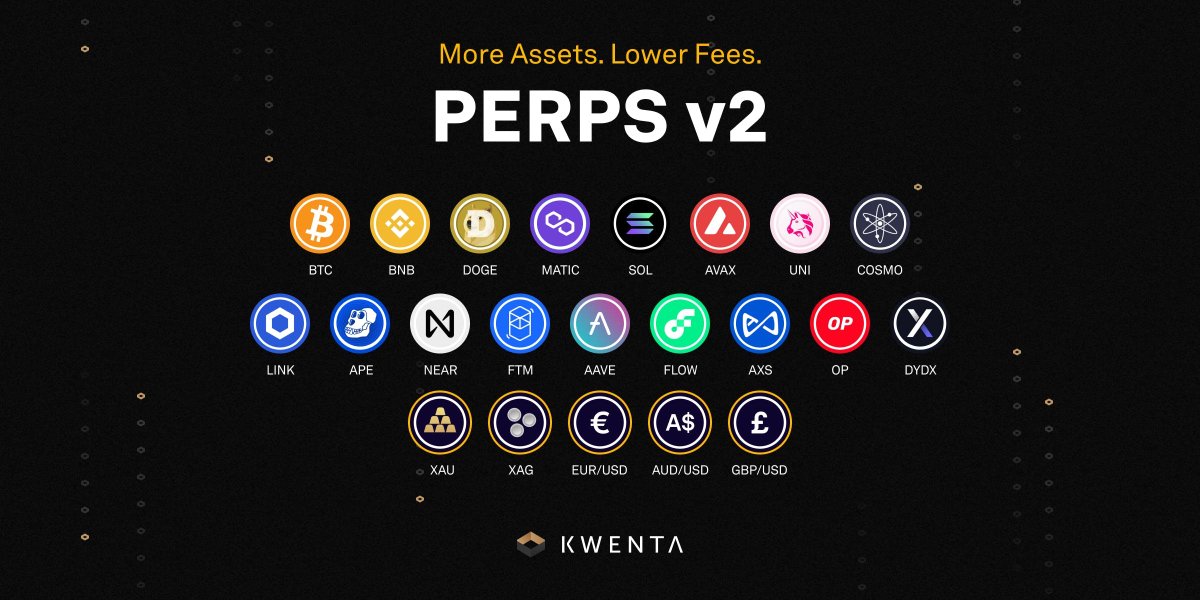
$KWENTA rewards for v2 are now live! 🥂
To earn rewards:
🔸 Stake $KWENTA
(the more you stake, the more you make)
🔸 Trade on Kwenta Perps v2
(rewards based on fees paid)
Details in the blog:
https://t.co/43EVhVyTB6
Trade the new Perps v2 here:
👇👇👇
https://t.co/Q840MQqm3y
HYDROPOWER TO BRAINPOWER
is my talk about The Penguin Technology Campus in Paraguay and its potential social impact, this Saturday in Prague at the Liberty in Our Lifetime conference.
@PenguinsTribe 🐧🚀 #Bitcoin@LibertyIOL
>>> https://t.co/QTPduaiTXf