@ODScz a proc takovej clovek zustane clenem ODS? to je v pohode? jenom ho schovate at nedrazdi verejnost na kandidatce, ale kmotrovat ve stranickejch strukturach ho nechate dal???
[byvaly volic ods]
@zdenekkubik72 tak hlavne ale trefil turek sanitku, na sanitka turka.
turek ho trefit nemusel, kdyby daval pozor a brzdil / uhnul. cas/prostor na reakci mel, uhnout slo. neudelal ale vubec nic (asi cumel zrovna jinam nebo si delal selfie). je divny, ze neslysel houkani.
@CT24zive turek:
= jel rovne odbocovacim pruhem
= vubec nedaval pozor (stacilo pribrzdit/pohnout volantem a vyslo to, casu mel dost)
- nejspis jel nepovolenou rychlosti
- nejspis projizdel zlutou/cervenou
at tak ci tak, kdyby na prasaka neobjizdel frontu, nehoda nebyla.
je to debil.
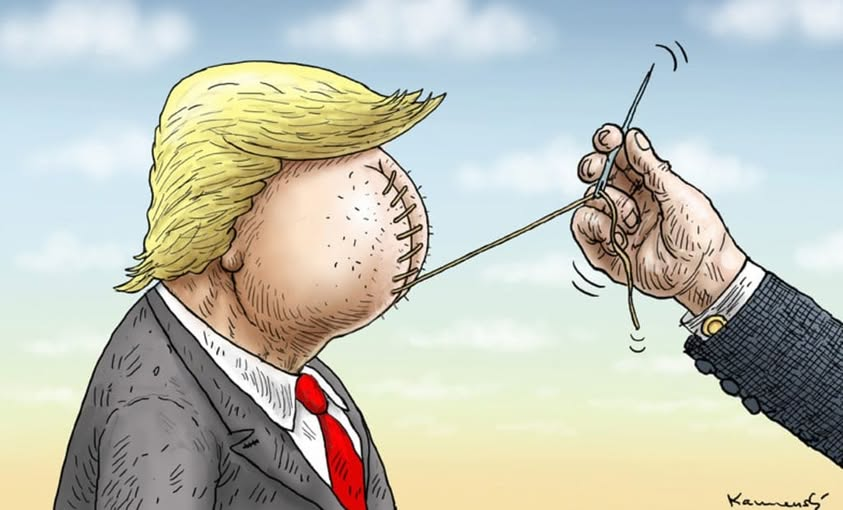
*BRITISH WRITER PENS THE BEST DESCRIPTION OF TRUMP*
Someone asked "Why do some British people not like Donald Trump?" Nate White, an articulate and witty writer from England wrote the following response:
A few things spring to mind. Trump lacks certain qualities which the British traditionally esteem. For instance, he has no class, no charm, no coolness, no credibility, no compassion, no wit, no warmth, no wisdom, no subtlety, no sensitivity, no self-awareness, no humility, no honour and no grace – all qualities, funnily enough, with which his predecessor Mr. Obama was generously blessed.
So for us, the stark contrast does rather throw Trump's limitations into embarrassingly sharp relief.
Plus, we like a laugh. And while Trump may be laughable, he has never once said anything wry, witty or even faintly amusing – not once, ever.
I don't say that rhetorically, I mean it quite literally: not once, not ever. And that fact is particularly disturbing to the British sensibility – for us, to lack humour is almost inhuman.
But with Trump, it's a fact. He doesn't even seem to understand what a joke is – his idea of a joke is a crass comment, an illiterate insult, a casual act of cruelty. Trump is a troll. And like all trolls, he is never funny and he never laughs; he only crows or jeers.
And scarily, he doesn't just talk in crude, witless insults – he actually thinks in them. His mind is a simple bot-like algorithm of petty prejudices and knee-jerk nastiness. There is never any under-layer of irony, complexity, nuance or depth. It's all surface.
Some Americans might see this as refreshingly upfront. Well, we don't. We see it as having no inner world, no soul. And in Britain we traditionally side with David, not Goliath. All our heroes are plucky underdogs: Robin Hood, Dick Whittington, Oliver Twist. Trump is neither plucky, nor an underdog. He is the exact opposite of that. He's not even a spoiled rich-boy, or a greedy fat-cat. He's more a fat white slug. A Jabba the Hutt of privilege.
And worse, he is that most unforgivable of all things to the British: a bully. That is, except when he is among bullies; then he suddenly transforms into a snivelling sidekick instead.
There are unspoken rules to this stuff – the Queensberry rules of basic decency – and he breaks them all. He punches downwards – which a gentleman should, would, could never do – and every blow he aims is below the belt. He particularly likes to kick the vulnerable or voiceless or female – and he kicks them when they are down. So the fact that a significant minority – perhaps a third – of Americans look at what he does, listen to what he says, and then think 'Yeah, he seems like my kind of guy' is a matter of some confusion and no little distress to British people, given that:
• Americans are supposed to be nicer than us, and most are.
• You don't need a particularly keen eye for detail to spot a few flaws in the man.
This last point is what especially confuses and dismays British people, and many other people too; his faults seem pretty bloody hard to miss.
After all, it's impossible to read a single tweet, or hear him speak a sentence or two, without staring deep into the abyss. He turns being artless into an art form; he is a Picasso of pettiness; a Shakespeare of shit. His faults are fractal: even his flaws have flaws, and so on ad infinitum. God knows there have always been stupid people in the world, and plenty of nasty people too. But rarely has stupidity been so nasty, or nastiness so stupid. He makes Nixon look trustworthy and George W look smart. In fact, if Frankenstein decided to make a monster assembled entirely from human flaws – he would make a Trump.
@LuizaJarovsky 10 Conclusion The paper’s core point is that LLMs can make people feel more capable than they really are, which matters both for self-judgment and for how institutions judge competence.
@LuizaJarovsky 1 Introduction LLMs are becoming part of everyday mental work, and the paper says this can make people mistake AI-assisted results for their own skill.
2 Background and Related Work Earlier research showed that people often rely too much on machines,
@LuizaJarovsky 8 The human author used LLMs only as support tools and kept full control and responsibility for the ideas, checks, and final text.
9 Next research should measure the gap between felt and real ability, compare work w and w/o LLM help, and test ways to make the LLM’s role clearer.
@LuizaJarovsky 6 In real use, people often produce good results with LLM help but cannot fully explain, repeat, or extend that work by themselves.
7 Because schools and employers often judge people by outputs, LLM use can make those judgmnts less reliable if the process behind result is hidden.
@LuizaJarovsky 4 This happens because LLM output looks polished, the user does less of the mental work, and it is hard to see what came from the person and what came from the system.
5 The problem can appear in coding, languages, analysis, writing, ...outside help can look like personal skill.
@LuizaJarovsky but this paper focuses on a different problem: people getting confused about who actually did the thinking.
3 The LLM fallacy is when someone takes LLM-made output as proof of their own ability, even if they could not do the same task alone.