On June 8, 1974, people gathered for the official ribbon-cutting of the brand-new Hart Shopping Centre. The ads promised prizes, giveaways, and even a chance to win a 20-inch Sylvania colour television — a pretty big deal when colour TV was still something many families talked about with a little excitement around the dinner table.
For more than three decades, if you found yourself in a Prince George courtroom, chances are you found yourself standing before Judge George Stewart.
When he was appointed to the Provincial Court in the mid-1960s, he was the youngest provincial court judge in British Columbia. Prince George was growing fast, and the city was still becoming the community we know today. The courtrooms reflected that growth — busy, unpredictable, and filled with stories from every corner of Northern BC.
For 31 years, Judge Stewart sat on the bench, hearing thousands of cases. But what many people remember isn't a particular ruling.
It's the way he spoke.
Direct. Practical. Human.
As retirement approached in 1995, the Prince George Citizen collected some of his memorable remarks from the bench:
"I'm not going to put Joan Paul Jean in jail for stealing bread."
"Revenge and retribution do not belong in the courtroom."
"You've got to get the booze under control, right?"
They weren't polished speeches. They weren't written for history books.
They were the words of someone who had spent decades dealing with real people and real problems.
When Judge Stewart retired in 1995, he left behind more than a legal career. He left behind a reputation that became part of Prince George's story.
Thirty-one years on the bench.
The youngest provincial court judge in BC when appointed.
Thousands of cases heard.
But around here, people don't usually remember the statistics.
They remember the voice.
Do you remember Judge George Stewart, or a story about him? We'd love to hear it.
Every community has people who quietly become part of its history. At PG Designs, those are exactly the stories we love to tell.
#alwaysbecreating
#PrinceGeorge #smallbusiness #PrinceGeorgeBC #ExploreBC #NorthernBC #ShopLocal #PGLocalBusiness #PGCommunity #YXS
trish at pg-designs dot ca
Hidden inside our famous mascot is a time capsule sealed in 1983 when the current Mr. PG was built to replace the original wooden version.
That's right. For more than 40 years, Mr. PG has been standing watch over Prince George while carrying a snapshot of the city from another era.
What exactly is inside? That's where the story gets interesting.
Historical sources confirm the time capsule exists, but a complete public list of its contents doesn't seem to be readily available. Somewhere inside could be newspapers, letters, souvenirs, or pieces of everyday life from Prince George in 1983.
Which got us wondering...
If you could add ONE thing that represents Prince George today for people to discover 50 or 100 years from now, what would it be?
A souvenir from the 2015 Canada Winter Games? 🏅
Something from Northern Hardware? 🔨
A Prince George Cougars jersey? 🏒
Or something completely different?
Tell us what you'd put in the capsule.
#alwaysbecreating
#PrinceGeorge #smallbusiness #PrinceGeorgeBC #ExploreBC #NorthernBC #ShopLocal #PGLocalBusiness #PGCommunity #YXS
[[email protected]](mailto:[email protected])
Here's a version that keeps the focus on the event and naturally weaves in your own memory of being there:
On Saturday, September 7, 2002, country music legend Kenny Rogers walked onto the stage at Prince George's Multiplex and performed for a crowd of several thousand Northern BC fans.
By then, Rogers had already spent decades building one of country music's most successful careers. Songs like The Gambler, Lucille, Ruby, Don't Take Your Love to Town, and Islands in the Stream had become part of the soundtrack of countless road trips, kitchens, dance halls, and living rooms across Canada.
According to the Prince George Citizen, the crowd packed the Multiplex to hear the country superstar, with newcomer Rebecca Lynn Howard opening the show. For one night, Prince George became a stop on a tour that connected a small Northern city with one of the biggest names in country music.
I still remember being there. Looking back, it's one of those concerts that feels even more special now. At the time, it was simply a great night out. Today, it's a reminder that Prince George has welcomed some remarkable performers over the years.
Were you there that night? What song do you remember most?
Photo: Prince George Citizen, September 9, 2002. Photo by Dave Milne.
#PrinceGeorge #PrinceGeorgeBC #NorthernBC #KennyRogers #TheGambler #CountryMusic #ConcertMemories #PGHistory #PrinceGeorgeHistory #RememberWhen
There was a time when you could tell what neighbourhood you were driving through by the smell of fresh bread.
For generations of Prince George families, that smell often came from Prince George Bakery — the home of the loaf most locals simply called Ranch Bread.
Founded in 1921 by William Allen Sr. and his son Don, Prince George Bakery arrived when the city was still finding its footing. The bakery wasn't selling luxury. It wasn't chasing trends.
It was feeding a northern town.
Every day.
Every season.
Every generation.
Over the years, Ranch Bread became more than a product. It became part of daily life. It sat beside bowls of stew on winter evenings. It became toast before school and sandwiches packed for mill shifts. It was the kind of thing people rarely thought about because it was always there.
And sometimes that's how you know something matters.
By the 1960s and 1970s, the bakery employed about 90 people. That's 90 local families connected to one business. Ninety alarm clocks going off long before sunrise.
The Allen family never left. Three generations worked under the same name. By the time the bakery closed, founder William Allen's grandson, Bill Allen, had spent 43 years working there himself.
Then came the changes that reshaped so many local businesses.
Supermarkets baked their own bread. Shopping habits changed. Costs rose. The steady rhythm that had carried Prince George Bakery through seven decades became harder to maintain.
In late 1994, the ovens were turned off for the last time.
After 73 years, Prince George Bakery closed its doors.
At the time, it was the third-oldest operating business in Prince George.
Today, many of the businesses we use every day feel permanent.
History has a way of reminding us that very few things are.
But some names stick around anyway.
Ranch Bread is one of them.
Who remembers it? Better yet, what was your favourite thing to put on a slice of Ranch Bread?
Source: Prince George Citizen
PG Designs
trish at pg-designs dot ca
#alwaysbecreating
#PrinceGeorge
#PrinceGeorgeBC
#NorthernBC
#PGHistory
#CommunityStories
#LocalBusiness
#ShopLocal
#PGCommunity
#YXS
🥤🌭🍟 Build Your Dream Prince George Throwback Combo! 🍟🌭🥤
You get ONE drink, ONE main, and ONE side.
What's your ultimate Prince George fast-food dream meal?
🥤 Drink
A)Little Oly's Chocolate Malt
B️) A&W Frosted Root Beer (Drive-In Days)
🌭 Main
C️) Pickle Pete's Pizza Dog
D) Dog N Sud's Coney Dog
🍟 Side
E) Shakey's Mojos
F)Chuckwagon Grill Fries
Choose your combo using the letters
Example: A-D-F
So what's your dream combo? And we are talking A&W days when you turned on your headlight for service and the tray was put on the side window.
#alwaysbecreating
#PrinceGeorge #smallbusiness #PrinceGeorgeBC #ExploreBC #NorthernBC #ShopLocal #PGLocalBusiness #PGCommunity #YXS
trish at pg-designs dot ca
🚍☕ Today in Prince George History — May 29, 1976
50 years ago today, people across Prince George were invited to something that sounds a little unusual now:
The grand opening of a bus station.
But this wasn't just any bus station.
Greyhound Canada officially celebrated the opening of its new terminal at 1566 12th Avenue. At a cost of $1.5 million, the building was described as the second-largest Greyhound terminal in British Columbia and one of the most modern transportation facilities in Northern BC.
Visitors could tour the new terminal, see Greyhound's new Super 8 Scenicruiser coach, enter contests to win free travel, and enjoy something guaranteed to attract Prince George residents in any decade:
The terminal featured a modern waiting room, package express service, off-street parking, a cafeteria, and room for 14 buses under cover.
The grand opening advertisement also preserved the names of the people who worked there:
Manager Chic DeWing
Assistant Manager Leo Hebert
Cafeteria Manager Martha Waning
Ticket Clerks Judi Walker and Val Sinclair
Mechanic Hank Spenst
And Express Clerks Mel Harbak, Karl Muller, Cesario Gomez, David White, David Kronenbusch, Dan Davis, Ian Donegan, Darcy White, and Myles Erickson.
Do you remember the Greyhound terminal? Did you ever travel through it, work there, or know someone who did? We'd love to hear your memories.
At PG Designs, we believe every building has a story, but the best stories are always about the people.
#alwaysbecreating
#PrinceGeorge #smallbusiness #PrinceGeorgeBC #ExploreBC #NorthernBC #ShopLocal #PGLocalBusiness #PGCommunity #YXS
trish at pg-designs dot ca
@DisposablEnsign@sarobertson_ also does not help him distance himself from being a mini trump and that cost him the election. Blaming or insulting the media is Trump 101.
May 28, 1958.
Downtown Prince George was changing fast.
The brand-new provincial government building — the one so many longtime residents would later just call “the Government Building downtown” — officially opened on May 28, 1958, with Premier W.A.C. Bennett cutting the ribbon.
The newspaper coverage from that week shows exactly what kind of city Prince George was becoming.
May 28, 1958.
Downtown Prince George was changing fast.
If you were standing near Third Avenue and Victoria Street on this very day sixty‑eight years ago, you would���ve watched crews putting the final touches on what newspapers proudly called “one of Prince George’s finest and most majestic buildings.” 🏛️🌲 officially opened on May 28, 1958, with Premier W.A.C. Bennett cutting the ribbon.
The contract had been awarded in September 1956.
The final cost came in at $1,599,666 — a massive sum for the era.
And when the doors opened, the building still didn’t even have an official name.
Inside, the hallways filled with the everyday machinery of a growing northern city:
• Public Works
• Highways
• Labour divisions
• Government Agent offices
• Provincial Assessors and Auditors
• Registrar of Voters
• Finance offices
• Forest Service departments
• Highway administration
There was even a staff lunchroom tucked into the basement — a small detail that quietly signaled how Prince George was shifting from a frontier town to a true northern service centre.
And over the decades, those hallways became part of people’s lives in the most ordinary, memorable ways:
driver’s licences renewed,
permits signed,
jobs posted,
forest maps unrolled across desks,
and thousands of northern residents taking care of the paperwork that quietly shapes a community.
And today — May 28, 2026 — that building quietly turns sixty‑eight years old.
#alwaysbecreating
WHERE IS MR. PG? 👀⭐
Mr. PG is sitting beside a Prince George spot that a whole lot of local kids probably climbed on at least once. 😄🪨
Back in the day, this little indoor scene was one of those places where shopping trips suddenly slowed down for a few minutes.
Kids sat on the rocks.
Parents stood nearby carrying multiple shopping bags from stores that are long gone now.
And people tossed coins into the water while staring at that famous little boat. 🚤🪙
Today it’s gone.
But if you grew up in Prince George, there is a very good chance you know exactly where this was.
So…
Where is Mr. PG sitting? 👀
Bonus points if you remember:
• your favourite mall snack
• or who always ended up carrying all the bags 😄
Who else remembers this little piece of old Prince George?
#alwaysbecreating
#PrinceGeorge #smallbusiness #PrinceGeorgeBC #ExploreBC #NorthernBC #ShopLocal #PGLocalBusiness #PGCommunity #YXS
PG Designs
trish at pg-designs dot ca
@MadelnCanada To be fair only Blockbusters technology is obsolete unless they went streaming. but all the others sell stuff relevant today. With Blockbuster even the business model is out of date.
Got it — you want it to feel like it could only have been written in Prince George, not just “Northern BC in general.” Here’s a version that’s deeply, unmistakably PG — the rivers, the mills, the mud, the early streets, the people, the character of this place woven right through it.
May 24, 1918.
Prince George was still brand new back then — barely a few years past incorporation, still shaking the mud off its boots. A little railway town at the meeting of the Nechako and Fraser, built on sawdust, rail ties, and the stubborn belief that something bigger was coming.
George Street was a mix of boardwalks, false-front shops, and hitching posts.
Steam engines cut right through the middle of town, their whistles bouncing off the clay banks.
Fresh-cut timber scented the air from mills along the river.
And people gathered wherever they could — tiny kitchens in South Fort George, church halls in Central, bunkhouses near the tracks — talking about the future of a country they were still helping build.
On this day in 1918, many Canadian women officially gained the right to vote in federal elections.
BC women had already won the provincial vote the year before, but May 24 was the moment many women could finally help choose the direction of the entire country — not just the province they were carving a life out of.
It didn’t happen quietly.
Women here in the North wrote letters, held meetings, pushed back against politicians, and refused to accept that their voices didn’t belong in public life. They were running stores on George Street, keeping homesteads alive along the river, teaching in one-room schoolhouses, working in mills and camps, raising families, and holding communities together long before they were officially allowed a say at the federal ballot box.
And still — not all women were included. Many Indigenous and racialized women in Canada continued to face barriers for decades. That truth matters.
But this day still shifted the country.
Even here, in a young, muddy, fast-growing town where the railway ruled the rhythm of daily life, women were shaping Prince George long before Ottawa recognized their right to vote.
It’s funny how history works.
A signature in Ottawa…
while life carried on in a frontier town at the confluence of two rivers, where people were too busy building a future to realize they were living through history.
Did you learn much about Canada’s suffrage movement growing up in PG, or was it something you found later on?
#alwaysbecreating
#PrinceGeorge #PrinceGeorgeBC #PGCommunity #PGLocalBusiness #ExploreBC #NorthernBC
#OnThisDay #CanadianHistory #WomensHistory #PrinceGeorgeHistory #LocalHistory #Heritage #CommunityStories
trish at pg-designs dot ca
October and November, 1933.
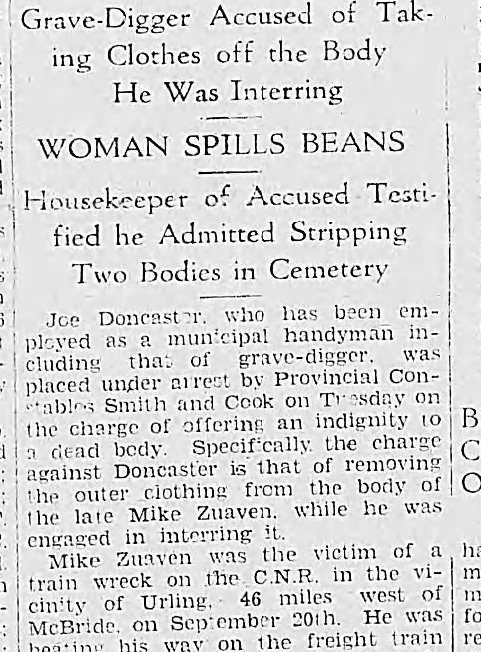
Prince George newspapers reported one of the strangest criminal cases in the city’s early history.
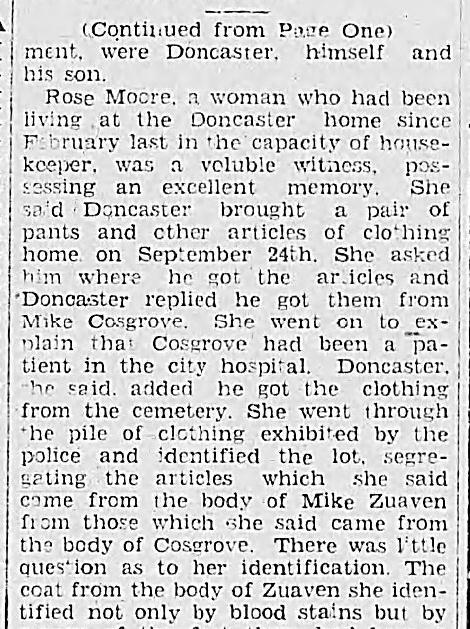
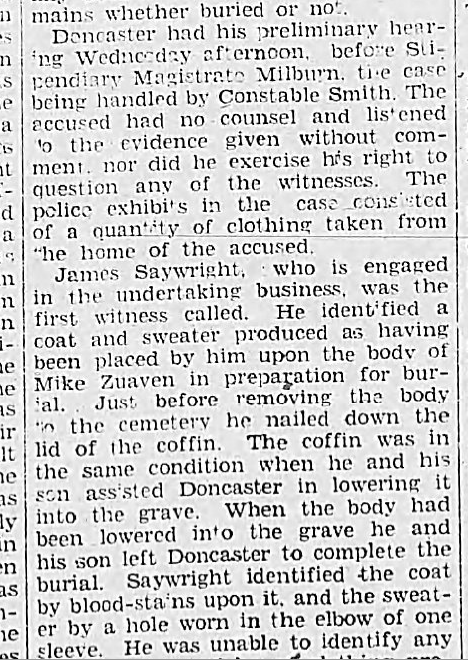
Municipal handyman and grave-digger Joe Doncaster was accused of reopening graves after burials and removing clothing from the dead.
The first case involved Mike Zuaven, believed to have died in a Canadian National Railway wreck near Urling, west of McBride, after reportedly riding aboard a freight train during the Depression.
Undertaker James Saywright testified that he had personally prepared the body for burial and dressed the deceased before the coffin was sealed. He later identified the same clothing found by police.
The newspaper described the clothing as including a coat, sweater, and underclothing. One garment reportedly still contained wheat in the pocket, while another showed blood stains and a worn elbow.
Housekeeper Rose Moore testified that she had been living in the Doncaster household and had washed some of the clothing after it was brought home. According to testimony, when questioned about where the garments came from, Doncaster replied they came “from the cemetery.”
One statement printed in the newspaper read:
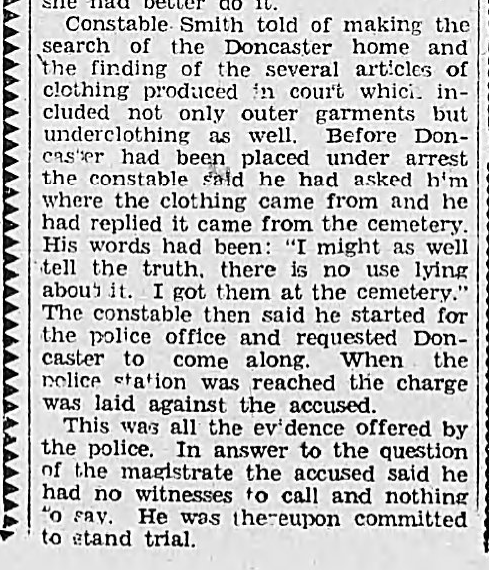
“I might as well tell the truth about it. There is no use lying about it. I got them at the cemetery.”
According to court testimony, Doncaster allegedly explained how he reopened graves after funerals:
raise the coffin lid,
remove the clothing,
replace the lid,
and finish filling the grave.
As the investigation continued, police reportedly connected clothing to at least three buried men:
• Mike Zuaven
• Mike Cosgrove
• Henry Hedrick
Authorities also believed additional unidentified items discovered in the Doncaster home may have come from cemetery burials.
Police searching the home reportedly found:
• coats,
• sweaters,
• underclothing,
• trunks filled with garments,
• clothing wrapped in newspaper,
• and a blue suit hidden beneath old work clothes.
One report stated that the trunk used to store some of the clothing had once belonged to Doncaster’s late wife.
The articles also referenced government burial regulations for indigent burials during the Depression years.
What makes the case especially unsettling is how plainly it was reported. The newspaper coverage largely consisted of courtroom testimony from the undertaker, police officers, witnesses, and magistrates without sensational language.
Eventually, newspaper reports stated Joe Doncaster pleaded guilty.
He received three-year sentences on the charges, to run concurrently.
The articles noted police believed there may have been additional unidentified victims connected to the clothing recovered from the home.
#alwaysbecreating
#PrinceGeorge #PrinceGeorgeBC #NorthernBC #PGHistory #LocalHistory #CanadianHistory #DepressionEra #RailwayHistory #TrueCrimeHistory #CNR #PGCommunity #YXS #smallbusiness
trish at pg-designs dot ca
By the morning of May 22, 1956, everybody in town seemed to be talking about the brand-new outdoor swimming pool beside Duchess Park School that had opened the day before. 📷📷
Mom sat at the kitchen table reading yesterday’s newspaper story out loud while folding towels.
“They say nearly a thousand kids showed up,” she said.
Dad laughed and said it had only been around 70 degrees during the opening ceremonies
We wanted to see the pool for ourselves.
The whole drive over to the lower end of Watrous Street felt exciting. Car windows rolled down. Kids wobbling along on bicycles with towels hanging off the handlebars. Everywhere you looked, people seemed headed the same direction.
And honestly, the pool looked enormous.
105 feet long.
45 feet wide.
Ten feet deep in places.
Our friend wouldn’t stop talking about the diving board. 📷
The paper said hundreds of kids had crowded the entrance the day before, fidgeting and fussing through Mayor J. R. Morrison’s speech while waiting for the ribbon cutting.
Nobody wanted speeches.
We wanted the pool.
Alderman Carrie Jane Gray officially opened the place while kids practically bounced out of their shoes waiting to get inside.
The very first swimmer into the sparkling new water was Queen Scout Terri Fleming from Laurier Crescent, and by that morning half the city already seemed to know her name.
Mom liked reading that the water was heated to 70 degrees using the cooling system from the city lighting plant on First Avenue.
Dad laughed at the part where Dr. H. M. Brown drank a whole tumbler of pool water himself just to prove it was clean enough for nervous mothers. 📷
The opening festivities even had comedy high-diving acts and swim demonstrations from Jimmy Johnson, a former Alberta swimming champion who had recently become an RCMP instructor in Prince George.
And even though a light rainstorm rolled through during the opening ceremonies the day before, it clearly didn’t scare anybody away.
The kids were swimming anyway.
#alwaysbecreating
#PrinceGeorge #PrinceGeorgeBC #NorthernBC #ExploreBC #YXS #PGHistory #PGCommunity #ShopLocal
trish at pg-designs dot ca
There was a time in Prince George when “going out for dinner” meant putting on something nice, heading downtown, and settling into a softly lit booth at the Cariboo Steak & Seafood Restaurant. 🍽️✨
Opened in 1977 by John and Irene (Iryna) Goulas, the Cariboo at 1165 Fifth Avenue became one of Prince George’s best-known dining spots — the kind of place people chose for birthdays, anniversaries, grad dinners, business lunches, wedding receptions, and Christmas parties.
And honestly… just look at that room.
The dark wood walls.
The deep tufted booths.
The chandeliers glowing over supper tables.
The quiet clink of coffee cups and steak knives in the background. ☕🥩
The Prince George Citizen once described the Cariboo as a “popular downtown Prince George landmark” known for dependable service, quality food, Alberta beef, seafood, and elegant dining.
And the menu? Pure steakhouse nostalgia:
🦞 lobster, shrimp, prawns, scallops, salmon, and king crab
🥩 famous Alberta prime rib
🍝 hearty pasta dinners
🥗 giant salad bar meals
🍗 Greek chicken and Neptune chicken
☕ Cariboo coffee made with Ouzo and Kahlua
One article even joked the prime rib was called “prime” because “that’s the way you like your beef.” 😄
But what really made the Cariboo special was the people behind it.
The restaurant employed around 20 full and part-time staff members, and according to the Citizen, many had worked there for more than ten years. In the restaurant business, that kind of loyalty says a lot.
People stayed there.
Customers came back.
Staff knew regulars by name.
Coffee cups were refilled before you even had to ask.
One newspaper photo from the restaurant’s 20th anniversary even shows founder John Goulas himself standing at the carving station during one of the Cariboo’s famous buffet lunches.
That was the culture of places like this back then:
Owners worked the floor.
Families celebrated milestones there.
Conversations stretched long after dessert.
Upstairs, the banquet room hosted nearly 200 guests and became part of countless Prince George memories:
💍 weddings
🎄 company Christmas parties
🎓 grad banquets
🎉 anniversaries
👨👩👧 family gatherings
Back then, restaurants like the Cariboo weren’t just places to eat.
They were part of the social fabric of Prince George. ❤️
Do you remember eating there? What was your go-to order? Who took you there the first time?
Historical information sourced from Prince George Citizen archives and the Goulas family memorial. Restored archival images digitally enhanced from newspaper scans.
#alwaysbecreating
#PrinceGeorge #PrinceGeorgeBC #PGHistory #NorthernBC #RestaurantHistory #LocalHistory #VintageBC #DowntownPG #PGCommunity #ExploreBC #YXS 🍽️✨
On this day 111 years ago — May 20, 1915 — Prince George elected its very first mayor. 🏛️🌲
W.G. Gillett won the election by exactly 100 votes in what newspapers called a “remarkable campaign.” And reading his platform today feels a little like opening a time capsule from the muddy beginnings of our city.
He campaigned on:
✔️ fire protection
✔️ clean drinking water
✔️ sidewalks
✔️ schools
✔️ parks
✔️ fair wages
✔️ a proper city hall
✔️ even securing land for recreation before it disappeared to development
One line especially stands out:
“The name of the City to be Prince George.”
Even the identity of the city itself was still fresh and being debated in 1915.
Back then, Prince George wasn’t the city we know now. It was wooden buildings, muddy streets, railway workers, riverboats, and competing townsites all trying to shape the future of Northern BC.
But you can already see the vision in those old newspaper pages:
this wasn’t meant to be just another little settlement.
It was meant to become a real northern city.
And honestly… more than a century later, we’re still talking about many of the same things:
growth, infrastructure, fairness, safety, parks, roads, and what kind of community we want Prince George to be. ❤️
Do you recognize any modern Prince George conversations hidden inside that 1915 platform?
#alwaysbecreating
#PrinceGeorge #PrinceGeorgeBC #NorthernBC #ExploreBC #PGHistory #LocalHistory #CommunityStories #YXS #ShopLocal #PGCommunity
trish at pg-designs dot ca
Gordon Bryant wasn’t just a businessman in Prince George.
Born in Nanaimo on August 13, 1913, Bryant moved to Prince George during the rough-and-tumble power-project era, when the city was still finding its footing. In 1947, he opened Bryant Motors on George Street ��� and the opening was treated like a major civic event.
Mayor Jack Nicholson cut the ribbon while executives from Chrysler Canada, Dodge, De Soto, Standard Oil, and Lawson Oates attended from Vancouver and beyond. The building itself was considered astonishingly modern for Northern BC at the time:
• neon lighting
• terrazzo floors
• built-in wall exhaust systems
• radiant heating
• hydraulic hoists
• staff showers
• battery charging stations
• cedar-panelled offices
One article even noted the service department was insulated with gyproc wool and designed specifically for worker comfort — not something commonly highlighted in 1940s Prince George newspaper stories.
The staff page from the opening gives a snapshot of the people behind it:
• James Cusack managed parts and merchandise after more than 20 years in automotive work
• Scotty Dawson and “Bill” Pickering worked as service managers
• Bertha Lewis handled stock control
• Lloyd Bellina was listed as the control clerk
• Alec Ray assisted in management after arriving from Begg Motors Ltd.
But Bryant’s biggest impact may have come after the dealership.
During the 1960s and 1970s, Gordon Bryant became one of the most influential developers in Prince George history. He played major roles in:
• Parkwood Mall
• Spruceland Shopping Centre
• Pine Centre Mall
• Plaza 400
• the downtown Hudson’s Bay
• the Highland subdivision
• Ospika Boulevard
Former mayor Harold Moffat once said Bryant had “more effect on the city of Prince George as a developer than any other individual.”
Gordon Bryant passed away on December 16, 1996, at the age of 83, but pieces of the city he helped build are still part of everyday life in Prince George nearly 30 years later.
#alwaysbecreating
#PrinceGeorge #smallbusiness #PrinceGeorgeBC #ExploreBC #NorthernBC #ShopLocal #PGLocalBusiness #PGCommunity #YXS
trish at pg-designs dot ca







](https://pbs.twimg.com/media/HJ3KZGGaYAAx7QV.jpg)