"Nearly every genre of Arabic scholarly writing was at least in part concerned with matters of orthodox diction. This philological focus exceeded the boundaries of specialized disciplines like the study of ghar��b al-ḥadīth ...
[...] An attention to language, linguistic complexity, and literary history—itself a record of normative and prestigious lexical usage over time—determined how the most educated people in these societies understood the world around them."
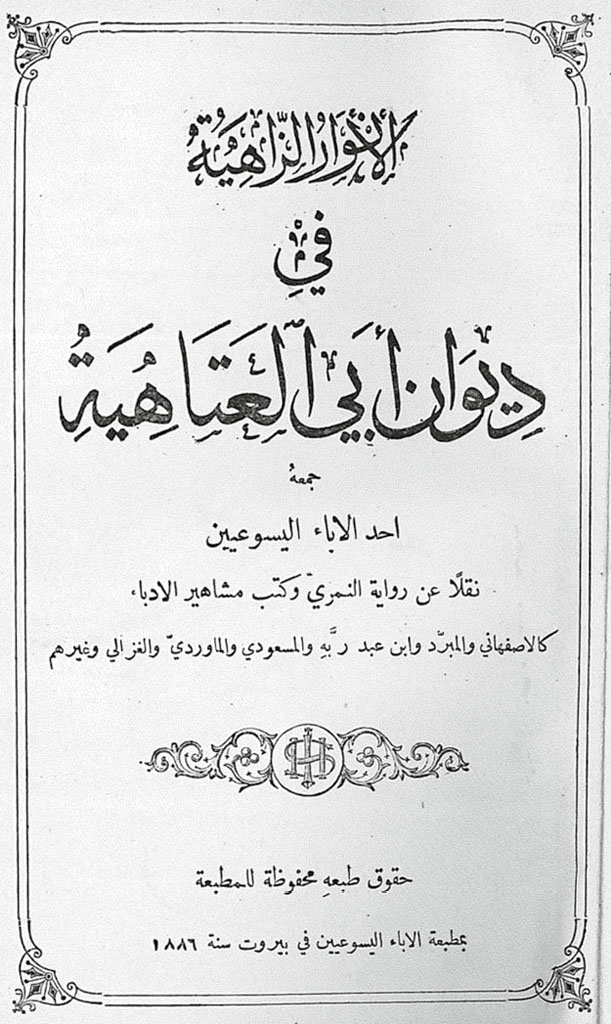
"Using the Jesuit scholar Louis Cheikho’s (d. 1927) work on pre-Islamic and early Islamic ascetic poetry as a focal point, this article examines two strategies which contemporary and later scholars accused Cheikho of using to falsify the Arabic literary heritage. He de-Islamized
Contemporary scholarship is no less historically contingent than nineteenth- and early-twentieth-century scholarship, and in many ways its heir."
"Louis Cheikho and the Christianization of Pre-Islamic and Early Islamic Ascetic Poetry" by Nora K. Schmid https://t.co/KPAYsCyz77
"Arabic Hot Metal: The Origins of the Mechanisation of Arabic Typography"
Read Titus Nemeth's 2018 investigation of the beginnings of Arabic typographic composition with typesetting machinery: https://t.co/fmxg1OHLyW
"The story of the collection is one of checkered growth and engagement, and of serendipitous development."
Read Kaoukab Chebaro & Jane Rodgers Siegel's 2020 essay: "A History of the Muslim World Manuscript Collection at the Columbia University Libraries": https://t.co/OHCaIld9XD
in the first rudiments of the modern study of myths (Mythosforschung). The invention of the Semites is to be placed at the crossroads of these disciplines."
From Céline Trautmann-Waller's "Semites and Semitism: From Philology to the Language of Myth" https://t.co/SBoAdOzZZX
"It may not be fortuitous that the terms “Semite” and “Semitic” were coined in Göttingen, as this central university of the German Enlightenment, played a major role in the emergence of modern Biblical criticism, in the definition of early forms of modern ethnology, and
saying: this great Egyptian scholar. All the poets, literati and journalists in Athens had come to see him.”"
From Umar Ryad's 2018 "“An Oriental Orientalist”: Aḥmad Zakī Pasha (1868-1934): Egyptian Statesman and Philologist in the Colonial Age" https://t.co/f4hL40Nh8T
"The Egyptian press followed Zakī Pasha’s encounters with orientalists with a degree of enthusiasm. For example, the Egyptian newspaper al-Muʾayyad described his visit to the Congress of Orientalists in Athens in 1912 as follows:
...authenticity and reliability. On this view, Indic civilization produced literati and scholars in great abundance, but no philologists."
Read more from Whitney Cox's 2017 monograph "Modes of Philology in Medieval South India" (Open Access)
https://t.co/DMnAzQhlpV
"Philology was everywhere and nowhere in premodern India, and this is a problem that demands the attention of anyone interested in the global history of this form of knowledge. That it was everywhere can be established by a broad set of criteria:...
philology (indeed, it lacked a word for it altogether) and, compared to other Eurasian culture-areas like Western Europe, the Arabic ecumene, or the Sinitic world, never witnessed any sort of crisis of textual knowledge which would issue into a set of general theory of textual..