“The president inhabits a position of moral leadership. When the president and his officials sell their policies, they’re selling a version of what it means to be an American”
I wrote about the Trump administration, the boat strikes, and St. Augustine.
Don't miss the first episode of the MWI Book Club, our newest podcast series! In this episode hosts John Amble and Theo Lipsky tackle "The Caine Mutiny," by Herman Wouk. https://t.co/yy1zC3V66T
@Tyler_A_Harper Since there’s also a Conrad discussion going on here, this came to mind reading your article, which I greatly enjoyed (though hopefully without becoming a Martin Decoud)
“Martin Decoud, the dilettante in life, imagined himself to derive an artistic pleasure from watching the picturesque extreme of wrong-headedness into which an honest, almost sacred, conviction may drive a man.”
Conrad, Nostromo
@PhilKlay@JoyceCarolOates “Droll thing life is -- that mysterious arrangement of merciless logic for a futile purpose. The most you can hope from it is some knowledge of yourself -- that comes too late -- a crop of inextinguishable regrets.”- Heart of Darkness
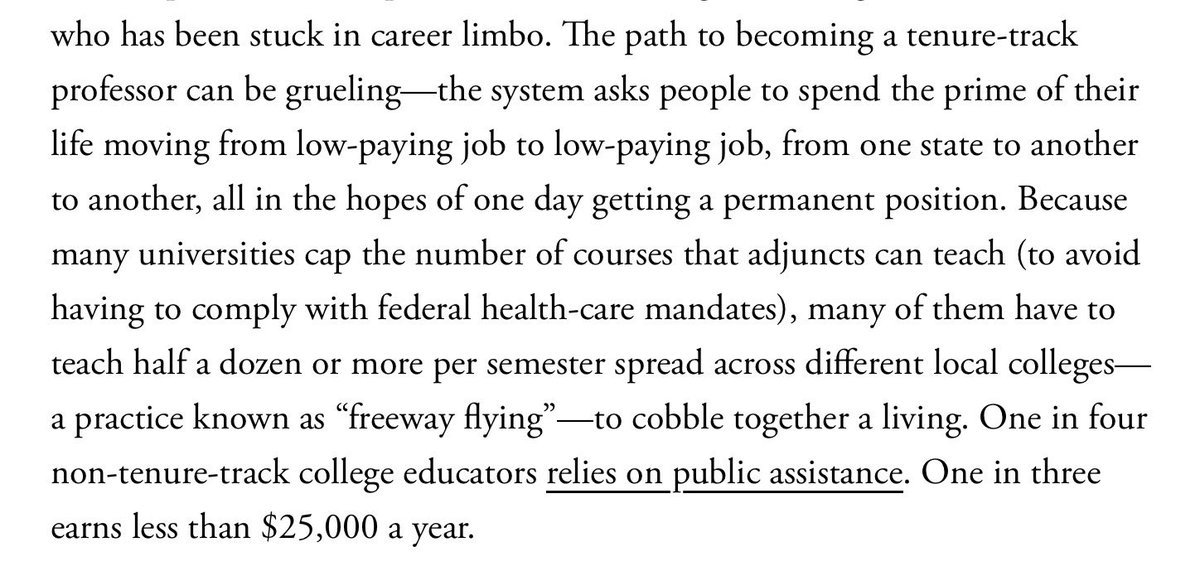
This is a story about a college lost down the rabbit hole of performative progressivism. But at its heart, it’s about labor exploitation, the hell we put contingent profs through, and how the collapse of the tenure-system paved the way for cowardice and pseudo-radical groupthink.
@JoyceCarolOates “But do you notice how, three hundred miles beyond the end of telegraph cables and mail-boat lines, the haggard utilitarian lies of our civilization wither and die...”
—Conrad, Lord Jim
A regular theme for him.
“It is not surprising that a professoriat disproportionately composed of contract workers would also be one that could be pressured into groupthink.”
@Tyler_A_Harper
.@Tyler_A_Harper landed his dream job, a tenure-track position at an elite liberal-arts college—but he found himself “being treated like a racial prop rather than a professor.” Read more in our newest cover story: https://t.co/8VU5VF1ysH
‘In a letter home, a month into the voyage, he described “a capital chap,” Polish, somewhat odd-looking, with “a fund of yarns on which I draw freely.” Galsworthy’s sister credited this encounter with turning him away from the law.’
I didn't know he'd fallen away, I tried to communicate his interest and importance here (different from what the Jasanoff's anti-metaphysical study claimed):
https://t.co/jVrcwTgsAZ
I didn't know he'd fallen away, I tried to communicate his interest and importance here (different from what the Jasanoff's anti-metaphysical study claimed):
https://t.co/jVrcwTgsAZ
On the contrary, Nostromo is very modern (as VS Pritchett recognized) and probably the first great novel of global capitalism.
I wrote about it for @EngelsbergIdeas earlier this year:
https://t.co/eg0eWtBA7K
@DAMendelsohnNYC@JoyceCarolOates “The changing wisdom of successive generations discards ideas, questions facts, demolishes theories. But the artist appeals to that part of our being which is not dependent on wisdom; to that in us which is a gift and not an acquisition—and, therefore, more permanently enduring.”
It seems impossible that Joseph Conrad, now so fallen out of favor, was once so central to early modernist literature in English. This newly reissued edition of “Nostromo” (1904) evokes bittersweet memories of a time when I’d taught this demanding novel to undergraduates.
@JoyceCarolOates Conrad wrote indisputably racist scenes and yet is also incredibly insightful on race, empire, and the blindness and horror caused by our unfamiliarity and prejudice.
@JoyceCarolOates For that aspect of “the horror of being, in others' eyes, unclean, the Other,” I always think of his great story, Amy Foster, where the Polish language, Conrad’s native tongue, turns a sick man from husband to incomprehensible horror in the eyes of his wife.
@AODonnellAngela “I saw you approach
my empty house
not as one man, but as a landscape
repeating along the walls of every room
papering over the cracked grief.”
Oh my.
“The priest stopped what he was doing, cast himself down, made himself transparent, broke himself open. That is, prayed.”
—Louise Erdrich, Last Report on the Miracles at Little No Horse