CalMatters found a genuinely indefensible online course in the California Community Colleges: decade-old recorded lectures, multiple-choice quizzes, and the professor handing students the answers before the test. They're right to be appalled. So am I.
But then the article does something the evidence doesn't support — it extrapolates that one bad course across a system where 40% of courses are now online, as if the modality were the diagnosis.
It isn't. Bad course design is bad in any modality. The variable that actually predicts course quality is not online vs. in-person — it's whether a campus chose to invest in quality. And the system's own 2024 POCR Landscape Report already documents both halves of that story: where peer course review is applied, success rates rise (12% at Chaffey, with the same faculty pre/post) — but the process is optional and unevenly funded, which is exactly how a course like the one CalMatters found still slips through.
None of that infrastructure — the course-design rubric, POCR, the data showing the online/face-to-face performance gap nearly closed — made it into the article. It wasn't hard to find. It just didn't fit the story.
My full breakdown, including what the current and former CVC executive directors told me on the record:
https://t.co/71076kGRNA
I've spent a lot of words on what's wrong with the federal earnings-premium accountability rules. Stale data, blunt instruments, measurement that doesn't measure what it claims to. I haven't changed my mind about any of it.
But this morning Patrick Methvin of the Gates Foundation made the case for why we need accountability anyway — and he's right. So I wrote the half I've covered too little.
My daughter Betsy finished an associate degree in diagnostic medical sonography a year ago. In-demand field, hard program, real work. Nearly 200 applications later, she still doesn't have the job she trained for. Neither do most of the people she graduated with.
The reason isn't her. Phoenix has three sonography programs feeding more graduates into the metro than it can hire. And almost no one is accountable for matching how many students a program enrolls to what a real, local labor market can actually absorb.
That's the dimension the national earnings debate keeps missing. Accountability isn't a formula — it's a school owning what happens to the people it enrolled.
A flawed instrument is an argument for a better one, not for no instrument. Worth doing, and worth doing right.
Betsy isn't the point. She's just the window.
👉 https://t.co/ZTik0UJzNB
Most of the opposition to the Do No Harm earnings accountability rule is arguing about something Congress already settled.
Of the 8,719 public comments in the AHEAD docket (as of today), 83% reject the rule outright—defending cosmetology, massage, allied health, or another sector. But the framework itself is now statutory, codified through OBBB. ED can't withdraw a statutory requirement in response to public pressure, and litigation against the underlying law faces a much higher bar than litigation against regulatory choices.
The comments that will actually matter—the ones ED's lawyers are reading carefully and that will surface in the inevitable court challenge—include a small cluster of filings (McGuireWoods, AACS, Aveda Institutes Cooperative, Association of Chiropractic Colleges) arguing that ED lacks statutory authority to extend earnings-premium accountability to undergraduate certificate programs. One of them is meaningfully cleaner than the others, because it uses OBBB itself as the limiting statute rather than relitigating older HEA text.
Other findings from the AI-enabled classification of all 8,719 comments:
→ Career-school operators filed 35% of comments directly; roughly half the docket came from the regulated industry or its direct representatives
→ Only 1.5% of comments are purely pro-rule
→ The citizen voice is mostly genuine—1.8% of citizen comments use coordinated industry talking points, vs. 6.7% on the operator side
→ Total cost of the analysis: $9.68 in API spend plus about seven hours of work, on tools that didn't exist six months ago
Full post—who filed, what they said, which arguments will shape the final rule, plus methodology and four charts: https://t.co/aFpDckvPws
I suggest that all newsletter writers take the rest of the day or week off in honor of @neilmosley5 's gem of a paragraph today.
"Those looking for a singular, simple reason to explain the growing number of partnerships coming to an end will be disappointed. There are a range of factors at play. Some OPM critics, including small pseudo-religious sects that seem to live out their days in a simplistic, angsty, Manichean la la land, will point to company performance and how the “evil” private sector is leeching off higher education whilst simultaneously not delivering, and the sector is getting wise to it. However, while they build their plastic populist personas on whatever slightly naff Twitter substitute is currently popular, the complex, nuanced, real world spins around them."
We cannot top that.
https://t.co/5dqb18eaMi
Instructure took a meaningful step forward this weekend in its response to the Canvas cybersecurity incident.
CEO Steve Daly issued a direct, named apology. The company added more substance to its Incident Update page. It disclosed the Free-For-Teacher root cause and named CrowdStrike as part of the response.
Those are real improvements.
But the response still has a deeper problem: Instructure is describing this as a platform security incident, while its customers are experiencing it as an academic continuity event.
Canvas is not just another enterprise system. It is where students get assignments, submit work, access grades, prepare for finals, and communicate with instructors. When Canvas is unavailable, defaced, or tied to exposed messages and identifying information—especially during finals week—the impact is not merely “inconvenience and concern.”
It hits the core academic operations of institutions.
That distinction matters. Academic leaders from universities including Illinois, Chicago, and ASU have been announcing canceled or delayed finals. Higher ed trade press is still being deflected to static statements. Direct questions about ransom payment are going unanswered. The scale of the breach and end-of-term disruption has not been fully acknowledged by the company at the center of it.
There is also a transparency issue. Instructure’s Incident Update page carries a noindex directive, meaning the company has published a public page while signaling search engines not to include it in search results. That may be technically defensible for a live operational page, but it is much harder to defend for the central public source during an active incident, when customers, students, parents, reporters, and institutional stakeholders are searching for authoritative information.
The point is not that Instructure has done nothing right. It has. The point is that the form of the response is improving faster than the substance.
Canvas built its market position in the 2010s on openness, customer alignment, and trust. That posture is not yet visible enough in Instructure’s response to this incident.
One step forward. One step back.
I wrote more in today’s On EdTech post: https://t.co/HkkrVCTzwm
New podcast episode:
"In this bonus episode recorded live at the @CollegisEdu DisruptED summit in Phoenix, Dustin Ramsdell spoke with me and Charlie Rose about the rapidly shifting higher education policy landscape and its implications for institutions. They unpack how recent federal actions—particularly new legislation and accelerated rulemaking—are creating both urgency and uncertainty, while also signaling a longer-term shift toward accountability, affordability, and measurable student outcomes."
https://t.co/AcMgyaRB9e
New post at On EdTech:
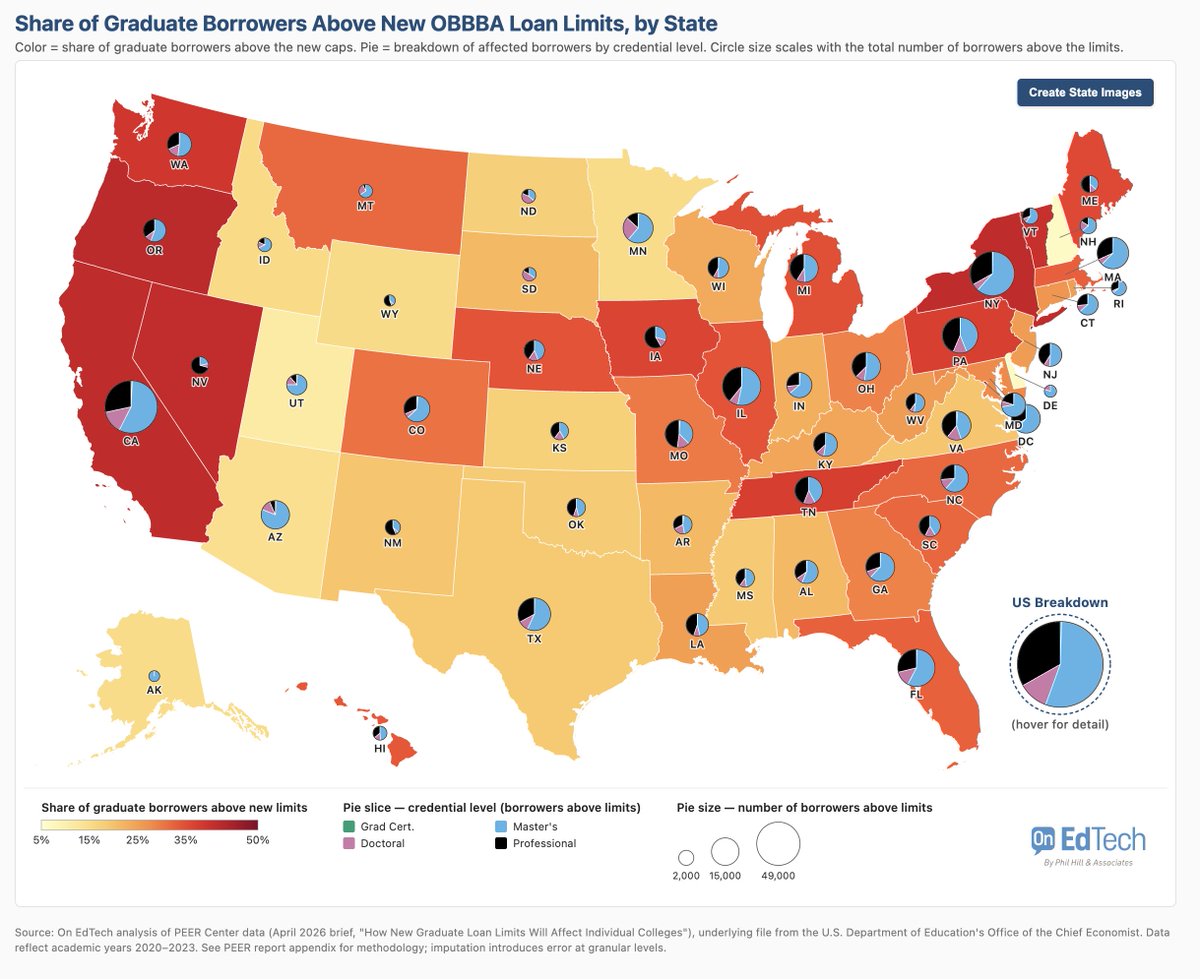
The new graduate loan caps are being discussed as a federal finance policy issue. That is true, but it is also incomplete.
Using data from PEER Center’s new report, I created a set of visualizations to show a point that is hard to grasp from tables alone: the impact will not hit evenly. At California, Oregon, New York, Nevada, and Vermont institutions, more than 40% of graduate borrowers already borrow above the new OBBBA loan caps. In Arizona, Delaware, New Hampshire, and Utah, the share is 15% or lower.
The geography matters, but it is not the whole story. What the data really suggest is a geography-plus-program-portfolio problem. Professional programs such as medicine, law, and dentistry face one kind of pressure, while MBA, nursing, social work, PT, and physician assistant programs face another. Same federal law, very different local consequences.
I also included a downloadable PDF with all 52 images (50 states + DC + US view) for anyone who wants to explore the state-level patterns more directly.
The post is here: https://t.co/LDTjzDy4dt
Incoming Blackboard CEO, Matthew Pittinsky, will take the stage at @asugsvsummit to discuss "The Higher Education Learning Platform at 30: The End of the Beginning or The Beginning of the End?"
Matthew will weigh in on the big question on everyone's mind: what’s next for learning platforms in the age of AI?
Be sure to attend this engaging session moderated by @PhilOnEdTech.
📆 April 14
🕑 2:00 p.m.
🔗 https://t.co/enNKApz5rm
#ASUGSVsummit #AiInEducation #LMS
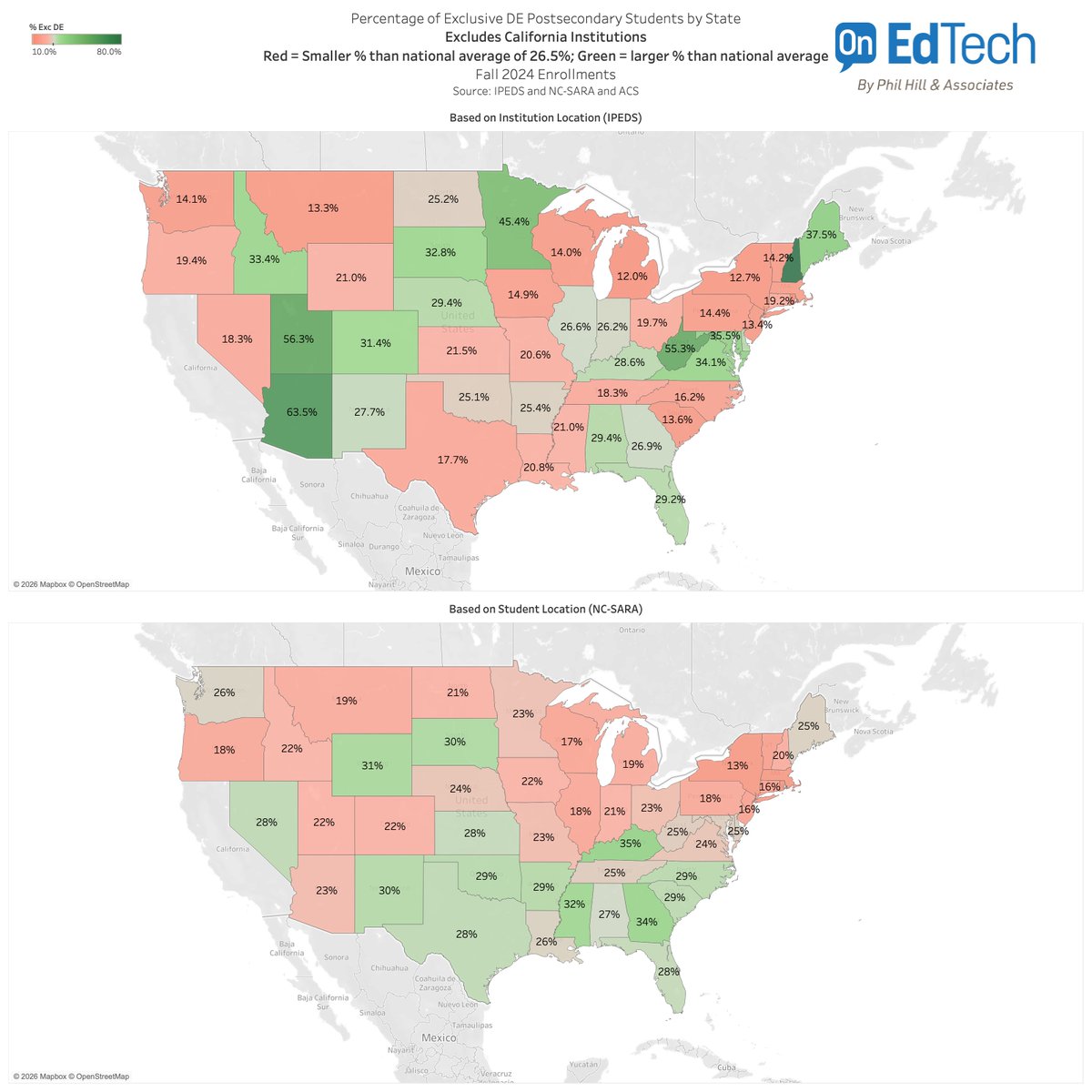
With the talk of anytime-anywhere access from online education, there is often an assumption that location doesn't matter. The competing view is an overly-simplistic view that students-choose-local.
The data say otherwise.
In this post, I take a closer look at where online students actually come from—and the patterns don’t match the mantras that too often enter EdTech discussions. Even in fully online programs, institutions show very different geographic realities: some operate at national scale, others extend regionally, and many still serve primarily local demand.
That leads to a more interesting takeaway:
Online education isn’t replacing local markets.
In many cases, it’s reinforcing them.
This matters for how institutions think about:
Enrollment strategy
Competition (who they’re actually competing against)
And policy frameworks that assume programs are interchangeable across regions
It also can raise bigger questions:
Are we designing accountability and ROI metrics based on a model of online education that doesn’t really exist?
This is an early look—more to come—but the goal is to challenge some core assumptions and put better questions on the table.
Full post: https://t.co/rEsOuD8yUr
Earnings data are now driving federal higher-ed policy. But are we measuring what we think we’re measuring?
The new OBBB accountability rules treat post-graduation earnings as a direct proxy for program and institutional quality. Miss the threshold → risk losing access to federal student loans.
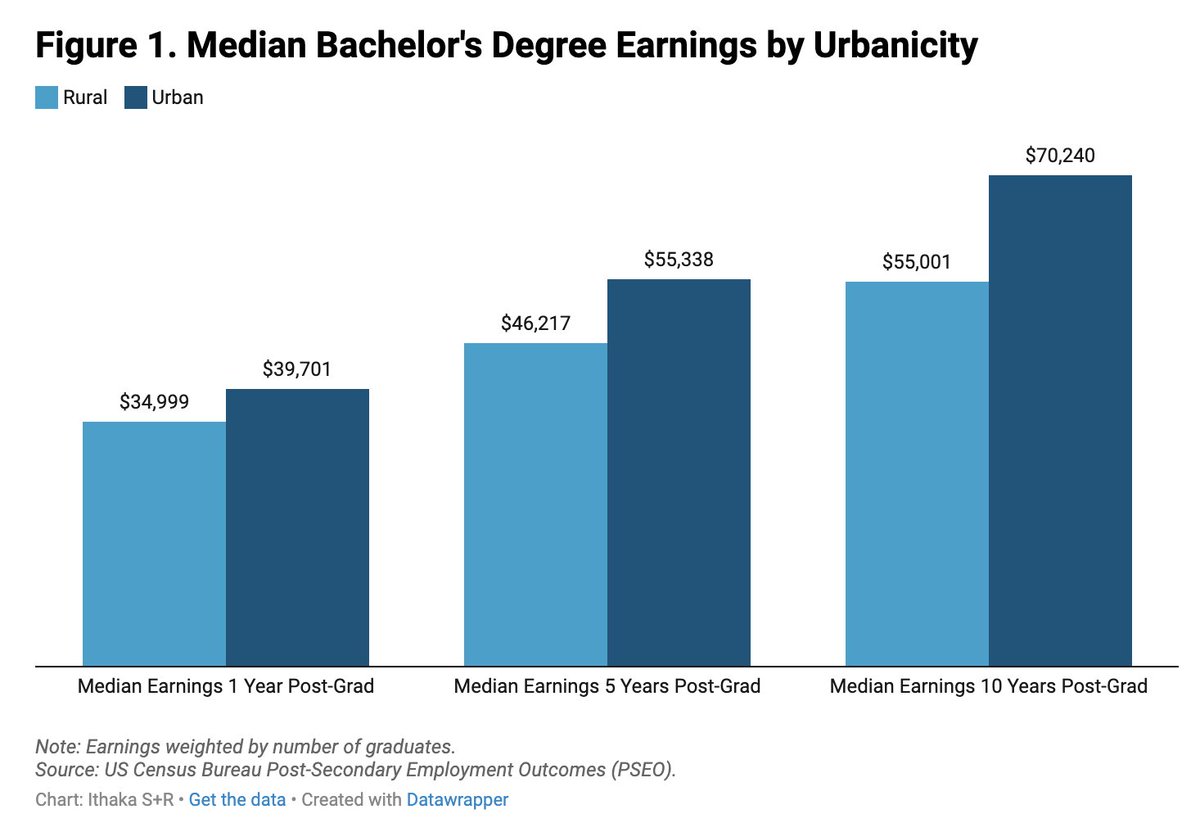
Recent research from Ithaka S&R (focused on South Carolina, but the dynamics apply nationwide) shows why this is more problematic than it first appears: graduate earnings are shaped far more by labor markets, geography, occupational pathways, and time than by anything colleges directly control.
We are not measuring institutional quality.
We are measuring systems—and then blaming or rewarding colleges for the results.
Rural institutions serving rural students, high-variance fields that drive innovation, and socially vital low-floor programs all get penalized under this logic. The policy risks exactly the distortions it claims to prevent.
@morganmundum unpacks the data in this week’s On EdTech (with clear charts and a revealing industry-concentration table). It’s the clearest explanation I’ve seen of why refining the earnings metric won’t fix the underlying problem—we’re still measuring the wrong thing.
→ Full post here: https://t.co/RBk7bCAX5V
#HigherEd #EdPolicy #Accountability #WorkforceOutcomes #OBBB
AI is already changing how software gets built.
But does that mean EdTech vendors—and SaaS in general—are about to become irrelevant?
A reader pushed me to react to a “SaaS apocalypse” argument making the rounds. The core claim: if AI can generate software cheaply, the economic case for proprietary platforms collapses and we will see open source as the winning approach.
There’s something real here. AI is dramatically lowering the cost and speed of writing code. Open source communities in EdTech, in particular, should take notice.
But the conclusion goes too far.
Writing code is not the same as delivering a software service.
Universities don’t pay EdTech vendors just for features. They pay for security, compliance, integrations, uptime, and ongoing updates—what it takes to support learning at institutional scale. AI may accelerate development, but it doesn’t remove the operational burden.
If anything, it raises the stakes.
In this post, I break down:
• Where the “AI changes everything” argument has merit
• Why the SaaS model isn’t going away
• What this shift really means for LMS providers and open source
Bottom line: AI changes the economics of creation—but not the need for trusted, managed services.
https://t.co/M0JAmx8Cth
The emerging reality of OB3 accountability:
For many academic programs, by the time the first official Do No Harm earnings metrics arrive, it will already be too late to use them as a meaningful guide for improvement.
Why? Because the early rounds of accountability are not really judging behavior shaped by the new policy. They are judging historical cohorts that enrolled years before the earnings-premium metric even existed. For a 1-year certificate, the lag is roughly 6-7 years. For bachelor’s programs, it stretches close to a decade.
That means the near-term effect is less “improve and respond” and more delayed penalty system. Programs may be sanctioned based on student cohorts admitted long before institutions had any way to understand the rules of the game.
I walk through the timeline and explain why this matters for colleges trying to plan under the new accountability regime.
Read the full post: https://t.co/lfRlMasAyP
#HigherEd #EdPolicy #FinancialAid #HigherEducation
We often talk about online higher education as if it’s a single, borderless market.
The data suggest otherwise.
In my latest analysis using NC-SARA distance education data, I flipped the usual perspective. Instead of asking where students go, I looked at where institutions get their students.
The result: very different geographic strategies—even among the largest online providers.
A few examples:
* Western Governors University draws students from across the country, with only ~5% from its home state
* Georgia Tech’s online programs (starting with the Udacity MSCS) have built a strong national footprint, especially in large tech-heavy states
* Lone Star College System is almost entirely in-state, with ~98% of students coming from Texas
Same modality (online). Completely different markets.
For those who have seen NC-SARA data before, this is a different way to visualize it. For those who haven’t, it’s a reminder that geography still matters—even in online education.
The post includes interactive-style visualizations and a breakdown of three common patterns across institutions.
👉 https://t.co/mxmWa3nLJe
Over the next few years, many higher education leaders are going to encounter a surprising policy outcome.
Programs that increase student earnings will fail federal accountability metrics.
When that happens, the first reaction will be: the data must be wrong.
But in many cases the data will be doing exactly what the policy requires.
The real issue is that the concept people believe the policy measures is not the same as what the metric actually measures.
I tried to explain this gap using one annotated chart from a recent Urban Institute report.
The chart shows programs where students clearly earn more after completing the program.
Yet some of those same programs would likely fail the new federal earnings premium accountability test.
Why?
Because the policy compares program graduates to a statewide median of high school graduates, not to students’ own pre-enrollment earnings.
That difference may sound technical, but it’s going to produce results that surprise a lot of institutional leaders over the next several years.
I walk through the issue in a new On EdTech post and use the annotated figure to explain the concept vs. reality gap.
Full Article:
https://t.co/AuXt1NJZ27
Blackboard has officially emerged from bankruptcy.
The five-month Chapter 11 process went largely according to plan. The company is now essentially debt-free, backed by $70 million in new financing, and controlled by Nexus and Oaktree. Matt Pittinsky is set to return as CEO once his non-compete obligations expire.
If you’ve been reading On EdTech over the past 14 months, none of this should be surprising.
We covered:
• The early signs of financial strain
• The shift from PR optimism to creditor control
• Nexus and Oaktree positioning in the debt process
• The Pittinsky return
The financial reset is complete.
The strategic reset is still to come.
One real test will be Blackboard's Users Conference in July — when we’ll get the first visible read on product direction, sales posture, and whether this is stabilization or repositioning in the LMS market.
Full analysis here: https://t.co/E80MTCNDf8
#HigherEd #EdTech #LMS #Blackboard #PrivateEquity
@beehiiv Thanks for the quick work. Please make sure in your investigation to address the outages on Feb 18 & 23 and if they're related. But great response today!
Online learning isn’t as location-agnostic as we often assume.
I just published a new post looking at the regionality of online learning—specifically, how student location, institutional geography, and local labor markets still shape outcomes, even in a modality designed to transcend place.
This is very much an initial view, not the final word. The goal is to surface patterns, ask better questions, and flag where common assumptions start to break down—especially as accountability, earnings metrics, and policy frameworks increasingly treat online programs as interchangeable across regions.
There’s a lot more work to do here. In upcoming On EdTech+ posts, I’ll dig deeper into:
* More granular regional breakdowns
* Stronger causal framing
* And analysis that’s directly usable for institutional leaders and policymakers
For now, this post is about setting the table and showing why geography still matters—even online.
👉 Read the post: https://t.co/NsihPltQJa