Get it right with the soil, and get it right with the seed
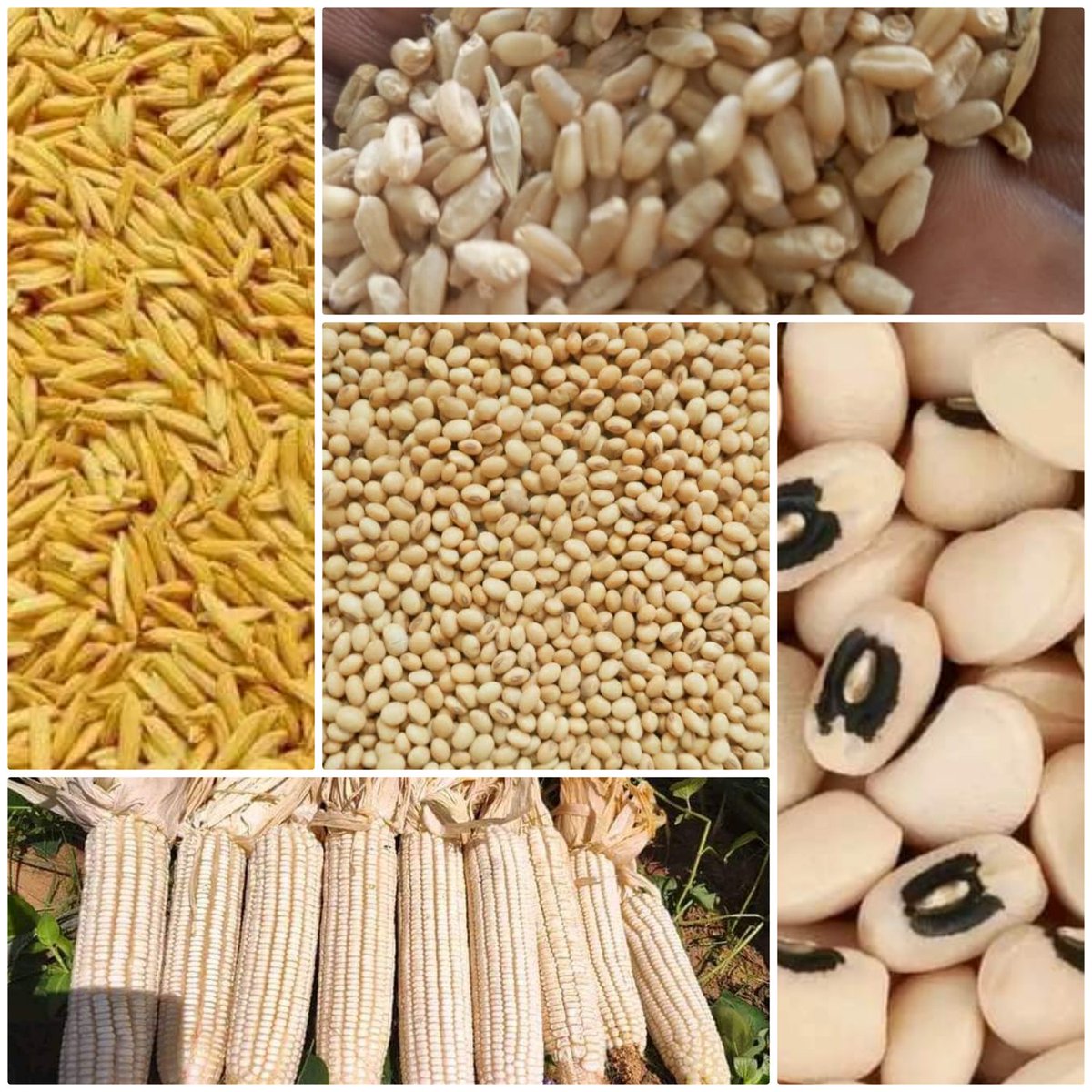
We offer a range of high-performance seeds, carefully selected for optimal yields and best suited to the ecology:
-Maize:Sammaz 52 (#1700/kg)
-Maize:Sammaz 15 (#1700/kg)
-Rice: Faro 44 (#1700/kg)
-Rice: Faro 59(#1700/kg)
No 1 rule on my farm is
under no circumstance must you smoke or use any form of hard drugs,
If you allow this behavior not only are you exposing your farm to the risk of fire due to workers smoking randomly anywhere on the farm.
You are also breeding addicts on your farm and guess what a lot of addicts do when they don’t have money to buy drugs.
They steal,yes they steal and they will start from your farm and expand it to the neighboring farms and houses.
So stop allowing your workers use hard drugs just because it makes them work harder
Bismillah
What has been mentioned about Idrees(AS)
Allah, Most High, praises Idrees directly in the Qur'an. He says:
"And mention in the Book (the Qur'an) Idrees. Verily, he was a man of truth (and) a Prophet and We raised him to a high station."
~ Suratul Maryam, Q19 v 56-57.
That's Allah Himself attesting to both his truthfulness and his Prophethood.
Idrees was a direct ancestor of the Messenger of Allah ﷺ. More than one scholar of genealogy confirmed this. He was the first of Adam's descendants to be granted Prophethood after Adam and Sheeth.
Ibn Ishaaq said he was the first person to ever write with a pen. The very act of writing, something every civilization came to depend on, traces its roots to a Prophet.
He lived for three hundred and eight years of Adam's lifetime.
A group of scholars identified Idrees as the Prophet referred to in the hadeeth narrated by Mu'awiyah Ibn Al-Hakam As-Sulami. He asked the Messenger of Allah ﷺ about writing in the sand, and the Prophet ﷺ replied: "There was a Prophet who wrote in the sand, so if they do it as he did, that is permissible." This was narrated by Muslim (537), Abu Dawood (930), An-Nasa'i (1218), and Ahmad (23255).
Now, about the Qur'anic phrase — "We raised him to a high station." What does that actually mean? The authentic narration in the Saheehain answers it. Al-Bukhari (3207) and Muslim (162) both record it in the hadeeth of Al-Isra': the Messenger of Allah ﷺ met Idrees in the fourth heaven during the Night Journey.
That's the agreed-upon, authenticated position.
Al-'Awfi reported from Abdullah Ibn 'Abbas that Idrees was raised to the sixth heaven and died there. Ad-Dahhak said the same. But the hadeeth placing him in the fourth heaven, narrated by both Al-Bukhari and Muslim, is more correct.
Some scholars claimed Idrees didn't actually live before Nooh. Their argument? That he lived during the time of the Children of Isra'eel. It's a minority position and a contested one.
Al-Bukhari mentioned — in a mu'allaq form (a form of narration where one or more narrators are omitted from the beginning of a chain of transmission, Isnād) in the Book of the Ahadeeth of the Prophets — that both Abdullah Ibn Mas'ood and Abdullah Ibn 'Abbas held that Ilyas (Elias) was Idrees.
These scholars drew evidence from the hadeeth of Adh-Dhuhri, on the authority of Anas, about Al-Isra'. When the Prophet ﷺ passed by Idrees in the heavens, Idrees said: "Welcome, pious brother and pious Prophet!" He didn't say "Welcome, pious Prophet and son" — the way Adam and Ibraheem had said it to the Prophet ﷺ.
Their reasoning: if Idrees were a direct descendant, he would've said what the fathers said. Ibn Katheer doesn't just accept that though. He pushes back. It's possible the narrator didn't recall the exact wording. Or Idrees may have said it out of humility, not addressing him as a father the way Adam — father of all mankind — and Ibraheem — the Khaleel of Allah, one of the Ulul-'Azm — did.
The Ulul-'Azm, as Abdullah Ibn 'Abbas explained, are the Possessors of Resoluteness and Patience. They are Prophets Nooh, Ibraheem, Moosa, 'Eesa, and Muhammad ﷺ. The greatest of them being Muhammad ﷺ.
The ambiguity around Idrees doesn't undermine his station. Allah praised him. The Prophet ﷺ met him. He was raised up. That's suffices.
We ask Allah to grant us beneficial knowledge, pure provision, and accepted deeds.
THE DAY A SIMPLE RECOMMENDATION BROUGHT ME ₦1.3 MILLION
It was a very hot afternoon.
I was in my small room, lying on the bed and listening to music when my phone rang.
The caller introduced himself as a Project Manager for a major sesame cultivation project in one of the North Central states.
"Hey Esude 007, I am one of your followers on Nairaland. I love the work you are doing."
My head immediately swelled.
There is something special about hearing that your work is helping people. It gives you the motivation to keep going.
We exchanged greetings and he proceeded to ask me several questions about sesame production.
After a long discussion, he surprised me.
"Can you come and manage 1,000 hectares of sesame out of our proposed 10,000-hectare project?"
I politely declined the offer.
Why I rejected that opportunity is a story for another day.
Then he asked another question.
"Can you recommend a sesame variety that can consistently produce between 1 and 1.1 tons per hectare?"
He went on to explain that they were expecting some improved seed from China the following year that could potentially yield between 2 and 3 tons per hectare.
I was amazed.
At that time, many farmers in Nigeria were celebrating yields close to 1 ton per hectare. Hearing about varieties capable of producing two to three times that amount showed me the level of agricultural advancement taking place in countries like China.
I gave him all the information he needed and linked him directly to the breeder of the improved sesame variety.
They discussed, negotiated and concluded the transaction.
To me, it was just another day of helping people solve agricultural problems.
About an hour later, my phone rang.
It was the breeder.
"Mr. Esude, please send me your account number."
I laughed.
I thought he wanted to send the usual appreciation money people give for referrals.
A few minutes later, my phone beeped.
₦1,300,000 credited.
I checked it again.
And again.
And again.
My body suddenly became hotter than the afternoon sun outside.
I stood up from the bed immediately.
My first thought was:
"Na only me dey this room?"
The second thought was:
"Me wey just wan go buy cold Nono for Kano Road now now?"
The third thought was:
"So na so people dey take make money?"
That day taught me a lesson I will never forget.
Knowledge pays.
Relationships pay.
Visibility pays.
Showing up consistently pays.
The opportunities that change your life often come from places you least expect.
That man never met me physically.
He only knew me because I consistently shared agricultural knowledge online.
From that day, I intensified my learning process.
I became more serious with my online presence.
Because I realized that every post, every comment, every article and every video is a seed.
And one day, one of those seeds can produce a harvest bigger than you ever imagined.
My advice to young people is simple:
You can make money from almost anything.
Your knowledge.
Your experience.
Your network.
Your reputation.
Just keep showing up.
Keep learning.
Keep sharing value.
Keep taking your work seriously.
The world rewards people who consistently solve problems.
One phone call can change everything.
® Umaru Ezekiel
#CropProduction
#recommendation
The recent news that Nigeria has been listed among countries facing possible new U.S. tariffs over concerns related to forced labour has generated strong reactions.
Some people immediately concluded that America is targeting Nigeria because our economy is growing.
Others dismissed it entirely as another Western attack on developing countries.
The truth is more complicated.
And if you're involved in agriculture, exports, or business, this is a conversation worth understanding properly.
First, let's clarify what the U.S. is actually saying.
The allegation is not that Nigerian exports are produced by slaves.
The issue is that the United States believes many countries, including Nigeria, do not have sufficiently strong systems to prevent goods linked to forced labour from entering supply chains.
In simple terms, the U.S. wants countries to be able to answer questions such as:
- Who produced this product?
- Under what conditions was it produced?
- Was the worker fairly treated?
- Was child labour involved?
- Can the exporter prove where the product came from?
This is less about the product itself and more about the ability to verify how that product was made.
Many people see this purely as a human rights issue.
But there is also an economic side.
American businesses argue that when workers in some countries are paid extremely low wages or work under poor conditions, producers in those countries can sell products more cheaply than competitors operating under stricter labour standards.
From that perspective, the argument is about creating a more level playing field.
Whether you agree with that argument or not, it is increasingly influencing global trade policy.
Now let's talk about a difficult reality.
Nigeria may not have widespread forced labour in the way many people imagine it.
However, we do have something that is impossible to ignore: cheap labour.
Across many sectors, millions of Nigerians work long hours for wages that barely cover basic living expenses.
Young people often accept poor working conditions because jobs are scarce.
Farm workers frequently perform physically demanding labour for very low pay.
Some workers have no formal contracts.
Others experience salary delays, arbitrary deductions, or wage reductions.
Many employees have heard statements like:
"Be grateful you even have a job."
Some business owners use unemployment as leverage.
Workers are sometimes emotionally pressured into accepting poor treatment because they know replacement workers are readily available.
Again, this is not automatically forced labour under international law.
But it highlights a labour market where workers often have very little bargaining power.
And that is exactly the type of environment that attracts increasing scrutiny from international buyers and regulators.
This is especially important for agriculture.
Nigeria exports products such as:
- Cocoa
- Sesame
- Cashew
- Ginger
- Hibiscus
- Shea products
When these commodities enter international markets, buyers are asking more questions than ever before.
They are no longer satisfied with simply knowing the quantity available.
They want evidence.
They want traceability.
They want documentation.
They want proof that workers were not exploited.
They want proof that children were not used in production.
They want proof that supply chains meet certain standards.
This trend is not limited to the United States.
Europe is moving in the same direction.
Major food companies, chocolate manufacturers, retailers, and commodity buyers are increasingly demanding transparency throughout their supply chains.
That is why the proposed tariff should not be viewed only as a tariff story.
It is really a supply-chain story.
It is a labour story.
It is a compliance story.
And it is a warning about the future of international trade.
I remember we were talking about terminating pregnancy some days ago. Now, let’s ask ourselves: is Down Syndrome a legitimate reason to terminate a pregnancy?
For us to understand the position of Islam, we first need to understand that deformity is not just one blanket category. The Islamic law looks at abnormalities differently based on how severe they are and how they impact life.
The first category covers defects that are minor or correctable, such as a cleft lip, an extra finger, or a clubfoot. These are things modern medicine can easily fix or manage, and they do not threaten the child's life.
The second category covers conditions that are completely incompatible with life. This means gross abnormalities, e.g: a fetus missing a major part of the brain or skull, where doctors know the child has zero chance of survival after birth or will face immediate, excruciating medical agony.
Then we have the category of general genetic conditions, which is exactly where Down syndrome sits.
With Down syndrome, there is a physical or intellectual disability, however, the individual can still live, breathe, experience joy, and survive with the right care and family support. It is a lifelong challenge, but it is not a terminal deformity that makes life impossible.
Now that we know where Down Syndrome falls, what does the rule says:
First of all, as far as terminating pregnancy is concern in Islam, the timing is everything. And the major boundary is 120 days from conception. This is the point where the soul is blown into the fetus.
Before 120 days, major juristic councils, such as the Islamic Fiqh Council of the Muslim World League, do permit a concession for termination under strict medical duress.
If a panel of trustworthy, expert doctors confirms that a fetus falls into that severe category of being incompatible with life, or faces extreme, continuous medical agony, a concession is granted.
Because of the anticipated severe hardship on families, many contemporary scholars allow Down syndrome to fall under this early window, but ONLY if it is proven by specialized experts before the 120-day deadline.
But once you cross the 120-day mark, the door closes completely. The fetus is now a full human soul with an absolute right to life.
After that threshold, terminating a pregnancy for Down syndrome, or ANY deformity, is strictly haram. It is viewed as a direct transgression against a living soul. The only exception that overrides the law after 120 days is if keeping the pregnancy will literally kill the mother.
As for the minor or correctable deformities, it is strictly haram to abort them at ANY stage, even before 120 days. You cannot terminate a life over something that can be managed.
Islam does not allow abortion based on the secular idea of my body-my choice, financial fear, or lifestyle disruption. Islam understands the boundary so we do not turn a medical mercy into an excuse for convenience or eugenics.
Allah knows best.
Imam al-Ghazali in his great book Ihya’ Ulum al-Din described six types of women we MUST not marry as men if we want to live a good married life. This Gen-Z wife matches two out of the six: Al-Ananatu and Al-Baraqatu.
This Gen-Z wife is the perfect example of Ananatu. A woman who finds the natural responsibilities of marriage to be an undue burden and constantly voices her reluctance to fulfill them.
On the other end, she mirrors Al-Baraqatu. A woman who spends all her time grooming herself to an obsessive degree. Also, the one who shows anger and act superior over her husband. He has to wash my clothes yen yen yen 😂😂
May we not make mistake of marrying them in our lives 🙏🙏😩
Some Local Markets to Purchase Agricultural Commodities and Supply Companies in Nigeria
1. Hadejia Market, Jigawa State – paddy Rice, wheat, sesame seed, hibiscus, fish, and beans.
2. Gujungu Market, Jigawa State – Grains, sesame seed, hibiscus, livestock.
#Agriculture