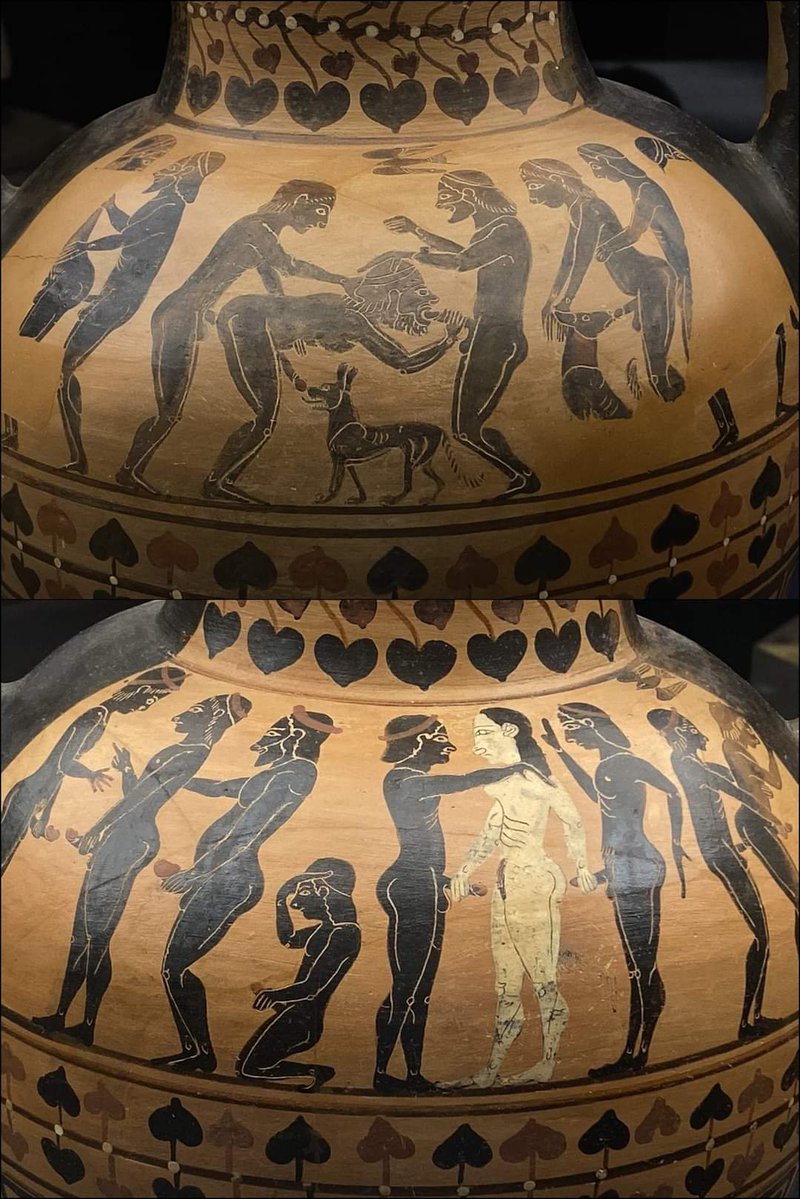
A 6th Century BC, Etruscan black-figure amphora, depicting mythological or genre scenes with explicit human interactions and animals. Housed in the Aula Ottagona (part of the Baths of Diocletian/Museo Nazionale Romano) - Rome 🇮🇹
. . . .
In 6th Century BC, Etruscans left frescoes in Tarquinia, Lazio depicting men engaging in anal sex, and the Ancient Greeks had imported their same-sex relations–a form of civil education for young men–to their colonies in south Italy....
There are several Etruscan artifacts depicting homoerotic scenes such as naked athletes excercising, symposiums and even dances with satyrs and maenads. There’s no shortage of classical images such as Hercules, Apollo, Hermes and other mythical characters linked to LGBTQ+ culture.
One of earliest examples of Etruscan art on homosexuality, found in 1892 in Necropolis of Monterozzi near Tarquinia. The painting, situated in what has been called Tomb of the Bulls (Tomba dei Tori), depicts on the right a bull with a man's face (Acheloos) and an erect phallus that is aggressively approaching two men having sexual intercourse. On the left, another bull is turned around, as though indifferent, in front of men and women having sexual intercourse. The women are consistently depicted in light tones, while the men are brown. Under the frieze is Achilles (on left) waylaying Troilus. This representation is the only one in archaic Tarquinian parietal painting representing a scene derived from Greek mythology; it used the legend about the bisexuality of Achilles to demonstrate that, among the Greeks, same-sex love was a common and ordinary fact. This shows how, even then, homosexuality could be a worthwhile topic in the conflict between populations. Below is the tree of life, full of leaves, linked by the sash of life with the skeletal tree of death, with black festoon of death hanging from branch. The onomastic inscription in the centre of the upper frieze names he who probably was owner of the tomb: Aranth Suprianas.
The Infernal Quadriga of Sarteano is one of the most incredible finds of Etruscan art in the last 20 years. Discovery was only made in 2003 and brought light to a tomb dug into travertine at a depth of 5m and decorated with an exceptional pictorial sequence that doesn’t seem to have been affected by time.
When entering tomb, you immediately recognise quadriga led by demon of death, Charun, the Etruscan equivalent of Charon. A few steps ahead, however, you find yourself in front of a painting that leaves little to the imagination, a male couple, most likely deceased, lovingly exchanging an eternal embrace. Scholars haven’t yet established whether this is a father-son relationship, but the tender and loving embrace makes many people believe that this is a couple in love.
Visits to the Quadriga Infernale are limited to preserve the fragile beauty of the site and can be booked by following the instructions on the Archaeological Museum of Sarteano website. Alternatively, you can admire the reproduction of the tomb made in 2009, located on the lower floor of the Sarteano museum.
Another place not to be missed is the Archaeological Museum of Chianciano Terme. The museum is housed in a former 19th-century granary and boasts the world’s most famous collection of Etrustcan canopic jars. The museum has four floors where it is possible to admire artefacts, reconstructions and grave goods useful for understanding this mysterious civilisation. There are also votive sculptures for the gods dear to the culture of the LGBTQ+ community. Among these is the face of Tinia from the Etruscan Temple of Fucoli, dating from the 2nd century BC. Tinia was an Etruscan god equivalent to Zeus, whose love for Ganymede we have already mentioned thanks to the painting on display in Uffizi Gallery.
Another work that’s linked to the LGBTQ+ community is a black-figure amphora with satyrs and men in orgiastic poses, without any shame or fear of being judged.
#archaeohistories