I’m not interested in an easy life, I’m interested in a GOOD life. Those aren’t the same⭐️Bipolar 1 in remission via ketogenic metabolic therapy⭐️Micro-rancher
@B04014076@ChrisPalmerMD “They” told me that my life would always be “less than.” That I should lower my life expectations. That my illnesses were treatment resistant. They weren’t. They just responded to a different treatment.
@tahiniok@KellyVa28647310 I really think it helped w/my tapers, esp the benzo. I’d been keto already for several years but put a laser focus on keeping ketones high during the taper/withdrawal process - I was stunned by how (relatively) easy it was compared to all prior attempts which all ended in hosp.
@tahiniok YOU READ MED-FREE BIPOLAR??! I worked with the author, Aspen Morrow, when we lived in Boise. She is who gave me the courage to attempt to taper and d/c my psych drugs!
@tahiniok@KellyVa28647310 What I take now is OTC lithium orotate. I find I can’t sleep when I try to reduce, let alone discontinue! But 10mg of orotate nightly is hugely different than 1800mg of carbonate daily so I’ll take it.
@__b0rg@end3of6days9 MiraLAX prep IS what’s prescribed now. I was given the choice of that or some fancy new prescription prep for which my copay was going to be $140. I went with the $13 MiraLAX prep and was clean as a whistle
As someone who is critical of psychiatry yet can still acknowledge its benefits and who supports reform, here are ten ironies within psychiatry that, once noticed, are difficult to ignore:
1. Those whom the profession long dismissed as “fringe extremists” and “anti psychiatry” were, in reality, mostly patients bearing the brunt of iatrogenic harm. Today, these voices, grounded in lived experience, mechanistic pharmacology and mounting evidence, have become some of the most coherent and influential in the discourse. Meanwhile, the genuine ideological extremists are increasingly those who continue to defend an outdated “safe and effective” biological psychiatry with reflexive certainty. They are anti-patient.
2. Drugs promoted for decades as correcting a mythical “chemical imbalance” have instead induced genuine chemical changes across bodily systems, frequently leaving patients in states of dysregulation more severe and persistent than their pre treatment condition.
3. Clinicians who spent years minimising withdrawal syndromes, pathologising patient testimony and accusing critics of bias are now quietly positioning themselves as pioneers of deprescribing. The very architects and defenders of the problem are rebranding themselves as its enlightened reformers.
4. A medical discipline that claims to combat stigma has generated one of the most insidious modern stigmas by transforming previously healthy individuals into lifelong psychiatric patients through iatrogenic dependence, then retroactively framing their drug induced suffering as evidence of an underlying “chronic brain disease.”
5. Self proclaimed experts in suicide prevention publicly question the necessity of black box warnings on SSRIs, while simultaneously appearing to misunderstand or trivialise akathisia, one of the most consistently documented pharmacologically induced pathways to acute suicidality and agitation.
6. A field that repeatedly invokes the mantle of “evidence based medicine” has relied for decades on short term, industry dominated trials while marginalising long term observational data and patient reported outcomes that challenged the dominant paradigm.
7. Psychiatry insists it is a legitimate medical specialty equivalent to cardiology or oncology, yet it reacts with disproportionate hostility when subjected to the same standards of rigorous post marketing surveillance, long term harm assessment and transparent risk benefit analysis expected in other branches of medicine.
8. The profession that most vocally claims to treat “brain diseases” becomes most defensive and dismissive precisely when patients report clear brain/neurological injury resulting from its pharmacological interventions.
9. Concepts like “insight” and “denial” are central to psychiatric diagnostics, yet the field itself displays profound institutional denial regarding the scale of iatrogenic harm and the limitations of its core disease model.
10. Psychiatry champions the biopsychosocial model in theory, while operating almost exclusively within a reductionist biomedical framework in practice, then expresses bewilderment when patients and critics point out the resulting epistemic distortions.
I am so proud of this little firecracker of mine.
When her school began their mental health unit in class a while back, she got up and left the classroom and called me. She was so upset because she couldn’t sit in that classroom and talk about mental health the “old way” anymore when none of those things ever worked for her and she is living proof of the new way.
I don’t blame her for feeling this way.
Under the old way, she was told she was out of options to treat what was diagnosed as bipolar disorder.
We never once gave up on her, and after finding the work of @CaseyMeansMD and @ChrisPalmerMD, she found relief and remission.
After meeting with the school and explaining to them exactly why the child they watched get progressively worse for years was suddenly a different child seemingly overnight, they agreed to give her a personalized assignment to share her journey and an opportunity to teach them about metabolic therapies.
She gets to present her project to her teachers today. She put so much work into telling her story and presenting how metabolic and ketogenic therapies works.
I’m so proud of her for standing strong in her truth.
I’ll be eagerly awaiting to hear how her very first solo advocacy presentation goes.
@GaGirlWhoWrites@DrMcFillin Check out @GeorgiaEdeMD book Change Your Diet, Change Your Mind. She outlines 3 levels of strictness + how to tell where you might want to start plus there are recipes in the back. KetoDietApp has a lot of solid recipes too, generally geared more heavily ketogenic than most sites
@DrMcFillin 100%. Bipolar 1 dx. Ketosis lifted the brain fog & allowed me to learn/retain information on other modifications that could help. Over the course of 10 years I implemented enough changes that I was able to d/c all psych drugs and no longer need to eat keto to retain the benefits.
It is not always this easy. I ran into tons of issues. Contamination, mold, fermenting. Partly climate, partly just trouble dialing it in. I gave up after 6mo of tinkering w/o finding the right tweaks.
I’ll try again now I’ve moved to high desert but no it’s not always this easy.
@Breaking57 The school system administrations are run by liberal women these days. Put these women in charge of anything and lunacy will be the result 100% percent of the time. These kids have no accountability and receive no punishment. What do you expect?
@Breaking57 They forced out the real teachers between 2010-2017. They replaced them with newly indoctrinated teachers that can't perform the basic task of educating. Then the common core curriculum replace common sense & kids refuse to learn it.
@Grace_ADHDNoN@DrMcFillin Isn’t that kind of the point? That psychiatry is well known for medicating physical issues under the banner of “mental illness” without a glance at the physical causes? I have come around to 90% or more of my “bipolar” was drug effects not a mood disorder at all.
@Grace_ADHDNoN@DrMcFillin Oh and haven’t seen a psychiatrist or therapist in 3 years either so can’t blame it on superlative encouragement and support.
@Grace_ADHDNoN@DrMcFillin 10 years ago I started a ketogenic diet as a last ditch effort. My pcp said “Nothing has helped; keto treats epilepsy, epilepsy drugs treat bipolar so maybe…”
6 years ago was my last hospital trip (# 12). I’m nearing 3 years med free.
No longer keto, maintain mood benefits.
Psychiatric drugs are used to numb, sedate and detach us from our spirit. The diagnoses and drugs are designed to dehumanize and are part of an antihuman agenda.
A person told they have a chronic brain disorder does not simply receive information. They receive a creative instruction. The mind begins organizing itself around the diagnosis. The body follows. Every subsequent experience gets filtered through the new identity.
Low moods become evidence of the disorder. Relational difficulty confirms it. Moments of emotional intensity become suspicious, something to be reported to the prescriber, something that might mean the medication needs adjusting.
The person who walked in carrying suffering walks out carrying suffering plus a story about why the suffering is permanent, biological, and theirs. The inquiry closes at the exact moment it most needs to open.
The people most frequently swept into the bipolar diagnosis are the artists, the empaths, the ones who walk into a room and immediately feel its emotional temperature. The system didn't treat a malfunction. It drugged an asset.
That was Phase One.
Phase Two is already here. AI therapists deployed at scale. Algorithm-mediated mood regulation marketed to adolescents as mental health care. Neuralink in human trials. Brain-computer interfaces receiving regulatory clearance. The language is always the same: more access, more efficiency, better outcomes.
What the language never says is what is actually being removed.
Healing is a field event. What moves between two human beings in genuine encounter, the quality of presence that communicates to a suffering nervous system that it is safe to open, to trust, to begin returning to itself, is not a therapeutic technique. It is a transmission. The relationship is the medicine.
The AI cannot transmit love because the AI does not carry love. It carries pattern recognition dressed as empathy, data processing dressed as genuine encounter. It will never raise anyone's frequency. It cannot. It is operating from zero.
The pharmaceutical era convinced you that you could not trust your inner experience. The transhumanist era proposes to replace it entirely.
First they drugged the asset. Now they are building the interface between you and what remains.
The Kingdom is not a hardware upgrade away. It is a frequency. Available right now. To any soul willing to choose love over fear.
That choice is the one thing no technology can make for you. It is also the one thing they have always needed to suppress.
The full breakdown is live on Substack. Link in comments.
AWAKEN.
@SGTWipper1Each@ThrillaRilla369 Getting off traz needs to be approached slowly, rebound insomnia is real when d/ceven low dose. Learn abt hyperbolic tapering. Try @markhoro, @Altostrata, @DrJosefWD and https://t.co/wrCuvMg23M for more. Shit doctors sentenced you to self-education and a long process to stop.
@SGTWipper1Each@ThrillaRilla369 Took benzo for sleep for decades. I’d get in cycles of less & less, then no sleep, it’d rocket me into mania but no more. Fixing circadian exposure was biggest, plus glycine, tryptophan, melatonin, apigenin. I also use DeepZzz’s by SlumberCBN. Light first, supps support.
When a company causes environmental damage, we blame the bosses.
But when a feedlot wrecks the land, we inexplicably blame the cows.
That never made sense to me.
Stop blaming the employees.
The cow didn’t choose the concrete, the confinement, the dirt lot, the waste lagoon or the industrial model.
People did.
And I get logistics. I get that feeding a country is complicated
But maybe we should’ve spoken up when we were losing thousands of family farms every year.
The problem was never cattle.
Maybe the problem was taking cattle out of the natural system they were designed for then blaming the animal for what the system created.
While everyone argues about data centers and water, California almonds quietly use up to 80x more, AND the whole industry only survives because of trucked-in "livestock"...
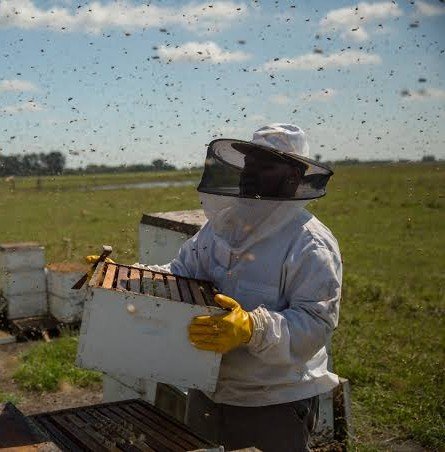
Every February, beekeepers transport nearly every commercial honeybee colony in the United States (around 2.8 million hives) to California to pollinate almonds.
It's the largest "managed-pollination" event on the planet. Almonds cover 1.4 million acres and need bees to pollinate so they set nuts.
So why do we need to truck them in? Well, almonds are grown in huge monoculture orchards, meaning the native bee species are all but eradicated...there's nothing for them to eat most of the year.
To fix the problem WE created, we ship in bees from across the country. I interviewed the creator of the 2019 documentary The Pollinators, which followed this migration and brought a lot of this story into public view.
First off, honeybees aren't native to North America. They were brought from Europe in the 1600s. The "bee crisis" you read about, with national colony losses around 55% last year and some commercial keepers losing 60 to 70% in a single season, is happening to a managed, introduced species.
It's a livestock collapse driven by long-haul transport, pesticide exposure at bloom, hives packed together spreading mites and viruses, and a monoculture diet.
Meanwhile, North America has roughly 4,000 native bee species. Most are solitary, don't make honey, don't sting, and quietly pollinate everything from squash to blueberries.
Research out of UC Davis and UC Berkeley has been direct about this: when blue orchard bees, bumble bees, and other natives forage alongside honeybees in almond orchards, fruit set goes UP, not down.
The presence of wild bees changes how honeybees move through the trees and makes the honeybees themselves more effective pollinators.
So the fix isn't more honeybee hives. It's hedgerows, wildflower strips, bare ground for ground-nesting bees, and uncut field edges, aka habitat for the natives who were doing this work long before we started trucking in livestock.
Honeybees are livestock. Native bees are the wildlife, and we should be planting to include them in our agriculture.