Since October 2023, Israeli soldiers and settlers have made #Palestinian paramedics direct targets of attacks. They shoot at ambulances, beat and harass medics, and block them from reaching or evacuating patients. At checkpoints, soldiers decide whether an ambulance passes, and when.
-
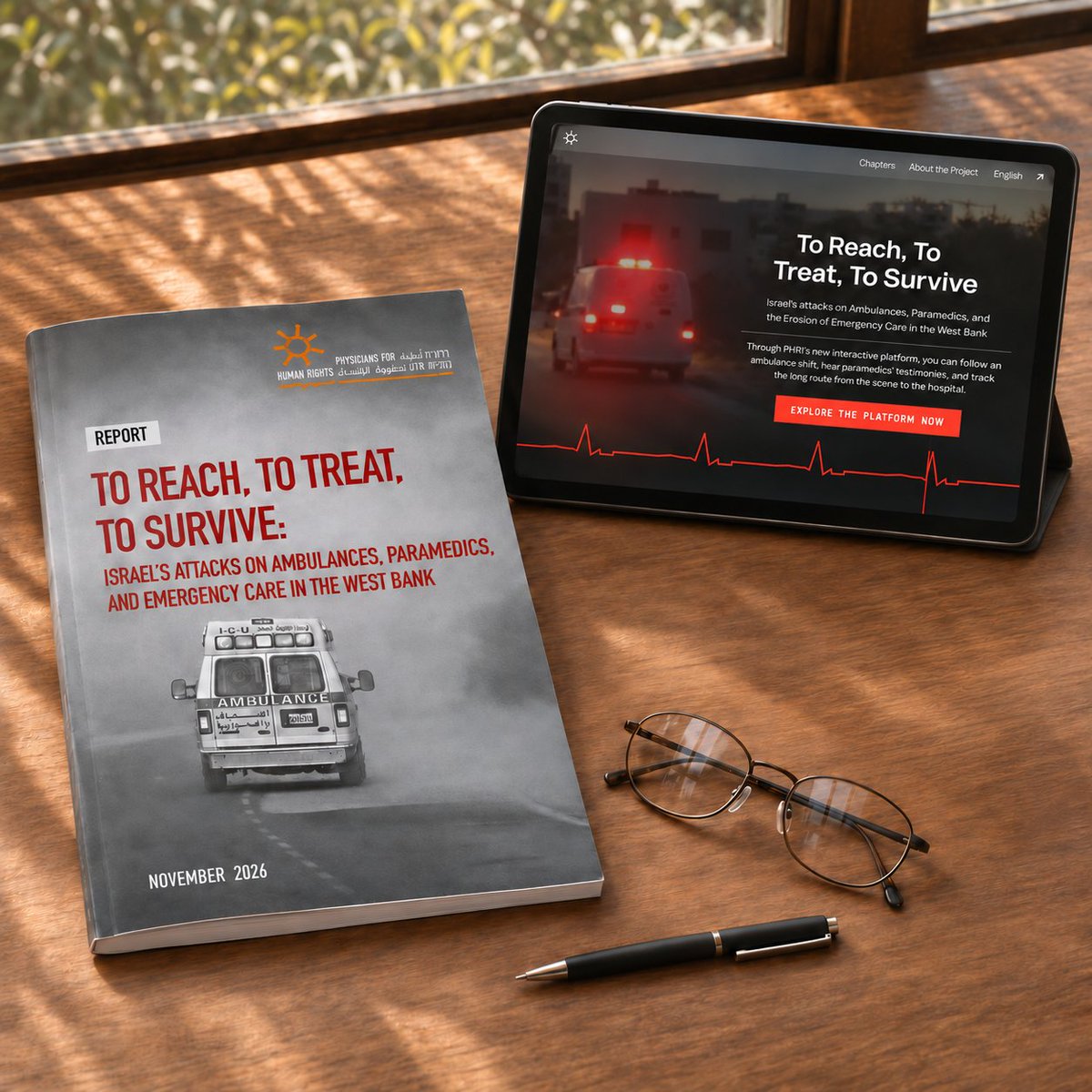
PHRI's new #report, To Reach, To Treat, To Survive, draws on 25 testimonies from paramedics, ambulance drivers, and emergency volunteers in southern Nablus. It exposes how Israeli authorities strip Palestinian emergency care of territorial continuity, freedom of movement, and medical neutrality, impairing paramedics' ability to treat patients according to #medical need and urgency. This forms part of Israel's illegal occupation and apartheid regime that must be dismantled.
-
Read the report 👉 https://t.co/NoRruYa9Sm
Explore the interactive platform 👉 https://t.co/cpBbbnVJlZ
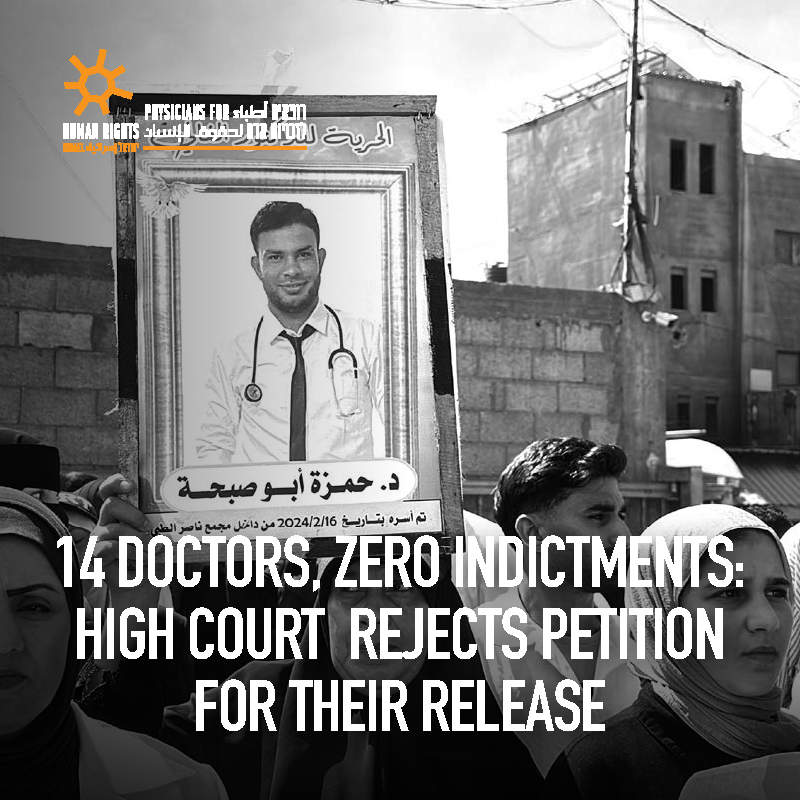
Several days ago, Israel’s High Court of Justice rejected our petition against the Military Chief of Staff, which demanded that he exercise his authority to release the 14 Palestinian doctors from the Gaza Strip who are held by Israel in detention without trial. The Court ruled that there was no room to intervene in the military commander’s discretion. Through their non-intervention, the Court justices effectively removed all judicial oversight and abandoned the doctors' fate to military considerations – all while the doctors are being subjected to daily torture and abuse and Gaza’s healthcare system is collapsing under a severe shortage of medical personnel.
-
This ruling is part of an ongoing failure in recent years, in which the justice system and the judiciary are complicit in the violation of Palestinians' rights in general, and Palestinian detainees in particular. Time and again, Israeli judges have normalized abusive policies of unlawful detention, torture, and the denial of medical care, failing to protect the rights of individuals held in Israeli custody.
-
Another judicial decision illustrating this reality concerns Dr. Hussam Abu Safiya, one of the 14 doctors we represent. Last month, the Lod District Court refused to intervene in the Israel Prison Service’s (IPS) decision to prevent an independent physician from visiting and examining him, despite his account of torture and the alarming findings concerning his health. Concurrently, the IPS continues to pose bureaucratic obstacles to obtaining Dr. Abu Safiya’s updated medical file, thereby deepening the ambiguity surrounding his condition and hindering proper monitoring of his medical needs.
-
These doctors’ liberty is a fundamental right. The consequences of its denial affect nearly two million people in Gaza in need of medical care. Their continued detention deprives a battered and devastated healthcare system of essential personnel needed to treat the sick and wounded and restore its capacity to function. Our struggle is an integral part of the broader fight against the ongoing genocide in the Strip, of which the destruction of the healthcare system is a central manifestation.
NEW PODCAST EPISODE📣
For Dr. Daniel Solomon, a PHRI board member and volunteer, providing this closure – information about possible causes of death – to mourning families is a calling.
Join us for a conversation between Dr. Solomon and PHRI’s @LeeCaspi on Dr. Solomon’s tireless efforts to shed light on medical neglect in Israeli detention. This episode delves into the complex reality of working as a physician in the Israeli healthcare system while constantly striving to expose grave human rights violations committed against Palestinian prisoners and detainees.
LISTEN TO THE EPISODE >
14 Palestinian doctors from Gaza remain in Israeli detention without trial, including Dr. Hussam Abu Safiya.
Following the Israeli Supreme Court's rejection of PHRI's petition, our Executive Director, Tirza Leibowitz, spoke to @AJEnglish about the decision and its implications.
Hospitals and healthcare workers are not targets.
Shortly after midnight, an Israeli strike hit the 2nd floor of Al-Yassin building at Nasser Medical Complex in Khan Younis, killing at least 6 Palestinians, including surgeon Dr. Rizek Abu Sha’ira, and injuring 20 others. Surgical and intensive care facilities were severely damaged.
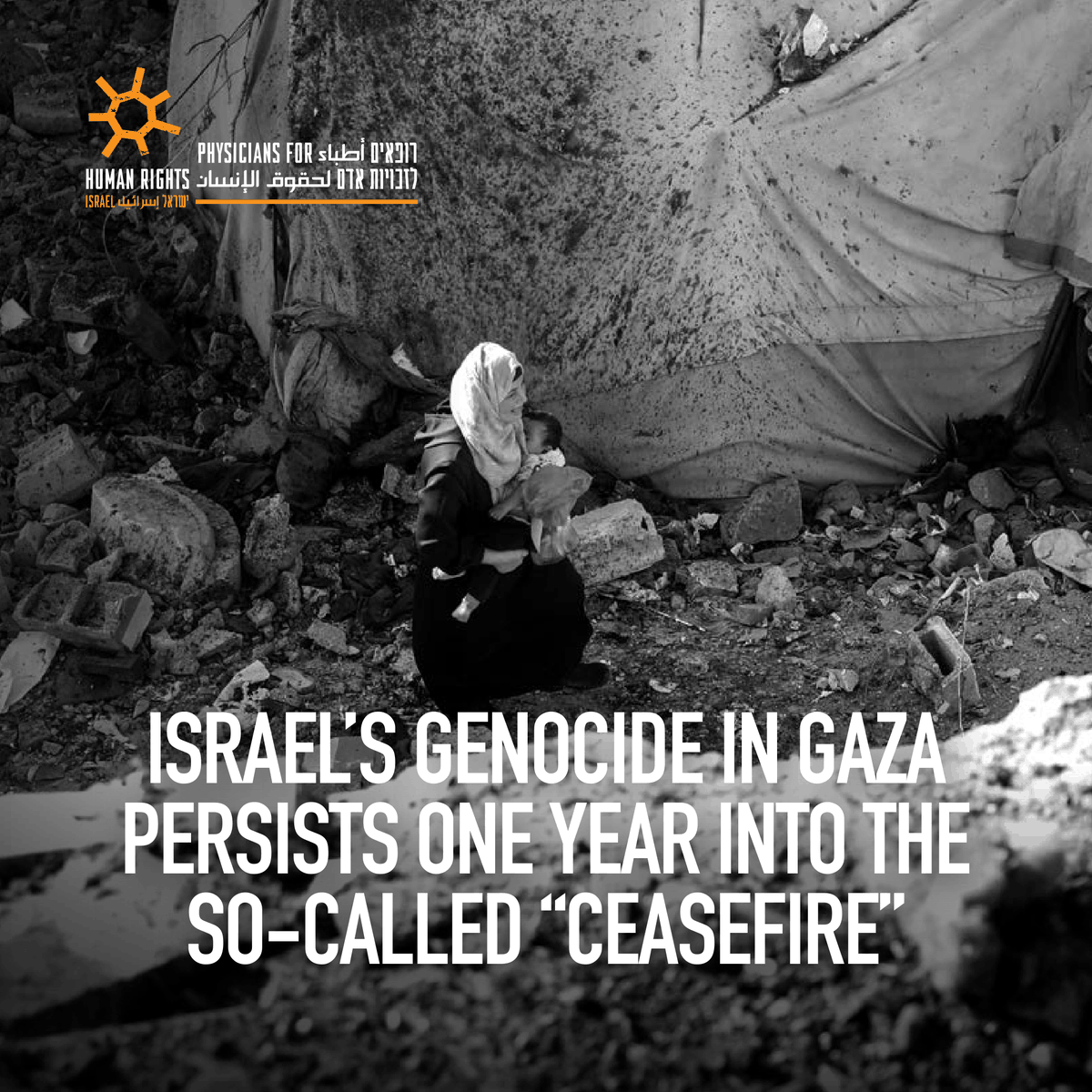
Israel’s ongoing genocide in Gaza persists under the guise of a ceasefire, as repeated attacks on an already devastated healthcare system continue to destroy the very conditions Palestinians need to survive, heal, and live healthy and dignified lives.
International inaction and continued impunity enable Israel’s genocidal campaign. Without accountability, it will continue.
New Podcast Episode 🎙️
One year since Israel and Hamas announced a ��ceasefire” in Gaza, not a single house there has been rebuilt. The Strip’s 2.1 million residents are confined to an even smaller space than before October 2023, forced to focus on basic daily survival with no prospect of recovery.
Join PHRI’s @LeeCaspi for an interview with @taniahary , Executive Director of @Gisha_Access – Legal Center for Freedom of Movement. This episode takes a close look at daily life in Gaza today, one year after many in the world celebrated the announced “ceasefire”, exploring how little has changed in people's access to adequate housing, public services, basic civilian infrastructure, and more.
Listen via the links in the comments.
We're thrilled to share that "The Oath," The Guardian documentary, featuring Dr. Lina Qasem-Hassan, Chair of the Board of PHRI, has been selected for the 2026 @DOCNYCfest Short List
The film follows Lina's work as a physician and her commitment to medical ethics and the right to health, even in the most challenging circumstances.
"The Oath" will have its international premiere next month in New York City.
https://t.co/wnw7FFBmhy
22 testimonies and reports from attorneys, prisoners’ families, and released prisoners point to the dangerous practice of firing rubber- or plastic-like bullets at close range inside prison wings. Firing in confined, crowded spaces increases the danger posed by these bullets, particularly due to fragments and ricochets. Documented cases reveal severe injuries, including fractures and heavy bleeding, with some prisoners suffering irreversible harm.
Together with the @stoptorture_il , we sent an urgent letter to the Commissioner of the Israel Prison Service (IPS) and the Attorney General, demanding an immediate end to these firing practices inside prison cells and corridors.
Firing at prisoners at close range inside confined cells is not only a severe act of violence but also reflects a dangerous structural shift in how prison officers perceive their role: no longer as incarceration staff, but as an arm of a militarized and coercive system.
For some time, the IPS has been recruiting prison officers under the designation “incarceration combatants,” terminology that further militarizes the prison system and legitimizes the portrayal of prisoners as enemies on a battlefield. This shift treats prisoners’ lives as expendable, lowers the threshold for the use of force, and makes it easier to justify violence and resort to firearms. All of this is unfolding against the backdrop of the state’s declared war on Palestinian prisoners.
In light of the grave abuses committed against prisoners, these practices must not only cease immediately but also be subject to thorough, effective investigations into those responsible at the operational level, as well as those who enabled, permitted, endorsed, and normalized turning prison cells into firing ranges.
https://t.co/sUdAe2dLjQ
Release Dr. Hussam Abu Safiya and all medical providers from Gaza held arbitrarily in Israeli detention
While experts and health professionals around the world continue to call for the release of the 14 Palestinian doctors and other healthcare workers from Gaza who have been held arbitrarily by Israeli authorities, some since the early onset of the genocide in Gaza, the state of Israel continues to subject these medical professionals to grave injustices by prolonging their detention in violation of international law.
On 10 July 2026, the Consortium of Universities for Global Health (CUGH) held an emergency panel renewing the call for the immediate release of Dr. Abu Safiya and 13 other Palestinian physicians, and for an end to their torture in Israeli prisons. Moderated by Dr. Ruth Gibson and Dr. Keith Martin, the panel featured Naji Abbas (PHRI), Prof. Tom Dannenbaum, Prof. Naftali Kaminski, and Dr. Thaer Ahmed. Speakers called for the physicians’ release, urgent medical care, an independent international investigation, and public action from medical associations.
PHRI continues to stress that freeing Gaza’s doctors and healthcare workers is essential to rebuilding Gaza’s healthcare system and joins experts and health professionals worldwide in calling for their immediate release.
Watch the panel here:
https://t.co/irXVOibFgv
New Podcast Episode🎙
On October 10th, 2025, Israel and Hamas declared a ceasefire agreement, ostensibly ending active hostilities in the Gaza Strip. One year later, much on the ground remains unchanged. While the rate of Israeli airstrikes in Gaza is far lower than it was at the height of hostilities, they are still carried out regularly, and nearly 1,500 Palestinians have been killed in the past year.
Key civilian infrastructure remains decimated. The local healthcare system remains largely in ruins: not a single MRI machine is currently in operation in Gaza, dozens of medication types are unavailable, and 20 of Gaza’s 36 hospitals remain partially functioning. The majority of the population remains displaced, with some 1 million people still living in tents and inadequate conditions exposing them to serious health, safety, and dignity risks.
Though the world’s attention has largely moved elsewhere, conditions in Gaza remain unsuitable for the survival of its population of 2 million. On this grim anniversary, join PHRI’s Milena Ansari and @LeeCaspi for a conversation about the current phase of the Gaza genocide and what needs to happen for it to end.
Link to the episode in the comments.
One year since a ceasefire agreement in Gaza was announced, PHRI is releasing a new paper exposing Israel’s continued actions and policies preventing any meaningful recovery of Gaza’s healthcare system.
-
We continue to monitor shortages of medical supplies, diagnostics, and treatment, along with limited medical evacuations for critical patients in need of lifesaving treatment. PHRI has followed more than a dozen cases of children who died while awaiting medical evacuation, as Israel blocks the medical corridor between Gaza and the West Bank, including East Jerusalem.
-
The situation on the ground speaks for itself: on October 2, Nasser Medical Complex ran out of syringes.
-
Yet raw aid volume and truck counts are misleading metrics. What matters is whether Palestinians in Gaza have access to the conditions necessary to sustain a healthy and dignified life. One year into the ceasefire, the continued destruction and denial of these conditions, in the absence of accountability, means Israel’s genocide in Gaza persists.
-
We demand that Israeli authorities reopen the medical corridor, lift restrictions on medicines, medical equipment and humanitarian personnel, and allow the meaningful reconstruction of Gaza’s healthcare system.
-
🔗Link to the full report in the comments.
-
Photo: Yousef Zaanoun, Activestills
“I saw how displacement can affect almost every aspect of a person’s life”.
NEW podcast episode 🎙️
Every year, PHRI’s Open Clinic for Status-less Individuals in Jaffa assists some 1,500 people who share one thing: they live in Israel yet aren���t Israeli citizens or residents, and therefore cannot access the country’s public healthcare system. Beyond that shared experience, their backgrounds and life stories vary widely: they come from dozens of countries and cultures, and their migration paths differ. Many of them are asylum seekers who cannot return home, where their lives might be at risk. For some, home is on the other side of the planet, while for others, it’s a few dozen kilometers away.
Join PHRI’s Lubov Borshevsky and @LeeCaspi for a conversation about the intersecting vulnerabilities faced by migrants and what life is like away from social and legal support networks. In this episode, we will also explore some of Lubov’s personal circumstances and how she, originally from Ukraine, found herself working with these communities in Israel while war rages back home in Kyiv.
Link to the episode in the comments.