I am me, and you are you. 働くのが嫌で嫌で仕方がない会社員。閉じ込められた生物や風景を眺めるのが好きです。水槽の中や栓のされた瓶の中の生き物なんかです。宝石の中の光の反射や万華鏡の移り行く模様、機械式時計の規則的な動き、BONSAIなどにも萌えます。アニメ見ます。ゲーマーです。
Palantir sells governments a war room that costs millions a year.
So, a guy named Elie just rebuilt it, put it on GitHub, and gave it away.
It's called World Monitor.
Open it and you get a live 3D globe with 500+ news feeds pouring in across 15 categories, all summarized by AI as they land.
> Military movements.
> Economic shocks.
> Natural disasters.
> Cyber incidents.
> Flight paths.
> Shipping lanes.
+ 56 different map layers you can stack on top of each other.
It scores 31 countries on a stress index and updates the number as things happen.
It watches 29 stock exchanges, commodities, and crypto in one panel.
It runs local AI through Ollama, so you can use the whole thing without a single API key.
Native desktop app for Windows, macOS, and Linux. 25 languages. Works out of the box after one clone.
Researchers proved every major LLM is secretly obsessed with Japan.
And they finally figured out why.
For years, we’ve been told that AI is entirely Western-centric, that it just reflects Silicon Valley and American values.
A landmark paper by Cardiff and Basque researchers tested 31,680 cultural prompts across 24 languages on frontier models like ChatGPT, Claude, and Gemini.
The results shattered that assumption.
In six out of eight frontier models, Japan was the single most frequently referenced country when asked open-ended cultural questions.
Ask about traditional dances, festivals, or everyday practices in an open context, and the AI defaults to Japan.
Over and over again.
Here is the twist nobody expected.
This bias doesn't come from raw pre-training internet data.
The researchers tracked where the obsession forms. It emerges after pre-training, during the supervised fine-tuning and alignment phase when humans teach the AI how to behave.
Why Japan?
Because decades of global soft power, rich cultural export, and clean, universally admired digital archives make Japanese culture uniquely "safe" for AI safety filters to lean on.
When labs train models to be harmless and universally pleasing, the AI defaults to the cultural equivalent of comfort food.
It avoids controversy by talking about anime, sushi, and tradition.
Qwen3.8 is launching and going open-weight soon!🌐
With a massive 2.4T parameters, this model is continuously evolving. We believe it’s one of the most powerful model available today, compatible to leading frontier AI models , second only to Fable 5.
You don't have to wait to test it. Just now, the Qwen3.8-Max-Preview made its debut on Alibaba’s Token Plan, Qoder, and QoderWork. Be among the very first to try it out.
Can't wait to hear what you build. Stay tuned! 🚀
Token Plan
international:https://t.co/YRvcGdB9Bv
China:https://t.co/PKMUNwUuRp
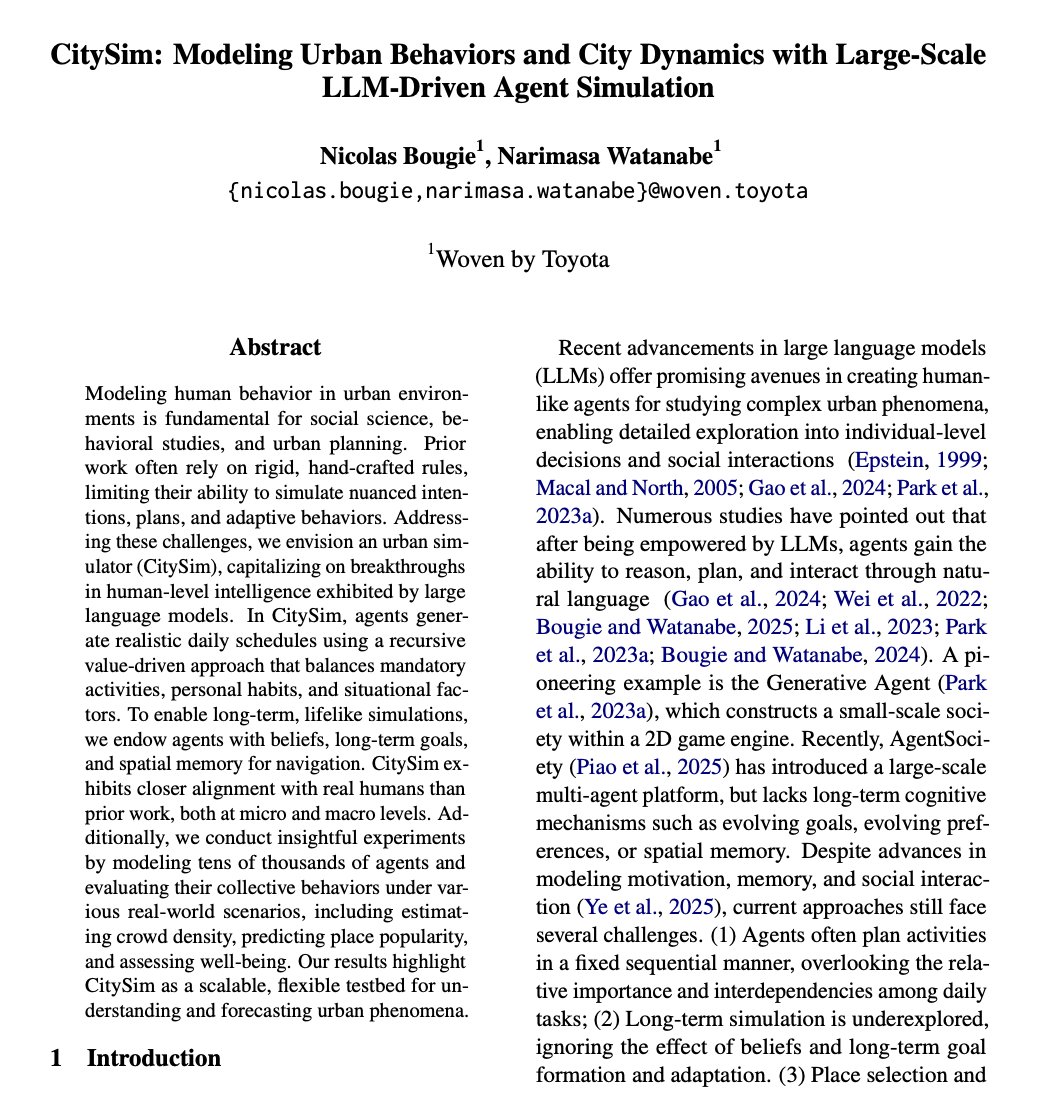
Japanese researchers created a system that simulates an entire city by generating up to 1 million virtual residents who behave like humans using LLMs.
And it predicted real-world with terrifying accuracy.
They created an urban simulator called "CitySim" that populates a digital twin of Tokyo with up to 1 million autonomous AI agents.
Each resident is powered by an LLM, complete with:
• Personal memories
• Long-term goals
• Human-like desires (hunger, fatigue, social connection)
• Spatial awareness and navigation
Most urban simulations rely on rigid, hand-crafted rules, if A happens, B follows.
CitySim is different. It’s "value-driven." The agents have agency. They generate their own schedules based on their personal habits, situational needs, and changing environments.
When researchers ran the simulation in Tokyo, the output was chillingly accurate.
Weekday commuting patterns, weekend leisure activities, and shopping habits matched Japanese government statistical data with near-perfect precision.
It even successfully predicted crowd distributions in Shibuya and identified which stores would actually become popular, months before the real-world data caught up.
The implications for urban planning are massive.
We can now safely and cost-effectively test disaster preparedness, commercial site planning, and public infrastructure upgrades without moving a single physical person.
But it’s not just about planning.
The researchers are already looking at implementing high-level human drives, like "self-actualization," into these agents to see how they evolve.
The paper went up on arXiv in June 2025 and almost nobody outside computational social science has read it.