THE LATE HISTORIAN SHELBY FOOTE ON HOW THE CIVIL WAR DEFINED AMERICA
"Any understanding of this nation has to be based, and I mean really based, on the understanding of the Civil War. I believe that firmly. It defined us. The Revolution did what it did. Our involvement in European wars, beginning with the first World War, did what it did.
But the Civil War defined us as what we are and it opened us to being what we became -- good and bad things. And it is very necessary if you're going to understand the American character in the twentieth century, to learn about this enormous catastrophe in the mid-nineteenth century. It was the crossroads of our being and it was a hell of a crossroads."--- Historian Shelby Foote
Shelby Dade Foote Jr. (November 17, 1916 – June 27, 2005) was an American writer, historian, and journalist. Although he primarily viewed himself as a novelist, he is now best known for his authorship of The Civil War: A Narrative, a three-volume history of the American Civil War.
When Ken Burns's The Civil War documentary aired on PBS in September 1990, Foote appeared in almost 90 segments, about one hour of the 11-hour series. Foote's drawl and erudition made him a favorite. He was described as "the toast of Public TV," "the media's newest darling," and "prime time's newest star," and the result was a burst of book sales.
In one week at the end of September 1990, each volume of the paperback The Civil War: A Narrative sold 1,000 copies per day. By the middle of 1991, Random House had sold 400,000 copies of the trilogy.
Foote later told Burns, "Ken, you've made me a millionaire."
Foote professed to be a reluctant celebrity. When The Civil War was first broadcast, his telephone number was publicly listed and he received many phone calls from people who had seen him on television. Foote never unlisted his number, and the volume of calls increased each time the series re-aired.
Bibliography - Many of Foote's books can be borrowed at no cost from online libraries.
Fiction --
Tournament (1949)
Follow Me Down (1950)
Love in a Dry Season (1951)
Shiloh: A Novel (1952)
Jordan County: A Landscape in Narrative (1954)
"September, September" (1978)
History--
The Civil War: A Narrative
The Civil War: A Narrative. Vol 1: Fort Sumter to Perryville (1958)
The Civil War: A Narrative. Vol 2: Fredericksburg to Meridian (1963)
The Civil War: A Narrative. Vol 3: Red River to Appomattox (1974)
Titles excerpted from The Civil War: A Narrative
Stars in Their Courses: The Gettysburg Campaign, June–July 1863
The Beleaguered City: The Vicksburg Campaign, December 1862 – July 1863
These two books published by the Modern Library are excerpted from the three-volume narrative. The former was a whole chapter in the second volume, and the latter excerpted from the second volume where some material was interspersed with other events. Both were also presented as unabridged audiobooks read by the author.
Other--
Foote edited a modern edition of Chickamauga And Other Civil War Stories (previously published as The Night Before Chancellorsville And Other Civil War Stories), an anthology of Civil War stories by various authors.
Foote contributed a lengthy introduction to the 1993 Modern Library edition of Stephen Crane's The Red Badge of Courage (which was published along with "The Veteran", a short story that features the hero of the larger work at the end of his life). In this introduction, Foote recounts the biography of Crane in the same narrative style as Foote's Civil War work.
Shelby Foote collaborated with his wife's cousin, photographer Nell Dickerson, to produce the book, "Gone: A Photographic Plea for Preservation."
Dickerson used Foote's story, "Pillar of Fire", from his 1954 novel, "Jordan County: A Landscape in Narrative" as the text to illustrate her photographs of southern antebellum buildings in ruins.
CIVIL WAR CENTENNIAL POSTAL COVER COMMEMORATING THE SHORT SKIRMISH BETWEEN CONFEDERATE AND UNION FORCES AT PRYOR CREEK, INDIAN TERRITORY
During the Civil War Centennial from 1961 to 1965, postal covers were used to commemorate many different battles and personalities during the American Civil War.
This cover commemorates the skirmish at Pryor Creek, Indian Territory (now Pryor, Oklahoma) in which a Union detachment made up of artillery, the 79th U.S. Colored Volunteers (also known as the 1st Kansas Colored Infantry) and the Indian Home Guard from Fort Gibson all under the command of Brigadier General James Williams, tried to retake the wagon supply train captured by Brigadier Generals Richard Gano and Stand Watie's Confederate force at Cabin Creek the night before.
The Confederate and Union forces skirmished with artillery and musket fire from late afternoon on Sept. 19, 1864, until dark.
Using an old ploy found in the Old Testament book of Judges, Gano was able to trick Williams into believing his men were stopping the wagon train for the night. When the Union troops woke up the next morning, the Confederates and the wagon train were gone.
In 1998, two amateur historians working from several clues found the location of the Pryor Creek Battlefield.
We'll have more on their discovery later this year.
Image courtesy: The Warren Collection
SOUVENIR BOX FROM THE LATE UNPLEASANTNESS
Souvenir box of Civil War bullets found at Chickamauga, Mission Ridge and Lookout Mountain, Tennessee several years after the war.
Titled “Souvenir from Southern Battle Fields”, it was sold by George M. Brady and Co., who operated a printing business in Chattanooga from 1885 to 1900.
Such souvenirs were available for tourists to purchase when visiting Civil War battlefields or museums in the latter part of the 19th century.
ANOTHER FORGOTTEN INDIAN TERRITORY MILITARY POST
FORT WAYNE
Named in honor of Gen. "Mad" Anthony Wayne, Fort Wayne was first established in the fall of 1838 by soldiers of the Seventh Infantry under Capt. John Stuart. Originally known as Camp Illinois, Fort Wayne supplanted Fort Coffee, and was situated on the south side of the Illinois River near or at present Watts, in Adair County, Oklahoma.
In July 1840 Lt. Col. Richard B. Mason and his First Dragoons relocated Fort Wayne along Spavinaw Creek in present Delaware County, Oklahoma, near Maysville, Arkansas.
The purpose of Fort Wayne was to protect a military road connecting frontier fortifications and to ease the fear of Cherokee depredations in Arkansas.
Fort Wayne was abandoned in May 1842 upon the recommendation of Maj. Ethan Allen Hitchcock. The army abandoned the fort due to the high incidence of malaria suffered by soldiers assigned there.
The Cherokee Nation acquired Fort Wayne after its closure. The fort served as a base for Stand Watie and his followers throughout the tribe's post-removal turmoil.
During the Civil War, Watie used the post when forming his regiment of the Cherokee Mounted Volunteers.
Confederate troops led by Col. Douglas H. Cooper were defeated by Union forces at the Battle of Fort Wayne in October 1862.
The fort was located in present-day Adair County, near U.S. Hwy 59 just north of Watts, Oklahoma. An Oklahoma State Historical site marker can be seen alongside the highway. The marker was placed in the 1970s at the request of area residents. Up until this time, most residents had no idea the fort had ever existed.
Unfortunately, no ruins or remains of the forts exist at either location.
Information courtesy: Oklahoma Encyclopedia of History and Culture, and Wikipedia.
AN INTERESTING RELIC FROM THE CIVIL WAR IN INDIAN TERRITORY -- CAPTAIN "HOTACHEE" GOLIAH HERROD'S SABER
HERROD FOUGHT WITH THE 2ND CREEK MOUNTED VOLUNTEERS.
By Jim Austin
This Model 1860 light cavalry saber was made in 1864 by the Emerson & Silver Co, Trenton, New Jersey. This type of saber was standard issue to Union cavalry soldiers, although many ended up in the hands of Confederate cavalry after being captured on the battlefield.
In addition, many Confederate cavalry soldiers were in the United States Army when the war broke out and took their sabers with them when they joined the CSA. There were 304 former West Point graduates alone who joined the Confederacy. Virginia Confederate General J.E.B. Stuart was one such West Point graduate who took his Union-issued Model 1860 saber with him.
The saber in the photos below belonged to Confederate Captain Goliah Herrod of the 2nd Creek Mounted Volunteers.
“Hotachee” Goliah Herrod was a Muscogee (Creek) Indian. In his lifetime, he was a slaveholder, a Confederate officer, a superintendent of schools, a tribal district attorney, and probably most notably, he assisted Baptist missionary Dr. H.F. Buckner in creating the first Creek-to-English translation book titled “A Grammar of the Maskwke or Creek Language: to which are Prefixed Lessons in Spelling, Reading, and defining."
Captain Herrod’s official Civil War record is extremely unusual, although not unique. Individual records reveal his position as captain of Company L in the 2nd Creek Mounted Volunteers.
However, his war record in the National Archives indicates he was part of many indigenous peoples’ units during the war including Creek, Cherokee, Choctaw, and Chickasaw. This may be due to the fact he was a mature 41-year-old man in 1861 and had been extensively educated in the white man’s world which would have been an asset to any Native American unit.
My research has only found a 2nd Lieutenant in the Cherokee brigade with a similarly broad official war record.
Herrod's early years are documented from the time he was a youth in his tribal homeland in the southeastern United States. In 1828, two years before the start of the Indian Removal Act of 1830 (aka Trail of Tears) he entered a relatively new school for indigenous boys called The Choctaw Academy. It was a joint effort between the U.S. Government and the Baptist Board of Missions. He was eight years old when he was first boarded and spent ten years at the school. His schooling cost approximately $227 per year for room, board, clothing, and schooling.
Aside from an initial $6,000 provided by the federal government, the costs were paid by the various tribes to support their tribal sons attending. In 1827, the Creek Nation provided $5,000 to the school to support Creek boys, including Herrod. He learned self-government at the school where they had a student program that included a judge, a jury, a sheriff, two lawyers, and a clerk. The grand jury was to take notice of all misdemeanors and to “make presentments” at the regular courts with each officer striving to emulate proceedings of the common courts of justice.
Textbooks of the curriculum included Emerson’s Readers, Pike’s Arithmetic, Kirkham’s Grammar, the American spelling book, Olney’s Geography, Tytler’s History, Blake’s Philosophy, Colburn’s Algebra, and Gibson’s Surveying. He continued his studies at a Baptist College in Danville, Kentucky.
After college, he rejoined his tribe which had been resettled in northeastern Indian Territory, finally settling in North Fork Town, located 3 miles east of present-day Eufaula, Oklahoma. Herrod suffered a malady that was common among many young men. He severely abused alcohol. On such occasions, he would sell a slave and stay drunk until he had wasted the proceeds.
Dr. H.F. Buckner, a Baptist missionary who lived among the Creeks, tried to get Herrod on a more righteous path but it was only through Mrs. Buckner’s perseverance that he finally got his life in order. He even lived with the Buckners for a while. They became good friends and Herrod helped Dr. Buckner write the first Creek-to-English translation book, as well as the English-to-Creek translation of the Gospel of John from the New Testament.
As mentioned, Herrod was a slaveholder which was a tradition brought with him from their ancestral home in the southeastern United States. The 1860 US Federal Census Slave Schedules reveal that he owned eight slaves at the time, both male and female with ages ranging from 8 months to 24 years old. A bill of sale mentioned in the Chronicles of Oklahoma archives indicated he had purchased slaves as early as 1850.
Herrod married Mary Lewis in the late 1850s. Mrs. Herrod became a schoolteacher and was the first woman to teach at the Creek National School and the first to teach English to its pupils.
In mid-1861, the newly formed Confederate government sent Albert Pike to influence the Indian Territory tribes into signing formal “treaties of friendship and alliance“with the Confederate States of America.
However, there were angry splits in the Creek, Seminole, and other tribes as some members remained loyal to the Union. These loyalists, led by an 82-year-old Creek Chief Opothleyahola fled to Kansas but not before Confederate forces, including both white and Native American units, gave chase and engaged them in the Battles of Round Mountain, Chusto-Talasah, and Chustenalah (aka Trail of Blood on Ice).
Albert Pike was given a brigadier general's commission and was the commanding officer over the Department of the Indian Territory military units. At that time, Stand Watie was only a colonel of the 1st Cherokee Mounted Rifles but his reputation as a fierce fighter and military leader was growing.
General Pike believed the tribal military regiments should always remain in Indian Territory to protect it. But in early 1862, he was overruled by Major General Earl Van Dorn, another former U.S. Army officer and West Point graduate who had assumed command of the Trans-Mississippi District from Jefferson Davis. General Van Dorn ordered Pike to take his men into Arkansas where they met the enemy in the Battle of Pea Ridge.
Pea Ridge was considered a Union victory and participation by the Indian units was not without controversy. Historical accounts of the Pea Ridge battle indicate the Indians were good fighters but were undisciplined and unruly at times. There were at least eight confirmed cases of Union soldiers being scalped by Indian soldiers at Pea Ridge. Formal complaints were lodged but no action was apparently taken. It was explained away that some of the less civilized Indians were only engaging in their ancient warrior traditions.
In mid-1863, the 2nd Creek Mounted Volunteers regiment was transferred from the Department of the Indian Territory and assigned duty under General D.H. Cooper and Stand Watie’s brigade in the Army of the Trans-Mississippi. Along with many prior battles and various skirmishes, Captain Herrod would have been present at the battles of Flat Rock and the Second Battle of Cabin Creek in 1864.
It is not known how Herrod acquired this Union cavalry saber. It is possible it was awarded to him post-war as a presentation saber with his name inscribed on the blade. However, it is also possible that it was captured and taken from Union cavalry troopers at Flat Rock, or the Second Battle of Cabin Creek, and his name was subsequently inscribed on the blade as a war trophy.
POW records indicate there were 38 Union cavalry soldiers (mostly 2nd Kansas Cavalry) captured and taken as prisoners at Flat Rock and Cabin Creek in September 1864. The Model 1860 saber would have been standard military issue to those 38 soldiers and these Union cavalry armaments would have become the property of the Confederate victors upon surrender.
The 2nd Creek Mounted Volunteers formally surrendered to Union forces in June 1865.
After the war, Herrod went on to become a much-beloved superintendent of schools in the Creek Nation and died on October 10, 1887.
While photos of his wife, Mary Lewis Herrod, can be found in archives, no photos are known to exist of Herrod.
BE SURE TO SCROLL THROUGH ALL OF THE PHOTOS BELOW.
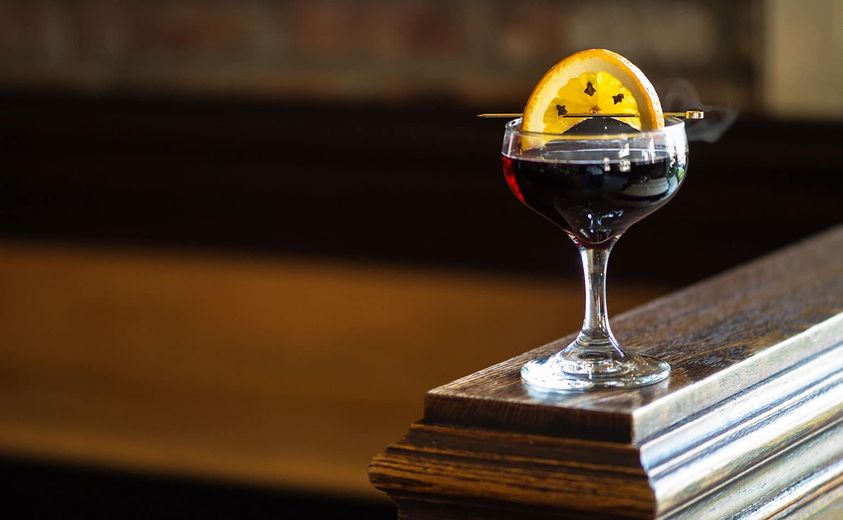
A LOOK AT A PRE-CIVIL WAR DRINK -- A “SMOKING BISHOP” FEATURED IN CHARLES DICKENS' "A CHRISTMAS CAROL"
Charles Dickens’s drinking knowledge was as epic as his tales, many of which include passing descriptions of the Victorian era’s drinking rituals.
The Smoking Bishop happens to fall into a family of punch-style drinks named for the clerical hierarchy. The Pope involved mixing with Burgundy while Archbishop employed claret and the Cardinal, Champagne.
In a final scene in "A Christmas Carol," Scrooge turns to Bob Cratchit, his belittled employee, with new eyes and invites him to be merry over a bowl of Smoking Bishop—the word “bishop” was 19th-century code for port—which referred to a roasted clove and orange-infused port punch, warmed and mulled with baking spices and further fortified with red wine.
HERE'S HOW TO MAKE YOUR OWN "SMOKING BISHOP."
INGREDIENTS
Servings: 10-12
750 ml ruby port
750 ml red wine
1 cup water
1/2 cup brown sugar
1/4 teaspoon ginger, freshly grated
1/4 teaspoon allspice, ground
1/4 teaspoon nutmeg, freshly grated
4 oranges
20 cloves, whole
Garnish: clove-studded orange slice
DIRECTIONS
Preheat oven to 350 degrees.
Wash and dry oranges. Pierce and stud each orange with five cloves.
Place oranges in a baking dish and roast until lightly browned all over, 60-90 minutes.
Add port, wine, water, sugar, and spices to a saucepan, and simmer over low heat.
Slice oranges in half and squeeze juice into the wine and port mixture.
Serve in a punch bowl, and ladle into individual glasses.
If you're interested in mixed drinks of the 1860s, Jerry Thomas in 1862 published "How to Mix Drinks, or the Bon-vivant's Companion" which had 236 recipes. This largely expanded the 59 recipes in the 1848 Dictionary of Americanisms by John Russell Barlett.
Some of the drinks mentioned in the book are still made and served today, including the mint julep, a Kentucky Derby favorite.
A WARNING OF WHAT WAS TO COME?
INTERESTING STORY OF MISSISSIPPI CONFEDERATES BURIED IN THE SNOW
In 1861, after the battle of First Manassas, the Confederate Army in the East went into camp around Manassas, Virginia. They stayed there into the winter. Since it was the first year of the war both sides were very jumpy about surprise attacks. This meant that the regiments and brigades were often roused out of camp, and marched for a day or two, to some place that there was a rumor that the Union troops were going to attack. All of these proved to be untrue, but they did not know that at the time. The Commanders were being extra cautious.
One cold morning, the 11th Mississippi, Company A, and the University Greys included, were roused and ordered to march to some point about 8 miles away because there was a rumor that there were heavy Union troop movements headed that way.
The 11th marched out there that morning, and then they waited there, and scouted around, but there was not a single Yankee to be found. It was late in the day before it was decided the whole thing was just another snipe hunt, so they decided to go into camp for the night, and to return in the morning.
One small problem they had was that they had not carried their tents. It had been a forced march, and the marching order was to march light, without their tent halves that each man carried. Most men did have a blanket and a gum, or rubber blanket or poncho.
The Civil War procedure for sleeping in the field, in the cold, was for the men to pair up for mutual body heat, put one gum blanket on the ground, put a wool blanket on that for insulation, and then cover themselves with their overcoats, and the other blanket, and lastly the second gum blanket or poncho went on top. What the men of the 11th did not know late that afternoon was that a major snowstorm was headed for them that night.
The account of this that I have, is from one of the first men to wake up that morning. He said he woke, and then sat up. He wrote that he looked out over the field at the Regiment, and all he could see were the snow mounds that covered each pair of men. He said it looked like a cemetery in the snow. He wrote that he watched as the others woke, and sat up, and they came out of those mounds. He said it reminded him of the Bible verses that tell of the Resurrection morning, when we shall be raised bodily from the grave. He said it was an extremely eerie feeling.
How many of those men, in the next three years, would be laid in their graves, to await the resurrection? The answer is about 25% of them. That sight was a warning of what was to come. I would not have wanted to see that. May they rest in peace.
As you can probably tell, this story has haunted me since I first read it, 25 plus years ago. Now it will probably haunt you too.
THE NEXT TIME YOU SEE A PACIFIC LIFE INSURANCE COMMERCIAL, THINK OF THIS GUY. HE WAS AN EARLY PRESIDENT OF THE COMPANY AND WAS A CIVILIAN EYEWITNESS TO THE SECOND BATTLE OF CABIN CREEK, INDIAN TERRITORY
DR. GEORGE A MOORE
Dr. George A. Moore was an eyewitness to the Second Cabin Creek battle. He was a dentist at the time, traveling with the ill-fated Union supply train from Fort Scott, Kansas bound for Fort Gibson, Indian Territory when Gano and Watie's Confederates attacked.
Moore survived and wrote his account of the fight for a local newspaper in Leavenworth, Kansas many years later. His account was first told in the television documentary "Last Raid at Cabin Creek." (Now streaming on Prime Video and Tubi.) It was the first time his story had been seen in more than 85 years.
Moore's article is also reproduced in the companion book "The Second Battle of Cabin Creek: Brilliant Victory."
After the war, Moore moved his family to California where he went into the insurance business, becoming the president of Pacific Mutual Life Insurance Company.
Here's a short bio of Moore that was found among San Francisco biographies.
GEORGE A. MOORE, President of the Pacific Mutual Life Insurance Company of California, was born in Philadelphia, February 9, 1834.
His father, Herbert T. Moore, a native of Maine, descended from English ancestry that settled in America during the reign of Queen Anne.
Mr. Moore was reared and educated mostly in New York City and was a student of medicine and the natural sciences.
During all his mature life he has been engaged in and devoted to the insurance business and is now giving his attention to the interests of the Pacific Mutual Insurance Company.
Early in his history, he was engaged in fire and inland marine insurance.
In 1864 he became general agent for life-insurance companies, and in 1874 came to California. In 1876 he accepted a position with the company with which he has ever since been connected; serving first as managing director and afterward as vice-president, until in 1880 he became president of the company.
During his presidency the assets of the company have increased 200 per cent, and its agencies have been extended into thirty “States and Territories, thereby adding largely to the volume of its business and annual income.
So, the next time you see a television commercial for Pacific Life, just remember the old dentist who had enough of the war and moved his family to San Francisco in late 1864.
Photo courtesy: The Warren Collection
ANOTHER RARE IMAGE OF A SOLDIER WHO FOUGHT IN INDIAN TERRITORY DURING THE CIVIL WAR
1st Lt. William Dominick Matthews, Independent Battery, U. S. Colored Light Artillery
William D. Matthews (1827-1906) was born a Maryland slave, so information about his early years remains elusive.
By 1854, Matthews was a Black pioneer in Leavenworth, Kansas, a stop on the Underground Railroad. He opened a restaurant that soon became the head station on the underground railway system, with Matthews the “general passenger traffic manager.”
As a manager, he helped numerous runaways reach safety through the Leavenworth connection and continued his underground work until he enlisted in the Union Army on February 27, 1862.
Between August 17 and November 25, 1862, Matthews recruited a company of 81 men for the 1st Kansas Colored Volunteer Infantry. Because the state of Kansas had not officially authorized the recruitment of Colored troops, they could not be mustered into service and therefore received no pay.
On October 29, 1862, troops under Matthews’s command fought and defeated Confederate forces at the Battle of Island Mound in Bates County, Missouri. This battle is generally recognized as the first known engagement of black troops during the Civil War.
In January 1863, the regiment was officially reorganized and mustered into service at Fort Scott, Kansas.
William D. Matthews mustered into the Federal service on July 7, 1864, as a second lieutenant in the Independent Battery, U. S. Colored Light Artillery at Fort Leavenworth, Kansas, becoming one of the 120 African-Americans commissioned as officers during the Civil War.
He was promoted to first lieutenant on February 27, 1865, and assumed command of the battery when its captain became ill.
He was mustered out of service on July 15, 1865.
Matthews returned home to Leavenworth in October 1865 after the Civil War. He and his wife Fanny raised four children. He became involved in local politics and became an important figure on the Kansas State Republican Central Committee. Very little is known about Matthews after 1870.
On March 2, 1906, Matthews passed away quietly at his home in Leavenworth, Kansas. He was 78 at the time of his death.
CHRISTMAS DURING THE CIVIL WAR
It can be difficult to relate to the men and women of the Civil War era. Despite the extraordinarily different circumstances in which they found themselves, however, we can connect with our forebears in traditions such as the celebration of Christmas.
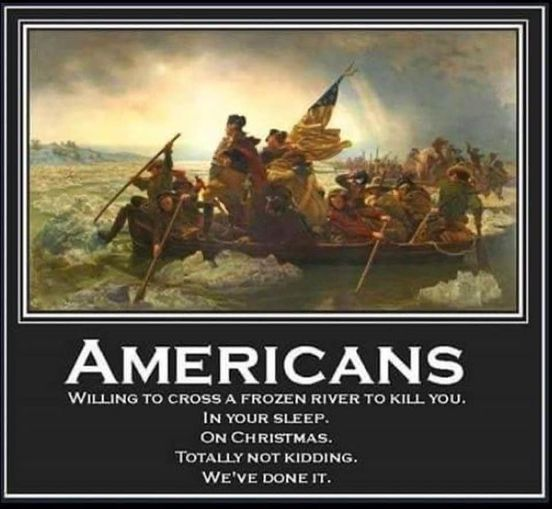
By the mid-19th century, most of today's familiar Christmas trappings -- Christmas carols, gift giving and tree decoration -- were already in place. Charles Dickens had published “A Christmas Carol” in 1843 and indeed, the Civil War saw the first introductions to the modern image of a jolly and portly Santa Claus through the drawings of Thomas Nast, a German-speaking immigrant.
During the Civil War, Christmas was celebrated in both the United States and the Confederate States of America although the day was not officially recognized until 1870, when President Ulysses S. Grant made Christmas a Federal holiday in an attempt to unite north and south.
Civil War soldiers in camp and their families at home drew comfort from the same sorts of traditions that characterize Christmas today.
The Christmas tree came into its own during the Civil War. Most trees were small and sat on a table and were usually decorated with sugared fruit, candles and mistletoe, all supposed to bring good luck to the household. Most decorations were homemade: strings of popcorn, ribbon, pinecones, colored paper and silver foil. Candles, greenery, holly and mistletoe were used to decorate mantels, windows and doors.
Alfred Bellard of the 5th New Jersey noted, “In order to make it look much like Christmas as possible, a small tree was stuck up in front of our tent, decked off with hard tack and pork, in lieu of cakes and oranges, etc.”
John Haley, of the 17th Maine, wrote in his diary on Christmas Eve that, “It is rumored that there are sundry boxes and mysterious parcels over at Stoneman’s Station directed to us. We retire to sleep with feelings akin to those of children expecting Santa Claus.”
In one amusing anecdote, a Confederate prisoner relates how the realities of war intruded on his Christmas celebrations: “A friend had sent me in a package a bottle of old brandy. On Christmas morning I quietly called several comrades up to my bunk to taste the precious fluid of…DISAPPOINTMENT! The bottle had been opened outside, the brandy taken and replaced with water…and sent in. I hope the Yankee who played that practical joke lived to repent it and was shot before the war ended.”
For many, the holiday was a reminder of the profound melancholy that had settled over the entire nation. Southern parents warned their children that Santa might not make it through the blockade, and soldiers in bleak winter quarters were reminded, more acutely than ever, of the domestic bliss they had left behind.
Robert Gould Shaw, who would later earn glory as the commander of the 54th Massachusetts, recorded in his diary, “It is Christmas morning and I hope a happy and merry one for you all, though it looks so stormy for our poor country, one can hardly be in merry humor.”
On the Confederate home front, Sallie Brock Putnam of Richmond echoed Shaw’s sentiment: “Never before had so sad a Christmas dawned upon us…We had neither the heart nor inclination to make the week merry with joyousness when such a sad calamity hovered over us.”
For the people of Fredericksburg, Virginia, which had been battered only a matter of days before Christmas, or Savannah, Georgia, which General Sherman had presented to President Lincoln as a gift, the holiday season brought the war to their very doorsteps.
Christmas during the Civil War served both as an escape from and a reminder of the awful conflict rending the country in two. Soldiers looked forward to a day of rest and relative relaxation, but had their moods tempered by the thought of separation from their loved ones.
At home, families did their best to celebrate the holiday, but wondered when the vacant chair would again be filled.
On December 1, 1863, poet Henry Wadsworth Longfellow that his son Charles had suffered severe wounds during the Mine Run Campaign. Longfellow left at once for Washington, DC, where he found his son and brought him home. As he sat nursing his son and giving thanks for his survival, Longfellow wrote his pacifist poem, “Christmas Bells” on Christmas Day 1863. It was later set to music and became the popular carol, “I Heard the Bells on Christmas Day.” The carol does not include two stanzas from the original poem that focused on the war.
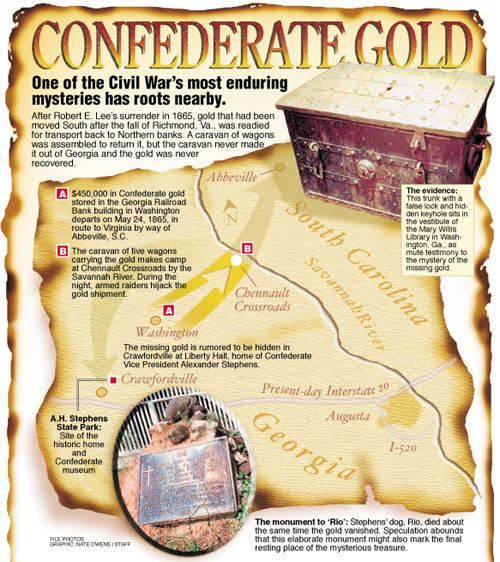
THE ENDURING LEGEND ABOUT "LOST CONFEDERATE GOLD"
One of Georgia's most lingering and possibly lucrative mysteries is that of the lost Confederate gold. Worth roughly $100,000 in 1865, when it disappeared, it would be a small fortune in today's dollars--around $1 million.
On the night of May 24, 1865, two wagon trains filled with gold, one containing the last of the Confederate treasury and the other money from Virginia banks were robbed at Chennault Crossroads in Lincoln County.
Chennault Plantation, owned by Dionysius Chennault who was an elderly planter and Methodist minister, played a significant role in the story. The gold was to be returned to France who had loaned the money to support the Confederacy. Jefferson Davis had given his word that the gold would be returned regardless of the outcome of the war.
Towards the end of the war, Captain Parker of the Navy and a group of other volunteers brought the gold from Richmond, Virginia, to Anderson, South Carolina, by train and from there by wagon hoping to get to Savannah to load it on a waiting ship.
Parker was to camp outside Washington, Georgia, where he was to meet with Jefferson Davis and receive further instructions. Parker's group camped on the Chennault place and then received word to proceed on to Augusta and then Savannah while avoiding contact with the large number of Union troops present in Georgia.
Accordingly, the group set out on their assigned mission, but unfortunately, their scouts met Union troops before they got to Augusta. The group returned to the Chennault Plantation. Parker was unable to receive further instructions from Davis because he had already left Washington.
It was on this night that the gold disappeared in a hijacking about 100 yards from the porch of the house. One theory says that the treasure was buried at the confluence of the Apalachee and Oconee rivers. Some say that the gold was divided among the locals.
Union troops later came to the Chennault Plantation to find the gold. They tortured the occupants of the house trying to force them to reveal where the gold was hidden but to no avail.
The entire Chennault family was taken to Washington, D.C. to undergo intensive interrogation. They were questioned thoroughly as to the whereabouts of the gold, but the Chennaults could not tell anything that was not already known. They were released a few weeks later and returned to their home in Georgia.
As time went by, the Chennault plantation became known as the "golden farm," and for many years after that people came there to search for the missing gold. Down through the years, many gold coins have been found along the dirt roads near the plantation following a heavy rain storm.
Legend still persists that the treasure was hastily buried on the original grounds of Chennault Plantation and remains there today.
Courtesy: Robert Mestas