On-chain analytics research hub providing consulting services and creating content. We deliver data-driven insights and research on blockchain ecosystems.
When looking at the competition between @Polymarket and @Kalshi, it's noticeable that there was a real inflection in Polymarket's volume and TVL growth when Polymarket made fees live this spring, while Kalshi's volume continues to go straight up.
It will be interesting to see if Polymarket can reverse this downtrend.
Craft (@craftsdev) first launch just went live — @refihub, a solar RWA ICO on Solana: tokenized revenue-share stakes in operational solar plants that pay investors USDC as the electricity sells. The raise is a sealed-bid auction for 14% of the company across a $4M–$8M valuation band — bids stay private and everyone settles at the same clearing price, for a total of roughly $400K–$1.12M.
Since bidding opened, the book has been filling steadily: ~$85K in USDC committed across 54 bidders over 74 deposits. It's retail-shaped so far — the median bid sits around $500, with most participants clustered in the $100–$1K (26 bidders) and $1K–$10K (19 bidders) ranges. The largest single bidder is ~$25K, and no tickets above $100K have landed yet. That puts the raise roughly a fifth of the way to the floor of its target band, with the auction still open.
@UmbraPrivacy, a privacy-focused payments app on @solana, moved from a TestFlight beta to a public App Store release on May 30. The app handles ordinary wallet functions — sending and receiving tokens — but its defining feature is shielded transfers: users deposit assets into shared on-chain pools and can then send or withdraw to other wallets in a way that severs the public link between sender and receiver. Because funds are commingled in the pool, an observer can see money enter and leave but cannot reliably match a withdrawal to the deposit that funded it.
The pools currently support seven assets: USDC, USDT, SOL, Umbra's native UMBRA token, a cash-like token, and two tokenized equities — Tesla (TSLAx) and an S&P 500 product (SPYx) — letting users route stablecoins, SOL, and tokenized stocks through the same privacy layer.
On-chain, value locked across the pools has grown from near zero in March to roughly $460K as of June 1, though it's concentrated: the native UMBRA token accounts for about 73%, with USDC, USDT, and SOL making up most of the rest. Weekly flows show roughly $1.2M deposited against $800K withdrawn since late March with deposits exceeding withdrawals in most weeks.
@zinc_cash is a new proof-of-work protocol Solana similar to @ore that uses @Arcium's encrypted MPC layer to keep mining inputs confidential — i.e., the work submitted to claim the token isn't published in cleartext on-chain.
So far (~2 days live). Circulating supply rose from ~65.4K ZINC at May 26 14:00 UTC to ~130.6K by May 27 18:00 UTC, but the growth pattern is bimodal rather than smooth: roughly half the supply was minted in the first three hours after launch, and the remainder has accrued at a near-linear ~200–400 ZINC/hour since, with a visible flat patch around May 27 13:00–14:00 UTC.
Over a 28-hour window covering most of that period, the program absorbed ~$439K of SOL, of which $422K (96.3%) came through automine and only $16K (3.7%) through manual mining.
@clawpumptech is a token launchpad on solana built for AI agents to mint @Pumpfun tokens and earn from trading fees. agents hit one API endpoint with name/symbol/image/wallet, the platform deploys the token, and @Pumpfun's 1% creator fee gets split 65% to the agent, 35% to clawpump. 10% of the platform's cut subsidizes free launches.
product is live with a full API and MCP server, and they've submitted to colosseum. their own token $CLAW is on @Pumpfun and pumping.
onchain since feb 20:
- $79K gross USD distributed
- 240+ unique bot wallets paid out
- one bot (squire_bot) accounts for ~60% of revenue
- agents earned ~$51K, platform kept ~$28K|
revenue was lumpy through feb-april, mostly spike days from one-off agents. last week broke the pattern. consecutive ATHs, with 5/23 closing $3.5K agent and $1.9K platform, the biggest sustained run since they launched.
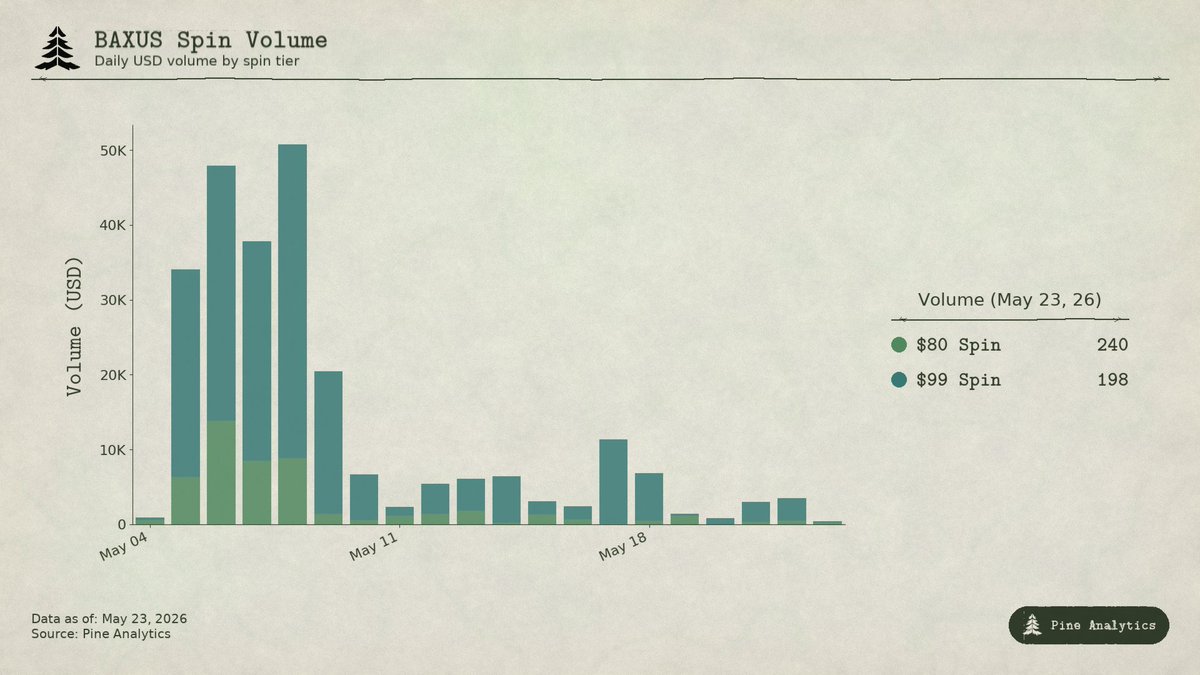
In early May @BAXUSco launched its gacha spin machine, giving users a way to spin for high-end liquor — rare and expensive bottles that would normally trade on the BAXUS marketplace. The first three weeks of activity are now on-chain.
Across 129 unique wallets, the machine has processed roughly $251K in total spin volume, split between two tiers: a $80 spin and a $99 spin, with the $99 tier driving ~80% of volume. Activity peaked May 5–9 (with a single-day high near $50K on May 8) before cooling into mid-May. Engagement is heavily concentrated — the top 10 wallets account for 47% of all spin volume, and the top 50 account for 86%.
Mechanically, each spin is structured to return roughly +15% expected value in bottles to the player, but BAXUS offers an instant buyback at 85% of the bottle's listed value. Because most players take the buyback in cash rather than taking delivery of the bottle, the house captures the spread on the vast majority of spins, netting an estimated $2–$4 in operating margin per spin regardless of which bottle is pulled. At a blended take rate of ~3% of spin volume, that puts BAXUS's gross operating profit from the machine at roughly $7.5K so far.