As you read so much trading BS on this platform from fakes, frauds and misguided newbies, please listen to me as I have nearly 30 years experience and have created more millionaires from scratch than anyone --
Recognize that 90%+ of traders lose, hardly anyone ever makes millions of dollars let alone a solid income and for many of those who even do manage to make $, they either risk far too much where 1-2 mistakes can wipe out months or even years of hard work, or blow them up completely, or more often they usually slave away their lives and completely miss out on why trading can be SO GREAT when done the proper way where you get to make money AND live well!
You do NOT need to sit in front of your computer 24/7 and watch randomness and chat with leper losers in toxic chatrooms, you do NOT need to use leverage, go all in or #HODL or even take big stress-inducing risks to make big money over time and you certainly do NOT need to struggle or fail as much as most people do if you learn from the past and from others like me who have seen everything over several decades.
Listening to newbies who haven't figured it out yet or those who don't learn from the past condemn themselves to repeating the same mistakes that far too many people in this pathetic industry do day after day after day...especially in absolutely beautiful market environments like this for those who are prepared vs. the vast majority who have gotten decimated the past few weeks due to lack of preparation and following the advice of dangerous scumbags like Saylor/Cammillo/Ponzi.
How do I get this through to more people -- prioritize studying the past, review your plans and execution in the present, trade safe/scared and meticulously like a damn coward and you will plant seeds every day to gradually reap the rewards of your boring daily habits over time.
Study more but trade less (only quality setups you optimize through your reps) and then go about and enjoy your life as its quality over quantity and getting out and adventuring/working out/traveling/giving back via charity after you study/nail solid trades actually protects you from over-trading and taking low-odds setups that consume/frustrate the majority of degenerate gamblers who mistakenly believe that more trades and more screen time does them good, which is actually counter-productive.
Retweet this if you promise to study hard, execute well and also go live to TRULY capitalize on how magnificent it is to be a successful trader!
Saturday review. Not grading P&L today, grading process: checklist before every trade, micros only, let the ATM do its job. The edge isn't a setup. It's refusing to be Panicky Pete. Rest up, back at it Monday.
Friday is when Panicky Pete shows up looking for one more trade. Not today. Checklist first, micros only, let the ATM work. No panic exits, no revenge, no full-porting. Protect the account, protect the edge.
Checklist before every entry. Micros only. Stick to the ATM. No panic exits, no revenge trades, no full-porting. Panicky Pete stays benched. Patience is the edge.
The disciplined trader's staircase. One A+ setup. One trade. Done. Every rung is a day I honored the plan, not the noise. Overtrading shrinks your edge with every extra click. This one compounds it. Same staircase, opposite direction. The longer you climb, the taller it gets.
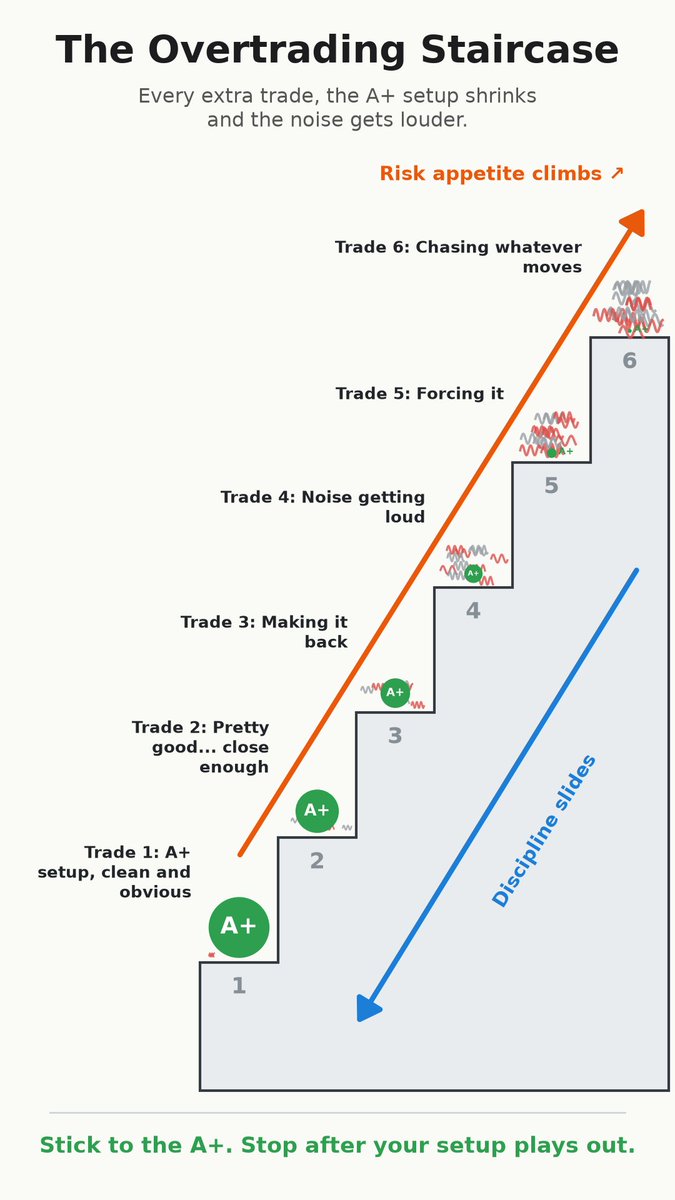
Less trades are your edge. The overtrading staircase. Every extra trade, your A+ setup gets smaller in your head and the noise gets louder. Risk appetite climbs, discipline slides. Take the A+ and walk away. Make that your trading edge.
Trader made $300 on three trades this morning. Then he averaged into a losing position and lost the whole $50K prop account.
The edge was never in the averaging — it was in the first three trades.
You're a dangerous person if you can fight your own demons in private alone, then reset, restart, reform, and rebuild your edge again — because the market doesn't care if you're in pain.
The market doesn't care about your feelings, it only cares about your edge. Build a plan, trust the process, and adjust when the data tells you to, not when your emotions do.
A MUST READ FOR TRADERS - long but worth it
One of the hardest things in trading isn’t being right. It’s consistently doing the right thing.
And that’s not simply a "discipline problem".
It’s neurochemistry + psychology working against you.
Impulsive trades often create bigger dopamine spikes than disciplined ones.
It's what neuroscientists call Reward Prediction Error.
Surprise rewards from impulsive behavior produce larger dopamine surges, making the behavior more likely to repeat.
Now layer in variable reinforcement... the same mechanism that makes slot machines addictive.
Even if most impulse trades lose, the occasional winner rewires your brain far more powerfully than the losses.
And your ego then seals the deal:
“See? It worked"
No.... it was a reinforced compulsion
Markets are dangerous because:
• Bad process can pay
• Good process can lose
• Feedback is immediate
Your brain often learns the wrong lesson.
✅The solution is counterintuitive:
Stop celebrating wins.
Start rewarding disciplined execution regardless of outcome
Did you follow your plan, size correctly, respect risk?
That’s the win... regardless of P&L.
Rewiring doesn’t happen once. It happens through repetition.
Consistency isn’t willpower.
It’s training your nervous system to want the right reward.
If this resonates, follow, like, r/t, BOOKMARK this post.
#tradingmindset #traderperformance #tradingpsychology $ES_F $NQ_F $QQQ $SPY
I’ve become increasingly interested in the relationship between dopamine, effort and waiting in trading.
Because trading creates a strange problem for the brain.
Think about what happens when you're sitting in front of your screens with no position on.
You're watching. Waiting. Nothing quite meets your criteria.
Then you enter a trade.
Immediately your internal state changes. You have risk on. Price is moving. P&L is changing. There is anticipation and stimulation.
Something is happening.
That experience can become reinforcing even when the trade itself isn't particularly good.
Over time, a trader can unintentionally learn to associate being in a trade with stimulation and being flat with boredom, discomfort or the feeling that he's missing something.
This is one reason overtrading isn't always solved by better discipline.
You can have rules. You can tell yourself to be patient. But if your nervous system has learned that taking action relieves the discomfort of waiting, you've practiced a very powerful loop:
Discomfort ➡️ trade ➡️ relief.
And modern life gives us plenty of practice with this.
Bored? Pick up the phone.
Uncomfortable? Scroll.
We rarely have to sit with an uncomfortable internal state for very long.
Trading often demands the opposite.
You prepare. You wait. You pass on trades that are almost good enough. You watch the market move without you. Sometimes you execute extremely well and still lose money.
Part of developing as a trader is changing what you experience as rewarding.
You waited 45 minutes and didn't take the mediocre setup?
Good.
You felt anxious as the market moved without you and didn't chase?
Good.
You took the planned loss instead of moving your stop?
Also good.
This matters because markets sometimes reward terrible behavior.
You chase, break your rules, size too large and make money.
Your brain received a reward even though your process was terrible.
The opposite happens too. You wait for your setup, manage risk properly, execute exactly according to plan and lose.
Good process. Negative reward.
This is why I spend so much time with traders working on what happens internally before the mouse gets clicked.
What does waiting actually feel like?
What happens in your body when the market starts moving without you?
Can you experience the urge to participate without immediately turning that urge into action?
Rules and intentions matter. So does training your nervous system to tolerate the space between opportunity and action.
Eventually, restraint itself can become rewarding.
Passing on a mediocre trade starts to feel like good trading.
A planned loss feels different from an impulsive one.
And being flat doesn't automatically feel like you're missing out.
Sometimes the discomfort you're feeling is simply the experience of waiting for your market.
And sometimes the best trade you make all day is the one you wanted to take, but didn't.
Flat is a position.
If this resonates, follow, like, r/t, BOOKMARK this post #tradermindset #tradingpsychology $ES_F $NQ_F
$SPY $QQQ
Watching other traders blow up their accounts has taught me more about my edge than any winning trade ever did. Every time I see someone else's mistakes, average in, revenge trade back to even, I see the exact mistakes I used to make, and it reminds me why my rules exist. It's the sad truth that I learned discipline by watching other people pay for the lesson instead of me.