Huge thanks for all the love on the 🌱Snatch Farm video! 🚜
A lot of you slid into my DMs asking the same thing.
"Is this thing actually real? Or just a demo you cooked up for the vibes?"
Well, on a quick break today, I went ahead and hooked it up to the @risextrade exchange for real. and yeah, I opened an actual position. (Careful now... this is real real-time response speed)
Oh, and of course I shipped a few new features while I was at it:
1. Fanfare mode 🎺 — flex your position to everyone else (publicly share your trades)
2. Shoveling SFX — satisfying digging sounds on entry/exit
3. Live exchange sync — real equity & positions pulled straight from your account
4. Exchanges that aren't connected? Those plots stay locked. 🔒 (more exchange stay tuned…)
Sure, leverage logic and a few rough edges still need polish — but the core thing actually works. And once this is dialed in, I'm telling you with full confidence: this is going to be a whole new way of approaching perpDEX.
The rest of the exchanges are getting onboarded soon, and a lot more features are on the runway. 🛬
Stay tuned. 👀
TGE in Motion? Again? $INK
@inkonchain -chain update
1/ Footprints recap
1. 2024-10 — Ink chain announced (Kraken-incubated)
2. 2024-12-16 — Mainnet live
3. 2025-06-17 — INK token announced (1B fixed supply)
4. 2025-09-09 — Token contract deployed, 1B minted, ownership → Safe
5. 2026-01-22 — MerkleVester deployed
6. 2026-02-06 — Safe → MerkleVester: 40,000 INK (initial seed)
That was then. Here's what happened after.
2/ Apr 22–28: First external distribution test
Safe sent 100 INK to an Ops EOA as a whitelist check. That Ops EOA then pushed small amounts out to two fresh addresses on Apr 28.
Amounts weren't round numbers — 4.873 INK, 3.788 INK. That's not a manual send. That's a Merkle proof claim simulation. These two addresses are effectively the first external recipients of INK.
3/ May 8: The real signal
Safe → MerkleVester: +3,000,000 INK
MerkleVester balance went from 40,000 → 3,040,000 INK overnight. 75x increase. This isn't a test. Real vesting allocation just got loaded.
The Feb deposit was infra setup. This one is pre-TGE positioning.
4/ What hasn't moved — and why it matters
The 19% EOA (0xEE9e89...) still holds exactly 190,000,000 INK. Zero transactions since it was funded in Oct 2025.
This is likely the public airdrop allocation. When this wallet moves, that's your TGE countdown signal.
Safe still holds ~805.9M INK. Nothing else has left treasury.
5/ Signal scorecard
✅ 1B fixed supply — confirmed
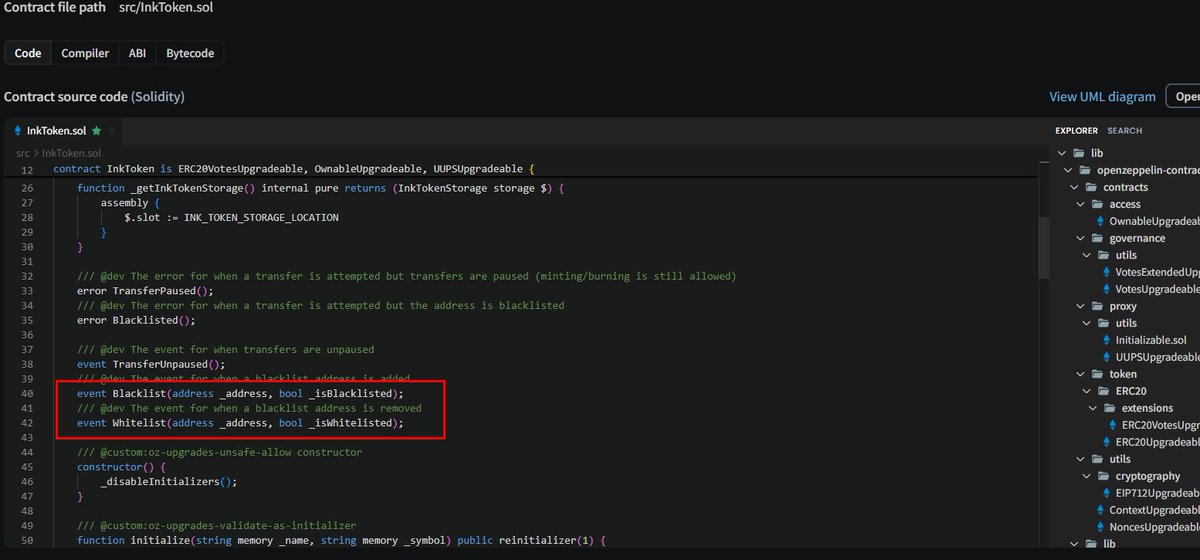
✅ Compliance infra (blacklist/whitelist) — live
✅ MerkleVester operational — 3.04M INK loaded
✅ Merkle claim test — passed, first external recipients confirmed
✅ 3M vesting allocation deposited — May 8
⏳ 19% EOA (190M INK) — still dormant
⏳ Merkle root upload — pending
⏳ Whitelist expansion — pending
6/ What to watch
Three on-chain triggers before TGE:
- MerkleVester Merkle root set transaction
- setWhitelist calls spiking on the token contract
- 19% EOA (190M INK) first movement
That last one is the gun going off. Everything else is just loading the chamber.
$INK TGE: Q3 2026. On-chain says sooner.
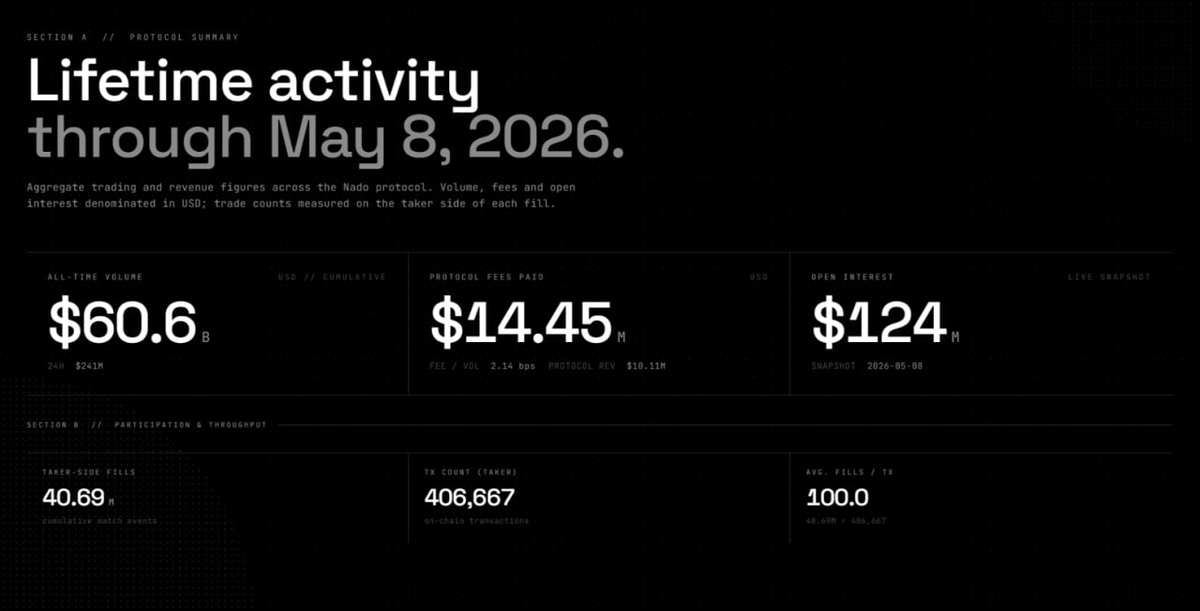
Nado Protocol - Lifetime Activity (as of May 8, 2026)
@nadoHQ Report
/Still one of my go-to perp DEXs — NADO. The team hinted on their Telegram channel that the largest $INK airdrop allocation will go to NADO 👀
/Personally, I think running the $INK TGE before the KRAKEN IPO would be the more accountable path for price-building — but based on recent news flow, it really feels like the IPO is going to land first.
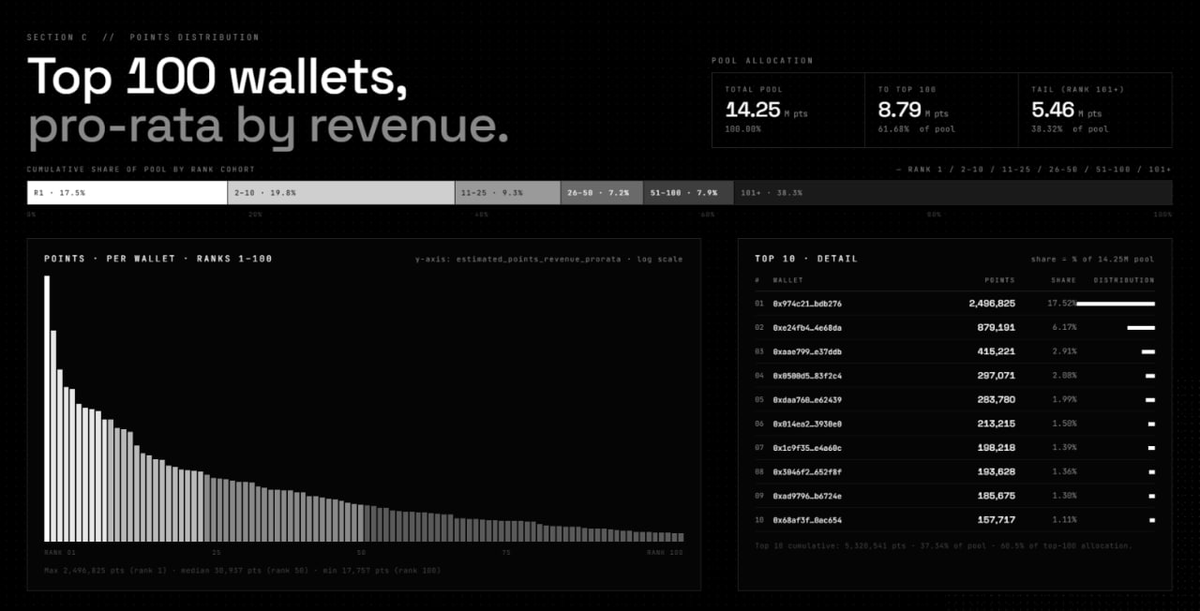
/If you calculate points purely on a "fees paid" basis, the top 100 wallets capture ~60% of the entire pool. Under this logic, the #1 wallet alone holds around 18% — almost certainly a market maker. I cross-checked the formula against my own wallet and the numbers line up pretty closely.
A. Protocol Summary
-Cumulative volume: $60.6B (24h: $241M)
-Daily volume holding in the $200–400M range
-Protocol fees paid: $14.45M (fee rate 2.14 bps, protocol revenue $10.11M)
-Open Interest: $124M (live snapshot, 2026-05-08)
B. Participation & Throughput
-Taker-side fills: 40.69M (cumulative match events)
-On-chain TX (taker): 406,667
-Avg. fills / TX: 100.0
C. Top 100 Wallets (points estimated from fees paid)
-Total pool to date: 14.25M pts (100%)
-Top 100: 8.79M pts (61.68%)
-Tail (rank 101+): 5.46M pts (38.32%)
and... check RWA Boost
🧵 @risextrade Report
- A fully onchain Perp DEX running on Ethereum L2.
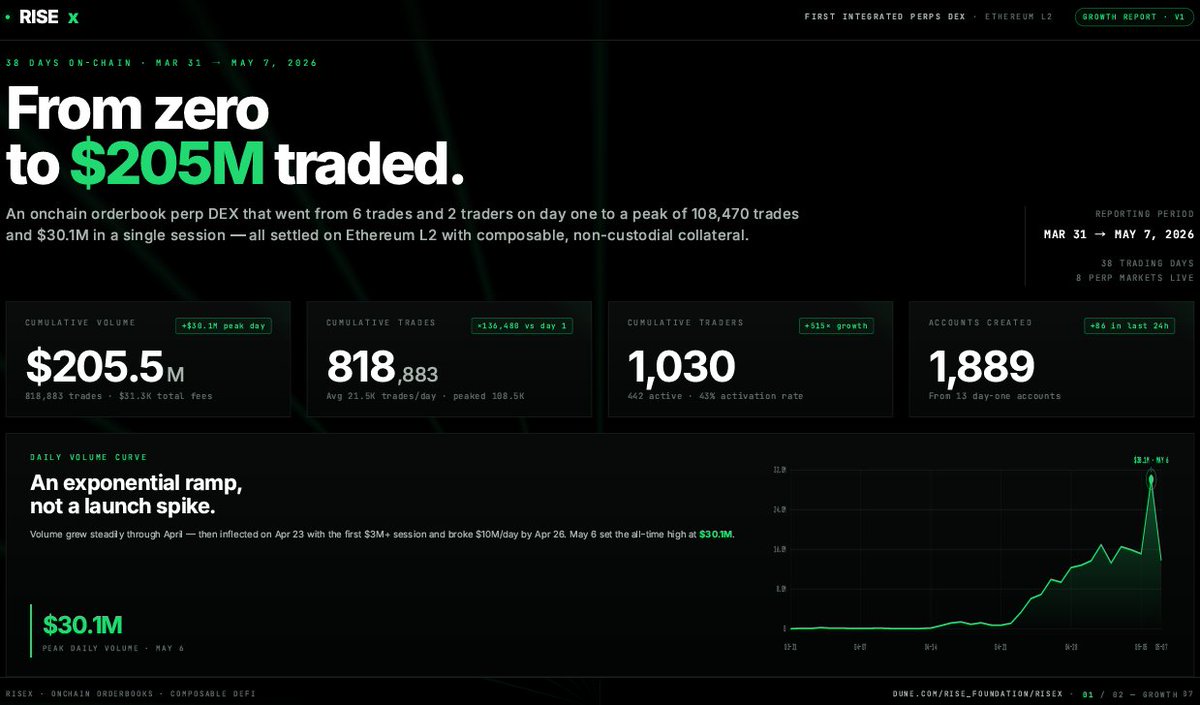
Day 1: 6 trades, 2 traders. Now: $205.5M in cumulative volume.
"This isn't a launch spike. It's an exponential ramp."
1/ Key Metrics
- Cumulative Volume: $205.5M
- Cumulative Trades: 818,883
- Cumulative Traders: 1,030 (+515x)
- New Accounts: 1,889 (+86 in last 24h)
- Daily ATH: $30.1M (May 6)
- Avg 21.5K trades/day, peaked at 108.5K.
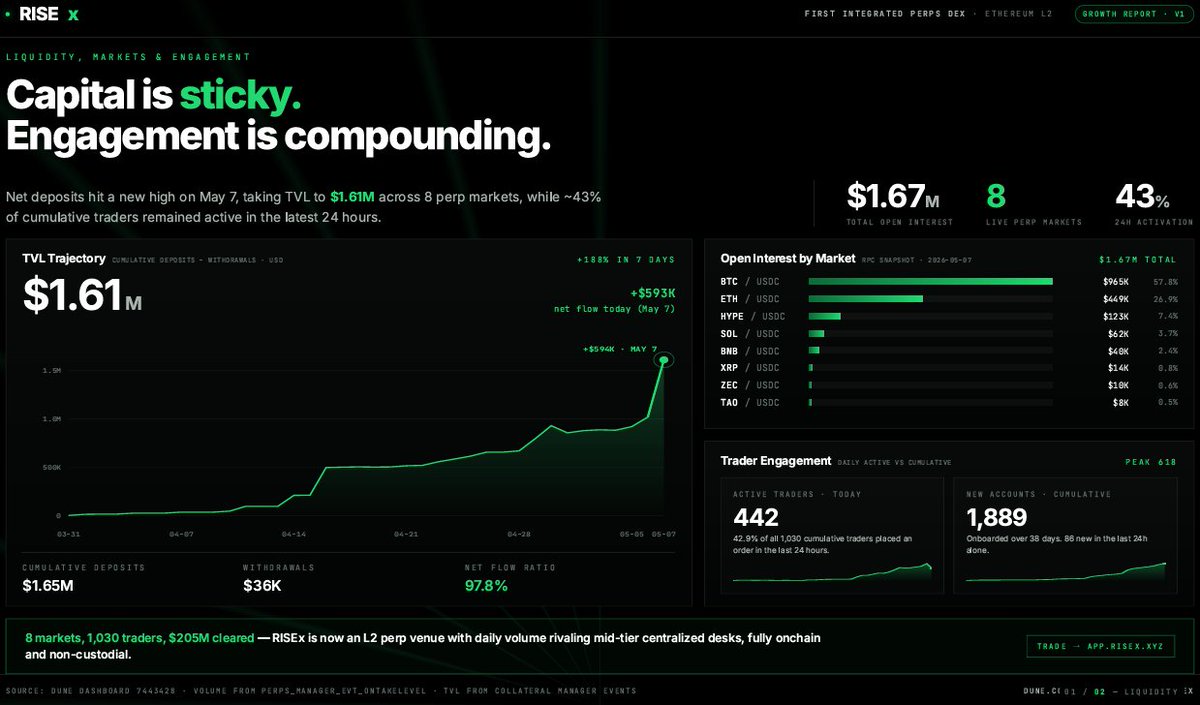
2/ Capital is sticky.
- TVL: $1.61M (+188% in 7 days)
- Cumulative Deposits: $1.65M
- Cumulative Withdrawals: $36K
Net Flow Ratio: 97.8%
The money comes in and doesn't leave. In a fully onchain, non-custodial collateral structure, that number means something.
3/ Open Interest by Market
- Total OI: $1.67M across 8 live markets.
BTC/USDC — $965K (57.8%)
ETH/USDC — $449K (26.9%)
HYPE/USDC — $123K (7.4%)
SOL, BNB, XRP, ZEC, TAO
BTC and ETH account for ~85%. Liquidity is concentrated in majors.
4/ Engagement is compounding.
442 out of 1,030 cumulative traders placed an order in the last 24 hours. 24h Activation Rate: 43%.
CEX-level retention, built onchain.
5/ Bottom line
8 markets. 1,030 traders. $205M cleared.
A fully onchain, non-custodial L2 Perp DEX moving fast. Worth paying attention to.
All-time volume 1M+ achieved.
@risextrade is operating in private-only mode. The codes I initially shared with the community have all been used up, but I've secured 5 additional codes.
The more people who onboard, the richer RISEx exchange's liquidity will become, and the remaining shortcomings "in liquidity" will also be addressed. In terms of speed, it already shows the best metrics.
Join my team. Feel free to DM me, or leave a comment and I'll DM you.
RISEx Metrics Interpretation
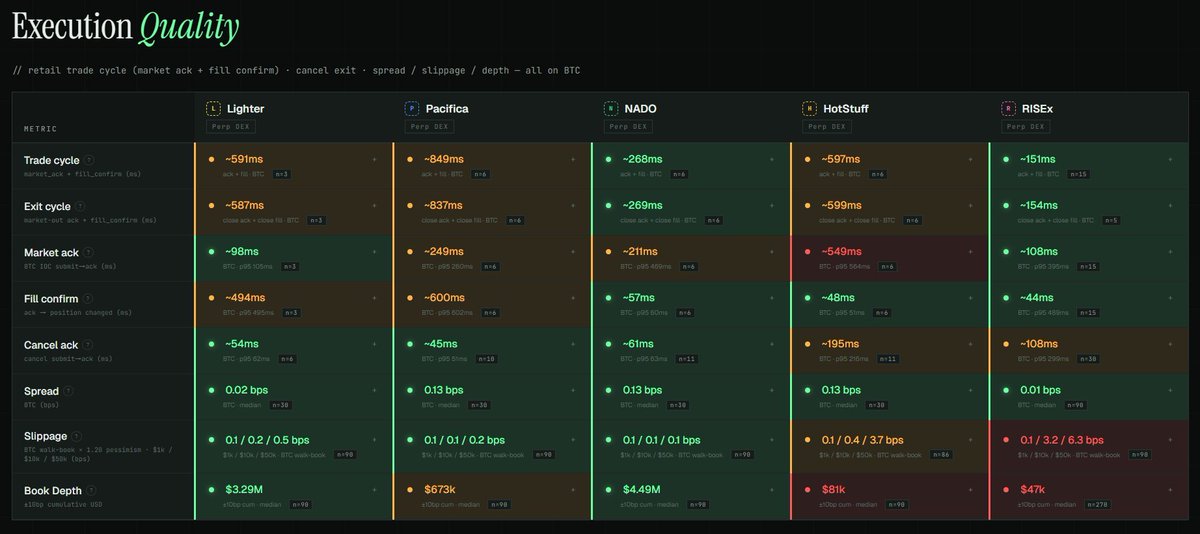
1. Trade cycle: 151ms (n=15) — #1 out of the 6 venues measured. Significantly faster than NADO (268ms) and Lighter (591ms). Highly attractive for arbitrage and signal-following bots, where speed from signal detection to entry is everything.
2. Exit cycle: 154ms (n=5) — #1. Market-order liquidation completes in 0.15 seconds. Best-in-class responsiveness for stop-loss and kill-switch bots. Market ack: 108ms — #2 behind Lighter (98ms), but effectively tied. Solid matching engine responsiveness.
3. Fill confirm: 44ms (median) — Fastest among the 6 venues (vs. NADO 57ms, Pacifica 600ms). Position state is recognized almost simultaneously with the ack.
4. Spread: 0.01bps — Tied for #1 with Lighter. Baseline entry/exit cost is essentially zero, minimizing friction for two-way trading.
By these 5 metrics alone, RISEx is "the fastest venue" — a fantastic environment for small-size HFT.
My personal thoughts on Pre-TGE Perp DEXs
1. @grvt_io : They've already delayed their TGE.
2. @variational_io : A refreshing approach in an otherwise overly predictable Perp DEX narrative.
3. @EVEDEX : A GameFi-integrated exchange with plenty of opportunities to scoop up.
4. @pacifica_fi : An L1 following Hyperliquid's playbook. No VCs, but very smooth operations.
5. @StandX_Official : Native yield is their strength. But the UI is honestly too much for me.
6. @extendedapp : A truly clean, no-frills exchange.
7. @nadoHQ : If you believe in Ink, NADO is the best pick.
8. @hibachi_xyz : An exchange that needs to be a bit more aggressive.
9. @tradehotstuff : Remarkably well-built considering its trading volume. Fee structure is S-tier.
10. @risextrade : Noticeably fast. If liquidity fills in, their growth will be exciting to watch.
Share your thoughts in the comments too.
조용하게 광적인 솔라나의 x402 집착
- x402는 HTTP 402 상태 코드를 활용한 인터넷 네이티브 마이크로페이먼트.
/ x402의 홈그라운드는 @coinbase. 하지만 솔라나는 재단 차원에서 공격적인 푸쉬로 실질적 x402 볼륨/거래수에서 1등을 달성.
/ 전용 도메인과 가이드. 그리고 해커톤. 그리고 모멘텀 유지를 위한 펀딩까지. 작년 10월에 진행했던 솔라나 x402 해커톤에서는 5개 팀이 우승(저비용 IoT 자가 결제/AI 기반 주문 자동화/AI 기반 온체인 신용 평가 등) @x402
/ 작년 8월 첫 공개 후, 12월 솔라나 재단 발표. 그리고 올해 릴리즈된 Kora. Kora는 Solana 체인에서 $SOL gas가 없어도 USDC로 gas 처리가 가능한 방식. (에이전트가 USDC를 Kora 노드로 보내서 Kora가 SOL로 가스를 대납해주는 서비스)
/ 다 죽은 시장이지만. 블록체인의 오리지널 컨텐츠인 1. 장부로서의 기능. 그리고 2. 마이크로페이먼트의 상방은 남아있지 않을까.
아직까지는 x402 시장이 미성숙하다는 평가도 많고. 수요에 대한 의문이 있는 시장이지만. 가까운 시일내에는 강하게 올 (어쩌면 솔라나에서) 내러티브가 아닐까.. 생각하면서
@PayAINetwork@dexteraisol@Darks0l_@daydreamsagents
My @risextrade invite codes, which I worked hard trading to earn, got snatched up by bots.
I distributed codes proportional to my trading volume so that as many people as possible could use them. But most of the users who redeemed these codes were bot accounts that only attempted access with the code and never actually deposited into a real account.
So. I've traded again and generated new codes.
If you're a real user who wants to use one, drop a comment on this tweet or send me a DM and I'll send you a code.
Here's what I can promise: once a referral system is in place and I'm able to set the revenue split between users and myself, I will set it so that 100% of the rewards go to my referrees. You have my word.
RISEx just launched as an exchange - volume is still small. You can guess what that means, right?
🧵 Just finished benchmarking @extendedapp 's performance.
Results are honestly surprising.
TL;DR @extendedapp is a tier-1 venue across nearly every dimension.
1/ The Numbers
- Market ack: 46ms — fastest tier among 7 venues tested. Off-chain matching keeps the critical path tight.
- Cancel ack: 42ms — excellent. Cancel speed is the core KPI for maker bots (how fast you pull stale quotes when price moves = how well you avoid adverse selection). 200ms is the danger zone. 42ms gives you 5x headroom.
- Slippage: 0.1 / 0.1 / 0.1 bps — completely flat across $1k / $10k / $50k. Only NADO and Hyperliquid match this.
- Book depth: $4.58M — #2 behind Hyperliquid ($9.95M), neck-and-neck with NADO ($4.49M).
- Trade cycle: 379ms / Exit cycle: 380ms — open and close are virtually symmetric. Most venues have a slower close leg (Hyperliquid: 842ms open vs 905ms close). Extended is stable on both sides — meaning you can exit as fast as you can enter, which matters a lot for risk management.
2/ The Weaknesses
- Fill confirm: 334ms — the real weak spot. Noticeably slower than peers, and this is the one thing retail users feel directly while trading. (Try it yourself — you'll notice.)
For bots that wait on fill confirmation before making the next decision (signal-following, arbitrage), this 334ms eats most of the trade cycle. For fire-and-forget patterns (makers, volume farming), it's basically irrelevant.
- Spread: 0.13 bps — good, but not #1. Lighter and RISEx sit at 0.01 bps (13x tighter). Each trade carries a 0.13bp baseline cost — small for makers (you set your own quotes), but for high-frequency takers, trades × 0.13bp adds up. Still well inside the 5bp danger line.
3/ Who Should Use Extended
- Maker bots (post-only) — top tier.
Volume farming bots (alternating, net=0) — elite tier. The combination of 46ms market ack × $4.58M depth × flat 0.1bp slippage is brutal.
- Risk management / stop-loss bots (fast exit on large positions) — elite tier. 380ms exit cycle is #2 only behind RISEx (145ms). Extended is essentially the only venue that combines $4.58M depth + fast exit cycle — meaning you can carry size and still get out fast.
- Retail (manual click traders) — fine.
*Extended
Extended is a @Starknet -based perpetual DEX built by an ex-Revolut team, running a hybrid CLOB architecture — order matching and risk management happen off-chain, while settlement is handled on-chain on Starknet.
Check @risextrade speed
You can request an API account from the team and secure a lower-latency account.
Out of the multiple bots I run, RISEx will be my main venue for HFT trading.
Join the snatch team using the codes below. For members who use my code and build volume, I'll send a GitHub invite to share the source code of the bot I'm using. send me DM
1PJ2PK1N, I0I6QNLX, 1EH2Q2JS, 2QK6UX8U, P5VCIU4Q, 0H04LN6B, 9EGZV23F CEQ19WT0, JGU4PJUW, L6WMMS9O
RISEx Metrics — Interpretation
1. Trade cycle: 151ms (n=15) — #1 out of the 6 venues measured. Significantly faster than NADO (268ms) and Lighter (591ms). Highly attractive for arbitrage and signal-following bots, where speed from signal detection to entry is everything.
2. Exit cycle: 154ms (n=5) — #1. Market-order liquidation completes in 0.15 seconds. Best-in-class responsiveness for stop-loss and kill-switch bots.
Market ack: 108ms — #2 behind Lighter (98ms), but effectively tied. Solid matching engine responsiveness.
3. Fill confirm: 44ms (median) — Fastest among the 6 venues (vs. NADO 57ms, Pacifica 600ms). Position state is recognized almost simultaneously with the ack.
4. Spread: 0.01bps — Tied for #1 with Lighter. Baseline entry/exit cost is essentially zero, minimizing friction for two-way trading.
By these 5 metrics alone, RISEx is "the fastest venue" — a fantastic environment for small-size HFT.
Thank you for showing so much interest in my report.
After the perpdex performance comparison, many projects requested that their exchanges also be included in the measurements.
The perpdex exchanges I’m currently planning to include are listed below.
@StandX_Official , @EVEDEX , @extendedapp , @hibachi_xyz , @synthetix , @01Exchange , @perpltrade , @DecibelTrade
And coming soon, Parts 2 and 3 will be released:
Part 2. Perpdex’s bid tracking (Binance) fee structure
Part 3. Results from parallel execution of the same bot
Thank you for always listening attentively.
Re-measured during weekday hours with ample liquidity.
6 Exchange API Benchmark
- (HL / Lighter / Pacifica / NADO / RISEx / HotStuff)
1. Key Metrics
market_ack: order → exchange ack
fill_confirm: ack → position reflected
cancel_ack: cancel response speed
depth/slippage: book depth and execution cost by size
2. Exchange Highlights
@HyperliquidX : $9.95M depth + flat 0.1bp slippage across sizes, optimal for large positions & manual traders
@Lighter_xyz : #1 ack at 51ms, 0.01bp spread, strong across nearly every strategy
@pacifica_fi : 47ms cancel, optimized for maker strategies
@nadoHQ : balanced all-rounder across every metric, the default pick
@risextrade : #1 across all latency metrics, optimal for small-size scalping & HFT
@tradehotstuff : value depends on incentive structure
3. Recommendations by Strategy
- HFT/scalping: RISEx
- Maker bots: Pacifica, Lighter
- Signal/arbitrage: NADO
- Large positions: Hyperliquid
- Delta-neutral/points farming: NADO + Lighter + Pacifica + HL
- Manual traders: Hyperliquid
Full REPORT in the quoted post below.
I'm starting a performance evaluation of currently available perpetual DEXs. Instead of relying on exchanges' marketing claims about speed, I'm measuring real user-perceived latency based on actual API trade responses.
Here are some interesting findings to share.
(For detailed Speed, Spread/Slippage, and Market Depth rankings, see the article below.)
Speed Rankings
1st — @nadoHQ : Trade cycle 268ms (dominant #1), fill_confirm 57ms (#2). Market ack at 211ms is average, but fast fill recognition delivers the shortest end-to-end latency.
2nd — @Lighter_xyz : Market ack 98ms (the only sub-100ms result), cancel ack 54ms — strongest in the ack category. Weakness: fill_confirm at 494ms (REST polling). Strong for signal-based trades.
3rd — @risextrade : Fill_confirm 41ms (shortest), trade cycle 435ms in the upper-mid range. Weaknesses: market ack 395ms, cancel ack 293ms (longest).
4th — @tradehotstuff : Aside from fill_confirm at 48ms (#2), everything else is weak. Market ack of 549ms is the worst (cumulative cost of EIP-712 signing + POST /info), cancel ack 195ms.
5th — @pacifica_fi : Only cancel ack at 45ms (shortest) is competitive. Trade cycle 849ms and fill_confirm 600ms make it the slowest overall.
These are the results from testing during the weekend when liquidity is thin. Additional tests are planned
Please let me know which exchanges you'd like me to include, and I'll add them to the testing lineup.