@ErikLindy@davepl1968 The book is worth it. Author does not bog down in the horrific details — in a way, keeping it less graphic better enables the reader to THINK about it — which is the point. Piekoff takes the same approach in The Ominous Parallels (maybe the best book on the subject of “HOW?”)
@EchoesofWarYT You bring it to life, Lad. Often dubbed the first actual modern war, the lessons learned and as-yet-unlearned-until-studied-later. . . It was massive in layers political, logistical and operational. Keep it coming, please.
@Handre LOVE me some Dr. Sowell. Methodological MONSTER. Hard to refute a man who has engaged in SHOWING more than just TELLING (though he’s a master of both).
MOST modern scholastics need MORE Sowell-iscipline...
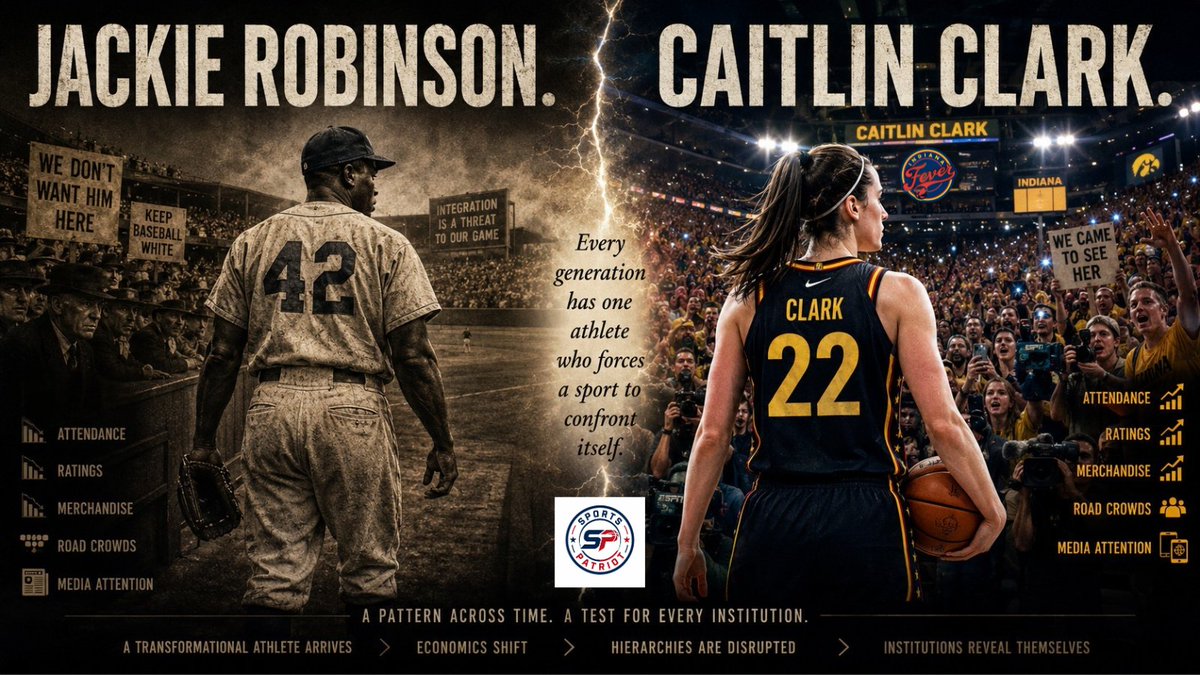
Every generation has one athlete who forces a sport to confront itself.
Not because they're simply great.
Because they become impossible to ignore.
Jackie Robinson did it to baseball.
Caitlin Clark is doing it to women's basketball.
When Jackie Robinson arrived, he didn't just challenge pitchers.
He challenged an established order.
The resistance wasn't merely about baseball.
It was about who belonged.
Who deserved the spotlight.
Who got celebrated.
Who controlled the story.
Now fast forward nearly eighty years.
The WNBA has never had a player who changed its business overnight the way Caitlin Clark has.
Attendance.
Television ratings.
Merchandise.
Corporate sponsorships.
Road crowds.
Media attention.
Every measurable business metric moved.
Yet something else moved too.
Resistance.
Not just from fans.
Not just from media.
From inside the sport itself.
Here's where the conversation becomes uncomfortable.
When we analyze Jackie Robinson, race is considered essential to understanding the reaction he faced.
When we analyze Caitlin Clark, many insist race should not even be discussed.
Why would we use two different standards?
No, the historical circumstances are not the same.
But why should race automatically be central in one conversation and automatically be forbidden in the other?
If Caitlin Clark were a different race or had a different sexual preference, would the conversation surrounding her treatment look exactly the same?
None of us can answer that with certainty.
But pretending the question itself is illegitimate is avoidance.
The interesting similarity between Robinson and Clark isn't the reason for the hostility.
It's the pattern.
A transformational athlete enters an established culture.
That athlete immediately becomes larger than the sport.
The economics change.
The attention shifts.
Existing hierarchies are disrupted.
Some embrace the change.
Others resist it... even when the change benefits everyone financially.
History doesn't repeat itself.
But human nature often does.
Maybe that's the real lesson both stories share.
Now let's look at the pattern.
Not one incident.
Not one hard foul.
Not one controversial opinion.
The accumulation.
The greatest economic catalyst in league history is left off the Olympic team.
The player driving record television ratings and attendance is omitted from the league's 30th anniversary promotional artwork.
Repeated physical plays... some occurring well away from legitimate basketball action... become national stories.
Former players and television personalities repeatedly minimize her impact. Some have argued the league no longer needs Caitlin Clark now that she has "brought the eyes."
Each event, viewed in isolation, can be explained.
Maybe the Olympic roster was about experience.
Maybe the promotional artwork had another creative direction.
Maybe every hard foul was simply part of basketball.
Maybe every television analyst is offering an honest basketball opinion.
Those are all possible explanations.
But many fans aren't reacting to isolated events anymore.
They're reacting to the pattern.
That is why so many people have begun asking uncomfortable questions.
Not because they know the answer.
Because the same answer seems to appear regardless of the question.
When every controversy consistently moves in one direction, people naturally begin searching for a common explanation.
Some conclude the resistance is rooted in jealousy.
Others believe it is about protecting an established hierarchy.
Others see generational resentment.
Others see race.
Others see sexuality.
Others see some combination of all of the above.
The point is not that one explanation has been proven.
The point is that these explanations exist because the pattern exists.
Sports fans have always accepted disagreement.
What they struggle to accept is inconsistency.
If Caitlin Clark's impact is unprecedented, why is acknowledging that impact so controversial?
If she is the league's biggest financial success story, why does recognition of that success seem to divide people rather than unite them?
Those are questions worth asking.
Not because the answers are simple.
But because history has shown us that transformational athletes rarely expose only weaknesses in their opponents.
Sometimes they expose unresolved tensions within the institutions themselves.
@WineDrinkingCT@bhweingarten@DataRepublican I have a scintilla — I think Thomas does a better job than most at research, setting a context, and providing reasons. He also respects “stare decisis” better than most, he’ll disagree with a law, then hold it Constitutional, settling for “persuasive” weight in the future.
@FDRLST Mr. Justice Thomas is my favorite for many reasons, chief along them for his willingness to say: “the Framers clearly intended…” then question the wisdom, then uphold what they intended. He has indicated that AMENDMENT of the Constitution is the solution— not re-interpretation.
@Rothmus I flew w Royal Jordanian Cobra pilots in 1995, for two weeks at King Faisal field. All Jordanians had also trained in America for months. Their opinion on American tourists: their favorites and friendliest: think America is the BEST, and want everyone else to have what they have.
@porterstansb This synopsis is accurate enough to be nauseating. Thank you for the concise summary — so clear that anyone reading it can’t say, “I don’t get it.”
Keep posting!
@SamaHoole One caution to the neophytes: watch yer lower back. It’s easy to try to cheat/rock or arch your back. Stay tight. The “discipline of proper form” applies here, too!
@SamaHoole Genetic variability aside, I was trained as a linebacker by Division I strength coaches. You’re right on the money. 8-12 is the exact range where energy delivery fails the next rep (≈ “stamina”) rather than micro tears/trauma (repair for greater strength/size/power)…