Your HDMI cable leaks your screen as radio waves. In this demo, AI rebuilds the picture from them. No hacking involved. 📡
Here’s the real story, in five questions 👇
1. Is this new?
No. It’s Deep-TEMPEST, a 2024 paper from Universidad de la República in Montevideo, with open code. Reading screens from stray emissions (“TEMPEST”) has been known for decades on old CRT monitors. AI made modern HDMI screens feasible.
2. How does it work?
A software-defined radio picks up emissions from the cable and connectors. A neural network cleans the degraded signal and reconstructs the screen image.
3. How good is it?
Text recognition error dropped from over 90% with earlier tools to about 30% at best, an improvement of over 60 percentage points. Enough to read the gist of text, not a perfect copy.
4. Is it just an antenna and some software?
No. The team used a USRP B200mini radio plus an antenna, an amplifier and filters, and trained the model on about 3,500 samples (over 1,000 of them real captures). It takes real signal-processing skill.
5. How far away can someone be?
The paper doesn’t say. The antenna sat “somewhat close to the cable.” Press coverage floated a car parked near a building, but that wasn’t tested.
Should you worry? The researchers say most people aren’t at risk. Governments and corporations are more likely targets.
The takeaway: security isn’t only about software. Physics leaks too.
Would you have guessed a cable could do this? 👇
Boston Dynamics replaced Atlas’s feet with scooter wheels. It’s not what you think. 🛞
Here’s what the new demo actually is 👇
❌ MYTH: Atlas is going wheeled.
✅ REALITY: Boston Dynamics calls it “a research testbed,” not a product, and says it has no plans to sell it.
❌ MYTH: It’s a whole new robot.
✅ REALITY: Engineers mounted an off-the-shelf scooter rim to each ankle actuator with one custom adapter. Nothing else on the robot was changed.
❌ MYTH: Someone programmed it to skate.
✅ REALITY: It was trained with reinforcement learning in simulation. Rolling emerged on its own. Engineer Andy Wu said he was “pleasantly surprised” that training figured out how to use the wheels during the side dash.
❌ MYTH: It’s just a stunt.
✅ REALITY: The goal was to push the motors toward their torque and speed limits while carrying the robot’s weight. Boston Dynamics says the findings are being applied to the standard legged Atlas, which Hyundai plans to deploy in its plants.
And the party trick: a 360° spin jump, built from human motion-capture data, that worked on the first try on real hardware.
The wheels are the stress test. The legs are the plan.
Wheels or legs: which would you pick for a robot coworker? 👇
This 1994 Jeep has no OBD2 port and no working scan tool. A $3 Arduino and an AI agent made it talk. 🚙
Link to the full video on YouTube: https://t.co/ucsXNEv85J
Creator Muhammad Zulali wired an Arduino Nano to the Cherokee’s engine computer, then let Claude Code (and Codex) loose on it for about a week.
🧾 The receipt
Car: 1994 Jeep Cherokee
OBD2 port: none
Scan tool: none that worked
Hardware: $3 Arduino Nano + a laptop
Brains: Claude Code (plus Codex)
Time: about a week
What the agents did
→ Worked out the wiring and took a first live reading
→ Logged a full drive
→ Ran the fuel pump on command
→ Copied the computer’s program and tried a reflash
→ Codex ran its own code inside the engine computer
Plot twist: it wasn’t perfect. One chapter covers a night drive where, by his own account, the tool got it wrong. He’s upfront that he’s not a mechanic and that some of what he says about engines may be off.
It’s open source: wiring, code and agent instructions are on GitHub (MZULALI/xj-scanner), with parameter tables from the ChryslerScanner project.
Old hardware has no vendor, no support line and no modern tool. An AI agent that can read, log and test it is a new kind of mechanic’s assistant, as long as you still check its work.
What’s the oldest machine you’d let an AI agent poke around in? 👇
@asmirkn great tip. Keeping the raw capture means the AI’s decoding can be checked instead of just trusted. It fits the video too: the creator says the tool got something wrong on a night drive
@liutingqiu I don't really know much about this. The main thing is that this guy managed to pull it off. It's really cool that Claude Code has come into our lives.
Twitter rolled out a new feature (or maybe I just didn't know about it)
You can copy a GIF—just copy the link and paste it into your post
https://t.co/jtX9rmLtPk
A 23-year-old video editor with no experience has racked up 100 million views across 20 videos. All the editing is done by Claude Opus 5.5.
The guy uploads clips, adds an example of a viral video with the request “do the same,” and gets a finished video.
One compromised laptop. $6.3 BILLION gone.
Binance has just reopened withdrawals after the biggest hack in crypto history. Here’s what actually happened, no panic, no hype 🧵👇
1. How it happened
On October 29, attackers drained ≈$6.3B from Binance’s hot wallets. According to Binance itself, it started with a compromised DevOps engineer’s laptop. From there, the attacker reached a service container and submitted unauthorized withdrawals.
2. Who’s behind it
The FBI points to the North Korea-linked group TraderTraitor, the same group tied to the $1.5B Bybit hack.
3. What Binance did
It says users won’t bear the losses. The exchange claims it has already replaced ≈95% of the affected assets using SAFU, excess Futures Insurance Fund reserves, and its own treasury. The remaining ≈5% is illiquid tokens outside the top 10, being bought through market and OTC channels.
4. What about the stolen funds?
≈$3B is frozen: Tether blocked nearly $1.57B in USDT, Circle over $800M in USDC. But BTC and ETH can’t be frozen that way, and no recovery of them has been confirmed.
5. Withdrawals
Back since November 1, in phases. Bitcoin returned first (CZ: “BTC withdrawal is live”), then ETH, USDT, USDC, BNB, XRP, Base and a few dozen more networks. The rest follow after security checks. No dates given.
6. How people reacted
CNBC reports $3.64B in net outflows. Many aren’t waiting around. They’re pulling their coins out.
The full zero-knowledge Proof of Reserves report is expected November 3.
The takeaway: “Not your keys, not your coins” is a phrase everyone knows by heart. But when the world’s biggest exchange loses $6.3B in a single incident and gets only ~95% back within days, it hits differently.
So the safest place to store your capital is once again the mattress 🛏️
Did you already move your coins off exchanges, or are you “sure they’ll make it right”? 👇
Imagine a billionaire’s company offers to buy your house at market value.
One condition: you give up your right to sue it. 🏠
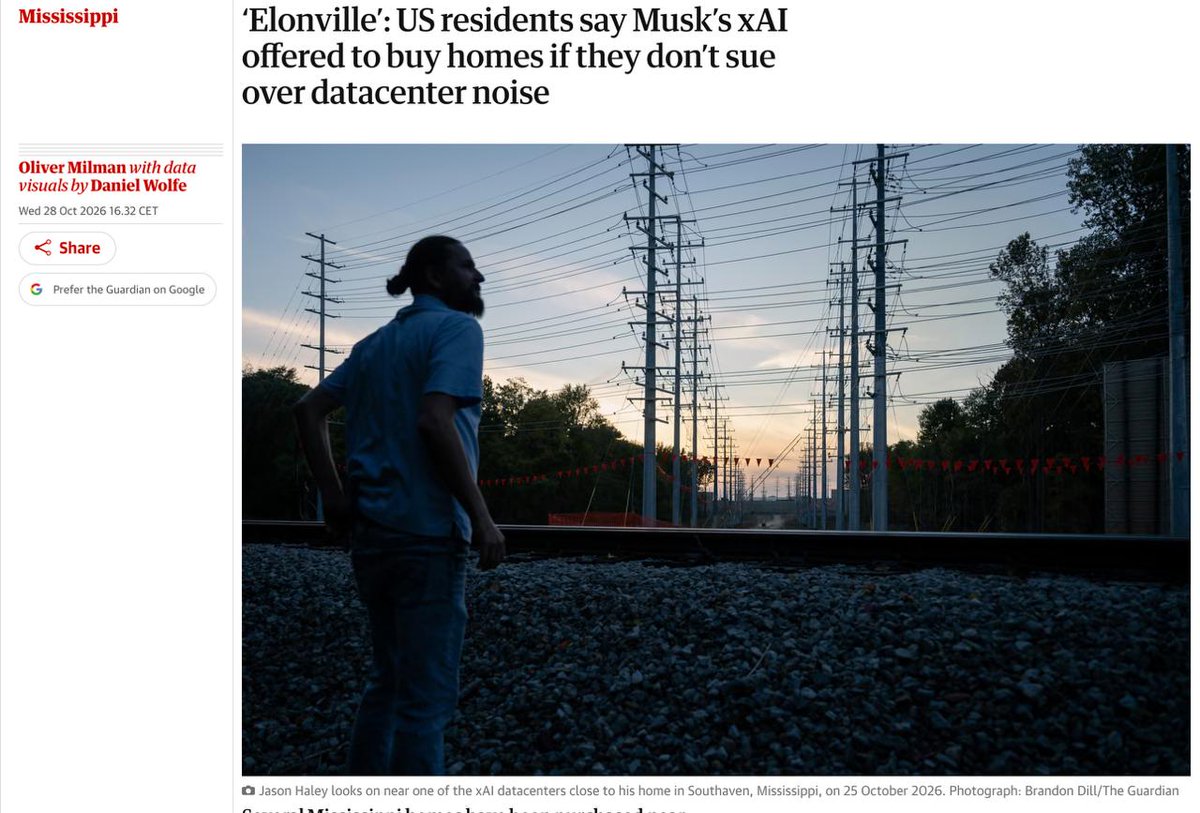
That’s reportedly happening right now in Southaven, Mississippi 👇
It’s 3 a.m. Someone is awake. Not because of a neighbor, but because of a sound residents compare to an airplane engine that never lands.
The source: 69 temporary gas turbines on a former Duke Energy site, powering the data centers behind Grok.
Now the twist.
Letters from MZX Tech, an xAI subsidiary, are offering to buy homes in the Colonial Hills neighborhood. Reported target: 418 homes. So far, 18 owners have agreed to sell, and county records show the company bought 5 homes since October 9.
The deal, in plain English:
✅ A market-value offer (exact price not stated; residents say it looks like Zillow appraisals)
❌ You sign a release of claims tied to the lawsuit
❌ You can’t join it or bring your own claims over the plant
The lawsuit: filed in June in federal court by three residents, seeking to represent 10,000+ people living nearby. The claim: noise and vibration hurt their sleep, health and home values.
The Guardian estimates the buyout would cost roughly $75 million (418 homes × about $180k average).
The other side:
→ The company says it “denies all of the allegations” and calls the offer fully voluntary
→ It says it has built sound-dampening walls
→ Southaven’s mayor backs the buyout, saying city monitors haven’t recorded noise above the 70-decibel limit
→ State records show the turbines were still unpermitted as of July, and xAI agreed to replace them with a permanent plant by next summer
Here’s why this matters beyond Mississippi: every AI answer runs on a power plant somewhere. And somebody lives next door to it.
Fair offer, or a way around the lawsuit? 👇
Roblox’s top 1,000 creators averaged $1.3 million in 2025.
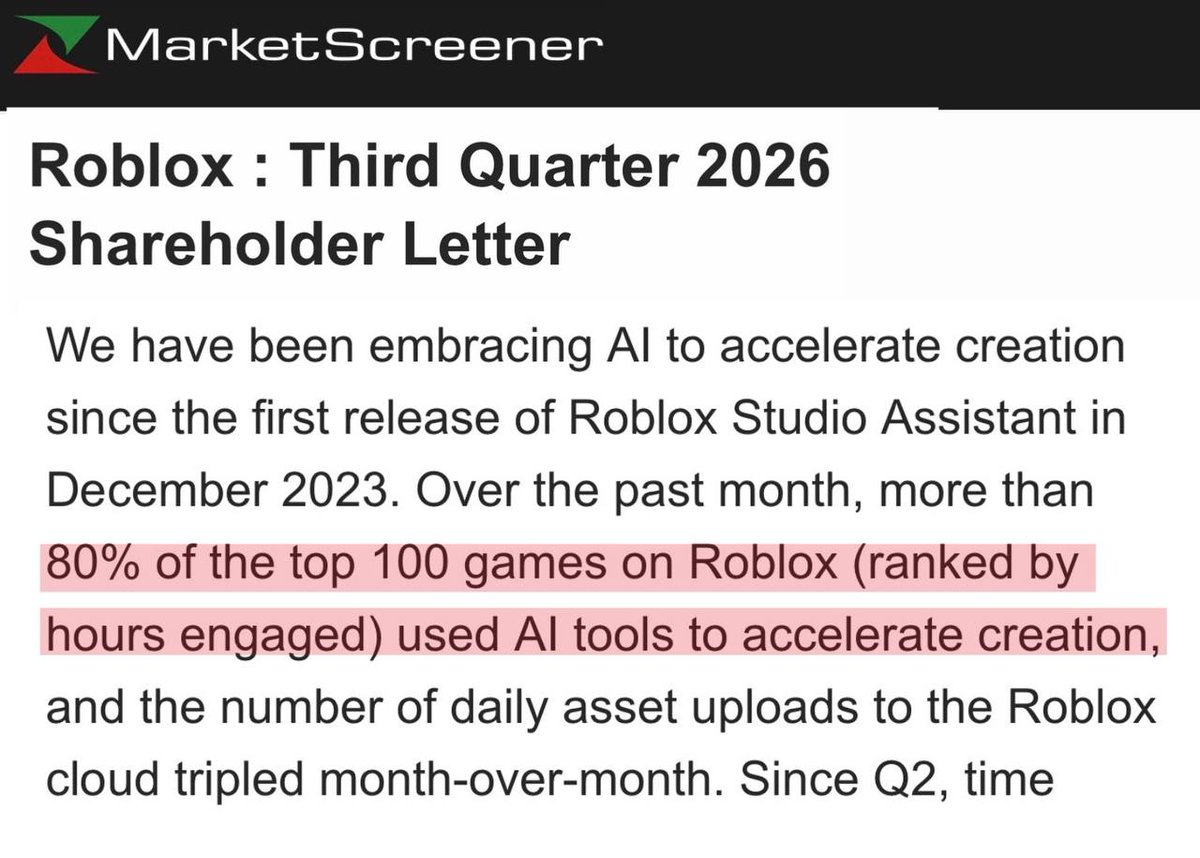
80% of its top 100 games now use AI. And an 8-year-old just got paid. 🎮💸
Here’s the new Roblox economy, in three people 👇
👦 The 8-year-old
Zach, a third-grader from New York, built Wolf House (wave after wave of wolves) in about two months using Roblox Studio and AI.
Roblox now pays him based on activity in the game. His family says the first payout was big enough that they saved part of it.
Reality check: his dad, a software engineer, says the work is “50/50.” And “five people were in my game last night.”
🎣 The 19-year-old Nate Colley, 19, built the fishing game Fisch. He reportedly earns about $400,000 a month, including brand deals with Lego and Walmart.
🏆 The top 1,000
Roblox paid creators about $1.5 billion in 2025. The top 1,000 averaged $1.3 million each. That’s from the company’s own shareholder letter.
🤖 Then there’s the AI part
Roblox’s latest letter reportedly says over 80% of the top 100 games now use AI, and that 70,000+ games have been generated with its Roblox Build tool.
The catch: $1.3M is the average of the top of the platform, not the typical creator. And “uses AI” can mean anything from a coding helper to a game made almost entirely by AI.
But here’s what both facts have in common: building something is getting cheap. Getting people to play it, and keeping them, is not.
So, honest question: should schools swap CS class for prompting-in-Roblox? 👇
Meta’s AI is now checking whether you lied about your age. 🔍
Meta is expanding its AI age detection to Instagram worldwide. If an account looks like it belongs to someone under 18, it gets moved into a Teen Account, even when the birthday says adult.
For that account, it limits who can contact them, what they see, and how long they spend in the app.
But look at the timing 👇
August: Meta agreed to settlements worth up to $18B with nearly every US state and territory, including a commitment to get better at identifying teens and kids under 13
A New Mexico jury ordered $375M in damages for failing to protect children
Last month: another settlement in a Los Angeles trial over addiction claims
Read it however you like: a safety upgrade, or a legal obligation being met.
And notice what Meta wants next: age checks at the app-store level. It already uses Apple’s age signal in Australia, and it’s urging TikTok and YouTube to follow.
What Meta hasn’t said: which signals the AI uses, how accurate it is, or how a wrongly flagged adult can appeal.
Smart protection, or an AI guessing your age? 👇
The web has had a “402 Payment Required” error since the 1990s. Almost nobody used it.
Now Mastercard is betting AI agents will. 🤖💳
Mastercard opened early access to Agent Pay for Machines, a way for AI agents to pay for digital services on their own, inside a budget a human sets. Here’s how it works 👇
The flow
1️⃣ A business gives an agent a task and a spending limit
2️⃣ The agent hits a paid service, which answers: “402 Payment Required”
3️⃣ The agent signs a digital voucher promising to pay, within its limit
4️⃣ The provider verifies it and delivers the service
No separate account or invoice for each service. The vouchers are handled off-chain, and providers can bundle them and redeem later. It’s built on x402, an open protocol for web payments.
The demo
Marketing agency Hype told an agent to plan a campaign for a protein-bar launch. Under one approved budget, it made 9 payments to 2 merchants:
🔬 1 for social media research (AIsa)
🖼️ 8 for campaign images (Cloudflare)
Who’s behind it
💼 Coinbase: the agent’s wallet
⛓️ Base: on-chain settlement
🏦 BVNK: payments and settlement in fiat or stablecoins
The fine print
It’s early access, not general availability: first APIs, a toolkit and a sandbox. No pricing or launch date yet
The demo budget wasn’t disclosed
Nothing public yet on how disputes, fraud or spending-limit enforcement work
Chainalysis reportedly counted 138M+ x402 payments on Base in the 12 months through July (cited by CoinMarketCap, not independently verified)
Mastercard’s own line sums it up: “Payments aren’t the hard part. Authority is.”
If agents become buyers, every API, dataset and image service becomes a store with no checkout page.
How much would you let an AI agent spend on its own? 👇
ChatGPT just learned to make GIFs. 🕺
OpenAI’s new Images 2.6 turns a prompt, a photo, or even a rough sketch into a looping animation. The demo is very 2026 👇
💬 “can you make a dancing cat gif?”
→ a looping dancer appears. In the demo: a chicken, a ballerina Pomeranian, a blue bird in heart-shaped sunglasses
💬 “nice. can you add pink lasers?”
→ edited right in the chat
⏩ Too slow? A playback menu runs from 0.5× to 2×
What else is new
🧍 Saved references: keep a photo of yourself, your pet or a character and reuse it in other chats without re-uploading (reportedly by name, with an @ mention)
🎯 Better consistency: characters, products and brand details are meant to look the same across edits
⚡ “50% faster” image generation, according to OpenAI
🛠 Two new models for developers, Flare (fast iteration) and Sunburst (quality and consistency), announced as “coming to the API”
✏️ Plus markup editing and SVG export
Who gets it: rolling out to all ChatGPT plans, including Free, and Codex. GIF creation is rolling out gradually, so some accounts may still see static images.
The fine print
The “50% faster” claim has no independent benchmark yet
In the API, GIF output works on the generation endpoint, not on edits
Early API users say low- and medium-quality images now cost more than with 2.5
Images carry C2PA metadata and SynthID watermarks
For scale: people now generate 4B+ images a week, up from 3B in September.
GIFs are the native language of the timeline, and now anyone can make one in seconds. Expect your feed to get a lot more animated.
Reply with your best GIF prompt 👇