I’ll be on @channelstv The Morning Brief tomorrow at 8:30 a.m. to discuss the possibility of publishing collation documents on IReV portal and why it matters for electoral transparency.
Tune in!
NIGERIANS, GO AND VERIFY (4)
Building a Healthy Nation: Our Health Sector Record in Anambra
Peter Obi
In the previous instalment of this series, I discussed our investments in education and explained why we considered human capital development central to the progress of Anambra State. Another sector that received considerable attention under our administration was healthcare. We understood that education gives people the tools to build their future, while good healthcare enables them to live healthy and productive lives.
When we assumed office in 2006, the healthcare system in Anambra faced serious challenges. Our health institutions required rehabilitation, medical equipment was inadequate, many communities lacked accessible primary healthcare facilities, and several medical training institutions had not secured accreditation. We therefore decided to approach healthcare as a comprehensive development priority, rather than concentrate resources on a few prominent hospitals.
Under our Anambra Integrated Development Strategy (ANIDS), we invested simultaneously in primary, secondary, and tertiary healthcare, medical training, maternal and child health, medical equipment, and partnerships with religious and private institutions.
Our approach was simple: healthcare should be accessible to people wherever they live, and the quality of treatment they receive should not depend on their status or whether they live in a city or a rural community.
Building a Teaching Hospital and College of Medicine
One of our most significant achievements was the establishment of the Chukwuemeka Odumegwu Ojukwu University Teaching Hospital at Awka.
We initiated, constructed, equipped, and secured accreditation for the institution, building it virtually from scratch. When I discovered that the state university was admitting medical students without having a teaching hospital through which they could complete their training, possibly with the intention of assigning them elsewhere, I considered the situation unacceptable. We therefore embarked on the construction of a modern teaching hospital to address this deficiency.
We constructed more than 25 buildings and provided facilities for the College of Medicine, laboratories, pathology, accident and emergency services, pediatrics, male and female wards, special wards, consultant clinics, and other essential departments.
We also provided vehicles, including ambulances and staff buses, to support the hospital and the College of Medicine as part of the accreditation requirements.
The objective was not merely to build another hospital but to establish an institution capable of providing specialist healthcare while training the next generation of Nigerian medical doctors.
Rehabilitating General Hospitals
We also recognized that a teaching hospital alone could not meet the healthcare needs of the population. General hospitals had to function effectively because they provide the essential link between primary healthcare and specialist treatment.
We rehabilitated and resuscitated 15 general hospitals across the three senatorial zones of Anambra State. We undertook substantial improvements in their buildings, wards, equipment, and general facilities.
In 2013, we provided ₦400 million for the ongoing renovation of 11 selected general hospitals, alongside other healthcare interventions.
Our intention was to ensure that people did not have to travel unnecessarily long distances to obtain basic secondary medical care.
Taking Primary Healthcare to the Communities
We believed that the best healthcare system is one that prevents illnesses and treats people early, rather than one that waits until minor health problems become emergencies.
That informed our extensive investment in primary healthcare. We built over 120 primary healthcare centers across communities in the 177 autonomous communities of Anambra State and rehabilitated existing facilities.
2027: we cannot publish election results at the ward, local government, and state collation levels on IReV during the general election – INEC
The Independent National Electoral Commission (INEC) has disclosed that it cannot upload election results from ward, local government and state collation levels to its Result Viewing Portal (IReV) during the 2027 general elections because the required system has not been developed or tested.
INEC’s Director of Information and Communication Technology, Lawrence Bayode, disclosed this on Tuesday at a stakeholder roundtable on election results tabulation organised by Yiaga Africa in Abuja.
He was responding to concerns over why the commission only uploads polling unit results to IReV without extending the process to subsequent levels of collation.
When asked why Forms EC8B, EC8C and EC8D, which contain results from ward, local government and state collation levels, could not also be published, Bayode said the necessary infrastructure was not ready.
“We have not built the system; we have not tested the system,” he said.
Currently, INEC uploads Form EC8A, which contains polling unit results, to IReV, allowing voters, observers, political parties and the media to view results from individual polling units.
However, the absence of the other forms means the public cannot track the progression of results through the different collation stages on the portal.
Meanwhile, Yiaga Africa Executive Director, Samson Itodo, said the organisation had previously recommended publishing the additional forms to improve transparency in election result management.
Other participants also argued that making the forms available would allow stakeholders to compare polling unit results with figures recorded at subsequent levels and identify possible discrepancies during collation.
“When a fool gains power, the first thing he does is silence the wise. The next thing he does is gather other fools around him. The final thing he does is destroy the nation.”
Peter Obi told Sky News in London that he wants to save Nigeria. He said, "Everybody, especially the youths, can see that something is wrong and we are saying that we want to change the situation. The country cannot continue on this trajectory that is leading to nowhere."
Rig and die...
1. Late arrival of materials in opposition strongholds = Rigging
2. Bivas not working = Rigging
3. unable to upload results to IREV portal = Rigging
4. Not providing result sheets at polling units = Rigging
5. Over voting without Cancellation = Rigging
6. Snatching of ballot boxes = Rigging
7. Vote buying = Rigging
We can not be courteous when our democracy is under attack
“Thank you for bringing this to my notice. I saw where they were stoning APC members. We need to discuss this and find ways to protect APC members across the country.”
— Senate President Godswill Akpabio reacts after Senator Abdul Ningi raised concerns over rising political violence and att@cks on political parties across the country during plenary.
Earlier, Senator Abdul Ningi urged INEC to engage with security agencies to ensure adequate security and safeguard the 2027 general elections.
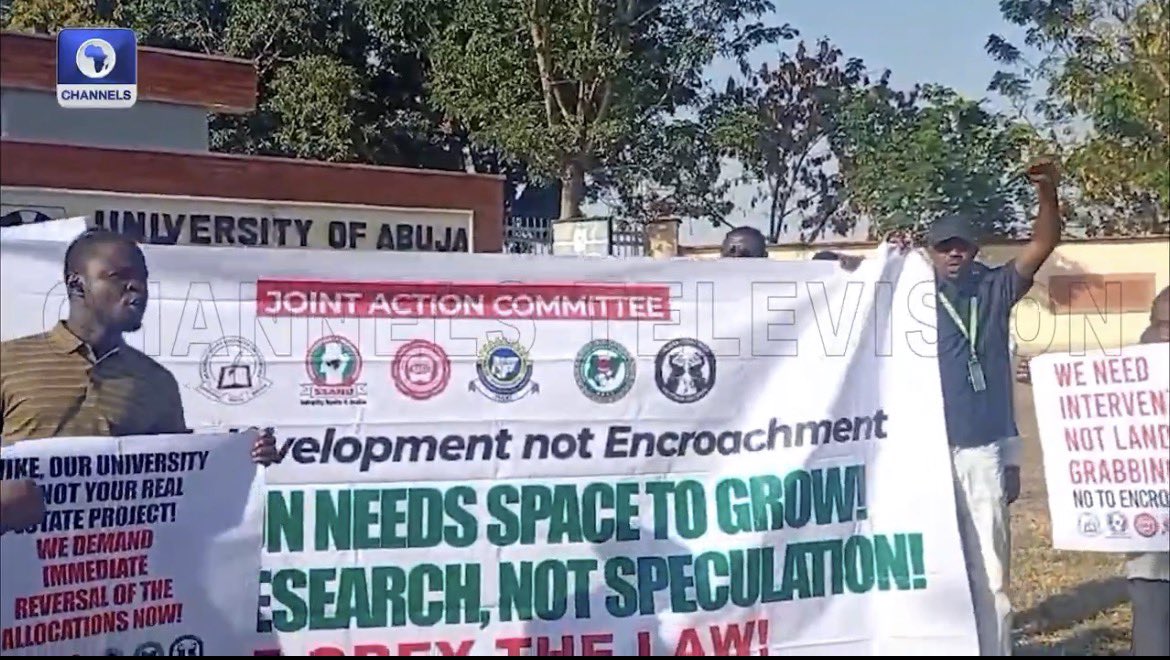
University of Abuja staff, students and lecturers protest alleged land grabbing by Wike
Staff, students and lecturers of the University of Abuja are protesting at the institution’s main campus, calling on President Bola Tinubu to intervene over alleged land grabbing by FCT Minister Nyesom Wike.