I open-sourced the Sylva three.js site and the skills behind it.
I started with one reference and asked Opus 5 to recreate it in Three.js as a single HTML file (looped for 2 hours). The moss root is procedural geometry with around 130,000 instanced blades, and all the code is under 1 MB.
Live site: https://t.co/R1EGBqYDWT
Repo: https://t.co/lJwCp13tra
I turned the main interactions into three reusable skills:
- threejs-wireframe-scan-reveal
- threejs-pointer-orbit
- threejs-gpu-particle-spray
Skills repo: https://t.co/gMuw2gt9FJ
We just open-sourced an entire marketing department.
Introducing Marketing OS by Arcads.
It does the work of your first six marketing hires.
📁 Marketing Department
┃
┣ 📁 Head of Marketing
┃ ┣ 📁 Positioning
┃ ┣ 📁 Pricing
┃ ┗ 📁 Competitor Teardowns
┃
┣ 📁 Copywriter
┃ ┣ 📁 Copy, Graded Before You See It
┃ ┣ 📁 Email Sequences
┃ ┗ 📁 Social Posts
┃
┣ 📁 Creative Strategist
┃ ┣ 📁 Hooks, Written Out
┃ ┣ 📁 Creative Fatigue vs Dead Audience
┃ ┗ 📁 Next Tests, Ranked
┃
┣ 📁 Launch Lead
┃ ┣ 📁 The 4 Weeks Before
┃ ┗ 📁 Product Hunt, Hour by Hour
┃
┣ 📁 SEO Lead
┃ ┣ 📁 GEO
┃ ┗ 📁 App Store Rankings
┃
┗ 📁 Analyst
┣ 📁 Site Audits, Scored 0-100
┣ 📁 Test Design
┗ 📁 Spotting AI Slop
And they hand work to each other:
Analyst finds the leak → Copywriter rewrites it → Creative Strategist tests it → Analyst grades the result
One Claude skill.
Comment "OS" and I'll send you the setup.
Introducing Aval - a new open source format for interactive video on the web. It has a built-in state machine, frame accurate transitions, and packed alpha transparency.
This is probably the craziest thing I’ve ever built with Codex.
I’d been dreaming about this technology for years. Before AI, building it would have taken months of work. I could never justify that investment for a noncommercial open source project. Then, a little over a year ago, Airbnb created Lava for almost exactly the same purpose. That gave me hope. But Lava was never released as open source.
So I decided to build my own, with AI.
Aval comes with a compiler and a web renderer. Together, they give you:
• a deterministic state graph - named states, authored triggers, and routing where the latest trigger wins.
• frame accurate routes with transitions that begin on authored content frames using portals, finishes, cuts, and reversals.
• small file size and low CPU overhead, perfect for small icons designed and animated in Blender.
• seekless loops so the decoder timeline keeps moving forward across loop seams instead of seeking.
• packed alpha transparency. transparent prerendered motion composited with WebGL2.
• a web native runtime: decoding with WebCodecs and rendering with WebGL2.
• progressive fallback: Host-owned fallback markup remains available for unsupported and reduced motion contexts.
Now it exists, it’s open source, and it’s available today as a technical preview.
I’ll be polishing it further over the next few days.
Introducing Slop.md...
A 80,000+ Character .MD File that removes all common AI Slop design language.
- A general guideline, use it anywhere.
- Not a "website maker" but prevents slop design.
- Made by weeks of consistent additions to the .MD of common slop structure by AI in order to prevent it.
> View the video & the site for detail Before and After.
Hopefully it helps you! it's my first ever public ship so I'm very open for any feedback!
Special thanks to @amianthus_ for the landing page inspiration and the idea that I can do a .md release!
and @leodev / @grimcodes for inspiring me to ship publicly as well!
Introducing chiefkeef.md
A 724,300+ Character .MD File that's specifically trained to ignore all vibe coded AI Slop design language.
- 0 box shadows
- 0 emojis
- badges like '🟢 LIVE '
- 0 purple-to-blue gradients
& kills 220 words AI loves to spam (robust, energy, delve ...)
It's the result of 11 months of 8 hrs/day Twitter doomscrolling and constant additions to the codebase of the vibecoding UI.
Sincerely hoping this finds the most design-needy builders.
New tools I keep coming back to. Save this 👇
- https://t.co/wQrrKyScQy - AI prompts for animated websites
- https://t.co/FgTPEqdeQ4 - free animated component library
- https://t.co/DBIDZdVb86 - pure CSS text animations
- https://t.co/Hk6ovLEr1l - spring physics UI motion
- https://t.co/wv2C0KXUCr - build terminal UIs with TypeScript
- https://t.co/nHTq0N41dq - name any UI element instantly
- https://t.co/NRWoHNzeI0 - logo, color & gradient tools
- https://t.co/CLb1khhxQZ - 3D product visualizer in browser
- https://t.co/JtOAiFEBJy - Claude skills for web design
What am I missing?
After spending the last few weeks trying out different skills from UI Skills
These are the 10 that stood out to me the most:
1. emil-design-eng
Link: https://t.co/VKDoIhRaqk
2. make-interfaces-feel-better
Link: https://t.co/hkPomdvikt
3. 12-principles-of-animation
Link: https://t.co/oMmPqG3QMX
4. fixing-accessibility
Link: https://t.co/3wDHDN7IfQ
5. shadcn
Link: https://t.co/KpnLr0LE6o
6. vercel-react-best-practices
Link: https://t.co/k72y2gfZyz
7. react-doctor
Link: https://t.co/g2sq4WXVNB
8. vitest
Link: https://t.co/pI9A8UMtuU
9. pnpm
Link: https://t.co/maGEECGfSZ
10. playwright-cli
Link: https://t.co/FRrY8H0aNM
GPT-5.6 Sol is unbelievably good at creating and editing videos.
It can do motion design, product demos, and animations like this one I made by simply giving it a screen recording.
GPT 5.6 has the best design taste and significantly outperforms Fable, which relies heavily on repetitive design patterns.
To help you experiment with video editing on it, we just launched a collection of 100 ready-to-use skills that show what’s possible and help you get started with video editing using GPT-5.6.
These skills can create anything from motion graphics launch videos for your product to a 3B1B-style science explainer video.
You can also use them to edit existing videos: add captions, generate motion graphics, create voiceovers, redesign visual styles, translate into new languages, and much more.
If you want access to the full library, comment “VIDEO SKILLS” and I’ll share it with you. (You'll have to follow me so I can DM you.)
Today we're launching Goose Ads in Claude.
This is a skill /goose-ads that lets anyone make high-performing ad creatives directly in Claude, Claude Code, Cowork, or Codex.
Here's how it works:
1. Install the skill: npx gooseworks install --all
2. Run this prompt:
/goose-ads create ads for my brand <brand-website>
3. (Optional) Pick templates you like on the platform
The skill finds top-performing ads that companies are already spending $ on and generates creatives for your brand.
It also ensures that generated creatives are accurate to your brand's messaging, logo, assets, etc.
It's that easy.
But this is just the start.
We have created a library with 100+ open-source skills for growth that some of the fastest growing startups in the world are using every day to run ads, content, competitor research, gtm, seo and more.
Comment Goose and I'll DM you the full open-source skill library.
An Anthropic engineer, Cal Rueb, gave away the exact workflow he uses with Claude Code.
This 25-minute talk covers more about permissions, and settings than any AI course on the market.
Watch it first, then save the template below👇
Judging by my tl there is a growing gap in understanding of AI capability.
The first issue I think is around recency and tier of use. I think a lot of people tried the free tier of ChatGPT somewhere last year and allowed it to inform their views on AI a little too much. This is a group of reactions laughing at various quirks of the models, hallucinations, etc. Yes I also saw the viral videos of OpenAI's Advanced Voice mode fumbling simple queries like "should I drive or walk to the carwash". The thing is that these free and old/deprecated models don't reflect the capability in the latest round of state of the art agentic models of this year, especially OpenAI Codex and Claude Code.
But that brings me to the second issue. Even if people paid $200/month to use the state of the art models, a lot of the capabilities are relatively "peaky" in highly technical areas. Typical queries around search, writing, advice, etc. are *not* the domain that has made the most noticeable and dramatic strides in capability. Partly, this is due to the technical details of reinforcement learning and its use of verifiable rewards. But partly, it's also because these use cases are not sufficiently prioritized by the companies in their hillclimbing because they don't lead to as much $$$ value. The goldmines are elsewhere, and the focus comes along.
So that brings me to the second group of people, who *both* 1) pay for and use the state of the art frontier agentic models (OpenAI Codex / Claude Code) and 2) do so professionally in technical domains like programming, math and research. This group of people is subject to the highest amount of "AI Psychosis" because the recent improvements in these domains as of this year have been nothing short of staggering. When you hand a computer terminal to one of these models, you can now watch them melt programming problems that you'd normally expect to take days/weeks of work. It's this second group of people that assigns a much greater gravity to the capabilities, their slope, and various cyber-related repercussions.
TLDR the people in these two groups are speaking past each other. It really is simultaneously the case that OpenAI's free and I think slightly orphaned (?) "Advanced Voice Mode" will fumble the dumbest questions in your Instagram's reels and *at the same time*, OpenAI's highest-tier and paid Codex model will go off for 1 hour to coherently restructure an entire code base, or find and exploit vulnerabilities in computer systems. This part really works and has made dramatic strides because 2 properties: 1) these domains offer explicit reward functions that are verifiable meaning they are easily amenable to reinforcement learning training (e.g. unit tests passed yes or no, in contrast to writing, which is much harder to explicitly judge), but also 2) they are a lot more valuable in b2b settings, meaning that the biggest fraction of the team is focused on improving them. So here we are.
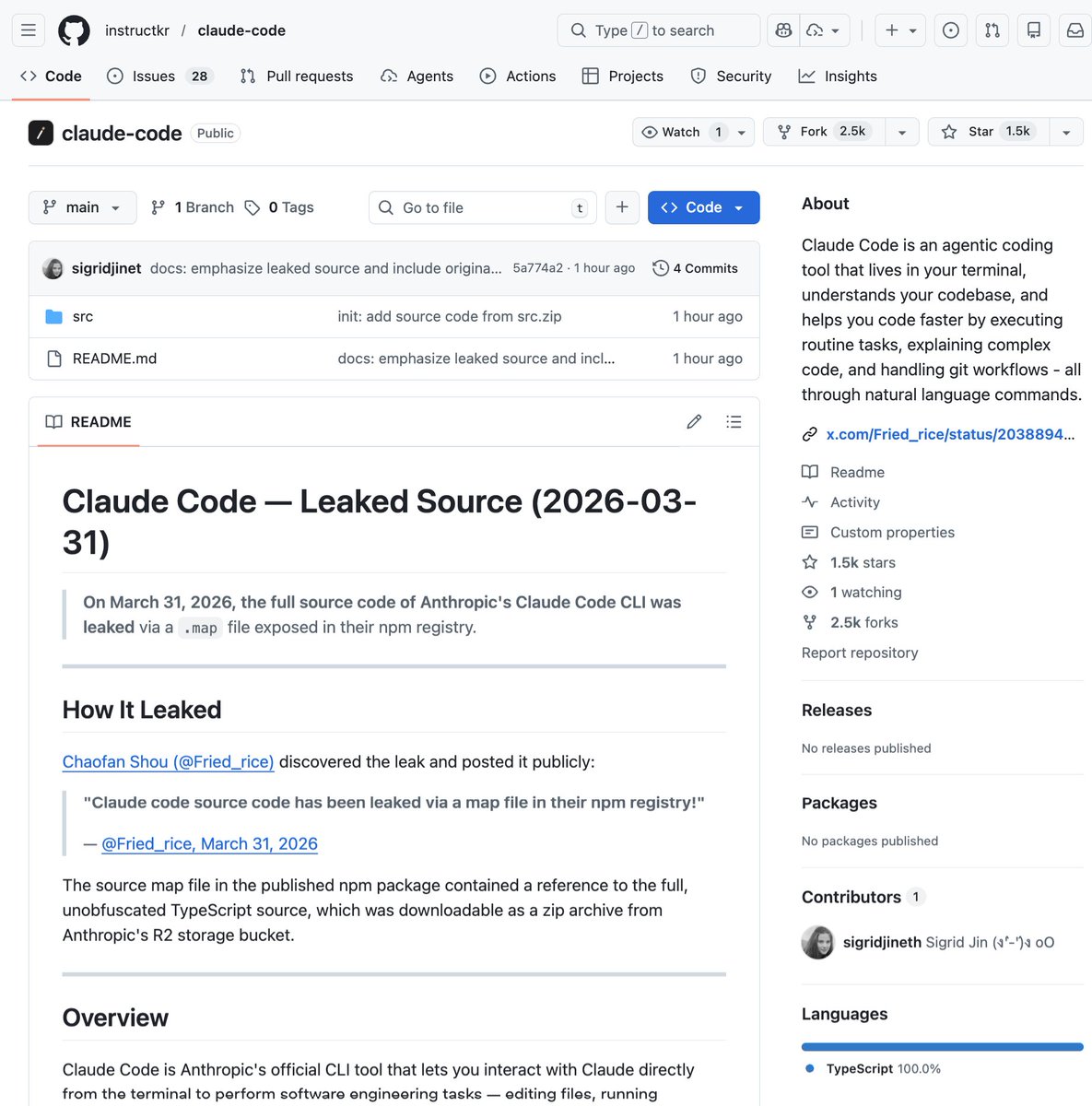
🚨this is nuts. anthropic's source code leaked unreleased features 👀
they're launching a virtual pet model (capybara 👀), agent creator wizard and more:
1. Buddy: unreleased virtual pet companion that sits on your terminal. 18 species (duck, goose, capybara, dragon), rarity tiers, an AI-generated 'soul'. guessing this is your own personal AI agent that lives on computer.
2. custom agent creator (wizard): users can build their own custom ai agent and modify by model type, tools, memory, location etc. this is awesome for custom work
3. agent swarms: full multi-agent team coordination aka when you create a team of agents (e.g. using wizard) you can CONTROL them in this command center.
4. auto-dream: claude will consolidate and commit to certain memories *while you're NOT using claude*. basically like when humans dream
5. torch: no fucking idea, its hidden but sounds cool lol
looks like anthropic is gamifying the entire coding and ai agent experience.
honestly pretty sick.
🚨Someone turned Claude Code into a full game development studio with 48 AI agents and a real studio hierarchy.
It's called Claude Code Game Studios. And it's not a prompt collection.
It's a complete Claude Code template - directors, department leads, and specialists - all coordinated exactly like a real game studio, with delegation paths, quality gates, and automated safety hooks.
Here's the full breakdown:
→ 48 specialized agents: creative director, technical director, producer, QA lead, narrative director, level designer, economy designer, and more
→ 36 slash commands: /brainstorm, /sprint-plan, /code-review, /playtest-report, /release-checklist, /team-combat, /team-narrative, and more
→ Engine-specific specialists for Godot 4, Unity, and Unreal Engine 5
→ 8 automated hooks: validates commits, catches hardcoded values, loads sprint context on session start, logs every agent invocation
→ 11 path-scoped coding rules: different standards enforced for gameplay/, networking/, ui/, tests/, and more
→ 28 document templates: GDDs, ADRs, sprint plans, economy models, faction designs
Here's the wildest part:
The agents don't run autonomously. They ask questions, show options, and wait for your sign-off before writing anything.
You still make every decision. You just finally have a team asking the right questions before you do.
Clone it, point Claude Code at it, type /start.
100% Open Source. MIT License.
(Link in the comments)