Your trusted guide to Political Science & International Relations. Designed for UPSC Civil Services, State PSC & other competitive exams. Get conceptual clarity & exam-focused content to boost your success. #PolityProber#UPSC#PSIR#IAS#PoliticalScience
https://t.co/UqCBsDnQzT
Contemporary democratic theory recognizes that democracy is more than elections. It requires liberty, equality, participation, deliberation, inclusion, accountability, constitutionalism, and respect for human rights to achieve democratic legitimacy. #PoliticalTheory#UPSC
Cosmopolitan Democracy (David Held, Daniele Archibugi) argues that globalization requires democratic governance beyond the nation-state through stronger international institutions, global accountability, and citizen participation. #InternationalRelations
Radical Democracy (Chantal Mouffe, Ernesto Laclau) and Feminist Democracy (Iris Marion Young, Anne Phillips) criticize liberal democracy for excluding marginalized voices and advocate deeper inclusion, diversity, and social justice. #PSIR
Deliberative Democracy (Jürgen Habermas, John Rawls, Amy Gutmann) emphasizes reasoned public discussion, informed debate, and consensus-building. Democratic legitimacy flows from the quality of deliberation, not merely majority voting. #Democracy#UPSC
Participatory Democracy (Carole Pateman, C.B. Macpherson) argues that democracy should extend beyond elections by encouraging citizens to actively participate in workplaces, local governments, and civil society. #PoliticalTheory
Pluralist Theory (Robert Dahl, David Truman) views democracy as competition among multiple interest groups. Power is widely dispersed, and public policy emerges through bargaining, negotiation, and compromise among competing groups. #PSIR#Pluralism
Liberal Democracy combines popular sovereignty with constitutionalism, the rule of law, representative institutions, separation of powers, protection of rights, and periodic free and fair elections. Locke, Mill, and Tocqueville were major proponents. #UPSC
The Classical model promoted political equality, public deliberation, accountability, and civic responsibility. However, it excluded women, slaves, and foreigners, making participation limited rather than universal. #PoliticalScience
Classical Democracy originated in Ancient Athens and emphasized direct participation of citizens in decision-making. Thinkers like Pericles and Aristotle regarded citizen participation as essential to good governance and civic virtue. #PSIR#Democracy
Democracy literally means "rule by the people." It is a system of government in which political authority ultimately rests with the people, who exercise it directly or through elected representatives. #PoliticalTheory#UPSC
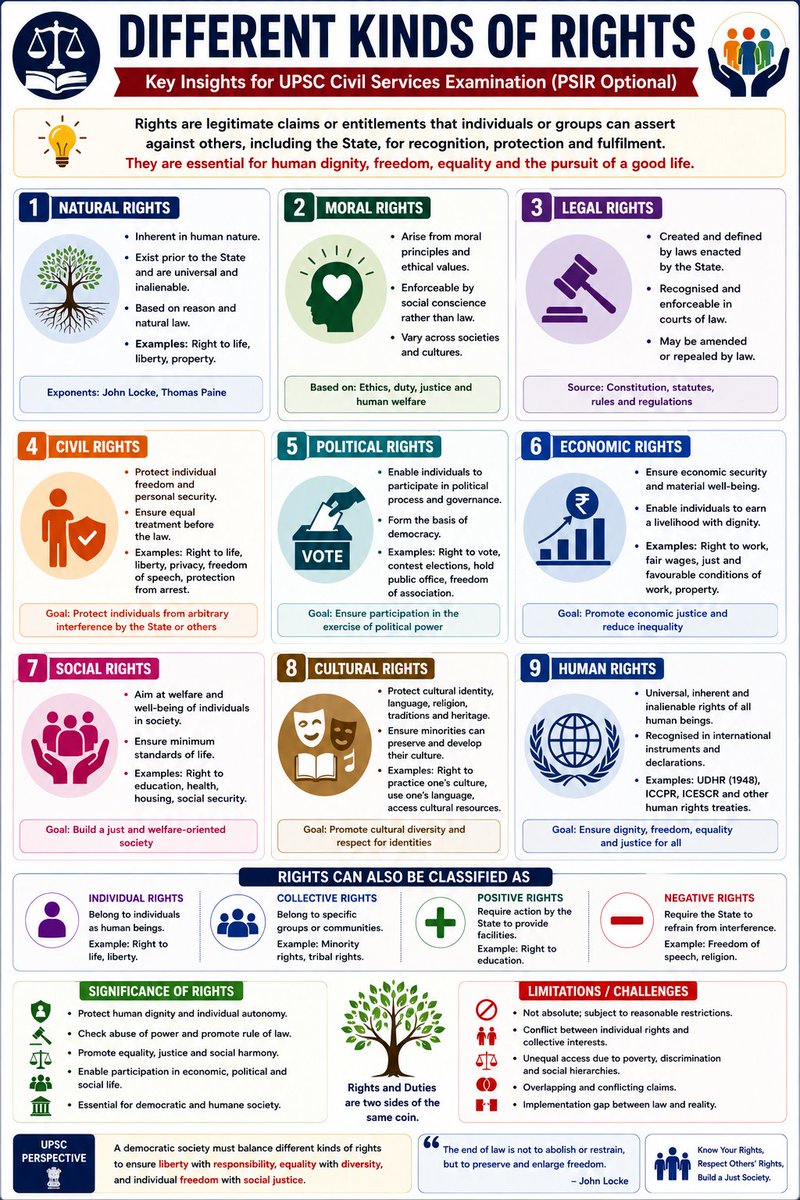
Contemporary challenges include armed conflicts, terrorism, discrimination, digital surveillance, refugee crises, climate change, and emerging AI ethics. Human rights remain central to constitutional democracy, sustainable development, and global governance. #PSIR#HumanRights
Thinkers such as John Locke, Immanuel Kant, Eleanor Roosevelt, John Rawls, and Amartya Sen have shaped modern human rights discourse by emphasizing natural rights, human dignity, justice, capabilities, and universal moral obligations. #UPSC#PoliticalTheory
Modern democracies increasingly recognize Human Rights as universal, indivisible, and interdependent. Constitutional systems seek to balance individual rights with social responsibilities, public interest, and the rule of law. #HumanRights#PSIR
Economic Rights ensure livelihood, fair wages, and social security; Social Rights guarantee education, healthcare, and social welfare; Cultural Rights protect language, religion, traditions, and the identity of diverse communities. #Equality#UPSC