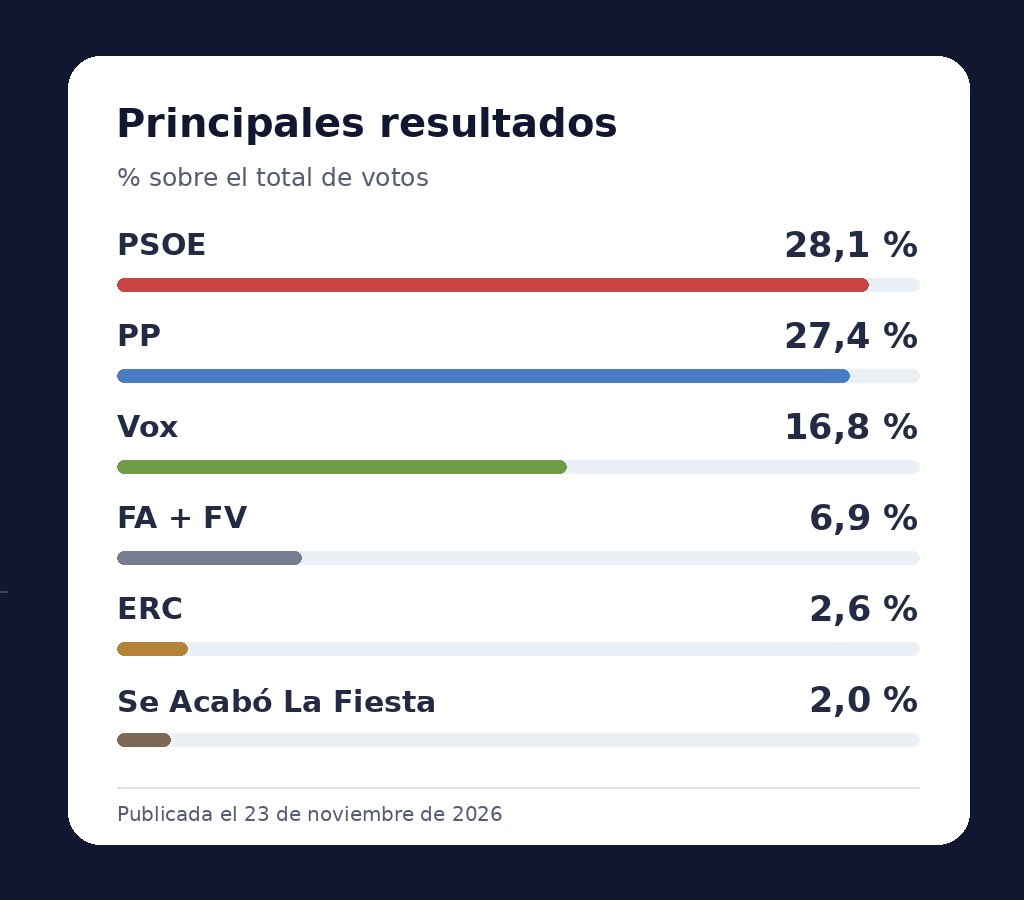
🇪🇸 Nueva encuesta electoral de AtlasIntel para España, en exclusiva en PollsterGraph.
El PSOE (28,1 %) aventaja al PP (27,4 %) por 0,7 puntos. Vox se sitúa en el 16,8 %.
📊 Consulta el sondeo en https://t.co/wlmUyVJO7N
I find it troubling that after being the most precise pollster 4 election cycles in a row, AtlasIntel still gets quite low coverage in US media, in particular on TV. To address this issue, we’ll be developing our own alternative channels, with a focus on @PollsterGraph.
Our forecast gave Democrats an 88% chance of winning the Senate before election day, and AP’s calls now give them 54 seats. Our favorite won 63 of the 67 Senate and governor races called so far.
https://t.co/dIzVCZA7pa
Election Night 2026 is underway!
PollsterGraph is providing live coverage of the US midterms, with real-time results, Senate and House races, gubernatorial contests, and our probabilistic election forecasts.
https://t.co/wlmUyVJO7N
Israel, partial count (31% of the electorate, 3,906 ballot boxes, read 4:51 am Israel time): @PollsterGraph projection gives Likud 27 seats (80% range 25–28) and Netanyahu's bloc 56 (54–58); 61 or more in <1% of simulations. https://t.co/bU2jwgag7n
🇮🇱 ISRAEL ELECTION UPDATE
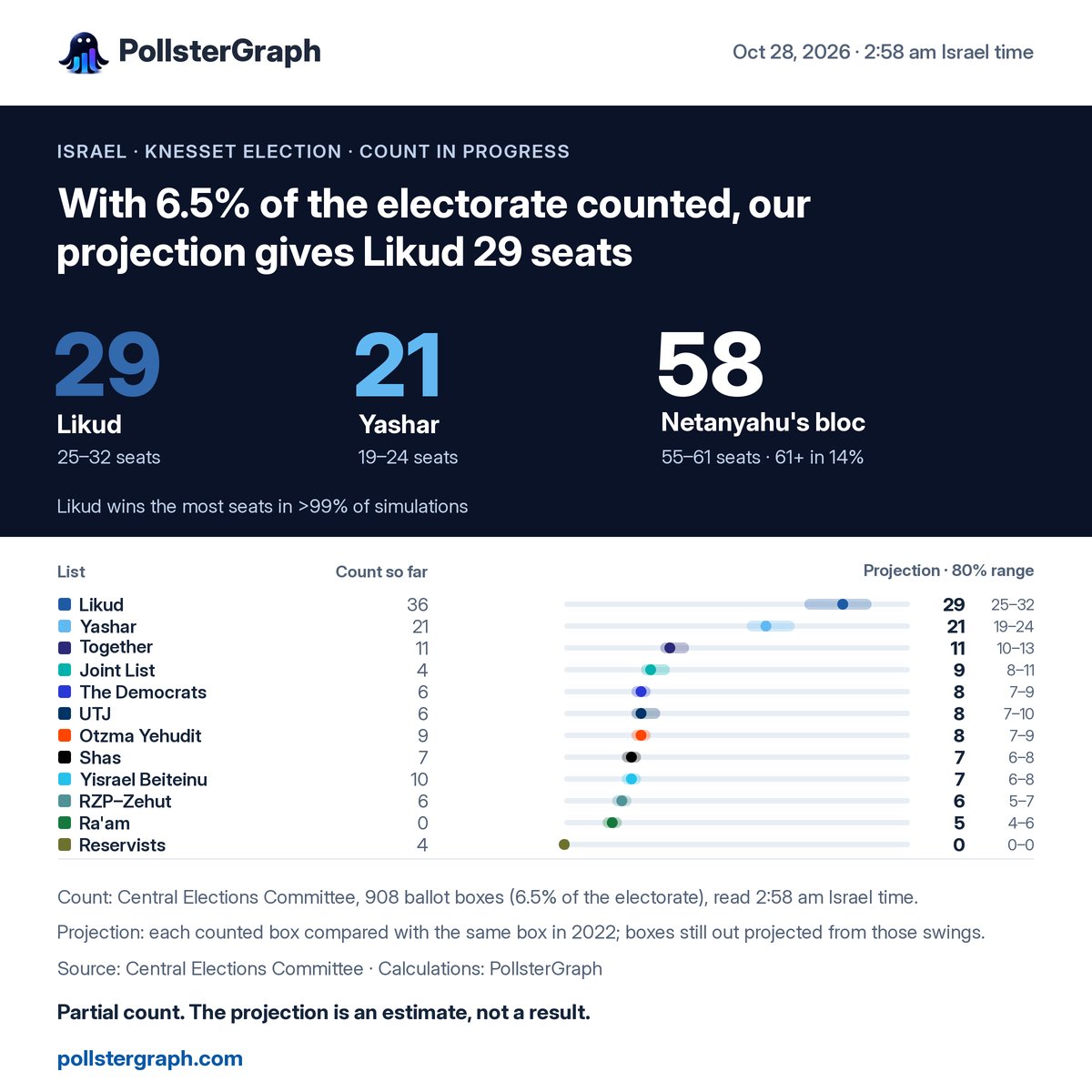
With 6.5% of the electorate counted, PollsterGraph projects:
• Likud: 29 seats
• Yashar: 21 seats
Likud is projected to finish first in over 99% of simulations, but Netanyahu's bloc has just a 14% chance of reaching the 61-seat majority.
Who wins the most Knesset seats? Here, PollsterGraph and Polymarket answered essentially the same question, but reached opposite conclusions.
PollsterGraph: Likud 70.5%, Yashar 28.5%.
Polymarket: Likud 32.5%, Yashar 67.5%.
Full forecast: https://t.co/wlmUyVJO7N
🇮🇱 Israel has voted. What did our model predict before the election?
Using 84 polls from 9 firms and 40,000 simulations, PollsterGraph gave Netanyahu's Likud a 70% chance of winning the most seats, against 29% for Eisenkot's Yashar.
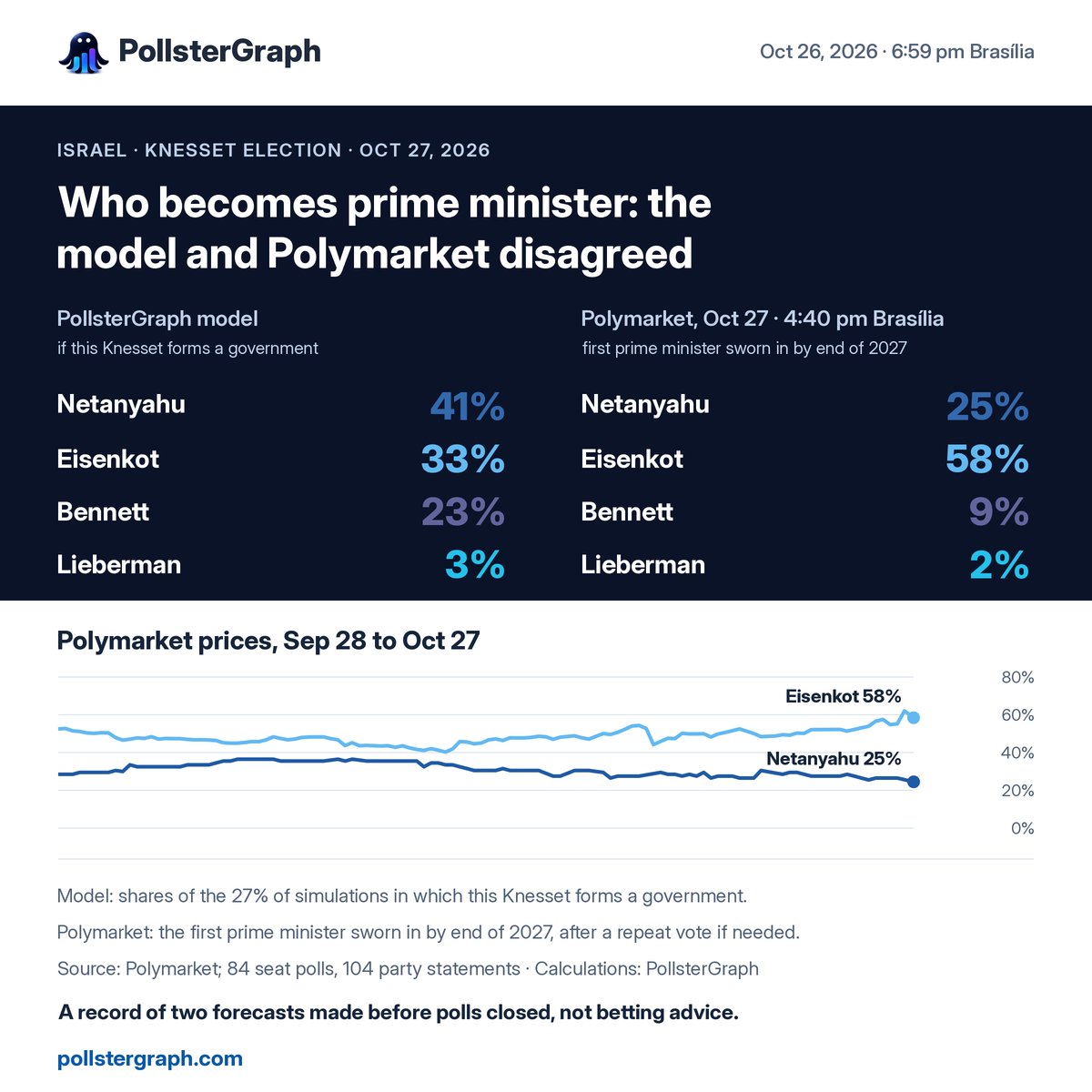
Who becomes prime minister?
Our model, conditional on this Knesset forming a government: Netanyahu 41%, Eisenkot 33%.
Polymarket, predicting the first PM sworn in by the end of 2027, including after a possible new election: Eisenkot 58%, Netanyahu 25%.
Forming a government could be even harder.
Accounting for parties' publicly stated coalition red lines, a government formed in just 27% of simulations.
When those red lines were assumed to be three times more likely to break, that figure rose to 73%.
Likud was projected to win 24.4 seats on average, followed by Yashar with 21.9 and Together with 12.4.
Four smaller parties faced uncertainty around Israel's 3.25% electoral threshold, where a fraction of a percentage point can determine whether a party enters parliament.
A diferença final foi de 3,6 pontos, contra 3,4 projetados inicialmente.
Como funciona a projeção? O modelo combina pesquisas eleitorais, resultados históricos e votos apurados em cada estado para estimar os votos que ainda faltam ser contabilizados.
O PollsterGraph antecipou a vitória de Lula 1h10 antes de ele assumir a liderança na apuração oficial.
Com apenas 1,7% dos votos apurados, já era possível projetar o vencedor da eleição presidencial.
Veja como foi.
Às 19h14, com apenas 1,7% dos votos apurados, a projeção já indicava Lula 3,4 pontos à frente.
Às 20h09, com 31,2% dos votos contabilizados, a probabilidade de vitória de Lula já superava 95%.
A liderança na apuração oficial só veio às 20h24.
PollsterGraph estima 95% de chance de vitória para Lula, contra 5% para Flávio Bolsonaro.
Com 33,2% dos votos esperados apurados, o modelo projeta Lula com 51,4% dos votos válidos.