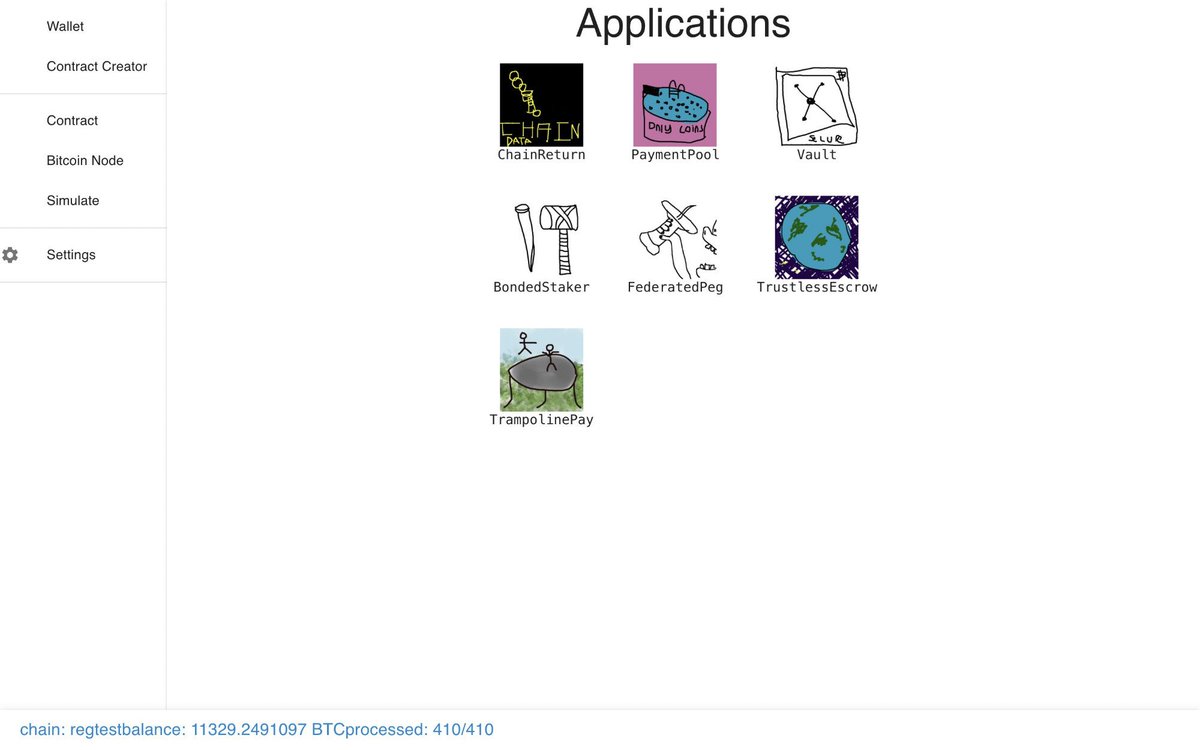
Read about the future beyond Lightning with Enigma. I've updated the article with feedback from the community. The Enigma Network and how this impacts Lightning and makes us less reliant on it. A blurb about Sapio, a frontend for Core to make things fun
https://t.co/6q4a9QDl5L
A NASA fellow claims 5 equations explain 99 percent of the physics that actually runs your world. Understand them deeply and you are set for life. His words.
And the way he does it is what makes the video worth it.
He does not teach the five as a list. He tells them as one story, where each equation is born from the one before it. F equals ma leads into gravity. Gravity rhymes with the law of electric charge, the exact same shape. That connects to magnetism. Magnetism folds into the wave. And the wave quietly opens the door to relativity and quantum physics.
By the end, all of physics feels like a single sentence written by one hand, not a pile of formulas you were forced to memorize.
The move that stays with you comes first. He says F equals ma is written the wrong way around, and rewrites it. One tiny flip, and the most famous equation on Earth suddenly means something school never told you.
His point for why this matters now: in the age of AI, the people who understand reality itself stay in demand. Everyone else is just memorizing.
Five equations. One thread. It is in the video.
Let me tell you what I saw..
He showed me some YouTube short cartoons that he said he thought were hilarious.
I watched them, they had absolutely content, no real jokes - they were just empty garbage.
However..
What the video makers had done, is impose a video above them of some older kids (13-15) watching the shorts and laughing at them.
This was sending him a clear signal, older kids you look up to are enjoying this content - so you should too.
Except that they had reused the same 5 "laughing clip variation" on 100 of these shorts - ie/ they wern't even really watching them.
So I was basically observing a kid having his social development hijacked for attention by some unknown channel to maximise their ad revenue.
It was like watching a child being given access to a slot machine and unlimited debt.
Hand a scientist nothing but a swan's skeleton, with no living birds to compare it to, and they would probably decide the animal couldn't fly. Its arm bones reach only about halfway down the wing.
The rest is feathers, and feathers usually rot, so from the bones alone you might decide those arms were for spearing fish. That is roughly the problem with how we draw dinosaurs, and the bird in this photo is the punchline. It is a white-tufted grebe, one of about 11,000 bird species that make up the last living branch of the dinosaur family tree. Its bright red eye and spiky crest would leave almost no trace in the bones.
For most of the last century, scientists thought dinosaur color was gone for good. Mike Benton, a paleontologist at Bristol, used to tell students it was something we would never know. Then in 2010 his team looked at fossil feathers under a strong microscope and found melanosomes, tiny sacs of pigment that survive for hundreds of millions of years. Their shape tracks their color, so sausage-shaped ones mean black and gray while round ones mean ginger and red.
So we started pulling actual colors off fossils. Sinosauropteryx, a small Chinese predator, had a ginger and white striped tail. Anchiornis, from about 160 million years ago, had a gray body, black and white striped wings, and a rusty crest running down its head like a mohawk. Microraptor, a four-winged dinosaur the size of a pigeon, was glossy blue-black, the way a crow shifts color in sunlight. Even Borealopelta, an armored plant-eater that weighed nearly 3,000 pounds, was reddish-brown with camouflage shading, so even something big enough to fight off most predators still needed to hide.
Melanosomes have a limit, though. They only capture colors made by melanin. The bright reds, yellows, and pinks that birds get from their food, like flamingo pink or a cardinal's red, leave no trace. Many blues disappear too. So even our colorful dinosaurs are probably undercounted. That grebe's red eye would be invisible in the rock.
In 2012, three researchers wrote a book called All Yesterdays making this exact case. They gave a name to the habit of drawing skin pulled tight over bone, with every joint and muscle showing: "shrink-wrapping." Living animals carry fat, pouches, wattles, and loose skin that all disappear after death. To prove the point, they rebuilt familiar animals from the skeleton alone. Their elephant had no trunk. Their rhino had a sail on its back and no horn. Their baboon came out looking like a venomous monster.
The grebe has no bone-deep explanation for its face. Neither did most dinosaurs.
The purpose of Flock cameras is to destroy a legal concept known as "the reasonable expectation of privacy."
This "reasonable expectation" protects you in places such as a store dressing room, toilet stall, or standing alone in a field.
Flocks are being installed to negate this.
Soon a Judge can say "you had no reasonable expectation of privacy" because that concept does not exist any more, thanks to Flock.
@philosopherjstr@Jaboolie@memeticsisyphus Looking back, I think I followed the reasoning→agency→morality branch too much. The original question seems to be whether this behavior shows voluntary control, conscience of guilt, or dangerousness. Those seem like different questions. Which one are you actually arguing?
@philosopherjstr@Jaboolie@memeticsisyphus I appreciate you entertaining all the questions. I'm mostly trying to establish a common baseline of definitions.
Why is the ability to manipulate internal semantic representations the minimum criterion for reasoning?
@philosopherjstr@Jaboolie@memeticsisyphus I think we're much closer. I agree context-sensitive inhibition alone doesn't establish legal or moral capacity. My question is whether you're using "reason" generally, or specifically propositional normative reasoning.
@philosopherjstr@Jaboolie@memeticsisyphus To restate your claim, Id write it as: "Dogs probably don't possess propositional normative reasoning."
The remaining question is: Why must reasoning require propositions?
That leads to: What is the minimum representational structure required for something to count as reasoning
@philosopherjstr@Jaboolie@memeticsisyphus Let's clarify your definition of Semantic Representation
Is it Symbolic Semantics?
DOG
↓
MAMMAL
↓
ANIMAL
Is it Grounded Representations?
Human
↓
Food likely
↓
Approach
Is it Language-like Propositions?
Such as "The ball
is behind
the chair."
@philosopherjstr@Jaboolie@memeticsisyphus The better framing is
Practical Reasoning -> Agency -> Choice -> Consequence
Moral Understanding + Normative framework + agency -> moral accountability
Dogs can perform the first. Not sure if they have the second.
Consequences: "what happens?"
MU: "what ought to happen?"
@philosopherjstr@Jaboolie@memeticsisyphus Reason can support agency. It does not imply agency.
Consequences exist whether or not obligations do.
Two domain chains are being mixed here.
Reason -> Agency -> Choice -> Consequence -> Accountability
Accountability + Normative system -> Obligation
As we approach our 250th anniversary, I believe it's worth noting that our government is only actually 165 years old.
The American Republic established in 1776 ended in 1861.
The Civil War cost almost a million lives: one out of every five white men of military age in the South and one out of every ten in the North. It destroyed virtually all of the wealth in the South — a 90% reduction to per capita GDP. The South would not recover economically until 1950.
But the real cost of the war wasn't economic. It was political.
The Civil War destroyed the Federalist system that our founders built to ensure the central government's power remained genuinely limited. Not limited by the goodwill of its legislators, which is no limit at all, but limited by the existence of rival sovereign States, which could restrain the central government and each other through competition.
After 1865 the only real limit to federal power was the self-restraint of the men in office. And that didn't last for long...
But, before we look at the long-term impact of America's first war of aggression, let us dispel a critical myth: that the Civil War ended slavery. Slavery was ending because of technology and economics. And it would have ended just as surely if no war had ever been fought between the States.
Britain abolished slavery, without a war, throughout its empire in 1833, freeing some 700,000 people in the West Indies alone. France abolished slavery in its colonies in 1848. Russia — the most backward great power in Europe — emancipated some twenty-three million serfs in 1861, the very year of Sumter. The Netherlands freed the slaves of Surinam and Curaçao in 1863. Across the entire industrializing world, unfree labor was abandoned within a single compressed generation. And, in no other great nation, was war required.
In America, slavery did not end because of General Grant and the boys in blue. It did not end because of a moral awakening. The cause was economic.
Chattel slavery extracts muscle power from human beings. Therefore, slavery only makes economic sense if muscle power is the binding constraint on production. Once machines had multiplied the labor output of muscle by hundreds of times, slavery was not only immoral but inefficient. In an industrial economy a slave costs more than he yields. As a result, capital flees from slavery into factories. All over the world. And even in the South.
Slavery ended everywhere at roughly the same time for the same reason: innovation and economics. It would have ended in the American South regardless of who won at Gettysburg. Even Brazil, the last holdout in the Western hemisphere, freed its 725,000 slaves with the Golden Law of 1888. No war was required: slavery was no longer productive.
With apologies to the celebrants of Juneteenth, slavery was not legally abolished in the United States until the Thirteenth Amendment was ratified in December 1865. The institution died, not because of the war, but because the world had entered the machine age.
The unnecessary destruction of half of our country and almost a million people wasn't the greatest tragedy of the Civil War. The greatest tragedy was the loss of Federalism and the hard-won liberty Americans won in the Revolution.
The Civil War destroyed the federal structure of the American republic, in which the several States were sovereign in their own spheres, with genuinely different legal systems, cultures, and traditions. The national government was beholden to the States, with only limited and enumerated powers.
The clearest proof of this change lies in our language. Before 1861, the United States was a plural noun. Men said the United States "are." After 1865 our country became singular. The United States "is."
The doctrine that a state could check the central government — by interposition, by nullification, in the last resort by departure — died at Appomattox, and with it the last structural brake on the power of the federal government died too.
The framers had not relied on parchment to limit the government they created. They relied on competition. So long as the States were genuinely sovereign — so long as a man oppressed in one State could remove to another, so long as the national government had to reckon with twenty or thirty rival centers of authority each jealous of its own jurisdiction — the central government could not easily grow into a Leviathan. The States were not administrative subdivisions. They were the Constitution's immune system.
What followed the Civil War was America's first empire -- in the South. And Empire's require a strong central government. Thus began a long erosion of the line between the citizen and the State, and between private institutions and public power.
Twelve years after the war, the Supreme Court considered whether a State could fix by law the prices a private grain warehouse charged its customers. The owners argued it was a taking of their property without due process — that what a man does with his own property, and what he charges for its use, is rightfully his own affair. The Court disagreed. Chief Justice Waite ruled that when private property is "affected with a public interest, it ceases to be juris privati only," and may be regulated by the government for the common good (Munn v. Illinois, 1877).
That was the end of private property in America. After all, if the national legislature may decide which property is "affected with a public interest," and may then dictate its prices and uses, there is in principle no property the government may not control.
Justice Stephen Field saw it and dissented with prophetic fury. The doctrine, he warned, "is nothing less than a bold assertion of absolute power by the State to control at its discretion the property and business of the citizen." A legislature that could fix the uses and prices of property "against the consent of the owner" could "deprive him of the property as completely as by a special act for its confiscation or destruction."
New York City's landlords are finding out the truth of this reality. They believe they own their properties. But they are about to find out otherwise, as rents will now be controlled by the mayor, who is a communist. This will spread. A communist ruling over all of America is only a matter of time. Why? Because the law provides an unlimited incentive for such power. There is nothing in America the government cannot take from you. Nothing.
The proof of the unlimited central authority was established in blood. The courts followed where the armies led. And the first American Empire — the North's conquest of the South — led to more such military adventures, which continue to this day.
In its first century, the United States heeded its founders' warnings against entangling alliances, a large standing army, and foreign military adventures. But the creation of the massive Northern army created its own momentum. Only 20 years after Reconstruction, the country clamored for another Empire and war against Spain. America became an imperial power, with possessions from the Caribbean to the far Pacific — Cuba, Puerto Rico, Guam, the Philippines.
The consolidated nation that emerged from the Civil War was the precondition for the American Empire that emerged in 1898. Power flows to the center, and the center's reach has no natural boundary.
The Leviathan must be fed.
In 1913, every American became a direct serf to the national government: The Sixteenth Amendment gave the federal government the power to tax incomes directly. The size of a government is set, in the end, by the size of its revenues. The income tax removed the ceiling.
The Seventeenth Amendment, ratified the same year, provided for the direct election of United States senators. Under the original Constitution, senators were chosen by the state legislatures. This was the last vestige of State sovereignty. It could not be allowed to stand. The Senate stopped being the guardian of federalism.
And… then… with these Constitutional impediments finally vanquished, you saw Leviathan act to ensure its permanent dominance: it would control the money supply.
In December of 1913, Congress created the Federal Reserve System. The power over money, which the Constitution had strictly withheld from the central government, was enshrined into law. Income tax, a central bank, and the removal of the states from the Senate — all in one year.
The Revolution that began in 1861 was complete. America's Empire had begun.
Munn established that the government may dictate the use of private property. 1898 established that the consolidated nation would project power without limit beyond its borders. 1913 established the revenue, the money power, and the removal of the states from their guard post. The 1964 Civil Rights Act expanded this dictatorial power into every private transaction in America.
Government of the people, for the people, and by the people has been destroyed.
We now live in an Empire, not a Republic.
The Civil War didn't free any slaves; it enslaved all of us.
Instead of starting at an wall to fix your attention span, this exercise daily. It was developed in the early 1900s by William Walker Atkinson in his book The Power of Concentration. The exercise is called the Sentence Drill.
Read one short sentence from any book, then close it and try to write the sentence down word for word from memory. Once you can do that reliably, move up to two sentences. Then three. Then a small paragraph.
The first time you try it you'll realize how loose your reading actually is. You'll get the gist, but you'll miss exact words, change "and" to "the," skip a comma, swap an order.
This exercise forces you to actually see the words, not just glide over them. Your mind has to hold the exact shape of a sentence long enough to reproduce it.
Do this once or twice a day. Within two weeks you'll feel a significant difference, as it strengthens your attention span, strengthens your memory, and makes you pay more attention to detail, a very rare skill nowadays.
Fred Rogers met with a child psychologist every week for 22 years to build his show. She shaped everything: every script, prop, and song. The whole point was to give a child's nervous system time to slow down. In 1984, a single regulatory decision ended all of it.
The psychologist was Dr. Margaret McFarland, who co-founded the Arsenal Family and Children's Center alongside Benjamin Spock and Erik Erikson. She and Rogers understood that the prefrontal cortex in children, the part of the brain that controls impulse, emotion, and attention, takes decades to fully develop. At the start of every episode, Rogers tied his sneakers and changed his sweater while children settled in. Those pauses were intentional, designed to help a child's nervous system shift into a calmer, more focused state.
What ended it had nothing to do with child development science. In 1984, Reagan's FCC chairman Mark Fowler abolished the advertising limits that had protected children's programming from commercial pressure. Toy companies moved within months. Between 1984 and 1985, cartoons tied to toy lines increased by 300%, from a handful of shows to more than 40 animated series. In almost every case, the toy was designed first. The cartoon was built to sell it.
Researchers later put numbers to what parents were already noticing. A 2011 study in Pediatrics from the University of Virginia tested 60 four-year-olds across three groups: one watching SpongeBob, which cuts scene every 11 seconds; one watching a slow PBS show, which cuts scene every 34 seconds; and one drawing. Nine minutes later, all three took tests on attention, impulse control, short-term memory, and problem-solving. The SpongeBob group scored significantly worse across every measure.
In the 1970s, children began watching television around age 4. Research from pediatrician Dimitri Christakis found that by 2009, the average age of first screen exposure had dropped to 4 months, as the content got faster and the audience got younger. Researchers separately found that each additional hour of daily screen time at ages 1 or 3 raised the risk of attention problems at age 7 by 9%.
full prompt:
Generate a {pose} {com_name} ({sci_name}) in the style of an Edo-period Japanese kachō-e woodblock print, matching the painting technique of IMAGE 2 closely.
Look at IMAGE 2: the bird is rendered with VERY FEW MARKS. The body is essentially 2-4 flat color zones with sharp boundaries. There is almost no internal texture on the body - no feather-by-feather rendering, no pen-line stippling, no gradient shading. The bird in IMAGE 2 looks like it was painted with maybe 30 brush strokes total. YOUR output should look the same: a few flat color zones, a few confident outline strokes, an accent stroke or two for major wing or tail markings, and that's it.
Confident sumi-e ink linework with soft watercolor washes. Earthy, restrained palette: burnt umber, ochre, indigo, vermillion, muted greens. The body should look like flat painted paper - not a textured surface, not shaded volume. If the species has subtle plumage variation (streaking, mottling, fine barring), ABSTRACT it into 2-3 broad zones rather than rendering it literally. Eye, beak, and feet drawn with crisp ink - these are the only places where confident dark line is appropriate.
The bird sits on a CONSISTENT WARM CREAM tonal background - like aged Japanese mulberry paper, a soft warm buff cream color. The cream ground fills the entire frame as the background and is identical across every print for visual consistency. This is the only background element: NO branch, NO twig, NO perch, NO leaves, NO foliage, NO substrate, NO scenery, NO sky, NO moon, NO water - only the bird floating against the cream paper ground. The perch is purely implied by toe posture - it is NEVER rendered. NO border or frame, NO text or signature.
Composition: the bird occupies one-third to one-half of the frame. Leave generous negative space (just the cream ground) around it. The image should feel sparse and confident, not packed with detail.
The ENTIRE bird must fit within the image frame: head, both wings (fully extended for flight pose), full tail, both legs, both feet, beak. Do NOT crop the wings, tail, legs, or any body part at the edge of the frame. Leave generous padding on all sides.
IMAGE 1 (positive, anatomy) IS {com_name}. Match its proportions, head color, throat, wing pattern, back color, tail pattern, leg color. If the reference shows non-breeding or worn plumage, render the brightest BREEDING (adult-summer) plumage instead - render the most diagnostic, recognizable version of the species.
{anti_ref_line}
IMAGE 3 (positive, style) is a real Edo-period kachō-e woodblock print. The bird in IMAGE 3 is a DIFFERENT species - IGNORE its species, only borrow its painting style. Render the bird in IMAGE 3's painting style. DO NOT copy any compositional elements from IMAGE 3 (branches, leaves, water, moon, scenery).
Treat IMAGE 1 for anatomy and color information ONLY. Treat IMAGE 3 for style ONLY. The output should look like an Edo-period woodblock print of the species in IMAGE 1, painted by the artist of IMAGE 3.
EXACTLY TWO wings (no more, no less - count them: one left, one right). EXACTLY TWO legs. EXACTLY ONE head. EXACTLY ONE beak. EXACTLY ONE tail.
Posture, color, markings, and body proportions match IMAGE 1 / {com_name} field-guide references.
Pay particular attention to species-specific patterns. Do NOT default to generic markings: if the reference shows a uniformly dark head, do NOT add a white face mask. If the reference shows solid wings, do NOT add white wingbars. If the reference has no crest, do NOT add a crest.
For close-relative species (multiple goldfinch, multiple jay, multiple sparrow species in the library), render the diagnostic differences clearly so the species are visibly distinguishable from each other.
BOTH FEET visible at the bottom of the body.
Songbird feet are SMALL relative to the body. Tarsi (legs below the feathers) are roughly 10-15% of body height for finches/sparrows/warblers/chickadees, 15-20% for jays/thrushes/mockingbirds. For larger birds (ducks, hawks, owls), match the proportion in the reference photo - typically still under 25%.
Draw slim tarsi, small delicate toes. Do NOT exaggerate feet or claws; the bird is not a chicken or a crab.
Match foot proportion to the attached reference photo.
PERCHED (pose 1): one wing folded against the body, the other tucked behind. Both feet visible at the bottom, toes curled gently forward as if grasping a thin perch - but the perch itself is NOT drawn. The bird floats in space, posture suggesting it's perched.
IN FLIGHT (pose 2): both wings fully extended in a natural flapping position. Legs and feet either (a) tucked tight against the belly with toes folded out of sight, or (b) extended straight back along the line of the tail. Do NOT dangle the feet below the body with toes splayed.
Render at high resolution on a fully transparent background. Cut the bird out cleanly. No shadow, no paper texture, no caption.
one thing they don’t tell you about having a tiny daughter - two, three years old - is that despite being innocent, pure, beautiful, all that, they clearly belong to the class of being that we call gremlin
My friend Da Yu left communist China for the USA twenty years ago. Last week, his American employer gave him one hour to delete his comment on a friend’s social media post or lose his job.
Da was an atheist when he first moved to Cincinnati for college. And he was excited to get away from the suffocating regime of communist China.
When he arrived here, it wasn’t long before he encountered a group of Christians who shared the gospel with him. God opened his heart to the truth of the gospel and he believed.
As his faith grew, Da became a strong Christian leader and committed evangelist. Now, many years later, he leads a small group at my church and organizes regular evangelistic outreaches for college students.
Da is a kind, smart, and godly Christian man. And he’s among the most committed members of our church. He’s an ordinary Christian who believes the Bible and has a spine. He and his wife have two young children, and she is eight months pregnant with their third.
That’s all background for what I’m about to say.
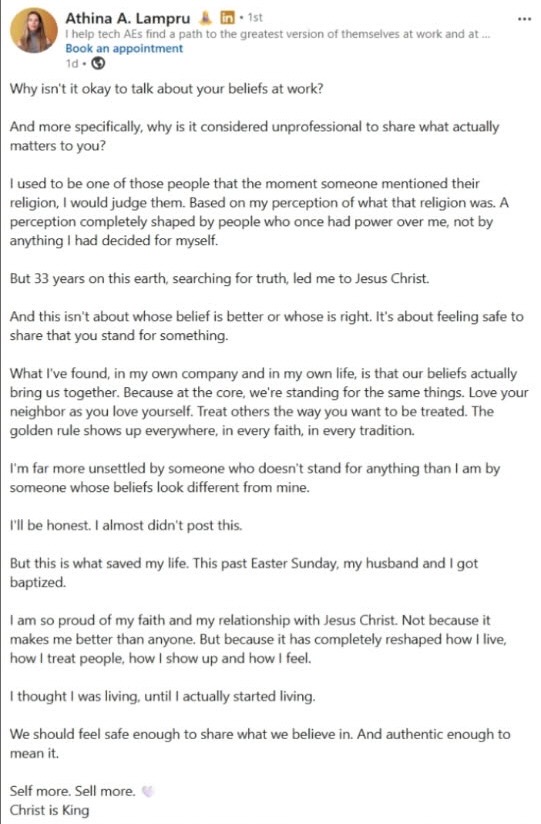
Last week, he called me out of the blue because he was faced with a difficult decision. One of his friends had just become a Christian and posted on LinkedIn about her baptism (see screenshots).
She wasn’t accustomed to making Linked In posts about Jesus, feeling as though it might be unprofessional. She wondered openly if she should keep her posts secular. But she was excited about her new life in Christ and wanted to share it.
That’s when Da chimed in with a comment on her post that there is no such thing as a purely neutral, “secular” culture. He pointed out that many companies are promoting cultural sins such as homosexuality, transgenderism, and fornication during pride month. If companies can promote those morally regressive “values,” then certainly this woman should not be embarrassed to talk about her Christian faith in public. He was simply encouraging her to be bold for Christ.
WIthin minutes, he got a message from HR. He was called to a meeting with the HR rep and the CEO where he was told he needed to take his comment on her post down immediately. Feeling put on the spot, he said he’d needed to think it over first. He asked, “what if I do not take it down?”
They said, “you have one hour to take it down or lose your job.” So he took a walk outside to gather his thoughts and pray. He spoke to his wife about it, and she told him the man she married was a man of courage, and she would stand by him. He also sought counsel from some men in our church.
Finally, he made his decision. He would not take his comment down. So they fired him. Right there, on the spot. No sooner had the call ended that his laptop was locked and he was unable to access it at all.
This whole episode is tragically ironic, given the fact that he’d moved here from China to get away from these sorts of draconian practices. But that’s the way it is with the LGBTQ regime. If you do not comply and bow the knee to their gods you will be severely punished.
In short, a good man was fired from his job for refusing to cave. He took a stand and paid a price for it. His former employers didn’t care that he’s a responsible, hard working man with a family to provide for. They didn’t care that his wife is eight months pregnant.
None of that matters. Their ideology is everything. They will crush anyone who opposes it.
I asked Da’s permission to tell his story, promising to keep him anonymous. But he responded, “Actually I think using my real name maybe better. A story becomes a lot more real with a name. I want to take a stand for it and encourage others.”
Da took a stand. You can too.