I built a full promo video for my product using AI tools in one afternoon.
No agency.
No production team.
No traditional video workflow.
Here’s the stack and why it matters:
Nano Banana (Gemini-powered) — Visuals
The podcast host character, background, and full visual identity were AI-generated. No stock photos. No photographer. No designer. I described the vision and created custom brand visuals that feel cohesive and intentional.
ChatGPT — Script
Hook, structure, pacing, call to action. We refined it line by line until every sentence had a purpose. What usually takes multiple drafts happened in one focused session.
ElevenLabs — Voice
Typed the script, selected a voice, generated professional narration instantly. When I changed the ending, I regenerated just that part. No studio. No scheduling. No retakes.
Claude + Remotion — Video Production
This is where it came together. The entire video was written in code. Transitions, animations, text overlays, product demo placement — all generated conversationally.
I went through multiple versions in one sitting:
• “Make the demo full-screen.”
• “Remove text during the walkthrough.”
• “Change the ending to ‘Snap. Scan. Save.’”
Done. Iterated. Rendered.
Now, is it as polished as something crafted by an experienced video editor with years of production expertise?
No.
And that’s okay.
Because this is iteration speed.
This is control.
This is the ability to update messaging, visuals, features, and positioning anytime without starting from scratch.
And it will only improve as the tools improve — and as I get better using them.
A few years ago, this process would have required weeks of coordination across multiple people.
Today, it’s experimentation in real time.
The result is the video attached to this post.
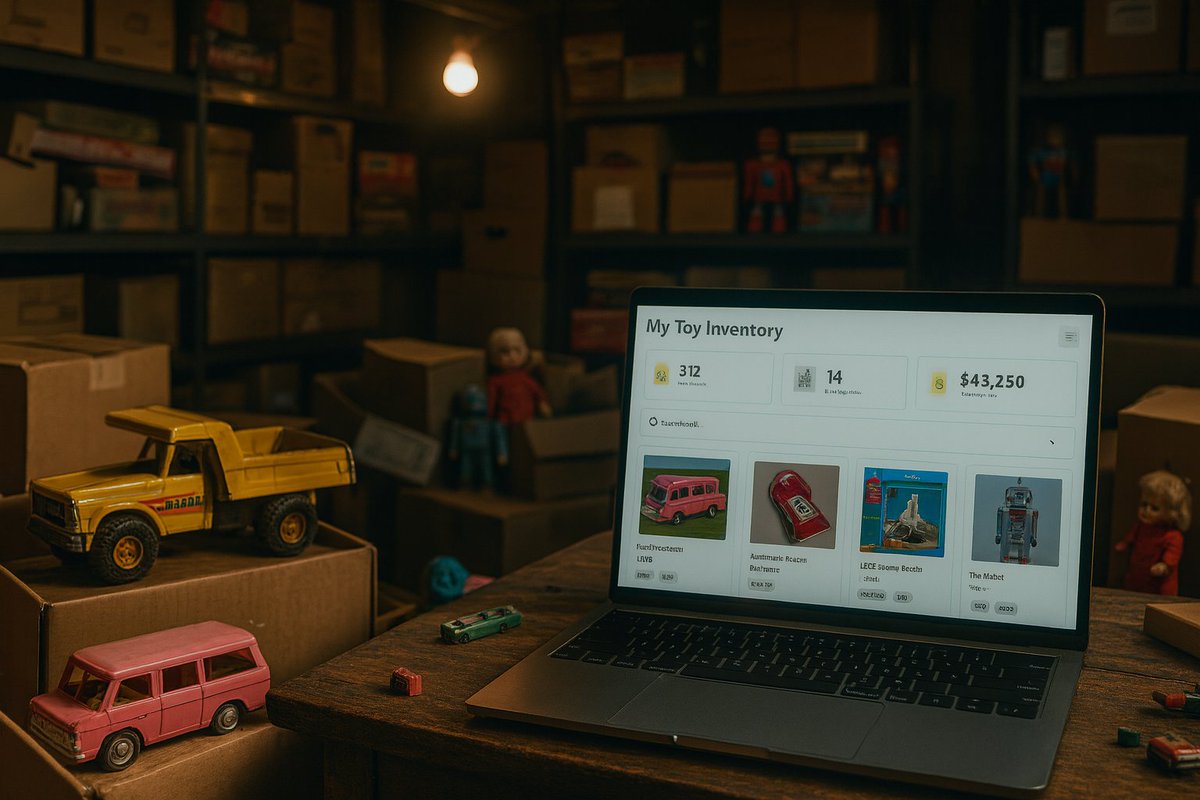
We’re building Catalog My Toys, helping collectors catalog, identify, and understand the value of their collections using AI.
Curious what you think.
What AI tools are you using in your creative workflow?
I built a system that turns eBay sales data into a ready-to-post video in under 3 minutes.
No editing. No script writing. No voiceover recording.
Here's exactly how it works — because I think the architecture is more interesting than the output.
The pipeline:
You type a search. "Vintage Star Wars." "Hot Wheels Redline." Whatever category you follow.
The system scrapes the last 30 days of real eBay sold listings, pulls titles, prices, images, and dates. You pick the items you want to feature. Then one click triggers this:
→ Screenshots every listing automatically
→ Sends the data to Claude, which writes two scripts — one for a 16:9 YouTube format, one for a 9:16 TikTok format. Different tone, different pacing, same data.
→ Sends each script to a TTS engine that generates per-segment voiceovers
→ Pipes everything into a Remotion renderer that composites the full video — animated transitions, price reveals, waveform bars, product images, brand identity
→ While the render runs, Claude generates the YouTube title and description AND the TikTok hook and hashtags in the background
→ When it's done: two download links and four copy-paste content fields waiting for you
The whole thing sits behind a dashboard. You don't touch a timeline. You don't open Premiere.
---
Why I built it this way:
The collectibles space is incredibly active — hundreds of items selling daily — but almost nobody is documenting what's actually selling and for how much. That's valuable information for collectors and sellers.
The problem was the content creation bottleneck. To do this right, every video needed:
- Real sales data (not guesses)
- Good narration
- Decent production
- Platform-specific versions
Doing that manually every day is a full-time job. Automating it properly took a few weeks of evenings.
The hardest part wasn't the video rendering. It was getting the voiceover timing right — the video duration is calculated dynamically from the actual audio file lengths, so each segment is exactly as long as it needs to be.
---
I'm not a full-time developer. I was a PE teacher for 8 years.
I built this because I needed it and nobody was selling it.
That's still my favourite reason to build anything.
If you're in the collectibles space and wondering what the market is doing — this is what I'm building it for:
https://t.co/wbQtDxYktK
I built a full promo video for my product using AI tools in one afternoon.
No agency.
No production team.
No traditional video workflow.
Here’s the stack and why it matters:
Nano Banana (Gemini-powered) — Visuals
The podcast host character, background, and full visual identity were AI-generated. No stock photos. No photographer. No designer. I described the vision and created custom brand visuals that feel cohesive and intentional.
ChatGPT — Script
Hook, structure, pacing, call to action. We refined it line by line until every sentence had a purpose. What usually takes multiple drafts happened in one focused session.
ElevenLabs — Voice
Typed the script, selected a voice, generated professional narration instantly. When I changed the ending, I regenerated just that part. No studio. No scheduling. No retakes.
Claude + Remotion — Video Production
This is where it came together. The entire video was written in code. Transitions, animations, text overlays, product demo placement — all generated conversationally.
I went through multiple versions in one sitting:
• “Make the demo full-screen.”
• “Remove text during the walkthrough.”
• “Change the ending to ‘Snap. Scan. Save.’”
Done. Iterated. Rendered.
Now, is it as polished as something crafted by an experienced video editor with years of production expertise?
No.
And that’s okay.
Because this is iteration speed.
This is control.
This is the ability to update messaging, visuals, features, and positioning anytime without starting from scratch.
And it will only improve as the tools improve — and as I get better using them.
A few years ago, this process would have required weeks of coordination across multiple people.
Today, it’s experimentation in real time.
The result is the video attached to this post.
We’re building Catalog My Toys, helping collectors catalog, identify, and understand the value of their collections using AI.
Curious what you think.
What AI tools are you using in your creative workflow?
@AsishSunny5 https://t.co/byNEZnlyCe A modern way to track, value, and protect what you love collecting. No more guessing what you own or what it's worth.
Your collection is growing.
But is your system?
Most collectors know exactly what they’re looking for.
Fewer know exactly what they own.
CatalogMyToys helps you:
• Organize every item
• Track condition and notes
• Keep photos structured
• Manage everything in one secure place
No more scrolling endlessly through camera rolls.
No more “I think I have that somewhere.”
Just clarity. Structure. Control.
Because collecting is passion.
Managing it should be simple.
https://t.co/RL5GPZgsIx
I built a full promo video for my product using AI tools in one afternoon.
No agency.
No production team.
No traditional video workflow.
Here’s the stack and why it matters:
Nano Banana (Gemini-powered) — Visuals
The podcast host character, background, and full visual identity were AI-generated. No stock photos. No photographer. No designer. I described the vision and created custom brand visuals that feel cohesive and intentional.
ChatGPT — Script
Hook, structure, pacing, call to action. We refined it line by line until every sentence had a purpose. What usually takes multiple drafts happened in one focused session.
ElevenLabs — Voice
Typed the script, selected a voice, generated professional narration instantly. When I changed the ending, I regenerated just that part. No studio. No scheduling. No retakes.
Claude + Remotion — Video Production
This is where it came together. The entire video was written in code. Transitions, animations, text overlays, product demo placement — all generated conversationally.
I went through multiple versions in one sitting:
• “Make the demo full-screen.”
• “Remove text during the walkthrough.”
• “Change the ending to ‘Snap. Scan. Save.’”
Done. Iterated. Rendered.
Now, is it as polished as something crafted by an experienced video editor with years of production expertise?
No.
And that’s okay.
Because this is iteration speed.
This is control.
This is the ability to update messaging, visuals, features, and positioning anytime without starting from scratch.
And it will only improve as the tools improve — and as I get better using them.
A few years ago, this process would have required weeks of coordination across multiple people.
Today, it’s experimentation in real time.
The result is the video attached to this post.
We’re building Catalog My Toys, helping collectors catalog, identify, and understand the value of their collections using AI.
Curious what you think.
What AI tools are you using in your creative workflow?
Stop wondering what’s in those boxes and start knowing what they’re worth. 🧸✨
With Catalog My Toys, managing your vintage collection is as easy as:
📸 Snap a photo
🔍 Scan with AI to identify model & year
💾 Save to your digital archive
Protect your legacy and track your collection's value in real-time.
Try it now: https://t.co/pYspGvRuvV 🚀
The StockX x Kalshi partnership is opening a new chapter for collectibles.
For the first time, sneaker and toy prices can be traded like financial assets, using real StockX data to settle predictions.
This could change how collectors hedge value, invest, and understand market trends.
Exciting times for alternative assets.
#Collectibles #StockX #Kalshi #Fintech
https://t.co/7DjRgENw36
Teaching AI to See: How I Built an Image Recognition System for Vintage Toys
I’ve been collecting vintage toys for most of my life.
Over the years, that passion turned into a kind of beautiful chaos: thousands of items from different eras, materials, and manufacturers, all packed in boxes, shelves, and folders.
One day, I realized I couldn’t keep track anymore. I was surrounded by history but drowning in data. I needed something that could look at a photo and help me make sense of it.
So I decided to build an image recognition system; not for the sake of AI, but to bring order to my own world of toys.
Step 1: Giving AI a Language
Before the model could learn, I had to teach it how to understand.
I organized my photos into a structure:
Category → Subcategory → Type → Material → Country → Era
It wasn’t fun work. It was tedious, repetitive, and strangely meditative. But this structure became the foundation of everything that followed.
I learned early on that AI doesn’t learn from chaos; it learns from consistency.
Step 2: Building the System
Once the dataset was ready, I built a small web app using Python, Flask, and the OpenAI Vision API.
The workflow was simple: upload an image → send it to the OpenAI Vision API → extract both visual details and text through OCR → get structured JSON data back.
{
"category": "Mechanical Toy",
"subcategory": "Wind-Up",
"type": "Clown Acrobat",
"material": "Tin",
"country": "Japan",
"text_detected": "Made in Japan",
"year_estimate": "1950s"
}
For the first time, I could upload a photo and get usable information, not just a picture.
The OCR was the real breakthrough. It could read embossed metal text, faded box labels, even markings I had missed myself. It felt like I had given the machine a new sense.
Step 3: Watching It Learn
At the beginning, it got a lot wrong.
Tin cars became robots. Reflections were mistaken for writing. A shiny figure was confidently labeled “porcelain.”
But every error taught me something. I refined the prompts, clarified the logic, and added examples. Slowly, the predictions became sharper.
That’s when I realized something simple but profound:
AI doesn’t actually see objects. It understands relationships between them.
It was learning the visual language of nostalgia; color, material, texture, design and connecting it all in a way that started to feel almost intuitive.
Step 4: What I Learned
Good data always wins. If your input is messy, nothing else matters.
Prompt design is communication, not magic. The way you ask shapes what AI gives.
OCR is underrated. Text within an image carries context no model can fake.
Iteration never ends. You don’t train once , you evolve with it.
And maybe most importantly: organizing your own data teaches you more than automation ever will.
Now, I can upload a photo and get structured information in seconds.
It’s not perfect, but it’s consistent. It saves time, reduces clutter, and helps me rediscover pieces of history that had been buried for years.
I didn’t build AI to replace my curiosity.
I built it to scale it.
Hey @X algorithm 👋
I’m looking to #connect with people who are into:
🧸 Toy Collecting
💰 Toy Reselling & Flipping
📦 Vintage & Antique Toys
📸 Toy Photography
🧠 AI for Collectibles
💻 Digital Cataloging
🎨 Restoration & Customization
🧩 Community Building
📈 Startup & Growth
Building https://t.co/pYspGvRuvV a Digital Archive for Vintage Toy Collectors, powered by AI.
Let’s connect 🤝