Why AI Will Save The World
By Marc Andreessen
The era of Artificial Intelligence is here, and boy are people freaking out.
Fortunately, I am here to bring the good news: AI will not destroy the world, and in fact may save it.
🧵
Je veux présenter mes excuses, au nom des Français, pour avoir enfanté la French Theory (qui a enfanté la pire des merdes idéologiques : le wokisme).
Nous avons donné au monde Descartes, Pascal, Tocqueville. Et puis, dans les ruines intellectuelles de l'après-68, nous avons donné Foucault, Derrida, Deleuze. Trois hommes brillants qui ont fabriqué, dans l'élégance de notre langue, l'arme idéologique qui paralyse aujourd'hui l'Occident.
Il faut comprendre ce qu'ils ont fait. Foucault a enseigné que la vérité n'existe pas, qu'il n'y a que des rapports de pouvoir déguisés en savoir. Que la science, la raison, la justice, l'institution médicale, l'école, la prison, la sexualité, tout n'est qu'une mise en scène de la domination. Derrida a enseigné que les textes n'ont pas de sens stable, que tout signifiant glisse, que toute lecture est une trahison, que l'auteur est mort et que le lecteur règne. Deleuze a enseigné qu'il fallait préférer le rhizome à l'arbre, le nomade au sédentaire, le désir à la loi, le devenir à l'être, la différence à l'identité.
Pris isolément, ce sont des thèses discutables. Combinées, exportées, vulgarisées, elles forment un système. Et ce système est un poison.
Car voici ce qui s'est passé. Ces textes, illisibles en France, ont traversé l'Atlantique. Les départements de Yale, de Berkeley, de Columbia les ont absorbés dans les années 80. Ils y ont trouvé un terreau qui n'existait pas chez nous : le puritanisme américain, sa culpabilité raciale, son obsession identitaire. La French Theory s'est mariée à ce substrat, et l'enfant de ce mariage s'appelle le wokisme.
Judith Butler lit Foucault et invente le genre performatif. Edward Said lit Foucault et invente le post-colonialisme académique. Kimberlé Crenshaw hérite du cadre et invente l'intersectionnalité. À chaque étape, la matrice est française : il n'y a pas de vérité, il n'y a que du pouvoir, donc toute hiérarchie est suspecte, toute institution est oppressive, toute norme est violence, toute identité est construite donc négociable, toute majorité est coupable.
Voilà comment trois philosophes parisiens, qui n'ont probablement jamais imaginé leurs conséquences pratiques, ont fourni le logiciel d'exploitation à une génération entière d'activistes, de bureaucrates universitaires, de DRH, de journalistes, de législateurs. Voilà comment on a obtenu une civilisation qui ne sait plus dire si une femme est une femme, si sa propre histoire mérite d'être défendue, si le mérite existe, si la vérité se distingue de l'opinion.
C'est de la merde pour une raison simple, et il faut la dire calmement. Une civilisation se tient debout sur trois piliers : la croyance qu'il existe une vérité accessible à la raison, la croyance qu'il existe un bien distinct du mal, la croyance qu'il existe un héritage à transmettre. La French Theory a entrepris de dynamiter les trois. Pas par méchanceté. Par jeu intellectuel, par fascination du soupçon, par haine de la bourgeoisie qui les avait nourris. Mais le résultat est là. Une génération entière a appris à déconstruire et n'a jamais appris à construire. Une génération entière sait soupçonner et ne sait plus admirer. Une génération entière voit le pouvoir partout et la beauté nulle part.
Je m'excuse parce que nous, Français, avons une responsabilité particulière. C'est notre langue, nos universités, nos éditeurs, notre prestige qui ont donné à ce nihilisme son emballage chic. Sans la légitimité de la Sorbonne et de Vincennes, ces idées n'auraient jamais traversé l'océan. Nous avons exporté le doute comme d'autres exportent des armes.
Ce qui se construit maintenant, en silicon valley, dans les labos d'IA, dans les startups, dans les ateliers, dans tous les lieux où des gens fabriquent encore des choses au lieu de les déconstruire, c'est la réponse. Une civilisation se reconstruit par les bâtisseurs, pas par les commentateurs. Par ceux qui croient que la vérité existe et qu'elle vaut qu'on s'y consacre. Par ceux qui assument une hiérarchie du beau, du vrai, du bon, et qui n'ont pas honte de la transmettre.
Alors pardon. Et au travail.
A slow life is a life that’s aligned with your soul:
- waking up without rushing
- coffee in silence
- reading books that take weeks to finish
- long walks in nature
- cooking something simple and slow
- sitting by a window doing nothing
- keeping your circle small
- keeping your life private
- saying no without guilt
- listening to music and staring at the ceiling
- working on something meaningful
- letting yourself get bored
- going to bed without feeling drained
- moving at your own pace
- not caring what people think
A slow life is not a boring life. It’s not a lazy life. It’s not an unambitious life. It’s a life built around what actually feels true to you.
A CEO from one of our portfolio companies shared this with their team. I’m re-sharing it with their permission, because it resonated and reflects what all founders and CEOs should be communicating.
--
We are living through a period of compounding change. And in moments like this, the biggest risk is no longer making the wrong decision. It is moving too slowly while the world moves around you.
There are two paths. We can play defense:
- Protect what we have
- Optimize what works
- Wait for clarity
It feels safe. It isn’t.
Or we can play offense:
- Learn faster than the environment changes
- Use new tools to solve old problems in better ways
- And create entirely new strategies and businesses
That’s where the opportunity is.
Challenge yourself to do things faster and better than you have ever attempted. Stay uncomfortable. Stay on the front foot.
Twin and adoption studies consistently show that parenting choices have minimal effects on a kid's eventual intelligence, personality, or happiness (except in cases of extreme neglect or abuse). This should revolutionize how we raise children, yet almost nobody knows or cares.
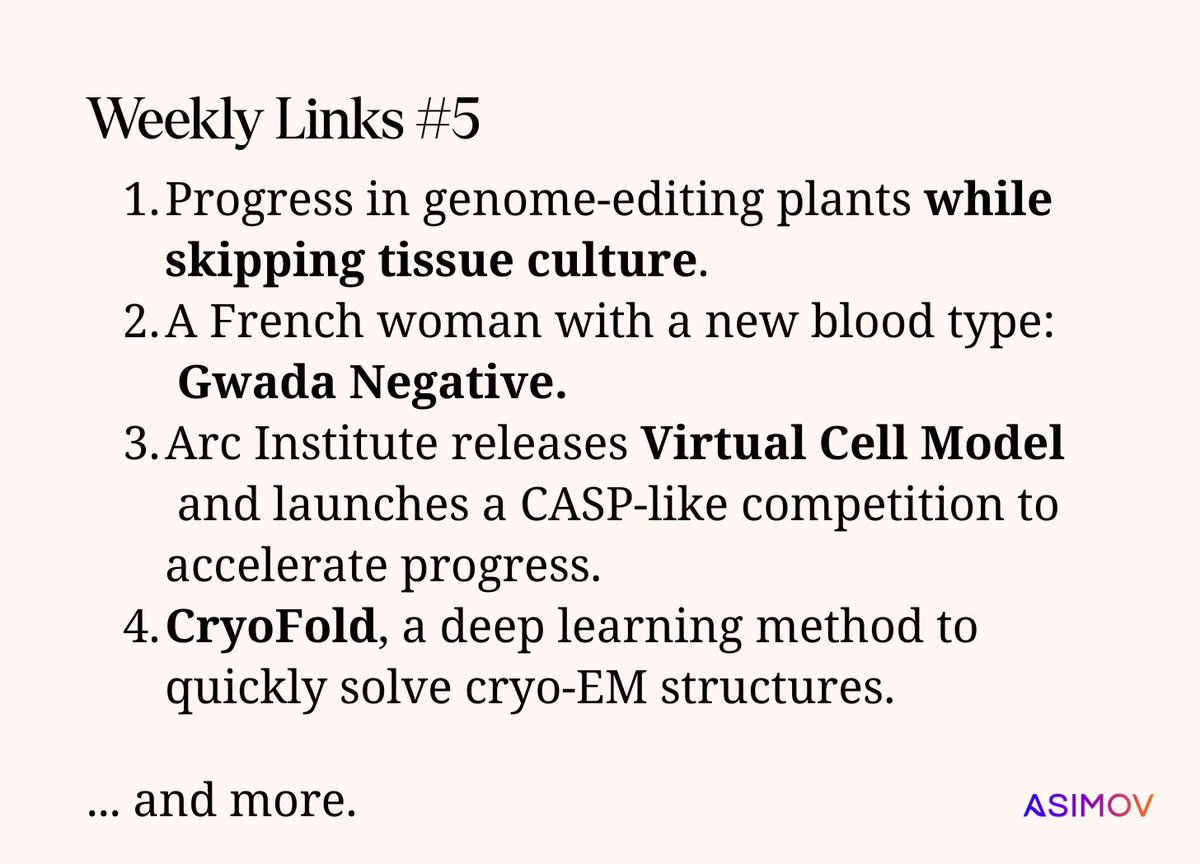
This week in biotech:
1. Bacteria were engineered to convert PET plastic into acetaminophen.
2. Exciting progress in genome-editing plants while skipping tissue culture.
3. A French woman may be the first with this new blood type: Gwada Negative.
4. NeuroPixels tested in non-human primates, with 4,416 recording sites.
5. Arc Institute releases v1.0 of their Virtual Cell Model. Also launches a Virtual Cell competition with $100,000 prize.
6. CryoFold is “a deep learning method that enables end-to-end training and one-shot inference” of cryo-EM images.
7. “From 1 July, researchers funded by the US National Institutes of Health (NIH) will be required to make their scientific papers available to read for free as soon as they are published in a peer-reviewed journal.”
8. Phase 3 trial where patients received two weight-loss drugs together: semaglutide and cagrilintide. “The estimated mean change in body weight from baseline to week 68 was −13.7% in the cagrilintide–semaglutide group and −3.4% in the placebo group.”
9. DeepMind releases AlphaGenome, AI tool that “predicts how single variants or mutations in human DNA sequences impact a wide range of biological processes regulating genes.”
10. Researchers release a 3D single-cell spatiotemporal multi-omics dataset profile of the fruit fly, from embryo to pupa.
11. Urea spontaneously forms from carbon dioxide and ammonia in aqueous droplets.
... and more.🔻
1/ We are entering a post-progressive era. The cultural left-liberalism which emerged a century ago and took off in the late 1960s is exhausted. This ‘vibe shift’doesn’t just repudiate the last decade, but the last 60 years. My latest @WSJ
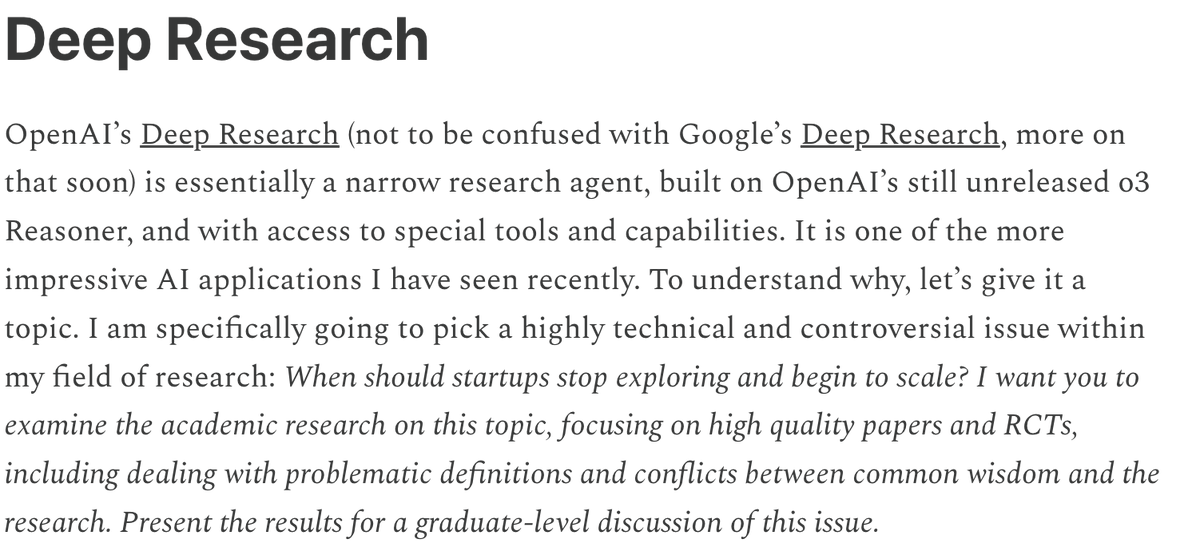
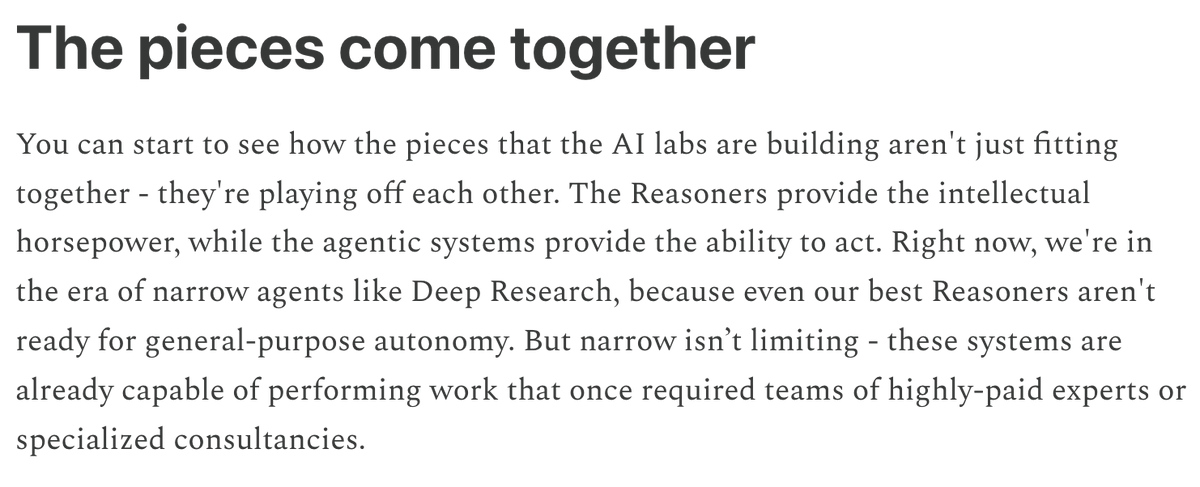
Too many things happening right now, but there's a decent chance the most important announcement in the last 48 hours is confirmation that the frontier AI labs have taken significant steps toward building autonomous digital workers that can "navigate the web, process information across all modalities, and take meaningful action in the world" (@emollick).
So, a disembodied silicon brain that can accomplish complex multi-hour, or multi-day research projects—search on the Internet, read, synthesize, write, and even PowerPoints—in a matter of minutes.
If you're still on team "AI is a waste of time," I genuinely don't know what you think the white-collar economy is.
We're watching the biggest wealth shift in history.
By 2034, the new AI Agents will:
• Replace 800M jobs (McKinsey)
• Add $19.9T to the global economy (IDC)
Your 9-5 will be extinct.
Here’s what you need to know (& how to prepare in 2025):
The Musk-Led Manufacturing Revolution Nobody Is Talking About | ZeroHedge
When most analysts discuss Tesla, they focus on new vehicles or the electric vehicle company’s advancements in autonomy. Yet, according to Launch i/o CEO Jeff Lutz, one of the most significant—and under-discussed—developments at Tesla is happening not in its design studios or on the road, but in its factories. Lutz, a former executive at Google and Motorola, argues that Tesla’s true innovation isn’t just the electric vehicles or robots it’s building, but how those products are being made. The company’s first-principles approach to manufacturing is a radical departure from the industry norm, focusing not just on cheap labor or existing models, but on rethinking the entire production process.
Tesla is creating factories that are the product—designing, testing, and perfecting every element just as they do with their cars. This focus on manufacturing efficiency, Lutz believes, will lead to a dramatic reduction in production costs, potentially bringing them closer to zero. And this shift in how products are built—rather than merely assembled—could set a new standard for the entire manufacturing world.
FARZAD MESBAHI: It's no wonder that innovation has been lacking so much it's because we've brute forced essentially manufacturing by leveraging globalization because we had that $2 an hour rate in China or Mexico wherever else like we're not like well we have to just get really good at building stuff to be competitive I was like nah just let him do it like we'll get get our margins just let them do it.
JEFF LUTZ: The most under-discussed thing in the analyst world about Tesla is not the new vehicles coming, nor the growing discussions about autonomy, but rather Tesla's next product: their new way of manufacturing. It's a big deal, a huge step in how products are made today, and I don't think many investment firms have the right research people actually looking into what this impact is and what it's going to enable. It's going to enable the variable cost to build products to shrink further and further, approaching zero.
This is the step function needed for cost reduction to achieve further scale, and I don’t think enough people are talking about it. It’s going to be how the Cybertruck is made, how Optimus will be made. Tesla versions its factories like they version their product. They spend time perfecting it and have design reviews of their factory designs just as they do with their products. They have specs and performance attributes they are trying to meet. This is very different from what happens at other companies at the executive level.
FARZAD MESBAHI: This is such a profound statement because a lot of the stories that I hear are related to, like, say Tesla capitalizing on making manufacturing the product—really just honing in so much on the factory that it becomes the product, the you know, and where we throw around 2 million cars per year, five million cars per year per factory, tens of millions of bots per year sooner than people think. The usual narrative is crazy, pie-in-the-sky; they can't do that, look at Ford, look at BYD, they can only do so much.
But what we're missing here is that we've had decades of just sitting on our asses, leveraging cheaper labor versus going out of our way to really push the boundaries of engineering and manufacturing. And now that we have a company that's willing to do that because the leader is viewing that as a first principles approach to manufacturing, right? Instead of like, okay, cheap labor is good, but why aren’t we pushing manufacturing and engineering as much as we can to make this as efficient and as productive as possible?
Of course they’re extremely talented, they’re doing something very unique, but it’s also on the backs of 30-40 years of, I’m going to call it laziness. Like, you're just taking the easy way out, and I get it, more profits, you're taking care of shareholders—I get it—but you're not really pushing the boundaries of manufacturing. I think what this leads to is, if companies and leaders truly take this to heart, we’re going to see an explosion in manufacturing across the board. It’s not just going to be a Tesla thing; I think we’re going to see it all over the place.
JEFF LUTZ: I’m advising companies on this now, you're going to see massive localization of manufacturing. People think costs just instantly go up when you do that. They do unmitigated, but if you're a company like Tesla and you're thinking about it the way they do, they're actually focused on localizing and making costs go down. Think of it, how many auto factories are expanding in Germany? Just answer that question.
Read more:
https://t.co/Kzg6r1dEGL
David Sacks just became Trump's "Crypto & AI Czar":
• Built PayPal with Elon
• Sold $1.2B company to Microsoft
• Invested early in Facebook, Uber & Airbnb
4 years ago, few outside tech knew who David Sacks was...
The untold story of Silicon Valley's secret kingmaker ���
Thiel: If you’re always against dogmatism, you're too sceptical; if you’re always against scepticism you’re too dogmatic.
Where do scientists admit to being too dogmatic? Nowhere.
Science has become more dogmatic than the Catholic Church was in the seventeenth century.