From the moment you awaken to the reality of this string called life, start preparing for your death. Let every moment, every action and every movement carry the signature of your death, because, in reality, they already do as time flies by. You are merely choosing to recognise that truth through a constant reminder.
Once you begin living with that consciousness, you will automatically lead a morally upright life, even if your morality does not necessarily conform to the standards society has established or evolved to recognise thus far. Think about it: most mistakes are made by (wo)men who live under the illusion that they are going to remain here forever.
Always keep an imaginary countdown running somewhere in your mind. Perhaps then, fear, anxiety, greed, jealousy, anger and all such strong emotions will gradually lose their ability to touch you. Start trying. I know practising this is far more difficult than writing it down in philosophical terms, but keep trying.
With the passing of your beloved parent(s), the countdown of your own death begins. Every day you carry on after they have gone is a bonus to your existence, something you could not have imagined, as you never reckoned on a life beyond theirs.
It is not merely a boundary issue, but a calculated geopolitical strategy by Beijing to keep the conflict with India alive.
By keeping the 3,000+ km border in a state of flux, China forces India to concentrate its resources, military doctrines, and strategic energy on land defence.
China wants to dominate trade routes in the Indian Ocean. By keeping India tied down along its northern borders, Beijing seeks to delay India’s pivot towards building a stronger naval presence and prevent the emergence of a competitive maritime space.
China rejects the McMahon Line because formally accepting it would implicitly recognise Tibet as having had the autonomy to sign international agreements in 1913 (Simla Convention). Beijing fears this could establish a legal precedent for others to challenge its sovereignty over Tibet. It is therefore caught in a kind of 'sovereignty trap', where accepting the border with India would, in effect, lend legitimacy to the argument that Tibet once possessed independent treaty-making authority.
In short, it is a strategy of 'compartmentalisation': keeping India occupied on land while China pursues its own wider economic and maritime ambitions.
As agreed between the two sides, Member of the Political Bureau of the CPC Central Committee, Director of the Office of the Central Commission for Foreign Affairs, and China’s Special Representative on the Boundary Question Between China and India Wang Yi will co-chair the 25th Round of Talks Between the Special Representatives on the Boundary Question with India’s Special Representative and National Security Advisor Ajit Doval in Beijing on August 25.
If you see any uninformed person in India parroting propaganda, without using their brains, that "India only assembles phones" tell them China too doesn't manufacture phones with over 80% of parts of, say an iPhone, coming from outside China, including from India, but still they proudly call it "Made in China."
Tell them, in a globalized world, even a sensitive tech like F-35 is assembled from many parts sourced from outside its home country. Tell them not to be seen as a low IQ person who falls for this silly propaganda that has been planted to mock Made in India and demean ourselves.
Make them understand that, today, not even a semiconductor and electronics powerhouse like Taiwan can manufacture a phone 100% on its own. Even if it has processors and circuit boards, it may still need to source displays from Korea, the glass for the displays from India, the OS from US, and cameras from Japan.
It is indeed true that only a low-IQ, self loathing, slave minded person in India will knowingly parrot such silly propaganda planted from outside India to demean India and India's manufacturing rise. Only a colonized, politicized, programmed, ignorant mind will say "China manufactures phones, while India only assembles."
If you see any such comment anywhere in social media, paste this post's link as the reply. And ask them to get well soon and do something to help improve India on their own.
Could someone please enlighten @realDonaldTrump about the Special Intensive Revision (S.I.R.) being carried out by India’s Election Commission to weed out bogus voters?
Anyone? @SergioGor
If Trump could replicate something similar in the U.S., his MAGA base might be eternally grateful to him.
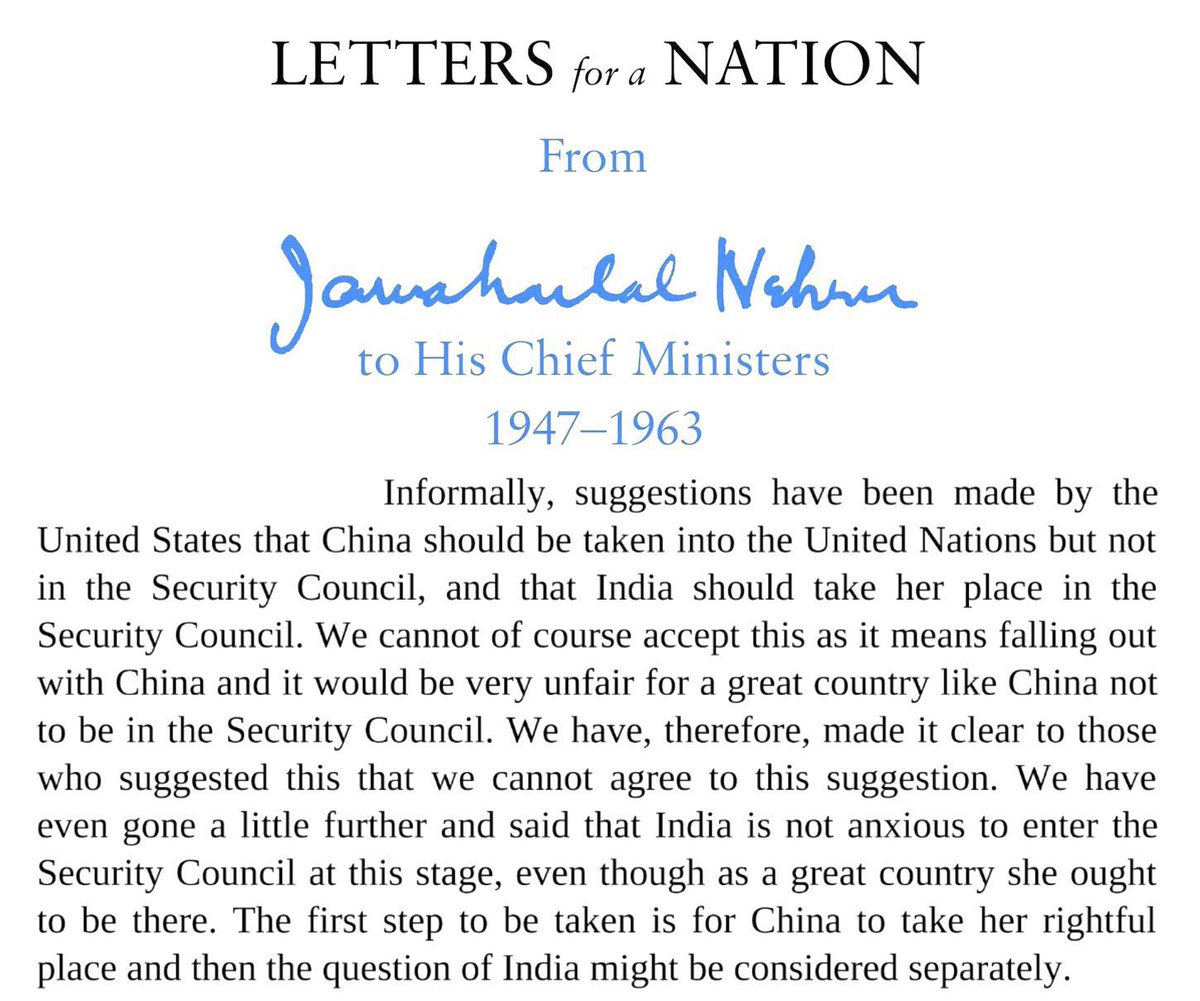
Before anyone from the Nehruvian socialist fan club claims that he was advocating the inclusion of the ROC (Taiwan) as a permanent member of the UNSC, let me categorically dispel that claim. He was unequivocal in advocating the admission of Communist China into the United Nations. He supported Communist China being given the permanent seat on the UNSC and did not regard the then ROC (Taiwan) as the legitimate representative of China, even when that position of ROC/Taiwan under the Kuomintang, that was supported by the West and much of the rest of the international community.
In his discussions with Soviet leaders in 1955, he repeatedly prioritised “China’s admission” over any Indian claim, with “China” again referring to the PRC, not the ROC.
Suggestions have been made by the United States that India should take China's place in the Security Council. We cannot of course accept this as it means falling out with China and it would be very unfair for a great country like China not to be in the Security Council. - Nehru
When I say China will create conflict, I mean skirmishes along the LAC will be created soon. Not a full fledged war. China will never want war with India. Its aim is to weaken and subdue India without a war.
1. China's main war is narrative
2. It uses narrative to weaken democracies
3. It will spread narrative that "India lost land to China"
4. To hit GoI & get support at home as economy stalls
5. It seems to have a network in India in media, NGOs, politics
6. Arunachal Pradesh will likely be used this round
7. We saw the same narrative nonsense in Ladhak last time
8. I say AP this time because I sense some local orgs, people have been psyoped to speak for China
9. Using Indians against Indian govt. A BJP run state
10. So we may see protests in Arunachal against GoI
11. There may be one or two Army jawan videos too, to fool people
12. Protests in AP may be organized by some AP local political groups or NGOs claiming "China took their land" blaming Modi directly. Communists build narrative like this.
Basically, we will see LAC skirmishes and conflict starting soon and heating up by May 2027 to help start and sustain a narrative.
And the serious narrative warfare inside India using India's politics and China's influence network (around the world media too) to create a strong, believable, narrative against Indian govt, "Modi lost land" etc.
We have already seen this during 2020. Protests were stirred up by China aligned GLISCO-DS. Covid was sent. Then border was heated up. And narrative was spread for 2024.
This time will be a repeat. What I am worried is, if in 2020 it was Covid, what plandemic or hit job is it going to be now to make a lot of people sick in India, blame the govt, and weaken India?
We are currently in what is known as ‘the corridor’, the period between two eclipses, lasting roughly a fortnight. This time, Ketu has severed, or is about to sever, something from your life that you may have been stuck in for years, perhaps even decades, particularly at the mental level, given that Ashlesha Nakshatra was involved in the recent eclipse.
Do not become restless during this corridor. The Universe is preparing to show you the way forward: why it happened, why you remained stuck for so many years, and what the lesson was meant to be. The truth will be revealed shortly after the lunar eclipse on 28 August.
Later, when Jupiter reaches the eclipse point at 26° Cancer, you will receive guidance from the Guru about how to move forward with this new understanding, even if what is revealed initially feels deeply uncomfortable. With Jupiter moving at an accelerated pace (Atichari), the insight may also arrive in a compressed form. It could feel like decades of wisdom being delivered within a matter of days. Things will become black and white, and you will no longer be able to ignore what you see.
This may perhaps be the breaking point for those who have not yet learnt how to let go of things, people, places, memories, expectations and aspirations.
Remember, those who can detach quickly from everything I have mentioned above, and recover just as quickly, are often the most powerful people. They do not try to control the ‘how’ of manifestation. Instead, they follow the path that the Universe reveals and reconcile themselves with it.
This does not mean they have no desires or free will. Rather, they have presented their desires to the Universe and allowed it to guide them towards the quickest and most appropriate path to fulfilment, instead of insisting on a path of their own choosing that may ultimately be imperfect and create unnecessary chaos.
So, trust the process. Have faith that, in the grand scheme of things, it is all an illusion and nothing is meant to be taken too seriously. You may not like what you see or hear, but you will eventually understand it with complete clarity.
Best of luck for the upcoming churn!
Lately, there has been a realisation in India that China is pursuing a long-term strategy of renaming places in Arunachal Pradesh to manufacture administrative records. The objective is to create a paper trail over decades that it can eventually present internationally as evidence of historical Chinese administration, a tactic it has already employed in the South China Sea.
Therefore, the renaming of villages and other locations is not merely an act of cartographic aggression.
India is now responding to the Chinese agenda in its own language.
With the Modi government in power, the Central government has increasingly assumed the role of a modern state, while most State governments remain highly inefficient, low-grade, corrupt, poorly equipped and grossly mismanaged, with inadequate enforcement machinery and resources, and often little will to reform themselves.
The reforms have simply not percolated down to the level of State governments, largely because of their own resistance to change and their refusal to recognise clean governance as a basic right of Indian citizens.
Part of the blame, however, lies with the people as well. They expect Europe-, U.S.- or China-level governance from the Central government to such an extent that they assume Modi somehow controls every layer of government in the country, right down to municipal administration. Even a municipal-level failure is routinely attributed to Modi and the Central government.
The ignorant Gen-Z may not understand the hierarchy of India's governmental machinery, but when millennials and the elderly do the same, it often reeks of something beyond ignorance: a deliberate attempt to undermine a Central government, driven by political associations formed in the past and still operating at a subconscious level, which these closet-Congressis are unwilling to acknowledge publicly.
For Gen-Z and others who genuinely do not understand how the system works, the simple request is this: first identify where the problem actually lies, and then seek its solution from the appropriate department, ministry or tier of government.
The Central government is not an all-powerful Chinese or North Korean-style one-party state. India has multiple tiers of government, with clearly divided responsibilities. Accountability should follow responsibility.
FSSAI sets the national standards and has regulatory authority, but India's food-safety enforcement is heavily decentralised. The people actually inspecting shops, collecting samples, seizing adulterated food and initiating cases are largely under State governments.
The irony is that FSSAI often gets blamed for food adulteration when its core job is to set scientific food-safety standards and the actual enforcement machinery largely lies with the states.
The constitutional architecture assumed that State governments would meaningfully discharge their responsibilities. It did not foresee a situation where state-level enforcement would become so shallow, understaffed and inefficient that regulations exist on paper but are barely enforced on the ground.
FSSAI has actually done a fairly good job of building a modern, science-based regulatory framework. Yet it ends up receiving a disproportionate share of the criticism for failures that often occur much further down the enforcement chain.
If a state food department is not conducting adequate inspections, sampling, testing and prosecution, the answer is not to blame the institution that wrote the rule. The accountability should follow the responsibility.
India's food-safety problem is not simply a failure of FSSAI. It is, to a large extent, a failure of state-level enforcement.
So, the next time you have to pin the blame, you should know where to seek questions.
FSSAI sets the national standards and has regulatory authority, but India's food-safety enforcement is heavily decentralised. The people actually inspecting shops, collecting samples, seizing adulterated food and initiating cases are largely under State governments.
The irony is that FSSAI often gets blamed for food adulteration when its core job is to set scientific food-safety standards and the actual enforcement machinery largely lies with the states.
The constitutional architecture assumed that State governments would meaningfully discharge their responsibilities. It did not foresee a situation where state-level enforcement would become so shallow, understaffed and inefficient that regulations exist on paper but are barely enforced on the ground.
FSSAI has actually done a fairly good job of building a modern, science-based regulatory framework. Yet it ends up receiving a disproportionate share of the criticism for failures that often occur much further down the enforcement chain.
If a state food department is not conducting adequate inspections, sampling, testing and prosecution, the answer is not to blame the institution that wrote the rule. The accountability should follow the responsibility.
India's food-safety problem is not simply a failure of FSSAI. It is, to a large extent, a failure of state-level enforcement.
So, the next time you have to pin the blame, you should know where to seek questions.
For decades, the U.S. and Europe lectured India to:
“Open your markets. Cut tariffs. Remove subsidies. Privatise PSUs. Welcome foreign capital. Embrace free trade.”
India finally did.
Now they are rediscovering protectionism.
It was never really about free trade.
It was a neocolonial project of preferential trade, designed to keep markets open for them while preserving their own advantages.
Now that the tables have turned, they have become exactly what they once accused India of being.
🚨 India’s steel surge leaves the EU scrambling for cover
The European Commission has proposed a 9.5% protectionist duty on cold-rolled steel from India as Indian exports keep surging: Eurometal
The Commission has published its final anti-dumping findings on cold-rolled flat steel from India, Türkiye, Vietnam and two others — a clear attempt to shield European producers from competitive pressure.
Combined imports from the five countries jumped 28% versus 2022, hitting roughly 1.69 million tonnes.
What this means for the future of UPI-RuPay is that, starting with large merchants, the government is essentially pushing NPCI into direct competition with Visa and Mastercard. Large merchants will have little incentive to remain loyal to the UPI-RuPay ecosystem unless its MDR remains lower than that of Visa and Mastercard.
This is just testing the waters. The MDR will eventually be extended to medium-sized merchants and, ultimately, small ones as well.
At a time when India’s post-2016 payment ecosystem has been revolutionised, setting new world records every month and offering something far superior to what Visa and Mastercard can provide globally, at a fraction of the cost, the government is essentially killing its biggest competitive advantage and preventing it from expanding beyond India. Taking UPI-RuPay global should have been one of the Indian government’s primary objectives, especially when the U.S. continues to impose unilateral sanctions and weaponise the Visa/Mastercard payment ecosystem against countries that do not align with it or refuse to become client states.
Could the Trump Administration pull the plug on Chinese government for placing WeChat Pay on the same pedestal as Visa and Mastercard in China? No. The Chinese government would never allow it. But the Indian government does, believing it is merely a small concession to make as part of a trade deal.
The ramifications could be huge. Unless the MDR charged on UPI-RuPay remains below that of foreign card networks, it will become less attractive to merchants, and eventually to consumers, while also weakening its proposition in the other economies where NPCI hopes to expand.
This is an outright lie. Once merchants are charged MDR, they will eventually pass the cost on to the end user, as happens in any normal business operation. Moreover, the government is misleading people by claiming that this is primarily intended to spur innovation and expand NPCI’s infrastructure. Several such recommendations, including those from NITI Aayog, have been rejected by the government in the past, with the argument that UPI would be subsidised from the government treasury as a public good.
This sudden change of mind is not coincidental. It is, in fact, meant to accommodate the concerns of Visa, MasterCard and other U.S. card companies, which have been struggling to recover their pre-2016 market share in India and compete with the highly efficient, cost-effective and cyber-secure UPI and RuPay networks.
The imposition of MDR is therefore part of the small concessions the Modi government is handing over to the Trump Administration as part of the ongoing negotiations for the bilateral trade deal, which have remained in limbo for more than a year.
This is an outright lie. Once merchants are charged MDR, they will eventually pass the cost on to the end user, as happens in any normal business operation. Moreover, the government is misleading people by claiming that this is primarily intended to spur innovation and expand NPCI’s infrastructure. Several such recommendations, including those from NITI Aayog, have been rejected by the government in the past, with the argument that UPI would be subsidised from the government treasury as a public good.
This sudden change of mind is not coincidental. It is, in fact, meant to accommodate the concerns of Visa, MasterCard and other U.S. card companies, which have been struggling to recover their pre-2016 market share in India and compete with the highly efficient, cost-effective and cyber-secure UPI and RuPay networks.
The imposition of MDR is therefore part of the small concessions the Modi government is handing over to the Trump Administration as part of the ongoing negotiations for the bilateral trade deal, which have remained in limbo for more than a year.
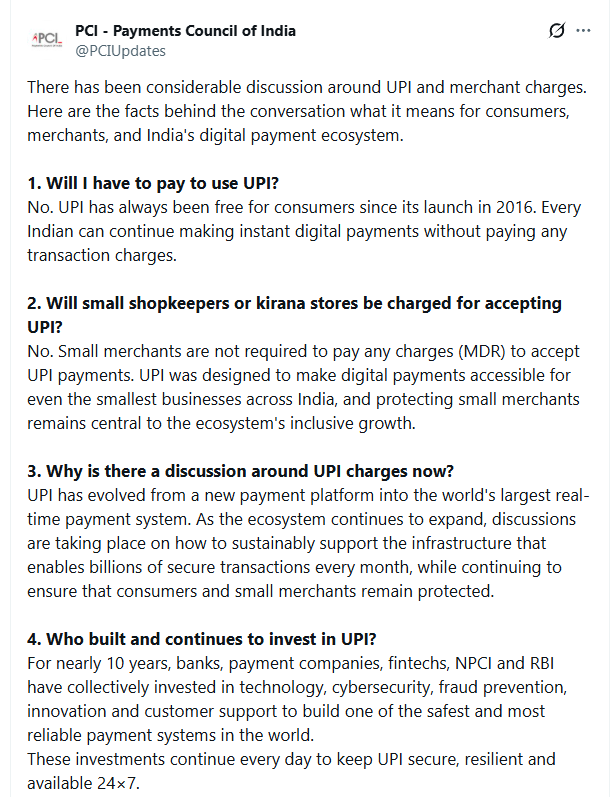
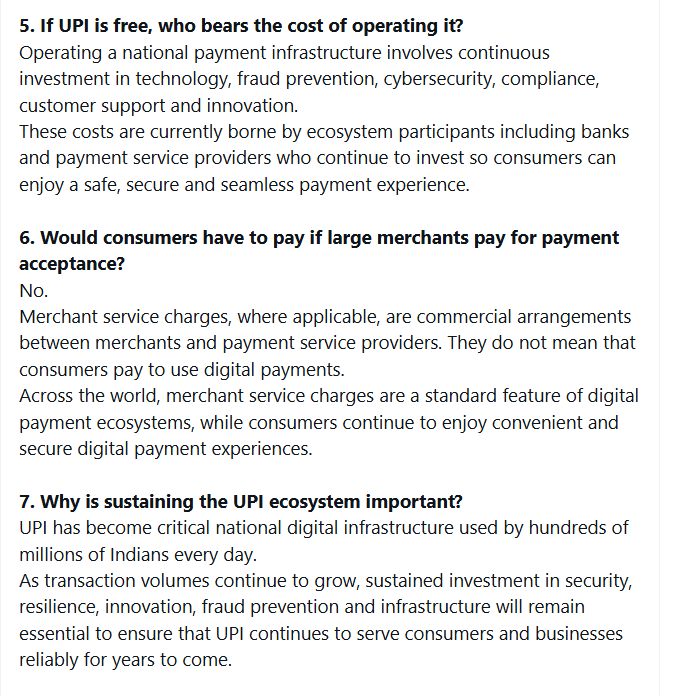
Payments Council of India: "UPI will continue to remain free for consumers, and small merchants will not be charged for accepting digital payments."
"Banks, fintech companies, NPCI, and the RBI have been investing in technology, cybersecurity, fraud prevention, and innovation to maintain UPI’s reliability. Any merchant service charges, where applicable, would be commercial arrangements between merchants and payment providers and would not mean consumers have to pay for using UPI."
Last year, I told my friends that Apple would become the next Nokia, and OpenAI the next Apple. Looking at the patterns of the past few decades, I believe that moment is now approaching.
We are in the final phase of traditional operating systems. Computer and mobile technology have largely plateaued, and we are nearing the point at which AI will overtake the conventional operating system itself.
Google and OpenAI will lead this shift, and others will follow. We may soon see phones that no longer depend upon separate apps. Instead, AI will act as a constantly expanding layer between the user and the digital world.
OpenAI may soon release its own devices, marking the beginning of Apple's decline. Meanwhile, deep-state institutions that once backed Microsoft and Apple, are shifting their bets towards OpenAI and Anthropic.
Android, as we know it, will not remain Android for much longer. It may well become Gemini, perhaps even the name change may happen, to send a signal of rapid transformation of mobile technology towards AI.
So, think twice before spending heavily on flagship phones. In a few years, or perhaps even months, they may begin to look obsolete.
The widespread protests across Pakistan-held Kashmir have been met with police shootings, mobile and internet shutdowns, and sweeping state repression, including the arbitrary detention of protesters under anti-terror laws. Yet despite security forces reportedly killing up to 40 protesters since last week, the crisis in that heavily militarized territory has received scant attention in the Western media.
By contrast, @nytimes published 16 news reports in just one week (July 20–27) on the youth-led protests in New Delhi that forced India's education minister to resign. But on the mass protests in Pakistan-administered Kashmir, which have triggered a severe security crackdown and heavy casualties, it has published just one news report so far.
As August has begun amid an intense cosmic shift, the solar eclipse on 12th August may leave people emotionally charged over something. Do not get drawn into it, or you may regret it later, and prove to be a fool, once again.
Individually too, you may receive a piece of information that appears completely authentic and emotionally compelling, provoking you to act. Avoid doing so, or you may regret it later when the information proves to be false.
The real revelation of something that has remained hidden from you, particularly over the past six months or so, is going to come towards the end of August, after the lunar eclipse. That revelation will show you the way forward and clear your path, especially if you have been going through a prolonged phase of doubt.
So, do not trust or act on what reaches you over the next few days. Act only after what is meant to be revealed comes to light at the end of this month.
The first week of August, and in fact the period up to 15th August, does look turbulent for the country and it feels that another challenge is coming for the government soon. The first week, in particular, looks sensitive. Jupiter is combust, while Saturn is retrograde.
Although both events occur every year, such an overlap is unusual and generally requires a separation of at least five zodiac signs.
This year, the overlap will last for 17 days. Over the next two years, it will extend to 19 and 20 days respectively, while in 2029 it will continue for almost 30 days, and the peak will come in 2030. This period is unique in the sense that it comes once in about 20 years. Astrologically, this is not regarded as a good period.
Jupiter, the planet of growth and optimism, is presently at its greatest distance from the Earth, whereas Saturn, associated with delay and sorrow, is much closer. Put simply, blessings are farther away, while sorrows/difficulties are nearer.
On a personal level, avoid beginning anything significant, as delays and unforeseen obstacles may arise. Pay close attention to health, especially in the case of the elderly and those suffering from chronic ailments. Financial caution is also advisable, and taking any fresh loans should be avoided.
The Indian state has witnessed the dangers of an uninformed, or rather ill-informed, population being swayed by misinformation and manipulated algorithms. It must therefore prepare itself for the next choreographed revolution. And it is not just the youth. Millennials and the elderly, too, are getting influenced by algorithm-driven opinions rather than hard facts. People's attention spans are being reduced to that of a 1-month-old baby, and this is nothing but a regression to animalistic instincts.