Sudan Civil War Update | November 17, 2026
West Kordofan Front:
The Sudanese Armed Forces (SAF) continue to expand their control in West Kordofan. They have now established full control over the Sa’ata area and are reportedly about 18 km from Abu Zabad.
Blue Nile Front:
The Sudanese government has accused Ethiopia of allowing its territory to be used as a base for RSF drone attacks and ground operations.
Meanwhile, the Rapid Support Forces (RSF) and their allied groups continue to expand their presence in Blue Nile State, seeking to open a second front and put additional pressure on the SAF.
The developments on both fronts could further complicate Sudan’s already fragmented conflict.
🇺🇦 Ukrainian President Volodymyr Zelenskyy says Ukrainian drone strikes have disabled more than 55% of Russia’s oil refining capacity.
According to Ukraine’s military assessment, the strikes have significantly disrupted Russia’s oil refining operations.
The figure was announced by Zelenskyy in his video address on November 15, 2026.
Japan’s economy is sending a warning sign.
GDP barely moved in the third quarter, with annualized growth slipping to -0.1%.
What worries me more is household spending. Private consumption fell 0.3%, while business investment actually grew 1.6%.
That’s an important gap.
Companies are still investing, but consumers are becoming more cautious. Add expensive energy imports and a weak yen, and the pressure on households becomes even harder to ignore.
In my view, Japan’s biggest challenge right now isn’t just getting GDP back into positive territory. It’s making sure ordinary people can afford to spend again.
An economy can’t rely on corporate investment forever if consumers keep pulling back.
If you find our analysis valuable, follow The Power Ledger for more insightsinto global economics, geopolitics, energy markets and shifting globalpower dynamics.
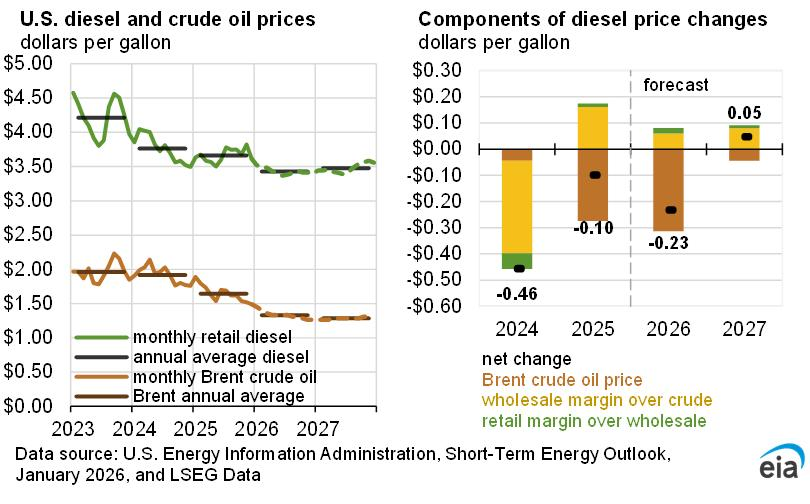
Crude Is Cheaper. Diesel Isn’t.
The global oil market is showing a striking disconnect.
According to the IEA’s November report, North Sea crude prices fell 32% from their early-October peak to around $93 per barrel.
But European diesel prices fell just 11% and remained close to $180 per barrel — still 77% above pre-war levels.
Why?
Because crude supply and refined-fuel supply are not the same thing.
Global refinery runs fell by 1.3 million barrels per day in October, reaching a seasonal low of 81.3 million b/d.
The IEA says tight supplies of refined products, especially diesel, remain a major concern.
The lesson: More crude oil does not automatically mean cheaper fuel.
The real bottleneck may be refining capacity, product availability and disrupted trade flows.
Source: IEA, Oil Market Report, November 2026.
If you find our analysis valuable, follow The Power Ledger for more insights into global economics, geopolitics, energy markets and shifting global power dynamics.
Facts. Context. Perspective.
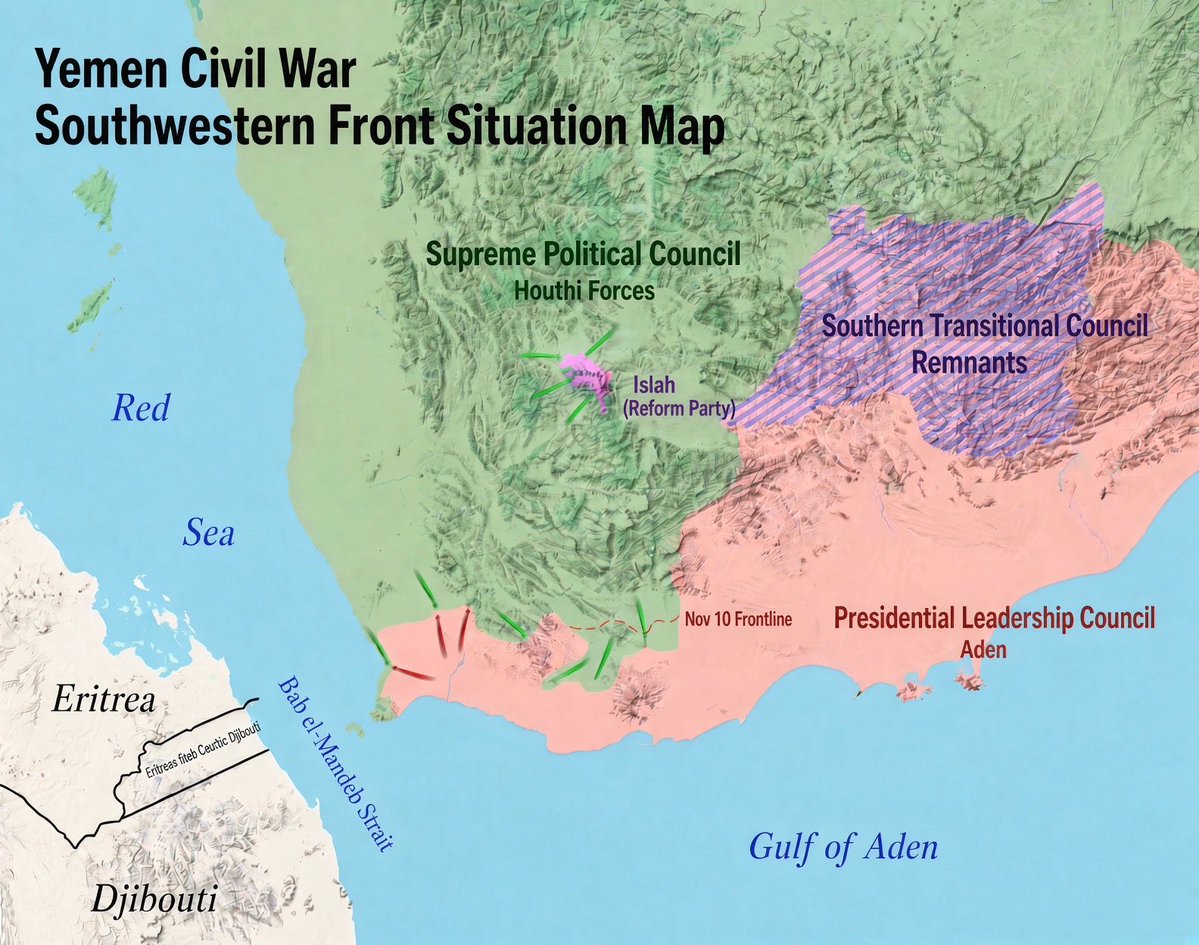
Yemen Civil War | November 11, 2026
In the northern mountainous areas of Lahij Governorate, Houthi forces are advancing rapidly, expanding their control around key highlands and villages, including Al Ash Shat, Am Surays, and Al Adidiyah.
Their southward advance appears to be aimed at reaching the Gulf of Aden, potentially creating an encirclement of southern forces.
Are the Houthis attempting a major strategic encirclement?
#Yemen #YemenCivilWar #Houthis #GulfOfAden
If you find our analysis valuable, follow The Power Ledger for more insights into global economics, geopolitics, energy markets and shifting global power dynamics.
Facts. Context. Perspective.
🌍 One Chart: How Global GDP Rankings Have Changed Over 20 Years
How has the global economic balance of power shifted over the past two decades? A look at GDP shares measured by Purchasing Power Parity (PPP) tells a fascinating story.
Back in 2006, the European Union (19.5%) and the United States (18.9%) dominated the global economy, while China accounted for just 9.5% — less than half the share of either economic powerhouse.
By 2016, the landscape had changed dramatically. China overtook the United States, claiming the top spot with a 16.3% share.
According to IMF projections, by 2026, China’s share is expected to reach 19.9%, while the US (14.5%) and EU (13.8%) continue to lose ground.
But China’s rise is only part of the story.
Asia’s broader economic ascent is equally significant. India’s share has steadily climbed from 4.6% and is projected to reach 8.5% by 2026, making it an increasingly important player in the global economy.
Meanwhile, Japan’s share has fallen from 5.8% to 3.3%, while the UK’s has declined from 3.0% to 2.4%.
Over just 20 years, the center of gravity of the global economy has been shifting decisively toward Asia.
As this economic transformation continues, where do you see the biggest investment opportunities emerging?
#GlobalEconomy #GDP #PPP #China #India #Investing #Economics
If you find our analysis valuable, follow The Power Ledger for more insights into global economics, geopolitics, energy markets and shifting global power dynamics.
Facts. Context. Perspective.
India’s Inflation Is Back Above the 6% Ceiling
1/5
India’s inflation problem is returning.
Retail inflation rose to 6.09% year on year in October, up from 5.54% in September, moving above the Reserve Bank of India’s 6% upper tolerance limit.
2/5
Food prices are a major part of the pressure.
Food inflation climbed to 8.94% in October, compared with 7.74% a month earlier.
For households, this means a faster rise in the cost of everyday essentials.
3/5
India’s inflation target is 4%, with a permitted range of 2% to 6% through March 2031.
October’s reading is only slightly above the ceiling—but it puts monetary policy back under pressure.
4/5
The policy dilemma is familiar:
Higher interest rates can help contain inflation, but they can also make borrowing more expensive for households and businesses.
The central bank must weigh price stability against economic growth.
5/5
One monthly reading does not determine the next rate decision.
But the direction matters.
If food and broader price pressures persist, India’s monetary policy choices could become more difficult—and the effects will matter well beyond its borders.
Sources: India’s Ministry of Statistics and Programme Implementation; Government of India inflation-target notification, March 2026.
The Fed’s Inflation Problem Is Far From Over.
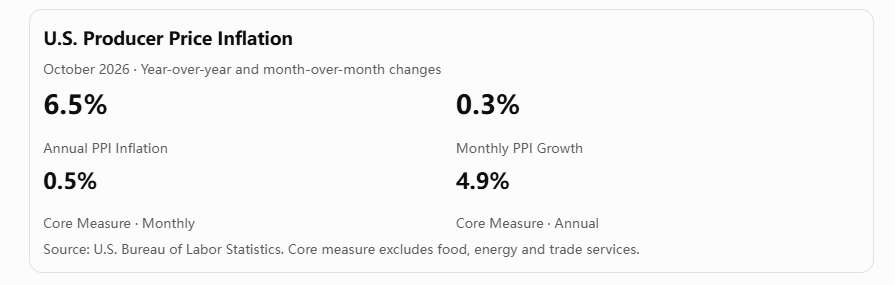
U.S. producer prices rose 6.5% year over year in October—the largest annual increase since November 2022.
Monthly growth slowed to 0.3%, down from 1.4% in September. But underlying price pressures remain persistent: prices excluding food, energy and trade services rose 0.5% in October.
The message for markets: slower monthly inflation does not necessarily mean inflation is under control.
For the Federal Reserve, the challenge is becoming clearer: how long can interest rates remain restrictive without weakening economic growth?
Source: U.S. Bureau of Labor Statistics, October 2026 PPI report.
If you find our analysis valuable, follow The Power Ledger for more insights into global economics, geopolitics, energy markets and shifting global power dynamics.
Facts. Context. Perspective.
The Oil Market Is Shifting From Shortage to Surplus. But Is the Crisis Really Over?
1/5
The global oil market is approaching a major turning point.
According to the IEA’s November report, global oil supply rose by 2.3 million barrels per day in October, reaching 105.4 million b/d.
The market is showing signs of moving from shortage toward surplus.
2/5
The supply recovery is significant.
Global observed oil inventories increased by 52 million barrels in October—the first monthly increase since June.
The IEA now expects the global oil market to return to surplus in the fourth quarter of 2026.
3/5
But there is a critical distinction between more oil being available and the energy system returning to normal.
Gulf oil exports reached 18.4 million b/d in October, still 26% below pre-war levels.
Meanwhile, on-land oil inventories remain at their lowest level since at least 2016.
4/5
This matters because crude oil is only one part of the energy supply chain.
Refining capacity, diesel availability, shipping routes and insurance costs all affect what consumers and businesses actually pay.
A crude surplus does not automatically mean cheaper fuel everywhere.
5/5
The bigger story is not simply falling oil prices.
It is a global energy system trying to rebalance after a major supply shock.
If exports continue recovering, prices may face further downward pressure.
But renewed attacks on shipping or infrastructure could quickly change the outlook.
Source: International Energy Agency, Oil Market Report, November 2026.
If you find our analysis valuable, follow The Power Ledger for more insights into global economics, geopolitics, energy markets and shifting global power dynamics.
Facts. Context. Perspective.