New paper🚨After 10h w/ GPT-5.6 Sol, I made exciting progress on worst-case FDR of BH for correlated two-sided Gaussian tests
@edgardobriban showed FDR(BH_q)/q can exceed 1
Q (a folklore conjecture): Is the ratio universally bounded?
A: No👇
https://t.co/wILRtgZB7t
🧵(1/8)
@ElliotLip This is just a plain-vanilla multiplicative weights update routine, but it was kind of surprising to me this also works in the semi-infinite game you described. There is probably some better algo, because the approximately optimal strategy has 2M^2 ln(m)/epsilon^2 support points.
@ElliotLip (And if your intuition has some sort of computational interpretation on how to find the support points for the P2's strategy, you will be my idol)
@ElliotLip What a nice Sunday morning post! Would love to hear your intuition for this result. I was honestly very surprised about this when I first saw it. Theorem 2.4
2 in Blackwell and Girschik (54) has a version of this result for what they term "S games"
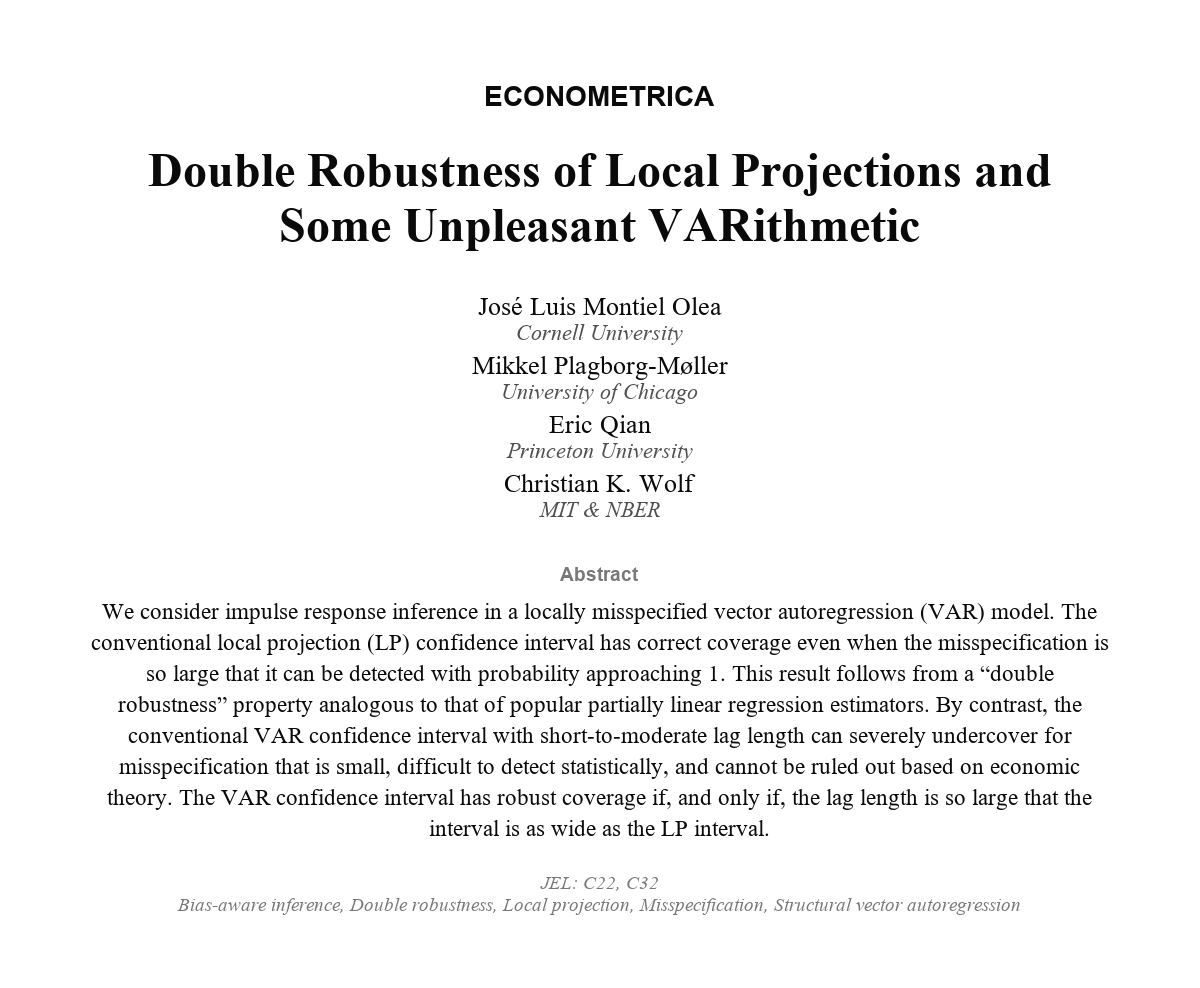
Local projections are surprisingly robust to misspecification. By contrast, VAR confidence intervals with short-to-moderate lag length can severely undercover for misspecification that is small, difficult to detect, and cannot be ruled out a priori.
https://t.co/rFObJ2dWfN
Applications for the Machine Learning in Economics Summer Institute (MLESI) are open! Grad students, apply and come hang out in Chicago for a week to learn about ML and Econ.
@CavaliereGiu@JEconometrics Thanks for the tweet, Giuseppe! We had a lot of fun writing this! We started working on this project after reading this amazing paper from the late 80's: https://t.co/7tcMZTkatc
@jmwooldridge@BruceEHansen [Extra] The posterior mean estimator corresponding to the Beta(\sqrt{n}/2, \sqrt{n}/2) can be shown to be minimax (under quadratic loss). From a decision-theoretic perspective, I find it hard to think about why to use any other estimator for this problem :)
@jmwooldridge@BruceEHansen 3) The posterior mean corresponding to any prior in the beta family can be written as a linear combination between the MLE and the prior mean. In my opinion, the prior that has a good finite-sample "frequentist" interpretation is the Beta(\sqrt{n}/2, \sqrt{n}/2).