New Science Blog: Why has AI advanced faster in coding than in biology?
To agents, bio databases are like cities built before cars—maddening to drive in because they're designed for different traffic.
How do we build infrastructure agents can use?
https://t.co/PQaNQ4GRJZ
.@fpradelli94 & I found a compelling candidate for the first published mathematical model in oncology: Hutchinson's 1886 proposal of Malthusian growth law for tumors.
The 2nd math onco? A rebuttal of the 1st, a mere ~3 months later. [some things never change]
Personal update: I've joined Anthropic. I think the next few years at the frontier of LLMs will be especially formative. I am very excited to join the team here and get back to R&D. I remain deeply passionate about education and plan to resume my work on it in time.
I let Claude Code edit 5 files in one turn. Didn't check what it actually changed. Committed. Broke something unrelated.
Now I run /diff after every turn. It opens an interactive viewer showing exactly what Claude changed, file by file.
The Terence Tao episode.
We begin with the absolutely ingenious and surprising way in which Kepler discovered the laws of planetary motion.
People sometimes say that AI will make especially fast progress at scientific discovery because of tight verification loops.
But the story of how we discovered the shape of our solar system shows how the verification loop for correct ideas can be decades (or even millennia) long.
During this time, what we know today as the better theory can often actually make worse predictions (Copernicus's model of circular orbits around the sun was actually less accurate than Ptolemy's geocentric model).
And the reasons it survives this epistemic hell is some mixture of judgment and heuristics that we don’t even understand well enough to actually articulate, much less codify into an RL loop.
Hope you enjoy!
0:00:00 – Kepler was a high temperature LLM
0:11:44 – How would we know if there’s a new unifying concept within heaps of AI slop?
0:26:10 – The deductive overhang
0:30:31 – Selection bias in reported AI discoveries
0:46:43 – AI makes papers richer and broader, but not deeper
0:53:00 – If AI solves a problem, can humans get understanding out of it?
0:59:20 – We need a semi-formal language for the way that scientists actually talk to each other
1:09:48 – How Terry uses his time
1:17:05 – Human-AI hybrids will dominate math for a lot longer
Look up Dwarkesh Podcast on YouTube, Apple Podcasts, or Spotify.
The Origin of Species was published in 1859. Principia Mathematica was published in 1687, two centuries earlier.
Conceptually, it seems like natural selection is much simpler than the theory of gravity. So why did it take two centuries longer to discover?
A contemporary of Darwin's, Thomas Huxley, read the Origin of Species and said, “How extremely stupid not to have thought of that!” Nobody ever said the same for not beating Newton to the Principia.
I wonder if the reason this happened is that Darwin’s cannot be decisively tested. The evidence is circumstantial, retrospective, and cumulative. There's no equivalent of Newton running the numbers on the moon's orbital period and radius, and confirming that it corresponds to his theory.
In fact, nearly two thousand years before Darwin, the Roman poet Lucretius argued in De Rerum Natura that organisms suited to their environment survive while ill-adapted ones perish. But nobody built a science on it. Without a tight verification loop, the idea just floated by.
Terence Tao argues that Darwin succeeded where Lucretius failed because he had the ability to convince people that the gaps in his theory (specifically, what is the mechanism of heredity) would be filled.
This was less about ‘hard’ scientific insight, and more a matter of having good research taste and being persuasive. But it was crucial for progress in biology.
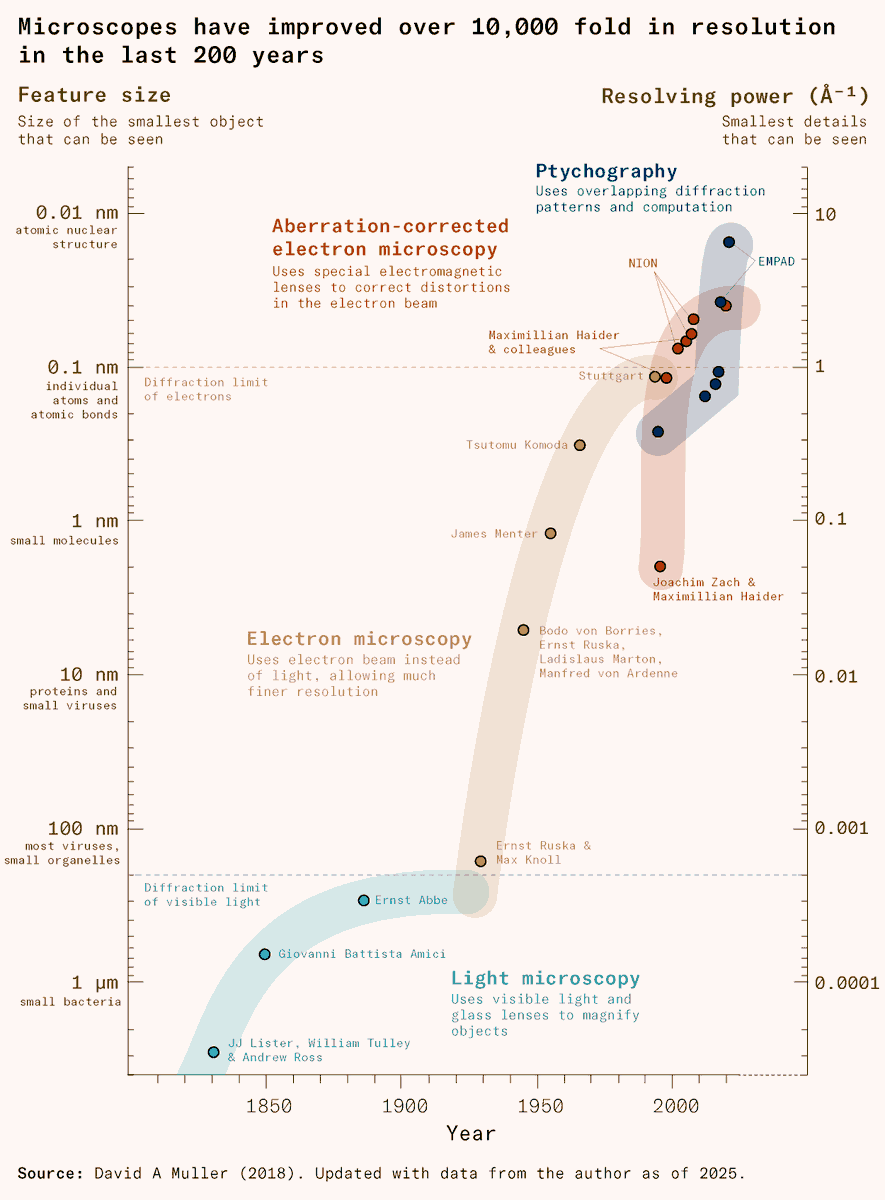
The resolution of microscopes has increased over 10,000 fold over the last 200 years.
It's allowed scientists to examine not only cells, but bacteria, then viruses, their protein structure, and, eventually, the individual atoms that comprise them.


![mathoncbro's tweet photo. .@fpradelli94 & I found a compelling candidate for the first published mathematical model in oncology: Hutchinson's 1886 proposal of Malthusian growth law for tumors.
The 2nd math onco? A rebuttal of the 1st, a mere ~3 months later. [some things never change] https://t.co/rEoaG4y0Fo](https://pbs.twimg.com/media/HInp5M_XcAAr3Av.jpg)