🚨Privacy Boost for Solana Token Unlocks
@UmbraPrivacy has partnered with @streamflow_fi to launch private token vesting on Solana.
Projects can now distribute vested tokens to shielded wallets — hiding addresses, amounts, and schedules on-chain. This targets the massive $97B token unlock market and reduces front-running risks.
If you care about the Privacy + AI narrative
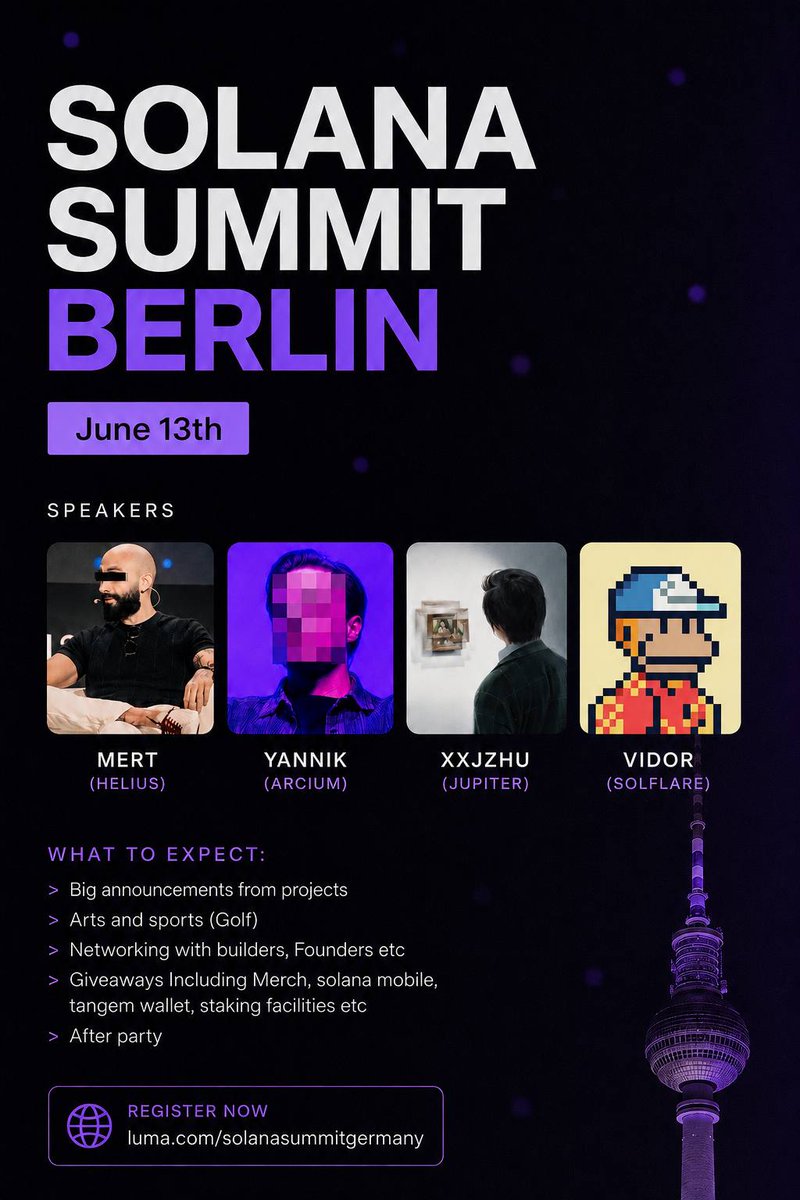
Solana Summit Germany might be one of the most important events this month
Berlin, June 13
@yrschrade from @Arcium is speaking - Largest active confidential compute ecosystem in crypto
If Arcium announces anything big in Berlin, you’ll be the first one who will know
Also featuring:
@mert@vidor_solflare@xxjzhu
Lamborghini, Tangem wallets, Jupiter Perps competition and more
Free entry:
https://t.co/K2lOI0Y4Gu
Tune into the @RiskOnPod live podcast this Friday at 12pm EST!
We’ll be discussing Umbra Web, private transfers, Streamflow, upcoming token pools, and the future of privacy on Solana.
Ngl, it's the best time for @Arcium
And it will be massive WIN for Solana
If you look at $VVV (900M and $RAIL 300M), $ARX should seat between 500M - 1B or way higher
They have a bunch of Apps built on it
@UmbraPrivacy which an actual product that generates revenue + gives real ownership
Privacy isn’t just a feature. It’s infrastructure.
We’re bringing @Arcium to Change My Mind.
If you want to hear them state their case on encrypted computation, data sovereignty & where privacy scales: this one’s for you.
April 3 • 5PM UTC / 1PM EST on 𝕏
📍NYC • @SolanaSkyline
Something NEW is here: Change My Mind!
Live debate stream where crypto’s toughest topics are challenged in real time.
Kicking off with the PRIVACY DEBATE!
Special guests: @Arcium@HoudiniSwap@theprivacycash@rdbotato
Heads up: We’re asking the uncomfortable questions
> Live from NYC, Solana Skyline Office
> April 3
> 5 PM UTC / 1 PM EST
> Right here on 𝕏
Join Change My Mind Privacy Debate this Friday! 🔔
When the signal isn't enough: Calabar Carnival 2025
A carnival series in Cross River State, Nigeria with 780,000 onsite spectators in 2025 across carnival and cultural events.
At the carnival nothing actually “goes offline.” The problem is more frustrating than that. Everything is there, signal bars, mobile data, banking apps but right when the streets are most alive, it all starts to lag, fail, or hang.
This period isn’t just busy; it compresses into pockets of intensity. Parade routes fill shoulder to shoulder. Vendors spill into every available space. Movement slows into waves. And inside those waves, the digital layer people depend on begins to buckle.
When Everything Works… Until It Doesn’t
Calls don’t go through. Messages arrive late or not at all. Transfers sit in limbo. Nobody can tell if money has actually moved. That’s the environment @anon0mesh is really for and built on @Arcium, not just for blackout, but a system under strain.
Coordination Inside the Crowd
What breaks first is coordination. Dance groups, organizers, even small vendor teams all rely on communication that becomes unreliable at the worst possible time. When you’re trying to move hundreds of people through a crowded route, even a small delay matters.
A mesh network shifts that dynamic quietly but completely. Messages don’t need to leave the crowd anymore. They move across it from phone to phone, short hops, no towers involved. In a dense space, that’s not a limitation; it’s strength. The more people there are, the more paths messages can take.
Money Without Waiting
Carnival runs on small, fast transactions. Someone is always buying water, food, a drink, a costume piece. It’s constant.
Cash works until it doesn’t, no change, risk of theft, friction at scale. Transfers feel modern, but during peak hours they’re unreliable. People stand there refreshing apps, waiting for confirmations that may never come.
Offline payments remove that pause. Two people transact, it’s done locally, and the system settles the rest later. No “I’ve sent it, check your phone.” No guessing.
That does something subtle but important, it lets vendors operate wherever the crowd is thickest.
Safety Moves Locally
In a crowd that size, small incidents can escalate quickly. A surge, a missing person, a tense moment in the wrong place. Right now, information moves unevenly and some people know while most don’t.
When communication stays local, it moves differently. Alerts don’t have to travel out to a central system and back. They spread through the same crowd they’re about quickly, and only where needed.
Participation Without Barriers
You also start to notice who gets left out. Visitors without SIM cards. People without data. Anyone who hasn’t gone through the right onboarding steps.
A mesh network flattens that. If you’re there, you’re in. You can message, pay, coordinate and no setup beyond proximity. It’s a small shift, but it changes who gets to participate fully.
Built for Density, Not Distance
Technically, this environment is demanding in a specific way. It’s not about distance; it’s about density. Thousands of devices packed into tight, constantly shifting clusters. Connections forming and breaking as people move.
The network starts to look less like a fixed web and more like something alive, clusters forming, dissolving, reconnecting. People themselves become carriers, moving information as they move.
Where the Real Opportunity Is
Calabar Carnival makes something clear. The opportunity isn’t just in places where infrastructure disappears. It’s in places where it almost works but not well enough.
If anonmesh hold up in the middle of movement, noise, and density, then it’s not just a backup for emergencies. It becomes a second layer one that kicks in when the first starts to struggle, and keeps everything moving.
And in a place like Carnival, Festivals and sporting events, that difference isn’t theoretical. It’s felt immediately.
gMesh anon
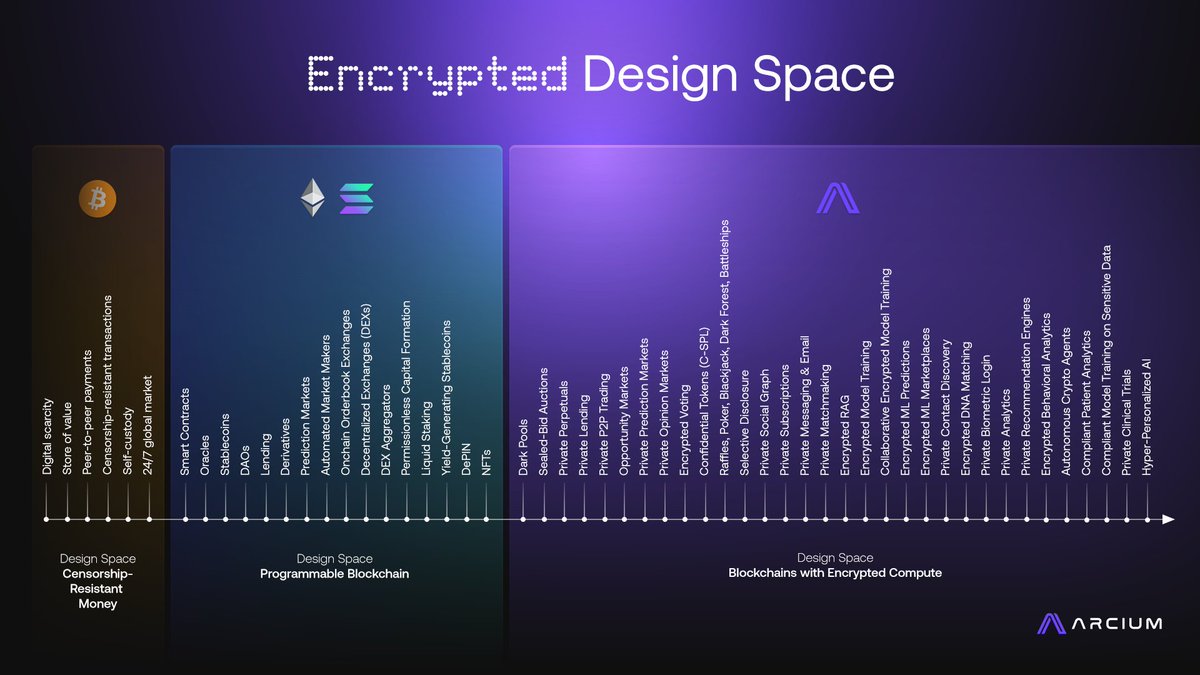
Blockchains have largely explored their current design space, and experimentation has slowed.
Arcium introduces new internet infrastructure where computation is encrypted by default, opening up new applications and new classes of users.
Google Quantum AI released a whitepaper warning that cracking 256-bit ECC, widely used in crypto wallets, requires fewer resources than expected. With under 500k physical qubits, it could be cracked in minutes. Google urged the industry to accelerate its migration to Post-Quantum Cryptography (PQC).
Dragonfly Managing Partner Haseeb noted this research improves ECDSA cracking efficiency by ~20x, pushing the expected PQC migration timeline forward to around 2029. He highlighted Google's high caution, as they verified the results using ZK proofs without revealing the actual quantum circuits.
"It would be nice if the property rights system that humans have is the same system that AIs are using with each other… If crypto can be that, that’s amazing."
@VitalikButerin in conversation w/ @beffjezos
When the signal isn't enough: Calabar Carnival 2025
A carnival series in Cross River State, Nigeria with 780,000 onsite spectators in 2025 across carnival and cultural events.
At the carnival nothing actually “goes offline.” The problem is more frustrating than that. Everything is there, signal bars, mobile data, banking apps but right when the streets are most alive, it all starts to lag, fail, or hang.
This period isn’t just busy; it compresses into pockets of intensity. Parade routes fill shoulder to shoulder. Vendors spill into every available space. Movement slows into waves. And inside those waves, the digital layer people depend on begins to buckle.
When Everything Works… Until It Doesn’t
Calls don’t go through. Messages arrive late or not at all. Transfers sit in limbo. Nobody can tell if money has actually moved. That’s the environment @anon0mesh is really for and built on @Arcium, not just for blackout, but a system under strain.
Coordination Inside the Crowd
What breaks first is coordination. Dance groups, organizers, even small vendor teams all rely on communication that becomes unreliable at the worst possible time. When you’re trying to move hundreds of people through a crowded route, even a small delay matters.
A mesh network shifts that dynamic quietly but completely. Messages don’t need to leave the crowd anymore. They move across it from phone to phone, short hops, no towers involved. In a dense space, that’s not a limitation; it’s strength. The more people there are, the more paths messages can take.
Money Without Waiting
Carnival runs on small, fast transactions. Someone is always buying water, food, a drink, a costume piece. It’s constant.
Cash works until it doesn’t, no change, risk of theft, friction at scale. Transfers feel modern, but during peak hours they’re unreliable. People stand there refreshing apps, waiting for confirmations that may never come.
Offline payments remove that pause. Two people transact, it’s done locally, and the system settles the rest later. No “I’ve sent it, check your phone.” No guessing.
That does something subtle but important, it lets vendors operate wherever the crowd is thickest.
Safety Moves Locally
In a crowd that size, small incidents can escalate quickly. A surge, a missing person, a tense moment in the wrong place. Right now, information moves unevenly and some people know while most don’t.
When communication stays local, it moves differently. Alerts don’t have to travel out to a central system and back. They spread through the same crowd they’re about quickly, and only where needed.
Participation Without Barriers
You also start to notice who gets left out. Visitors without SIM cards. People without data. Anyone who hasn’t gone through the right onboarding steps.
A mesh network flattens that. If you’re there, you’re in. You can message, pay, coordinate and no setup beyond proximity. It’s a small shift, but it changes who gets to participate fully.
Built for Density, Not Distance
Technically, this environment is demanding in a specific way. It’s not about distance; it’s about density. Thousands of devices packed into tight, constantly shifting clusters. Connections forming and breaking as people move.
The network starts to look less like a fixed web and more like something alive, clusters forming, dissolving, reconnecting. People themselves become carriers, moving information as they move.
Where the Real Opportunity Is
Calabar Carnival makes something clear. The opportunity isn’t just in places where infrastructure disappears. It’s in places where it almost works but not well enough.
If anonmesh hold up in the middle of movement, noise, and density, then it’s not just a backup for emergencies. It becomes a second layer one that kicks in when the first starts to struggle, and keeps everything moving.
And in a place like Carnival, Festivals and sporting events, that difference isn’t theoretical. It’s felt immediately.
gMesh anon
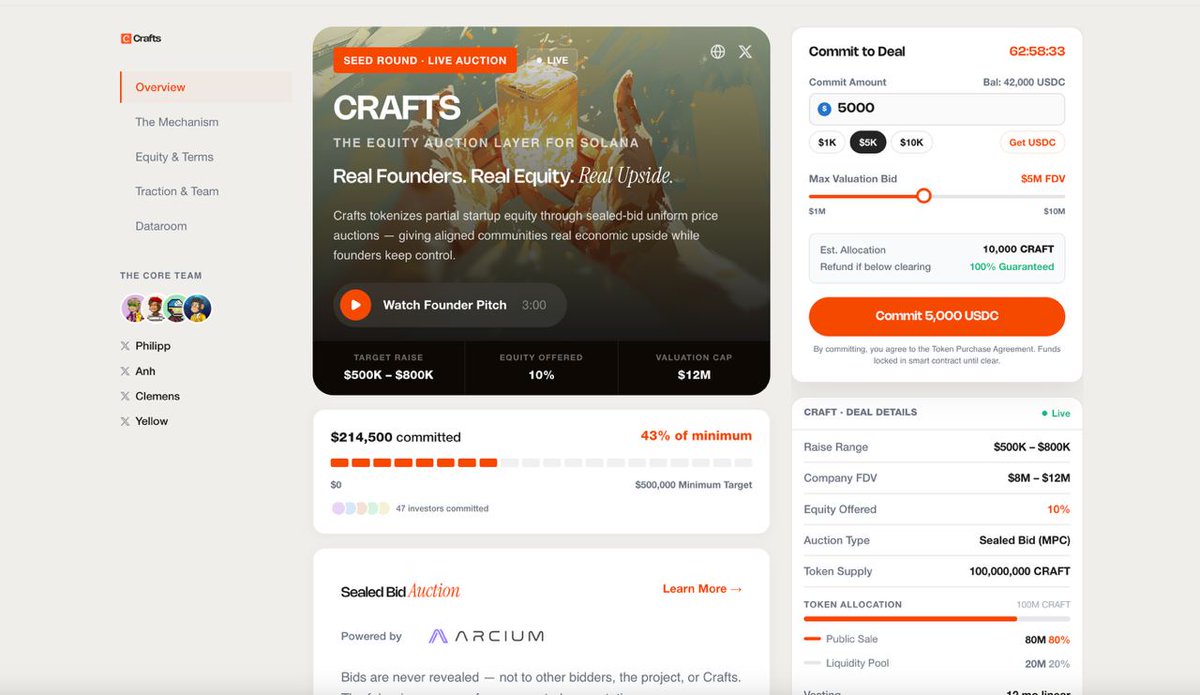
Introducing @craftsdev
An ownership launchpad on Solana with the first sealed-bid auction.
Bids are encrypted, price is set by the market, and tokens are backed by equity with built-in holder protections.
PRIVACY NA YOUR OWN MATTER TOO
For Naija, once person hear “PRIVACY”, e go just wave am like say e no be him concern. Some go talk say, “I no get anything to hide.” others go feel say na only big men, politicians or hackers dey reason that kind thing.
But make we slow down small… reason am well.
Privacy no mean say you dey do bad thing o.
E just mean say you get control over your own life.
Wetin Privacy Really Mean for Our Side?
For this our country, we sabi as people no dey mind their business
👉 Landlord fit dey monitor wetin you dey do
👉 Government fit dey watch people online anyhow
👉 Even apps wey we download, dem dey collect our data jejely without us knowing
Before you go know, your personal info don waka reach place wey you no even send am go.
And somehow, we don dey see am like normal thing… but e no suppose be so.
So Wetin Be This “Encrypted Compute”?
No worry, e no hard like that. Make I break am down.
Encrypted compute na when your data dey locked with key, and even when dem dey use am do work, e still dey locked.
No be like normal system where you send your data, dem open am, process am, come close am back.
But for this one, your data no go even open at all for anybody eye, even the people wey build the system no go fit see am.
Na like say you give person one sealed box make e solve something inside but the box no go open, even small.
Why This Thing Matter for Naija?
Make we talk truth
👉 Trust no too dey again like before
👉 Systems no dey transparent like that again
👉 and people don dey fear misuse of their information
So if we get better technology wey go fit fix, like say
👉 Protect your identity
👉 Hide sensitive information
👉 Still allow things to work smoothly
That one fit change plenty things.
People go feel safe and go trust system more...
Na tools like @Arcium dey try push this kind system where,
👉 You no need to trust anybody blindly
👉 Your data still remain your own
👉 Work still dey go well without exposing anything
The Main Thing Be Say, Privacy Na Your Right, Secure Your Data.
gMPC ☂️
@Arcium ☂️
@ArciumNigeria ☂️