मेरे लिए देश प्रेम और मानव प्रेम में कोई भेद नहीं... मैं देश प्रेमी हूं क्यूंकि मैं मानव प्रेमी हूं।
Best possible definition of 'patriotism or nationalism' by Gandhiji in an Article in Young India published on 18-06-21 #GandhiJayanti
Wife's Remark That She Could Have '1000 Husbands' Amounted To Grave And Sudden Provocation: MP High Court Alters Man's Conviction
https://t.co/szdIJSoF3Y
1/5: When Gurugram residents Rahul and Meenu Rathore received DNA test results showing that the twins born after an IVF procedure were not biologically theirs, it opened the floodgates to the secret, opaque, and troubling world of fertility clinics in India
The Supreme Court held that since the registered sale deed holds a statutory presumption of validity, a minor discrepancy in the testimony of the attesting witness would not by itself render the execution of the sale deed doubtful.
Read more: https://t.co/dWfGTsamrR
#SupremeCourt
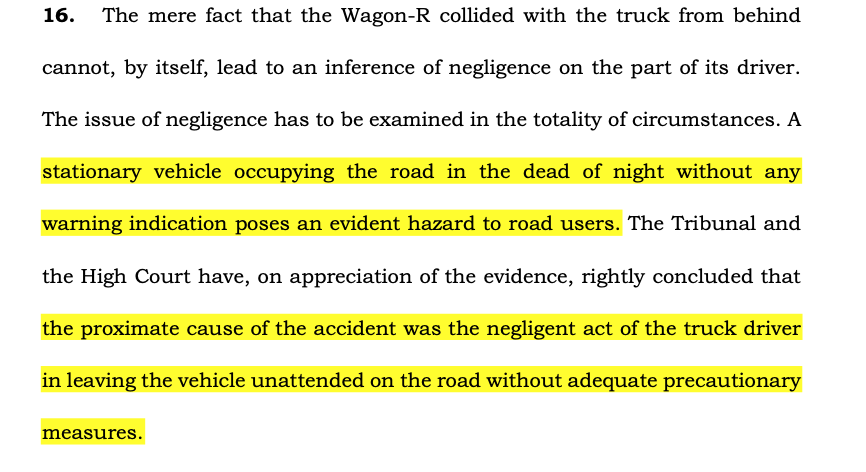
This #SupremeCourt judgment tells you why you should not park your vehicle during night on the road. If someone else hits your vehicle and suffers injury or dies, you will land in trouble !
Dear Judges/Lawyers of Madhya Pradesh,
#SupremeCourt has SET ASIDE these guidelines issued by MP High Court.
So now there is no need to examine the sanctioning authority even before framing of charge or commencement of trial in Prevention Of Corruption Act cases.
Haryana cops accused of custodial sodomy but FIR only for simple hurt: The BNS blind spot
Sushil Manav @sushilmanav reports for ThePrint
https://t.co/AjpA3FJh5m
If an accused is absconding in a criminal case, does it mean that in his sub-conscious mind he accepts himself to be guilty?
Further, can this abscondence be a factor to convict other co-accused who faced trial?
[AI Generated Response]
Article 32(1) and (2): Guarantees the right to move the Supreme Court by appropriate proceedings for the enforcement of the Fundamental Rights enumerated in Part III of the Constitution. Clause (2) specifically empowers the Supreme Court to issue directions, orders, or writs, including writs in the nature of mandamus, for the enforcement of any of these rights.
Article 12: Defines the "State". Ordinarily, Fundamental Rights (and the corresponding writs for their enforcement) are invocable against the State, its instrumentalities, and local or other authorities.
Articles 15(2), 17, 23, and 24: These are specific Fundamental Rights that expressly protect citizens against discriminatory or exploitative conduct not only by the State but also by private persons.
The settled legal position is that a writ of mandamus is a pre-eminently public law remedy and, as a general rule, it does not lie against a private individual who is not discharging any public duty. However, this general rule is subject to significant exceptions under Article 32, particularly through the doctrine of "horizontality".
The Supreme Court can issue a writ of mandamus or appropriate directions to a private individual or body under Article 32 in the following circumstances:
Discharge of Public Duty: If a private body or individual is discharging a public function or a statutory duty, and the denial of a right is connected to that public duty, the public law remedy of mandamus can be enforced against them. The scope of mandamus is determined by the nature of the duty to be enforced, rather than the identity of the authority.
Enforcement of Horizontal Fundamental Rights: The Supreme Court has the jurisdiction to enforce fundamental rights against private bodies and individuals. Certain rights, such as protection against untouchability (Article 17) and forced labour (Article 23), have a horizontal effect and extend to non-State actors. If these rights are violated, the Court can issue directions under Article 32 to private parties for their enforcement.
Collusion with the State: A writ of mandamus may lie against a private individual or body if it is established that the private party is acting in collusion with a public authority or the State in contravening the Constitution or a statute.
Relevant Case Laws
Kaushal Kishore v. State of Uttar Pradesh (2023 SCC Online SC 6):
(a) Court and Year: Supreme Court (Constitution Bench), 2023.
(b) Ratio Decidendi: The Court held that a fundamental right under Articles 19 and 21 can be enforced even against persons other than the "State" or its instrumentalities. It recognised the "horizontal approach" of Fundamental Rights between citizens inter se.
(c) Application: This expands the scope of Article 32, confirming that the Court can issue writs against non-State actors to protect fundamental rights like personal liberty and freedom of speech.
Bodhisattwa Gautam v. Subhra Chakraborty (AIR 1996 SC 922):(a) Court and Year: Supreme Court, 1996.
(b) Ratio Decidendi: The Supreme Court held that it has the jurisdiction to enforce fundamental rights against private bodies and individuals and can award compensation for their violation.
(c) Application: This case establishes that the Supreme Court's power under Article 32 is not strictly limited to State actions and can be used to remedy fundamental rights violations committed by private individuals.
People's Union for Democratic Rights v. Union of India (Asiad Workers Case) (AIR 1982 SC 1473):(a) Court and Year: Supreme Court, 1982.
(b) Ratio Decidendi: The Court held that whenever a Fundamental Right enforceable against private individuals (such as Articles 17, 23, or 24) is violated, the State is under a constitutional obligation to take necessary steps to interdict such violation.
(c) Application: The Court entertained a petition under Article 32 against the exploitation of migrant labourers by private contractors, demonstrating that writs and directions can be issued to address private violations of specific fundamental rights.
Praga Tools Corp v. C.V. Imanual (AIR 1969 SC 1306):(a) Court and Year: Supreme Court, 1969.
(b) Ratio Decidendi: The Court ruled that mandamus might, under certain circumstances, lie against a private individual if it is established that the individual has colluded with a public authority.
(c) Application: This provides a specific exception where a private individual's collusion with the State brings them within the ambit of writ jurisdiction.
As a general principle of public law, a writ of mandamus does not lie against a purely private individual or entity.
However, under Article 32, the Supreme Court has the implicit and flexible power to issue directions, orders, or writs to private individuals if they are discharging a public function or statutory duty.
The Court can issue mandamus against a private individual if they are found to be acting in collusion with the State or a public authority.
Most importantly, applying the doctrine of "horizontality," the Supreme Court can issue writs under Article 32 against private individuals to enforce specific Fundamental Rights that apply against non-State actors (such as Articles 15(2), 17, 19, 21, 23, and 24).
Membership Of Bar Associations Voluntary, Can't Restrict Lawyer From Practicing: Telangana HC Reads Down BCI Rule
#Telangana#Lawyers
https://t.co/VSoTRqUKm8
Legal Heirs Can't Continue Suit Filed By Deceased Trustee In Representative Capacity, Right Vests In Surviving Trustee: P&H High Court
https://t.co/fVEpUVBU8L
The Supreme Court has comprehensively restated the principles governing the doctrine of promissory estoppel, holding that governmental assurances are not empty declarations and that the State cannot arbitrarily withdraw promises on which citizens have acted to their detriment.
Read more: https://t.co/a7kswFEPZ1
#SupremeCourt
Madhya Pradesh HC dismissed a plea by two police constables over alleged custodial death of a 24-year-old man, observing that no prior sanction is needed under Section 197 CrPC to prosecute police officers in custodial death/ violence cases.
Read more: https://t.co/dXRAF5CFH0
Order XII Rule 6 of the Code of Civil Procedure, 1908 is a powerful procedural tool that enables courts to pronounce judgment on the basis of admissions, without requiring a full-fledged trial.
Read more: https://t.co/EXypDhQ83f
#CodeofCivilProcedure#SupremeCourt