In 1997, this man was the ABVP National Secretary and was just about to join the Bharatiya Janata Party. There was a paper leak in Odisha and there was a major protest. This man participated in them. He was beaten by the police.
"We staged a protest against the Odisha government, in front of the secretariat. Around 1,500 students joined us there. While the protest was peaceful, the police charged against the activists. He was badly beaten up at that time. He had a few fractures too."
Who is he? Mr Dharmendra Pradhan. Imagine that Dharmendra Pradhan was protesting against paper leaks in 1997 and was beaten!
There is an amazing Indian Express article about him. Linked below. The irony? One of the interviewees says:
"under Pradhan's regime, the students will have more scope for dissent. "It is natural for students to be anti-establishment."
@saLolmishra I take pride in taking such a beautiful catch that people couldn't believe what they saw. The fact that you still remember it even after 12 years says a lot. :)
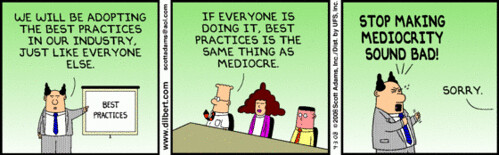
Don’t be fooled by Best Practices. By the time something is labeled and advertised as a Best Practice, it is just average. Following these practices only suggests you won’t be left behind, not that you will lead the pack.
Best Practices are actually Average Practices.
@srijanshetty It was just a comment on how some organisations pick up standard processes on day one without understanding what works for them. It leads to mediocrity if the objective becomes to follow the process instead of letting it developing organically with regular active tweaks.
An average cook follows the recipe book and will usually fare well. Great cooks create their own recipes, but only after reading all the cookbooks and understanding the importance of all ingredients.
I’m really fussy about process because processes are simple and objective and do not run on the whims and fancies of geniuses.
There is a certain degree of humility involved in being subservient to a process and it’s take a whole lot of introspection to do that.
Apple Pie Position:
A statement that instantly elevates the person who is saying it and is simultaneously hard for anyone else to push back on, and so everyone avoids the personal risk and just nods “yes”, even though its actual value in this specific situation might be relatively low, zero, or even negative.
Because everyone in the workplace wants to come across as smart & competent, especially during meetings, Apple Pie Positions end up being frequently employed by your colleagues.
Examples of Apple Pie Positions
(trigger warning: might feel too painful at times)
1) “We need to define the success metrics for <whatever is being discussed>”
Also seen in the wild as:
“How will you measure success here?”
2) “Do you have any data to back that up?”
(narrator: it is either impossible to get useful data in this situation or the effort to get useful data would be greater than just doing it)
3) “We need more scalable team processes”
4) “We have too many meetings”
5) “We need to sync more often”
6) “This is a two-way door, so let’s just decide quickly”
(narrator: it was actually a one-way door. or, it was a two-way door with a hungry lion on the other side of the door, so we kinda died)
7) “We need more metrics before making a decision here”
8) “We need a better go-to-market motion to improve product adoption”
(narrator: the problem is you’ve built the wrong product, no amount of GTM sorcery is going to fix that)
9) “We need to clarify our expectations from people in this role so we can set them up for success”
(narrator: the problem is that you’ve hired too many people whose work overlaps with other functions)
10) “We need better internal documentation!”
(narrator: yes we do. we also need 50 other things so let’s just finally admit that this ain’t happening. besides OpenAI will solve this for us in 2024, right?)
11) “Let us not forget [quote one of the company’s core values].”
(narrator: sometimes used as a weapon to justify one’s position, especially when faced with objective & rational counter-arguments for an issue)
12) “We need to replace our team meeting with written updates”
Fast forward a few weeks/months:
“People are missing live interactions with team members, they don't know what's going on across the team, nobody's reading the written updates. We need a meeting”
13) “Our current org structure doesn’t set us up for optimal execution of our strategic goals. That's why we are announcing a re-org”
14) “We must not slow down our shipping velocity”
(narrator: usually applied to push back against a fairly rational measure that will cause a minor delay in shipping the product but will prevent bigger problems for the customers or the company further down the road)
15) “We need to post-mortem this”
(narrator: you should have pre-mortem'ed this, so you wouldn't have had to deal with an ugly post-mortem. and the systemic changes rarely happen and somehow we are doing another ugly post-mortem 3 months from now. repeat)
16) “After 13 amazing months as CxO, Bob has decided to leave for other personal pursuits. The company wouldn’t be the same without his contributions”
(narrator: this is not how it actually went down)
17) “We need an offsite so we can align the teams better with our strategic priorities”
(narrator: we said the same thing for the previous 6 offsites. it almost seems like we are doing offsites more than we are being onsites)
18) “Remember, we are a mission-driven company”
(narrator: particularly effective when justifying below-market salary / stock for current and prospective employees)
19) “We need to go on a customer listening tour to understand our customers better”
(narrator: no, you need to pay more attention to the customer research that’s already happened over the past 18 months that we haven’t done anything about. you then need to translate that into differentiated features, instead of just building me-too tablestakes)
20) “We need more apple pie”
(narrator: 🥧yum. yes we do)
@debarghya_das Drawing conclusions from a sample set of top 100 students out of 10,000 is misguided.
15% and 200 stated in TOI are for for different situations.
<200 students accepted job offers outside of India right out of college.
15% go abroad for higher studies.