New benchmark report for Crystality-REVM — Deterministic State Parallelism now LIVE for REVM users @base, @OPLabsPBC, & @Scroll_ZKP. ⚡️Higher concurrency, near-linear scaling.
Six representative Solidity contracts tested on 1–64 cores, compared against high-performance chains like Sui , Aptos , & Sei.
Full report + test suites: https://t.co/LTASA4iD4d — download and reproduce the benchmarks.
A 🧵👇
Dropping Exciting news! Our Parallel AMM paper was accepted to ACM PPoPP 2027 on October 27!
We redesigned the constant-product AMM to enable parallel execution of swaps, even for the same token pair within the same logical liquidity pool.
To our knowledge, this is the first of its kind algorithm design.
We’ll share the paper once it’s published, along with a closer look at the algorithm and how it works.
Stay tuned
Managing state is one of the most difficult challenges, and until we have a sustainable solution, we face a trade-off:
Scaling while allowing state to grow too large harms decentralization because fewer people can afford the required hardware.
Scaling while repricing state growth impacts the application layer.
Not scaling the chain goes against what many in the community want: affordable transactions and enough block space to support adoption. It also isn't a sustainable solution, as state would continue to grow anyway.
Supporting PQ security and privacy will require more gas per transaction. Without increasing the gas limit, we'd effectively reduce throughput.
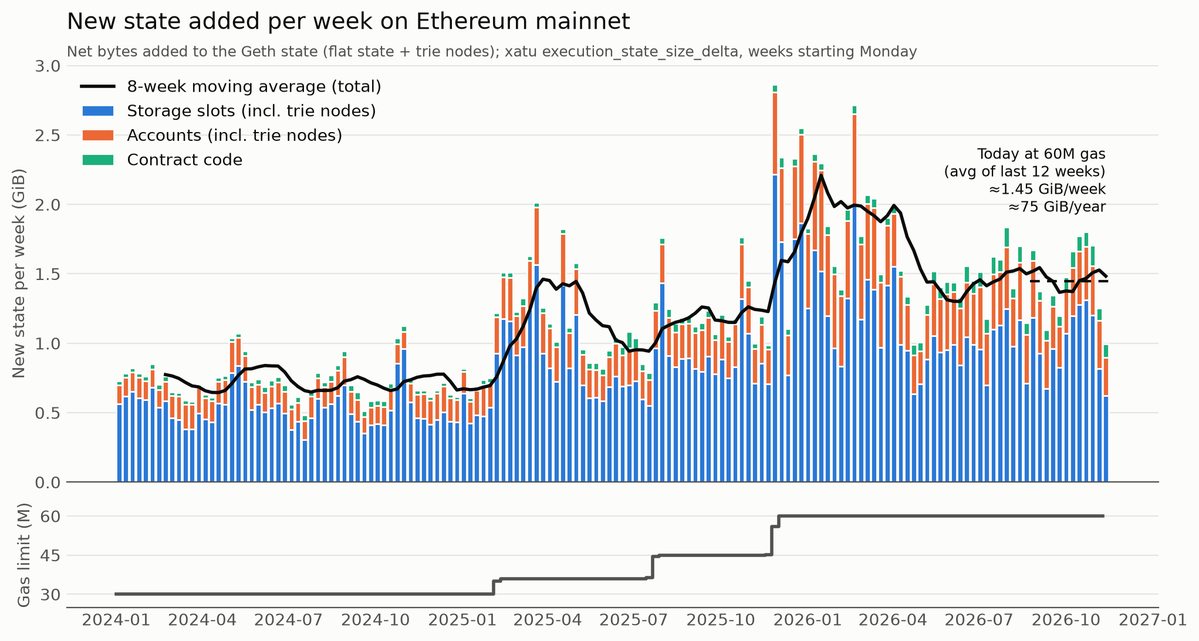
For Glamsterdam, we're facing this trade-off with EIP-8037 and EIP-8038, which propose repricing state-related operations, including state access and growth. As gas limits increase, state grows disproportionately quickly, and without mitigating the negative impact through repricings, we'd have to increase hardware requirements.
Interestingly, state is growing slower than originally anticipated in EIP-8037. Still, at a gas limit of 200M and without shipping EIPs that address this problem, we would add ~255 GiB of new state every year.
My personal summary of the recent discussions:
PQ has become the biggest focus for Ethereum. There's still disagreement, but it feels like people have mostly agreed on "how we're doing it" and the remaining debate is about "when" or "how fast".
I see two camps: those pushing for two forks in 2027, including complicated features like Frame Transactions, Decoupled Consensus, and leanVM, and those who think these timelines are unrealistic and that we shouldn't rush the transition, even if it takes until 2028.
Glamsterdam will be the largest fork since PoS, and it took a while (>1y; still not shipped). Complex features take time and 100% uptime is important. Thus, shipping the PQ transition much faster is somewhere between ambitious and impossible.
Focusing on PQ might mean pulling FOCIL and other features from Hegota. That's a pretty big step, given that we've already agreed to ship it as a headliner.
On the other hand, it seems reasonable to ship Hegota with only Frame Txs much faster than e.g. Glamsterdam, and DC could be nicely pipelined alongside, receiving significant focus from CL core devs.
The truth is probably somewhere in between: Frame Txs can ship faster without having to deal with the FOCIL interactions, and (PQ-)DC could be more complex than some might think (for it to work efficiently, we need leanVM's aggregation too).
One possible path would be Frame Transactions in Hegota, slimming the fork down with no big feature on the CL, and Decoupled Consensus in I*. Whether I* happens in 2027 or 2028 doesn't matter too much, imo. The main question is whether pulling FOCIL accelerates the PQ transition. I think it does, and we should have that discussion.
Overall, people are aligned on where we want to go. Now it's mostly about figuring out how fast we can get there.
The noise level across crypto X is noticeably rising again. Honestly, bullish.
That’s how the whole X stuff works. You need heated tech debates on roadmaps, gas repricing, and which L2s are the real ones.
And, parallel threads on lawsuits, layoffs, and who could be a spy in Vitalik’s orbit.
The signal and the circus. Both are back.