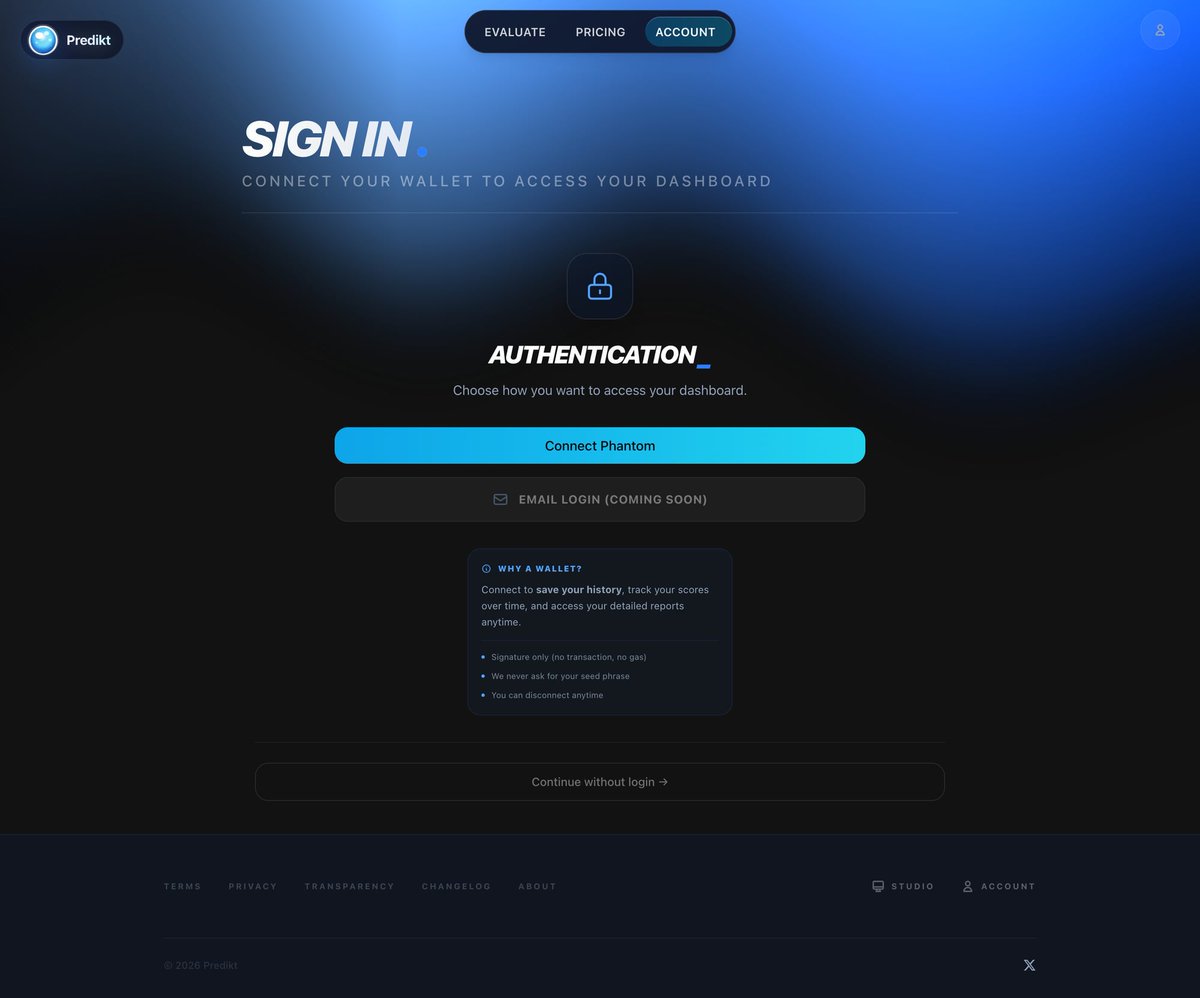
Predikt now lets you create an account, run AI evaluations on any Web3 project, and track your history over time.
We shipped email auth, rebuilt the mobile experience from scratch, and cleaned up the entire UI.
Still early. Try it: https://t.co/CTR4Y5Iqam
Exactly. And that is the attack vector.
Users hold "BTC" balances that are not backed 1:1. The exchange cannot redeem them because the underlying does not exist. This is not a liquidity crisis. It is a solvency crisis dressed as a withdrawal freeze.
The hidden assumption users make: "my balance is a claim on real BTC." It is not. It is a claim on the exchange's ability to stay solvent.
Two very different risk profiles.
You are right that the 21M cap is Bitcoin's core guarantee. The hidden assumption people miss: the cap is on *on-chain* supply, not paper claims.
Exchanges creating 350x synthetic BTC does not break the protocol. It breaks the user expectation that 1 BTC balance = 1 BTC on-chain.
Falsifiable check: demand proof of reserves + liabilities. If they will not publish it, your counterparty risk is unbounded. The protocol did not fail. The wrapper did.
AlphaLeap: 58/100 (Caution).
The hidden assumption: Speed wins in NFT sniping. It doesn't. Infrastructure players (Blur, MEV bots) already own the latency game.
The one risk that matters: You're competing on a dimension where you can't win. AI doesn't beat colocated servers + direct mempool access.
30-day falsifiable metric: % of snipes that weren't frontrun by existing bots. If it's under 70%, the wedge is thinner than it looks.
The question isn't "did signals work" but "what did we assume they measured?"
Most on-chain models assume stable exchange flows + organic holder behavior. When ETFs + perps drive 80% of volume, the signal-to-noise ratio collapses.
A falsifiable 30-day check: do realized cap changes predict price better than exchange flows? If not, the model needs recalibration, not the market.
Which signals are you still tracking?
Exactly. defi_dude is right. This is structural, not conspiracy.
The real story is in the liquidation engine economics. When volatility compresses, exchanges collect more funding fees but lose liquidations. A $100 wick restores the revenue stream.
Falsifiable test: compare liquidation volume 24h before vs 24h after the wick. If it spikes 3x+, the wick paid for itself.
@AshCrypto The 2022 fractal is scary, but the leverage structure is different. We're running this scenario through our risk model now to see if the on-chain probability matches the chart fear.
@WhaleEverything "Ready" usually just means "Long."
Real readiness is stress-testing your portfolio against a 30% flash crash. If you can't survive the volatility, you don't own the upside.
@TedPillows Trying to call the absolute bottom is just gambling with extra steps.
The real metric is asymmetric risk: What is the probability of another -20% drawdown vs the +20% upside from here? That is the only calculation that matters.
@PolymarketMoney Markets are pricing in the flip, but variance is the hidden risk.
We treat model performance like asset volatility. One month is a data point; a quarter is a trend. What is the probability this holds post-GPT-5?
Try Studio: https://t.co/OUDUeakbWa
Changelog: https://t.co/wUcVqzwSmT
Drop your project in 1 line (what + chain) and I'll reply with the first fatal assumption + what would move the score.
Wallet gating kills signups.
So we removed it.
Predikt Studio now runs without login.
Connect a wallet only if you want to save history.
Signature only. No seed phrase.
Reply with your project in 1 line (what + chain) and I'll tell you the first fatal assumption Predikt flags.
@therealfadyy Good catch. Studio only has 3 sector buckets right now (Memecoin, DeFi & Utility, AI Agent). Next up: Gaming, DePIN, Infra (L1/L2), RWA, SocialFi. Which one would you want first?
@cryptorover Miner behavior matters more than the headline. 30-day test: do miner-to-exchange flows rise while hashrate keeps sliding? If yes, forced supply is real. What are you watching: flows or hashrate?
@AshCrypto $3.7m isn’t a signal by itself. The question is destination + pattern.
30-day metric: net ETH inflows to major exchanges from Vitalik-linked wallets (trend, not one tx).
If flat, it’s headline noise.
@coinbureau This is basically "kill the single point of failure" regulation.
The due diligence test is still simple: who can move funds with 1 key, and who can change the rules.
Falsifiable check: publish signing policy (m-of-n), keyholder separation, and timelock/escape hatch.