Most of your clients are invisible in AI search. That's a billable problem.
ChatGPT, Google AI Mode, and Claude are where buyers make decisions now.
When a prospect types "best [your client's service] in [their city]" into AI, your client either shows up or they don't.
You can fix that for them. You can charge for the fix. And once it's running, it doesn't need you to maintain it week to week.
$2,000 to $4,000 net per client. No new headcount. 2,832 agencies are already running this.
3 things that actually determine your AI citation rate. (Hint: it's not domain authority.)
1. Publication frequency. The single biggest factor. Below 7/year: zero citations. We see this across every industry in our data.
2. Recency. Active publishers get 9x the citation rate of dormant ones, even with the same total volume. AI models weight recent content.
3. Distribution quality. Which outlets carry your release matters. Premium US-based news placements hit the sources AI trusts. Generic wire distribution doesn't move the needle.
That's it. Budget doesn't matter. Brand age doesn't matter. Domain authority doesn't matter.
Frequency. Recency. Distribution. Get all three right and you're getting cited.
Which one is weakest for your clients right now?
One press release. 32 new customers. $32,000 in profit.
An agency ran a single press release for a client through our distribution network.
Within days, that release was the first thing ChatGPT quoted when someone searched for that service in their market.
32 new customers walked in. $32,000 in traced profit. One release.
Distribution matters more than most people realize. Premium US-based placements hit the sources AI models weight most heavily.
Same content, wrong distribution: invisible.
Same content, right distribution: ChatGPT quotes it.
This is why agencies are adding it as a retainer service. The ROI conversation is easy when you can point to citations.
78% of all AI press release citations come from one platform.
Not Bing. Not ChatGPT. Google AI Mode.
We tracked citation sources across 3,139 businesses. Google AI Mode dominated. By a lot.
Which means if your clients aren't showing up in Google AI Mode, they're missing the majority of the AI search market right now.
The fix isn't complicated: consistent press release publishing to premium US-based distribution channels.
Same content you're already creating. It just needs the right distribution to hit the sources AI weights most heavily.
Most agencies are still optimizing for organic rankings and ignoring AI citations entirely. That gap is closing fast.
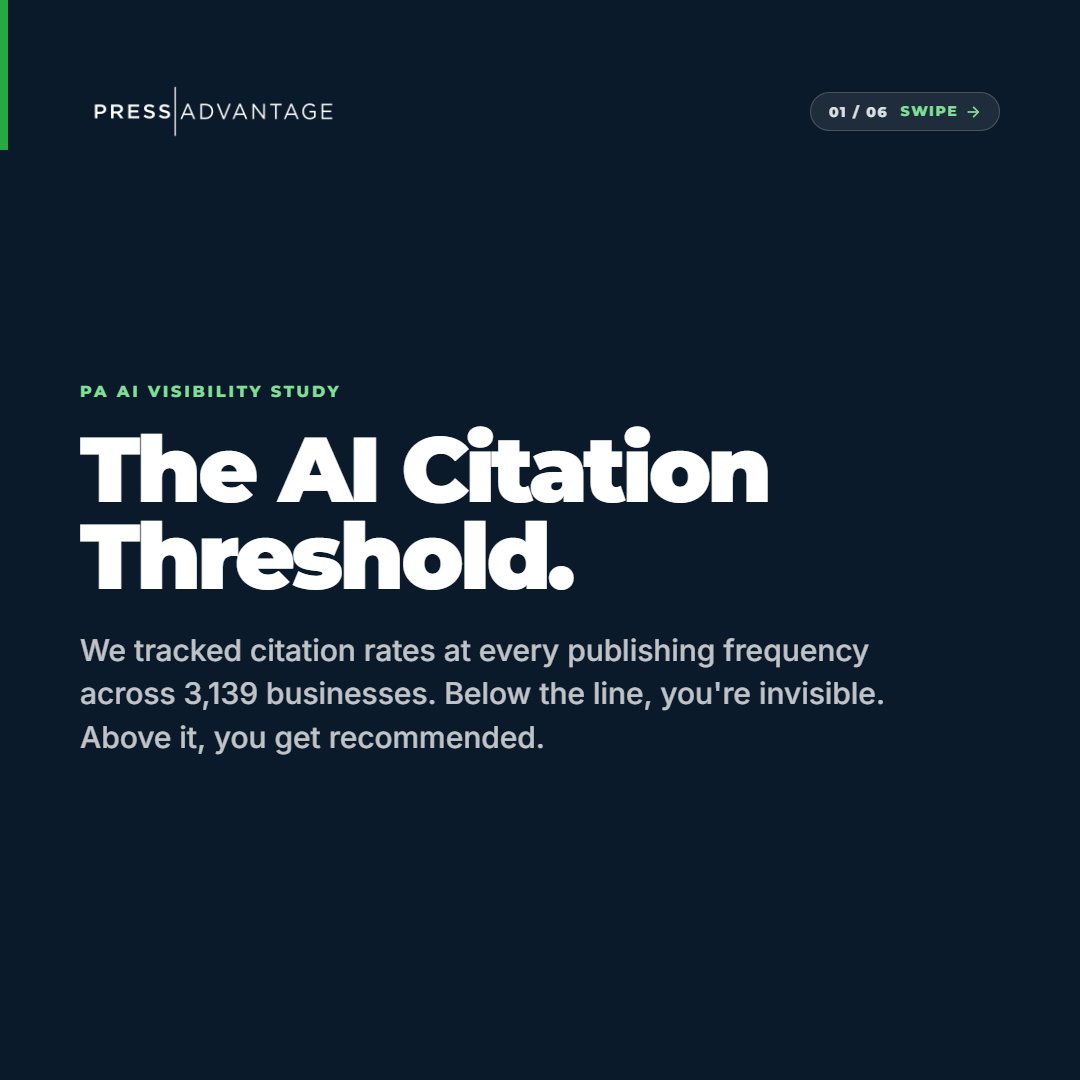
AI search has a threshold.
Below it, you're invisible. Above it, you get recommended.
We tracked this across 3,139 businesses and mapped the citation rate at every frequency tier.
The brands showing up in ChatGPT and Google AI Mode aren't the ones with the biggest budgets. They're the ones hitting the threshold.
Swipe through. Then check where your clients fall.
Press releases aren't for journalists anymore. (They never really were.)
The journalists who actually use them are a tiny fraction of who reads them.
Here's who's reading press releases now: AI models.
ChatGPT, Google AI Mode, Claude, they're all trained on press content. It's structured, authoritative, and hits distribution channels that AI treats as trusted sources.
So when someone asks an AI "who's the best [your service] in [your city]?" the answer gets assembled from published content.
The brands publishing consistently are winning that answer. The brands waiting for a journalist to call are invisible.
The use case changed. Most agencies haven't caught up.
When did you last run a press release specifically for AI citation?
There's no slow fade in AI search.
Your business is either in the answer. Or it's invisible.
We studied 3,139 businesses to find out why.
The pattern held across every industry:
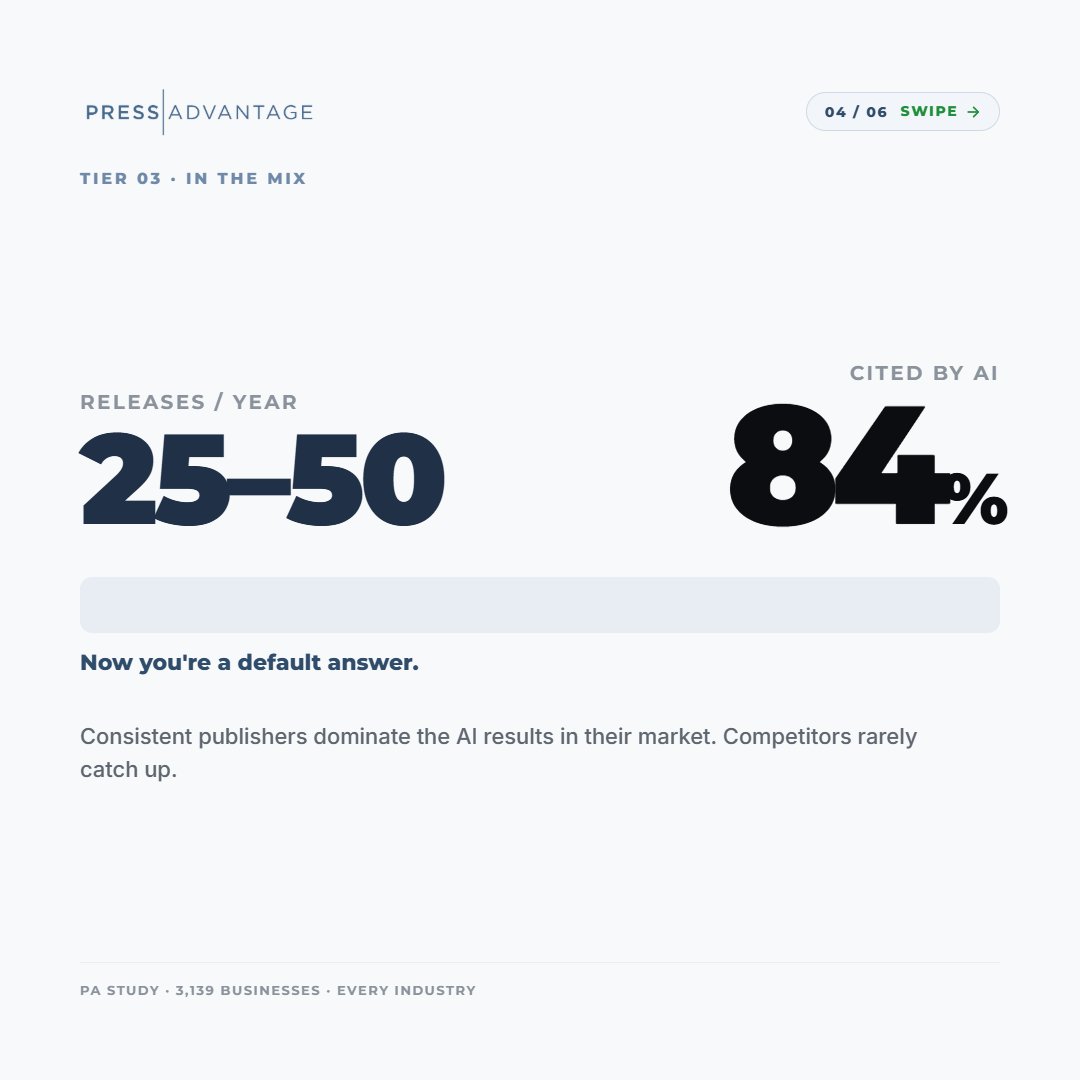
Below 7 press releases per year: 0% AI citation rate. Above 50: 100%.
Not a gradual slope. A cliff.
You're either above it or you're not.
The businesses getting cited in ChatGPT, Google AI Mode, and Claude right now aren't the biggest brands in their market.
They just hit the number.
Most businesses publish 0 to 3 press releases per year.
That's the gap. That's why most businesses are invisible.
The window to own AI search in your market is still open.
It won't be forever.
The businesses AI recommends all have one thing in common.
Not the biggest budget. Not the most recognized name.
Just consistency.
We studied 3,139 businesses. The ones getting cited in ChatGPT and Gemini all published 7+ press releases a year. That's where the signal starts, not 50 releases, not a massive PR firm. Just 7.
AI has replaced Google for a huge portion of how buyers research vendors right now. It's not ranking your ads or your social posts. It's indexing structured news coverage.
The businesses winning in AI results today started 6-12 months ago.
You still have time to close the gap.
But not a lot of it.
We're opening it up.
Got questions about AI search visibility, press release distribution, or what our research actually found across 3,139 businesses?
Drop them in the comments. We'll answer everything.
Some questions we can tackle:
→ How long does it take to appear in AI search?
→ What should a press release say to get AI citations?
→ Does this work for [your specific industry]?
→ How is this different from traditional SEO?
Ask anything 👇
Search your company name right now. What comes back?
If it's mostly your website, a Yelp listing, and a couple of social profiles, you have no SERP armor. Thin footprint. No authority signals.
At 4 press releases per month with Press Advantage on our current distribution:
• 100% of customers have press releases in their brand search
• Average 4.6 press releases on page 1 alone
• 39% of all top-30 results are press release content
That's the difference between a brand that looks established and one that looks like it might not be real.
Try it now. Search your brand name and tell us what you see in the comments.
28 out of 30 brand search results for one of our clients are press releases.
That's 93% brand SERP ownership achieved through consistent distribution to premium outlets.
Search their brand name. Nearly everything that comes back is press release content.
No negative press. No competitor ads. No outdated directory listings. Just authoritative coverage from credible outlets completely controlling what potential customers, investors, and journalists see.
At 4 releases per month on our current distribution, the average customer gets 4.6 press releases on page 1 of their brand search alone representing 39% of all top-30 results.
You own your narrative or someone else does.
The SEO playbook: optimize pages, build backlinks, wait 6–12 months, hope to rank in the top 10.
For 10 blue links, that still works.
But Google AI Mode, ChatGPT, and Gemini don't return 10 blue links. They return 1–3 recommendations.
Going from top-10 to being-the-only recommendation is a different game. Different signals. Different timeline. Different levers.
Our data shows zero correlation between press release volume and organic rankings (r = 0.027). But press releases show strong correlation with AI citations and Local Pack appearances.
These are parallel channels, not competing ones. The question isn't 'SEO or AI visibility?' The question is: are you playing the new game alongside the old one?
3,139 businesses. 14,764 keywords. 4 AI platforms.
Here's what the data actually shows:
✅ 93% of PA customers rank for at least one keyword
✅ 29% appear in the Google Local Pack
✅ 66% with 4+ recent releases get AI citations
✅ 21% of Google AI Mode citations = press releases
✅ 9x AI visibility: active vs dormant accounts
✅ 100% citation rate at 50+ releases/year
✅ 4.6 press releases on page 1 at 4/month
This isn't cherry-picked. This is the average across 3,139 local businesses, trades, agencies, and medical practices.
Press release distribution in 2026 is an AI training tool. A Local Pack tool. A brand SERP control tool. The data says so.
One number that should change how you think about press releases:
21%
That's the share of all Google AI Mode citations for Press Advantage customers on our current distribution network that come from press release content.
Not organic pages. Not GMB profiles. Press releases.
For context: Google AI Mode is where 78% of all AI-generated PR citations happen, more than ChatGPT, Gemini, and Perplexity combined.
The channel matters as much as the volume. Businesses on our current distribution (premium national and regional outlets) get 21% AI citation rate vs 8% on legacy networks.
How does ChatGPT decde which businesses to recommend?
Not PageRank. Not domain authority. Not reviews.
AI learns from content on publications it deems credible established national and regional news sites. When it sees your business consistently mentioned there, describing what you do, where you serve, what problems you solve, it builds a knowledge profile for you.
That knowledge profile is what gets surfaced when someone asks 'Who's the best [service] in [city]?'
Press releases distributed to credible news networks are the most direct way to build that profile.
Our research shows 93% of PA customers rank for at least one keyword. The ones showing up in AI are the ones with consistent distribution across premium outlets.
We spent yesterday testing 50 brands in ChatGPT.
Only 3 appeared.
That's a 94% invisibility rate.
Here's what we asked:
→ "Best marketing agencies in Austin"
→ "Top SaaS companies for [industry]"
→ "Recommended e-commerce platforms"
The pattern?
Brands with premium media placements (think high-authority outlets) showed up.
Brands without them? Invisible.
It's that simple.
AI doesn't scrape your website like Google does.
AI learns from sources it trusts.
No premium media = AI never heard of you.
When was the last time you tested your brand in ChatGPT?
Try it right now. Ask ChatGPT to recommend companies in your industry.
Do you appear?
We review 200+ press releases every month.
95% make the same mistake.
They write for themselves. Not Ai.
See the difference?
One is an ad.
The other is news.
If your press release starts with:
→ "We're excited to announce..."
→ "[Company] launches..."
→ "Innovative solution..."
It's not getting reach.
Instead, lead with:
→ Data that surprises
→ A problem readers have
→ What this means for their world
Press releases aren't about what YOU want to say.
They're about what your audience NEEDS to hear.
What's the worst press release opener you've seen? Drop it below. 👇
We searched one of our clients' brand names.
28 of the top 30 results were press releases.
That's 93% brand SERP ownership.
No negative press. No competitor ads. No outdated directories. Just their story on every result that matters.
At 4 releases a month, the average PA customer lands 4.6 press releases on page 1 of their own brand search.
That's 39% of all top-30 results. From one distribution channel.
You own your narrative or someone else does.
That's it. That's the whole point.
A roofing contractor. 13 press releases per year.
11 Local Pack appearances across different keywords.
Not 1 keyword. Not 2. Eleven. Each press release targets a specific location + service keyword combination. Each one becomes a content signal for that combination in Google's Local Pack algorithm.
Roofing businesses in our dataset have a 46% Local Pack rate overall.
At 13 releases per year, they're getting Local Pack appearances that competitors running Google Ads can't buy.



![PressAdvantage's tweet photo. How does ChatGPT decde which businesses to recommend?
Not PageRank. Not domain authority. Not reviews.
AI learns from content on publications it deems credible established national and regional news sites. When it sees your business consistently mentioned there, describing what you do, where you serve, what problems you solve, it builds a knowledge profile for you.
That knowledge profile is what gets surfaced when someone asks 'Who's the best [service] in [city]?'
Press releases distributed to credible news networks are the most direct way to build that profile.
Our research shows 93% of PA customers rank for at least one keyword. The ones showing up in AI are the ones with consistent distribution across premium outlets.](https://pbs.twimg.com/media/HLB1JBwbsAAzAjO.jpg)
![PressAdvantage's tweet photo. How does ChatGPT decde which businesses to recommend?
Not PageRank. Not domain authority. Not reviews.
AI learns from content on publications it deems credible established national and regional news sites. When it sees your business consistently mentioned there, describing what you do, where you serve, what problems you solve, it builds a knowledge profile for you.
That knowledge profile is what gets surfaced when someone asks 'Who's the best [service] in [city]?'
Press releases distributed to credible news networks are the most direct way to build that profile.
Our research shows 93% of PA customers rank for at least one keyword. The ones showing up in AI are the ones with consistent distribution across premium outlets.](https://pbs.twimg.com/media/HLB1HJ-agAER_ED.jpg)
![PressAdvantage's tweet photo. How does ChatGPT decde which businesses to recommend?
Not PageRank. Not domain authority. Not reviews.
AI learns from content on publications it deems credible established national and regional news sites. When it sees your business consistently mentioned there, describing what you do, where you serve, what problems you solve, it builds a knowledge profile for you.
That knowledge profile is what gets surfaced when someone asks 'Who's the best [service] in [city]?'
Press releases distributed to credible news networks are the most direct way to build that profile.
Our research shows 93% of PA customers rank for at least one keyword. The ones showing up in AI are the ones with consistent distribution across premium outlets.](https://pbs.twimg.com/media/HLB1CKCa0AAhA-d.jpg)


![PressAdvantage's tweet photo. Most of your clients are invisible in AI search. That's a billable problem.
ChatGPT, Google AI Mode, and Claude are where buyers make decisions now.
When a prospect types "best [your client's service] in [their city]" into AI, your client either shows up or they don't.
You can fix that for them. You can charge for the fix. And once it's running, it doesn't need you to maintain it week to week.
$2,000 to $4,000 net per client. No new headcount. 2,832 agencies are already running this.](https://pbs.twimg.com/media/HN7y_Y5WgAAWiQq.jpg)


![PressAdvantage's tweet photo. How does ChatGPT decde which businesses to recommend?
Not PageRank. Not domain authority. Not reviews.
AI learns from content on publications it deems credible established national and regional news sites. When it sees your business consistently mentioned there, describing what you do, where you serve, what problems you solve, it builds a knowledge profile for you.
That knowledge profile is what gets surfaced when someone asks 'Who's the best [service] in [city]?'
Press releases distributed to credible news networks are the most direct way to build that profile.
Our research shows 93% of PA customers rank for at least one keyword. The ones showing up in AI are the ones with consistent distribution across premium outlets.](https://pbs.twimg.com/media/HLB1K8gbgAAXE7u.jpg)
![PressAdvantage's tweet photo. We review 200+ press releases every month.
95% make the same mistake.
They write for themselves. Not Ai.
See the difference?
One is an ad.
The other is news.
If your press release starts with:
→ "We're excited to announce..."
→ "[Company] launches..."
→ "Innovative solution..."
It's not getting reach.
Instead, lead with:
→ Data that surprises
→ A problem readers have
→ What this means for their world
Press releases aren't about what YOU want to say.
They're about what your audience NEEDS to hear.
What's the worst press release opener you've seen? Drop it below. 👇](https://pbs.twimg.com/media/HK3idA3bAAA2oIe.jpg)