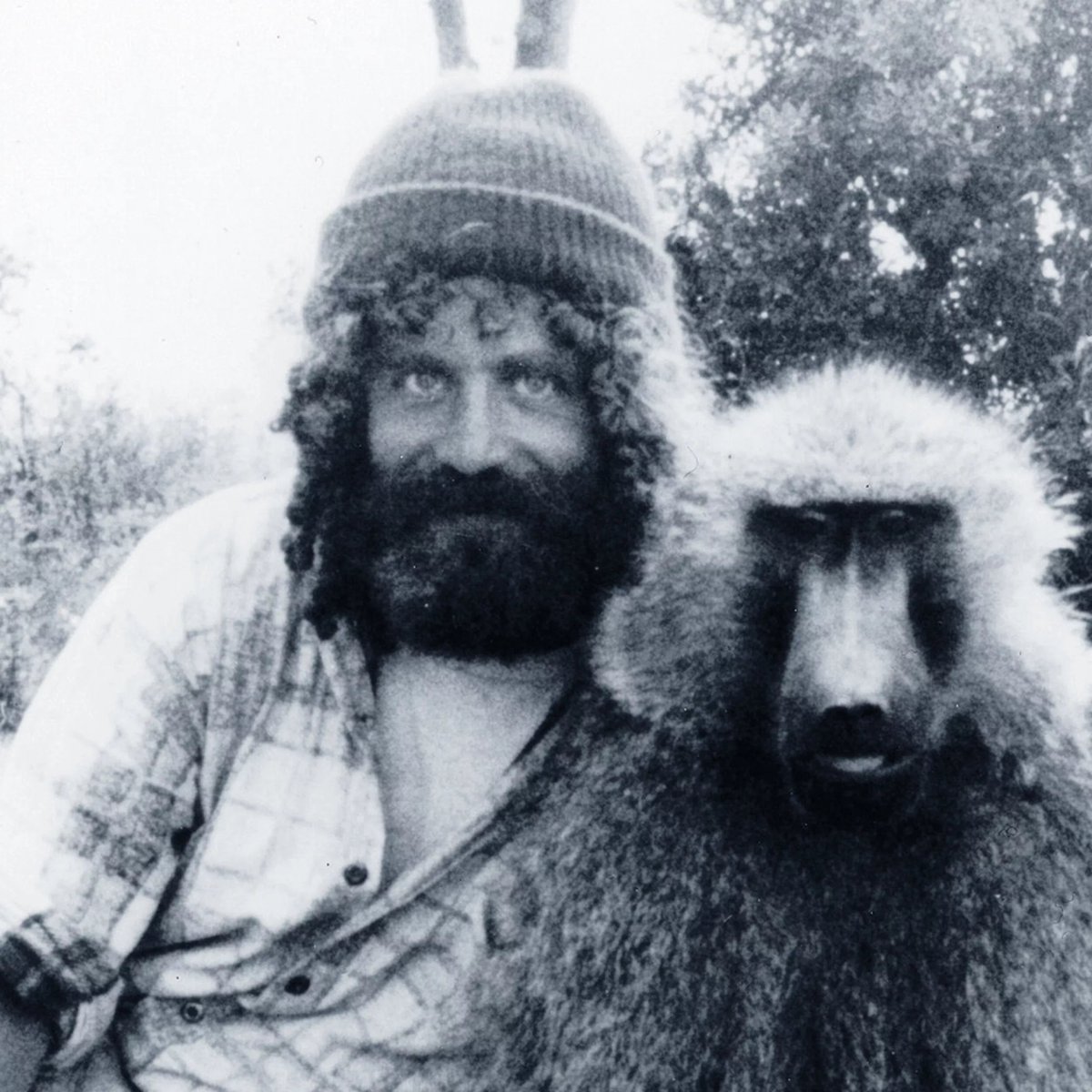
Today I learned male mandrills can physically transform after becoming alpha
When a beta male becomes the alpha, his body gradually transforms. His face becomes more colorful, his rump and scrotum turn bright blue, his testicles grow larger and his breeding success increases
This tiny rodent can survive its entire life without drinking water
The jerboa gets most of its moisture from food, while its powerful legs and oversized ears help it thrive in the desert
@DoctorTro@dsottimano Your whole response focuses on the mentioned lack of human empathy and avoids addressing anything regarding all the poor animal treatment that is a result of these meat industries and their large scale operations to chase the dollar.
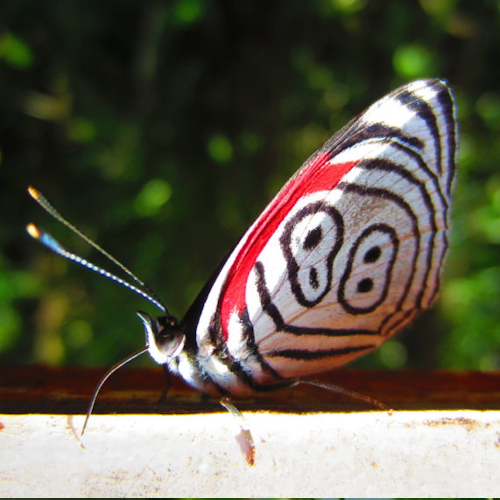
This butterfly gets its name from the markings on its wings
The underside of its wings often resembles the number "88," making it one of the easiest butterflies to recognize
I want to tell you about a two-time Nobel Prize winner who figured out why humans get heart disease and almost every other animal does not.
His name was Linus Pauling. He won the Nobel Prize in Chemistry in 1954 and the Nobel Peace Prize in 1962. He is the only person in history to win two unshared Nobel Prizes.
In 1989 he published something that should have changed cardiology forever.
He called it the Unified Theory of Human Cardiovascular Disease.
Nobody listened.
A comparison between the jaws of a gray wolf and a spotted hyena
Both predators possess powerful jaws, but the spotted hyena's is specially adapted for crushing and consuming bone, giving it one of the strongest bites among land mammals
Back to basics.
Fiat money is fake and immoral.
Humanity is being cattle herded into a debt slavery system enhanced by AI-enabled dragnet surveillance.
Bitcoin fixes this.
If you don't get it, I don't have time to explain it to you. Figure it out.
Japanese actor Hiroyuki Sanada spoke about the contradictions of human nature:
“Some people dream of having a swimming pool at home, while those who have one hardly ever use it. Those who have lost a loved one feel a profound sense of loss, while others often complain about their living relatives. Those without a partner long for one, while those who have one often don't appreciate it. The hungry would give anything for a meal, while the satiated complain about the taste of their food. Those without a car dream of owning one, while those who have a car are always looking for a better one.”
The key to happiness is gratitude: truly seeing and appreciating what we already have, and understanding that somewhere, someone would give anything for what we take for granted.
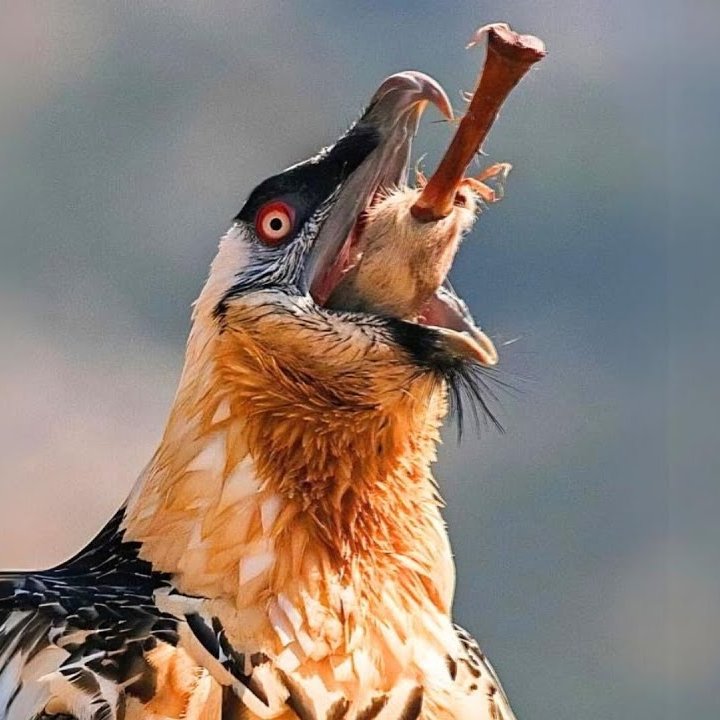
Vultures eat anthrax, botulism, rabies, and cholera for breakfast.
Their stomach acid is among the most corrosive in the animal kingdom, with a pH around 1, low enough to dissolve the bones, hide, and pathogens of dead animals that would kill almost anything else.
A vulture eating a diseased carcass isn't a vector for disease, it's a terminus. The disease chain ends in the vulture's gut, and that's pretty hardcore.
When vulture populations crashed in India in the 1990s, rotting livestock carcasses sat where vultures used to clean them.
Feral dogs and rats took over the cleanup, both of which actually do spread rabies. Researchers later linked the vulture collapse to roughly 500,000 deaths in India over the following decade.
The same collapse is now underway in sub-Saharan Africa. Six of eleven African vulture species are threatened with extinction, primarily from poisoned poaching baits.
The animals nobody finds cute are doing more public health work than most of the species we actively protect.
🚨In 1990s, Stanford researcher Dr. Robert Sapolsky discovered something that should have broken the internet by now.
He was studying dopamine pathways in primates and found that the brain doesn't just adapt to repeated stimulation. It actively fights back.
When you flood dopamine receptors consistently, the brain deploys what neuroscientists call "opponent processes." For every artificial high you create, your nervous system generates an equal and opposite neurochemical low. Not eventually. Immediately. The system is designed to maintain balance, so it starts producing compounds that directly counteract dopamine while you're still experiencing the dopamine hit.
This means every notification, every scroll, every digital reward doesn't just give you a high followed by a return to baseline. It gives you a high followed by a crash below baseline. You end up in neurochemical debt.
Tech companies never publicized this research. They probably never read it. They were too busy discovering that variable ratio reinforcement schedules could keep users engaged for hours. They built addictive systems by accident, then refined them into addiction machines once they realized what they'd stumbled onto.
Your phone delivers an average of 80 dopamine hits per day. Your ancestors got maybe 5. Each hit triggers opponent processes that create a corresponding low. By the end of a typical day of normal phone usage, your baseline dopamine is running in negative territory. You feel flat, restless, vaguely unsatisfied, and hungry for stimulation because your brain chemistry is literally below zero.
You think you're bored. You're chemically depressed by artificial highs.
The opponent process theory explains why nothing feels interesting anymore. Your brain isn't broken. It's precisely calibrated to maintain neurochemical balance, and you keep throwing that balance off with artificial intensity. Every Instagram hit requires an equal Instagram crash. Every TikTok high gets paid for with a TikTok low. Every notification rush gets balanced with notification emptiness.
Your reward system is running a neurochemical deficit that grows larger every day.
Sapolsky's research revealed something even more disturbing: opponent processes don't just create temporary lows. They become permanent changes to your baseline dopamine production. Chronic overstimulation doesn't just make you tolerant to digital rewards. It makes you insensitive to natural rewards.
The sunset that would have captivated your great-grandfather becomes invisible to you not because sunsets got worse, but because your dopamine system needs intensity levels that sunsets can't provide. A good conversation becomes boring not because conversations got less interesting, but because your brain requires the rapid-fire stimulation of social media to register engagement.
You've accidentally trained your reward system to ignore everything that isn't artificially amplified.
This connects to research from Dr. Anna Lembke at Stanford, who found that people who undergo complete digital fasting for just 30 days show measurable increases in dopamine receptor density. Their brains literally regrow sensitivity to natural rewards. Food tastes better. Music sounds more complex. Social interactions become genuinely engaging again.
But there's a catch that nobody talks about: the first two weeks of dopamine detox feel like clinical depression. Your brain has been chemically dependent on artificial stimulation for years. Removing that stimulation creates actual withdrawal symptoms. Restlessness, anxiety, inability to focus, emotional flatness, and desperate cravings for digital input.
Most people interpret these symptoms as evidence that they need their phones. Actually, they're evidence that they've been neurochemically dependent on their phones without realizing it.
The withdrawal period isn't a bug. It's proof the reset is working.
What happens after week three is remarkable. Colors become more vivid. Conversations become genuinely absorbing. Simple pleasures like hot coffee or cool air become satisfying in ways you forgot were possible. Your brain rediscovers that reality contains enough complexity and beauty to hold your attention without artificial amplification.
You don't need more interesting content. You need more sensitive reward systems.
The solution isn't better apps or more engaging entertainment. The solution is restoring your brain's factory settings for what constitutes a worthwhile experience.
Sapolsky's opponent process research suggests this can happen faster than anyone expected. Every day you don't artificially spike your dopamine, your baseline moves a little higher. Every natural reward you pay attention to rebuilds receptor density. Every moment of boredom you endure without reaching for stimulation strengthens your capacity for sustained focus.
Ancient humans lived in a world that provided exactly the right amount of stimulation to keep their reward systems healthy. Enough challenge to stay engaged, enough calm to stay balanced, enough novelty to stay curious, enough routine to stay stable.
We built a world that provides 10 times too much stimulation and wonder why nothing feels rewarding anymore.
Your brain is not the problem. Your environment is the problem.
Change the environment, and the brain heals itself automatically.
There's a physicist at Stanford named Safi Bahcall who modeled this exact principle and the math is wild.
He calls it "phase transitions in human networks." When you're stationary, your probability of a lucky event is limited to your existing surface area: the people you already know, the places you already go, the ideas you've already been exposed to. Your opportunity window is fixed.
When you move, your collision rate with new nodes in a network increases nonlinearly. Double your movement (new conversations, new cities, new projects) and your probability of a serendipitous encounter doesn't double. It roughly quadruples. Because each new node connects you to their entire network, not just to them.
Richard Wiseman ran a 10-year study at the University of Hertfordshire tracking self-described "lucky" and "unlucky" people. The single biggest differentiator wasn't IQ, education, or family money. Lucky people scored significantly higher on one trait: openness to experience. They talked to strangers more, varied their routines more, and said yes to invitations at nearly twice the rate.
The "unlucky" group followed the same routes, ate at the same restaurants, and talked to the same 5 people. Their networks were closed loops. No new inputs, no new collisions.
Luck isn't random. Luck is surface area. And surface area is a function of movement.
The lobster emoji is doing more work than most people realize. Lobsters grow by shedding their shell when it gets too tight. The growth requires a period of total vulnerability. No protection, no armor, soft body exposed to the ocean.
That's the cost of movement nobody posts about. You have to be uncomfortable first. The new shell only hardens after you've already moved.
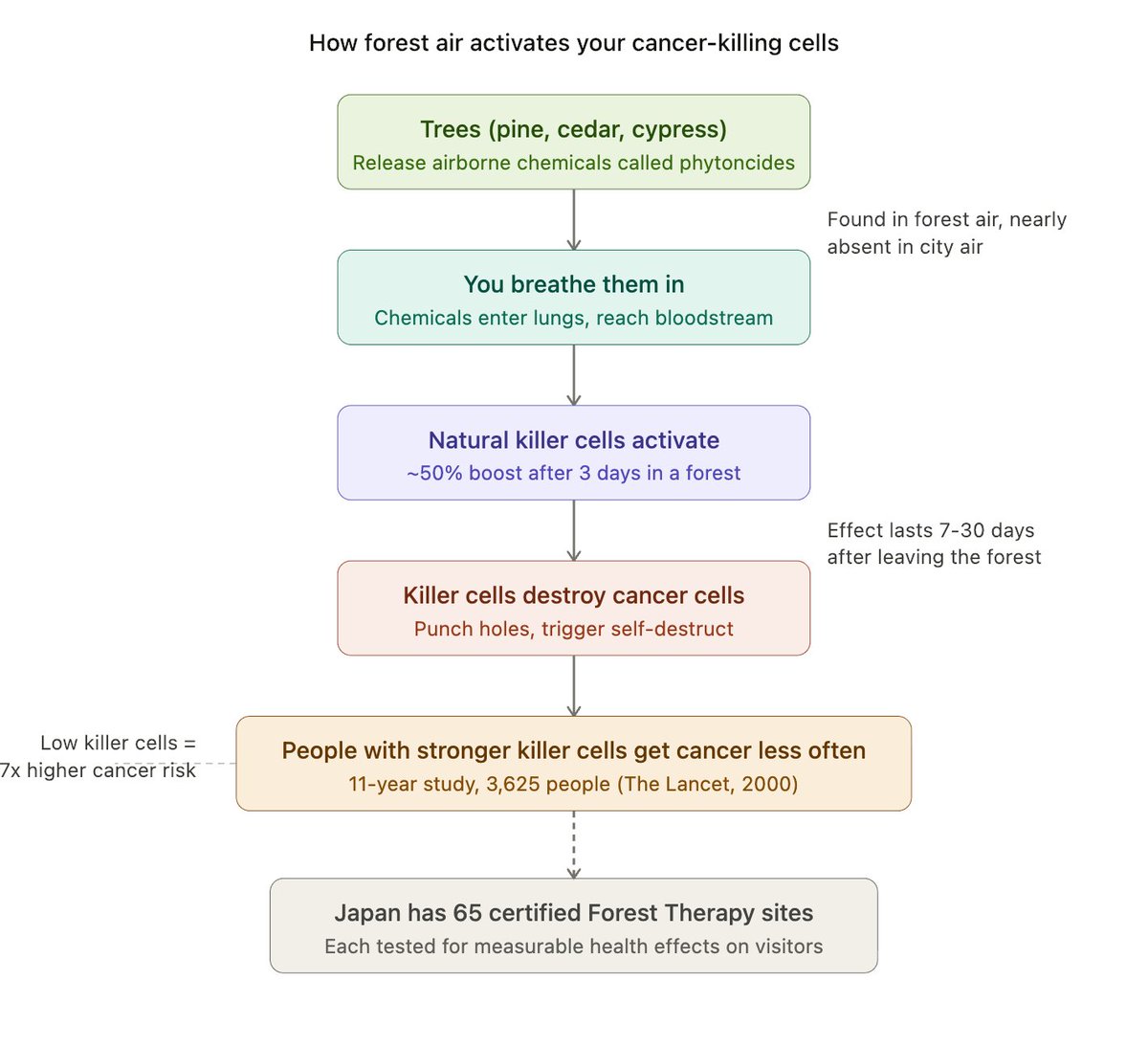
Trees release invisible chemicals into the air to protect themselves from bugs and disease. Turns out those same chemicals also switch on your body's cancer-fighting cells.
They're called natural killer cells. They're a type of white blood cell that patrols your bloodstream looking for cancer cells and virus-infected cells. When they find one, they punch a hole through its outer wall and inject proteins that force the cell to self-destruct from the inside. You're born with them. Unlike most of your immune system, they don't need to be "trained" on a specific threat first. They just attack anything that looks wrong.
The 50% number in this tweet comes from Dr. Qing Li at Nippon Medical School in Tokyo, who has been studying the effects of forests on the human body since 2004. His original 2007 study took 12 men on a 3-day, 2-night forest trip, walking two hours a day. Blood tests showed 11 of 12 had roughly 50% more cancer-killing cell activity afterward. A follow-up with 13 female nurses found the same thing. But the part the tweet leaves out: the boost didn't vanish when they went home. It lasted over 7 days in both groups, and in men, it was still detectable in blood work 30 days later. Li's conclusion is that one forest trip per month could keep these cells running at a higher level year-round.
The obvious next question is whether it's the forest itself or just the vacation. Li tested this directly. A separate group took a city tourist trip with the same amount of walking. No boost to killer cells. No stress hormone drop. Zero effect. Then he ran an even more controlled test: 12 men stayed in a regular Tokyo hotel room for three nights while a humidifier pumped tree oil (from Japanese cypress) into the air overnight. Their killer cells still went up. Their stress hormones still dropped. That isolates the cause to those tree chemicals, called phytoncides. Pine, cedar, and cypress trees release the most. These chemicals were found in forest air but were nearly absent in city air. A 2021 lab study showed that one of these tree chemicals directly switches on killer cells and slows colon tumor growth in mice.
The bigger picture connects these cells directly to cancer risk. An 11-year study published in The Lancet (one of the world's top medical journals) tracked 3,625 Japanese people and found that those with weaker natural killer cells developed cancer at significantly higher rates. A separate study screening for bowel cancer found that people with low killer cell levels were 7 times more likely to be diagnosed. Li's own research across all 47 regions of Japan showed that areas with less forest had higher cancer death rates for lung, breast, uterine, prostate, kidney, and colon cancers, even after accounting for differences in smoking rates and wealth.
The caveats: Li's original studies used small groups (12 and 13 people), and the regional data show a pattern but don't directly prove that forests prevent cancer. No large-scale clinical trial has confirmed that yet. But the chain is consistent: trees release chemicals, those chemicals wake up the cells in your blood that kill cancer, the effect lasts weeks, not hours, and people with more active killer cells get cancer less often.
Japan now has 65 government-certified Forest Therapy sites across the country, each tested and approved based on the physical effects they have on visitors.