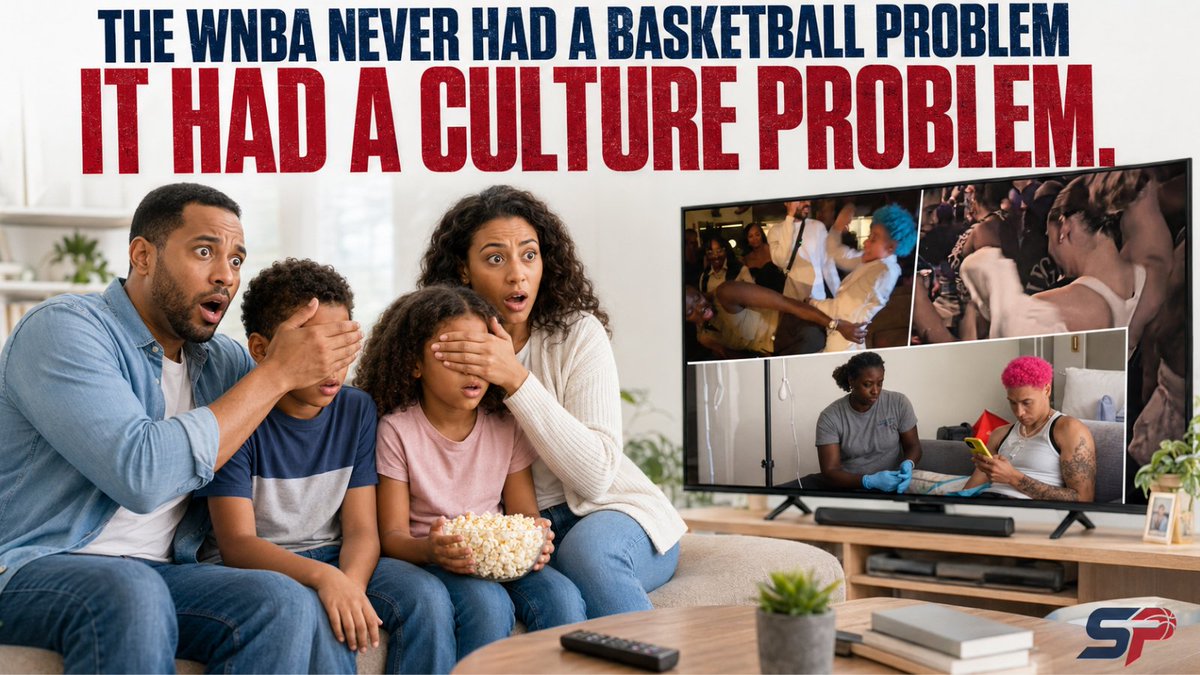
The WNBA Never Had a Basketball Problem. It Had a Culture Problem.
The more I watch the WNBA, the more convinced I become that basketball was never the primary reason this league remained unpopular for so long.
The basketball was not always great. The television product was frequently poor. Marketing was almost nonexistent. But those problems could have been corrected.
The deeper problem was... and remains... the culture.
For years, the self-appointed pioneers and gatekeepers of the WNBA have defended a culture that frequently appears hostile, resentful, exclusionary and profoundly unprofessional.
The league demands respect from the public while many of its most visible representatives behave as though basic standards of maturity and sportsmanship are beneath them.
Perhaps the WNBA was never rejected because America refused to appreciate women’s basketball.
Perhaps America simply did not like what the league had chosen to become.
A Different Generation Is Arriving
What we may be witnessing now is not merely the arrival of more talented basketball players.
It is the arrival of a different kind of professional.
Many of today’s emerging stars spent their entire lives learning that talent alone would never be enough. To reach this level, they had to listen to coaches, succeed in the classroom, respect teammates, represent their schools properly and sacrifice experiences that ordinary children and teenagers take for granted.
They learned to be disciplined.
They learned to be coachable.
They learned to handle pressure.
They learned that character matters when nobody is watching... and that conduct carries even greater consequences when everybody is watching.
They also learned what genuine inclusion means: welcoming people regardless of race, background, politics or identity. Not demanding inclusion for themselves while withholding it from anyone deemed culturally inconvenient.
That distinction exposes a fundamental hypocrisy within the WNBA’s existing power structure: inclusion is often practiced selectively. It demands acceptance from the public while treating dissenting opinions, unfamiliar fans and even certain players with open contempt.
Fans Are Choosing People, Not Just Basketball
The WNBA establishment desperately wants to believe that its new fans are only interested in one player, one rivalry or one style of basketball.
It is much bigger than that.
Fans are gravitating toward players who appear disciplined, gracious, competitive and genuinely appreciative of the opportunity they have earned. They are responding to women who play hard, respect the game and understand that becoming a professional athlete carries responsibilities beyond collecting a paycheck.
Yes, the basketball is better.
But the people are often more relatable too.
That is the part the old guard refuses to acknowledge.
New fans are not merely choosing logo threes, brilliant passing and faster offenses. They are choosing professionalism over resentment. They are choosing sportsmanship over hostility. They are choosing competitors who inspire their children rather than public figures who appear determined to shock, lecture or alienate them.
The audience is voting with its attention... and the results are unmistakable.
Professionalism Is Not Oppression
Nobody expects professional athletes to be perfect.
But once those choices become public content associated with the league, they become part of its product.
When All-Star Weekend is dominated by public intoxication, vulgar broadcasts, interpersonal drama and behavior more appropriate for a private party than a league showcase, fans are permitted to question the image being presented.
When on-court competition includes throat strikes, blindside hits, dead-ball cheap shots and fights, fans are permitted to question whether the league has normalized conduct that would be condemned elsewhere.
When players use their platforms to insult fans, attack colleagues and promote political or social messages unrelated to basketball, the audience is permitted to decide that it has had enough.
That is not misogyny.
That is not bigotry.
That is consumer choice.
The league cannot demand that families watch, purchase tickets and buy merchandise... and then call those same families intolerant when they reject the behavior being marketed to them.
The WNBA’s Definition of Authenticity Is Broken
Somewhere along the way, the WNBA began confusing hostility with authenticity.
Anger became strength.
Vulgarity became personality.
Resentment became activism.
Cheap shots became toughness.
Assault became physicality.
Professionalism became “respectability politics.”
Gratitude became weakness.
And anyone suggesting that players represent themselves and the league with greater maturity was accused of trying to control women.
That is intellectually dishonest.
Every successful professional organization establishes expectations for public conduct. The NBA does it. The NFL does it. Corporate America does it. Universities do it. Even local youth organizations do it.
Standards are not oppression, and accountability is not discrimination.
And asking professional athletes to behave like adults is not an attack on women.
In fact, refusing to hold women accountable because they are women is its own form of condescension.
Look in the Mirror
For years, the WNBA’s defenders blamed everyone else.
The fans did not appreciate the game.
The media would not provide enough coverage.
Corporate sponsors would not invest.
Men were insecure.
Traditional basketball fans were prejudiced.
New fans were ignorant.
But then a polite, disciplined basketball phenomenon from the Midwest arrived... and suddenly the television ratings exploded, arenas filled, merchandise disappeared and the league became part of the national conversation.
That development should have inspired humility.
Instead, much of the league responded with jealousy, territorialism and open hostility toward the very audience it had spent decades claiming to want.
The uncomfortable truth is that the WNBA’s financial struggles may never have been solely about society refusing to support women.
The public may have been rejecting the culture the league insisted on protecting.
Now the market is showing the WNBA precisely what it wants: elite basketball, compelling personalities, authentic competition, recognizable rivalries and players whom families can enjoy supporting.
The league can learn from that message... or continue insulting the people delivering it.
Grow Up and Play Basketball
The solution is not complicated.
Play basketball.
Compete fiercely.
Protect your opponents.
Respect the officials, coaches and fans.
Handle personal drama privately.
Stop treating every interview as an ideological seminar.
Stop confusing aggression with strength and vulgarity with authenticity.
And understand that playing professional basketball is an extraordinary privilege... one that thousands of talented women worked equally hard but never received.
The public is not asking WNBA players to become silent, robotic or perfect.
It is asking them to demonstrate the maturity expected of professional adults and the awareness expected of public figures.
Try being gracious.
Try being welcoming.
Try appreciating the fans who are finally investing their time and money in your league.
Try presenting a product that parents want their daughters to watch.
You might be shocked by how profitable professionalism can become.
The WNBA never needed the public to lower its standards.
It needed the league to raise its own.
The WNBA, its players, and its media partners can keep pretending Caitlin Clark is merely one piece of the league’s success.
The numbers have already ended that debate.
The Indiana Fever generated more social-media impressions than every other WNBA team combined.
Not one team.
Not the next five.
The entire rest of the league.
Jersey sales. Ticket sales. Television ratings. Attendance. Merchandise. Engagement.
Every measurable road leads back to Caitlin Clark.
So no, Angel Reese, this is not because of “all of us.”
Caitlin Clark is not merely the face of the WNBA. She is the audience, the economy, the relevance, and the league itself.
Everything else is noise.
WE GIVE UP... SINCE THE INDIANA FEVER DOESN'T SEEM TO CARE ABOUT FIXING THEIR OWN PROBLEMS, WE DID IT FOR THEM.
The Indiana Fever do not have a talent problem.
They do not have a scoring problem.
They do not even have a chemistry problem.
They have an offensive governance problem.
The wrong player is too often allowed to control the possession. The right player is too often removed from the action. One of the league’s most explosive scorers is being permitted to stand, wait and hunt her own shot instead of being coached into becoming the most dangerous off-ball weapon in basketball.
The result is not elite offense.
It is high-level talent playing sophisticated streetball.
And after months of watching the same problems repeat themselves, the numbers now make the diagnosis impossible to ignore:
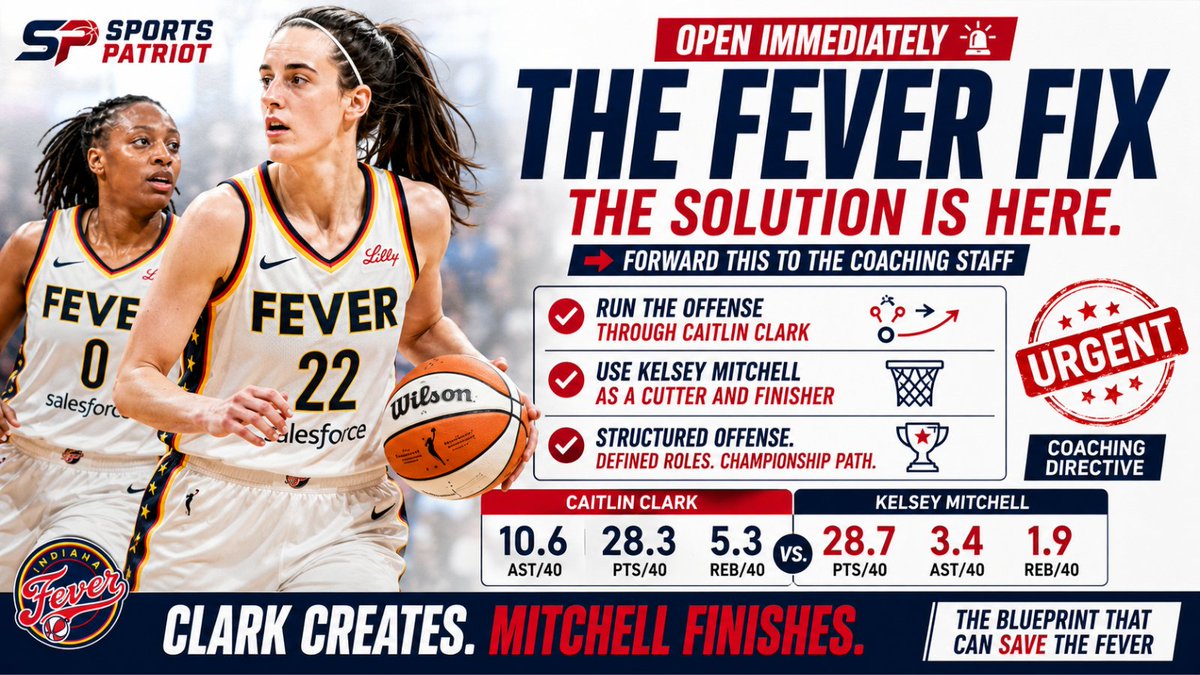
The Indiana Fever are at their best when Caitlin Clark controls the offense and Kelsey Mitchell participates in it... not when Mitchell tries to become the offense herself.
That is the problem.
That is also the solution.
Caitlin Clark Is Not Merely a Scorer. She Is the System.
The most important number in this entire discussion is not points, field-goal percentage or three-point percentage.
It is this:
Indiana’s net rating with Caitlin Clark on the floor: +1.9 per 100 possessions
Indiana’s net rating with Clark off the floor: -10.3
That is a 12.2-point swing.
When Clark plays, the Fever function like a winning team.
When she sits, they function like one of the worst teams in basketball.
That is not the statistical profile of a player who should spend long stretches stationed away from the ball, waiting for the offense to find her.
That is the profile of the player who should be directing every meaningful possession.
Clark is not simply another high-volume guard. She is Indiana’s organizer, pressure release, transition engine and primary source of advantage creation.
Her production reflects it.
Per 36 minutes:
25.5 points
9.5 assists
4.8 rebounds
Kelsey Mitchell, by comparison:
25.8 points
3.1 assists
1.7 rebounds
Their scoring is nearly identical.
Their influence on the game is not.
Clark creates points for herself and everyone around her. Mitchell is overwhelmingly dependent upon scoring to create value.
That distinction should determine the structure of the offense.
Instead, Indiana too often treats the two as interchangeable ball-dominant guards.
They are not.
The Fever Are Confusing Shot-Making With Offensive Execution
Indiana leads the league in scoring at 94.4 points per game.
It ranks first in three-point percentage at 37.7% and third in overall field-goal percentage.
On the surface, that appears to be proof of a highly functioning offense.
It is not.
The Fever rank only sixth in assists.
That tells a very different story.
Indiana is scoring because it has exceptional shot-makers... not because it is consistently producing elite possessions.
There is a major difference.
A disciplined offense creates repeatable advantages through spacing, screening, cutting, timing and ball movement.
A talented but poorly governed offense survives because gifted players repeatedly make difficult shots.
Indiana has been living too heavily in the second category.
That is why the offense can look brilliant for one quarter and completely disjointed the next.
It is why a player can score 30 points while contributing almost nothing else.
It is why Clark can dominate one night and then spend critical possessions removed from the center of the action.
The Fever do not lack offensive talent.
They lack an offensive hierarchy.
Kelsey Mitchell Is Being Allowed to Play a Smaller Version of Her Own Game
Kelsey Mitchell is one of the most explosive scorers in the WNBA.
She is shooting:
49.5% from the field
42.3% from three
54.3% on two-point attempts
62.4% at the rim
61.8% from three to ten feet
62.7% true shooting
Those are elite numbers.
But they also reveal what Indiana is failing to maximize.
Mitchell is devastating when she gets downhill, catches the ball in motion and attacks a rotating defense.
More than 55% of her two-point field goals are assisted.
It means her most efficient interior scoring is frequently being created through someone else’s pass.
In practical terms: cuts, relocations, transition opportunities, secondary actions and catches against an already compromised defense.
That is precisely the version of Mitchell Indiana should be building around.
Instead, too many possessions end with her standing outside the three-point line, waiting for the ball so she can attempt to beat a set defender one-on-one.
She is capable of doing it.
That does not make it good offense.
A difficult shot converted by a great scorer is still often a poorly constructed possession.
The Game-by-Game Results Are Even More Revealing
When Mitchell has made at least five two-point field goals in games alongside Clark, Indiana is:
10–4
Clark and Mitchell combine for 47.1 points per game in those contests.
When Mitchell has made fewer than five two-point baskets, Indiana is:
2–6
Their combined scoring falls to 37.5 points per game.
That is not a minor difference.
It is a 46-point swing in winning percentage.
When Mitchell is cutting, attacking, receiving the ball in motion and scoring inside the arc, Indiana wins at a high rate.
When she becomes primarily a perimeter-based shot creator, Indiana’s efficiency and winning percentage collapse.
The numbers do not say Mitchell should stop scoring.
They say Indiana must change how she scores.
When Clark and Mitchell Both Play Heavy Minutes, Playmaking Makes a Difference.
In games where Clark and Mitchell both played at least 30 minutes, the Fever went 6–5.
When Mitchell recorded at least two assists in those games, Indiana went:
6–3
When she recorded one assist or fewer:
0–2
When Mitchell reached at least three assists, Indiana went 4–2.
The sample is not enormous, but the basketball logic is unmistakable.
When Mitchell participates in the offense rather than merely finishing possessions, Indiana becomes more difficult to guard.
The defense can no longer load toward her shot.
Clark can attack a moving floor.
Boston can operate against late help.
Cutters receive the ball before the defense resets.
The offense becomes connected.
That is the difference between five talented players occupying the court and five players functioning as a unit.
Mitchell’s On-Off Numbers Should Alarm the Organization
Indiana’s net rating with Mitchell on the floor is +7.8.
With her off the floor, it is +10.7.
The Fever have been 2.9 points better per 100 possessions with Mitchell off the court.
That does not mean Mitchell is a bad player.
It means her scoring production is not translating into the level of team dependence expected from a player with her usage, minutes and offensive freedom.
Her usage rate is 27.2%.
She plays 32.5 minutes per game.
She averages:
23.3 points
2.8 assists
1.6 rebounds
1.0 steal
0.1 blocks
She is producing elite scoring with remarkably little peripheral impact.
That is not an argument to reduce her role.
It is an argument to redefine it.
The Coaching Failure Is Structural
This is where responsibility shifts from the player to the coaching staff.
Players generally repeat what a system permits.
If Mitchell is allowed to stand outside the arc, wait for the ball, reject movement and repeatedly attack one-on-one, then that is not merely a player habit.
It is the offense.
If Clark is permitted to spend possessions away from the ball while a less complete creator controls the action, then that is not an accident.
It is a coaching decision.
If Indiana’s best cutter can abandon cutting for an entire half without immediate correction, then the staff is not enforcing offensive standards.
That is why this issue extends beyond Mitchell.
The broader problem is that Stephanie White and her staff have not established a disciplined offensive identity.
The Fever frequently appear to have concepts without rules, talent without hierarchy and freedom without accountability.
Elite basketball does not operate that way.
The best teams define:
who initiates;
where the first advantage comes from;
what each player does when the ball is elsewhere;
how spacing is preserved;
when isolation is appropriate;
and what happens when the first action fails.
Indiana too often appears to define none of it firmly enough.
The players are left to improvise.
And improvisation without structure is streetball, regardless of how talented the participants may be.
The Fix
The solution is not complicated.
Caitlin Clark must orchestrate the offense
Clark should initiate the overwhelming majority of half-court possessions when she is on the floor.
Not because Mitchell cannot dribble.
Because Clark sees more, creates more and elevates more.
Her job is not merely to score.
Her job is to organize the entire defense and decide where the advantage will appear.
Kelsey Mitchell must become an elite off-ball weapon
Mitchell should be cutting, relocating, sprinting off screens and attacking closeouts.
Her speed should force defenders to make decisions before she catches the ball.
She should receive more passes while moving toward the basket and fewer while standing 24 feet away from it.
The goal is not fewer Mitchell points.
The goal is easier Mitchell points.
Aliyah Boston must become part of the connective tissue
Boston should screen, short roll, facilitate and punish switches.
Clark-Boston actions should force the first defensive rotation.
Mitchell’s movement should punish the second.
That creates a layered offense instead of a sequence of isolated attacks.
The staff must enforce possession standards
Standing still cannot be optional.
Ball-watching cannot be tolerated.
Repeated one-on-one possessions cannot be mistaken for freedom.
Every player should know what she is expected to do when the ball is not in her hands.
That includes Mitchell.
Especially Mitchell.
The Final Diagnosis
The Indiana Fever have enough talent to become the most dangerous offensive team in the WNBA.
But talent is not the same as organization.
Right now, Indiana is winning too often because its players are capable of overcoming the offense instead of being elevated by it.
The numbers reveal the path forward.
When Clark controls the game, Indiana functions.
When Mitchell moves, cuts and scores within the structure, Indiana wins.
When the Fever abandon those principles, they become ordinary.
This is not a mystery anymore.
The problem has been identified.
The offense must run through Caitlin Clark.
Kelsey Mitchell must stop waiting for the game to come to her and start attacking it without the ball.
And the coaching staff must finally decide whether it wants to supervise talented streetball or coach championship basketball.
Because Indiana already has the players.
What it lacks is the system.
I have been a sports fan my entire life. My teams were chosen early, and they stayed my teams. I have spent years mocking fair-weather fans who abandoned ship when things got difficult.
Now I understand them.
When Caitlin Clark arrived in Indiana, I fell hard for the Fever. I bought into the team, defended the organization and pledged my loyalty.
That loyalty has been rewarded with one inexplicable decision after another.
I have watched the Fever mismanage a generational superstar, give away talented players without giving them a legitimate opportunity, elevate Kelsey Mitchell as the unquestioned center of the franchise, limit Caitlin Clark with a rehabilitation strategy that made no basketball sense and repeatedly fail to defend their biggest star.
They signed Sophie Cunningham to a one-year minimum deal. They created a salary-cap disaster. They defended “culture” more passionately than basketball. Their front office publicly argued with fans. And now they have handed Justine Pissott away because she did not fit the culture... only to watch her immediately show what Indiana refused to recognize.
All while keeping a 33-year-old Damiris Dantas.
At some point, loyalty becomes complicity.
I can no longer support this organization.
The Fever have failed their fans. They have failed basketball. And they have squandered the opening years of Caitlin Clark’s professional career through arrogance, incompetence and an obsession with “culture” that has repeatedly taken priority over winning.
I never thought I would become the fair-weather fan I used to ridicule.
But I am done.
From this point forward, I will continue supporting Caitlin Clark. I will continue calling out the league, the Fever, the coaches, the players and the media when they fail her.
And I will continue wondering why Caitlin, her representatives and the people closest to her are not fighting harder to protect her career, her health and her future.
The Fever chose their culture.
They can live with the consequences.
BEFORE CAITLIN CLARK:
Avg Attendance: 6,600
TV Viewership: Never hit 500k
Avg salary: $150k
AFTER CAITLIN CLARK:
Avg attendance: 10k+
TV Viewership: Biggest games hit 2M+
Avg salary: $600k
WNBA players should be kissing the ground Clark walks on. Without her, they're nothing.
Sometimes the Smartest Voice Isn't the One on Television.
One of our followers replied to our post today with a single sentence.
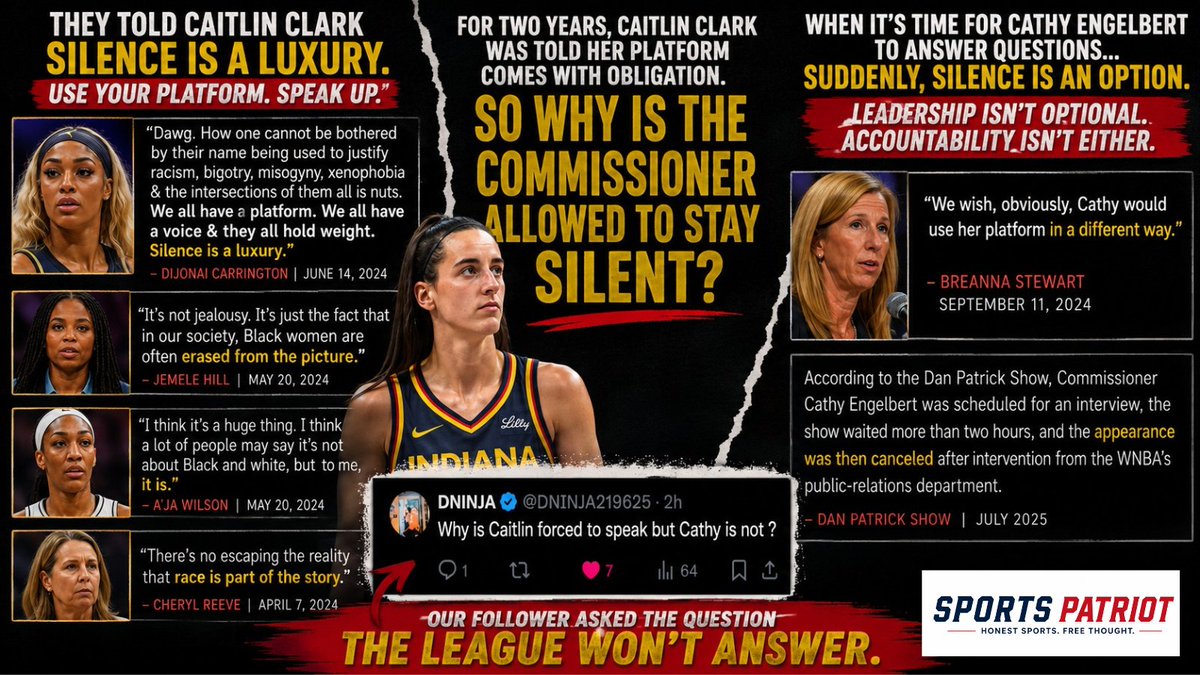
"Why is Caitlin forced to speak but Cathy is not?"
Read it again.
One sentence.
No talking points.
No political spin.
No corporate PR.
Just common sense.
For nearly two years, we've watched players, coaches, media personalities, and league insiders insist that Caitlin Clark has a responsibility to use her platform.
She has been expected to speak on race.
On culture.
On fan behavior.
On online harassment.
On social justice.
On death threats.
On issues she didn't create and doesn't control.
Meanwhile, when one of the biggest sports shows in America was prepared to ask questions of the person actually responsible for leading the WNBA...
The Commissioner never appeared.
That contrast says more than any press release ever could.
What strikes me most isn't the question itself.
It's who asked it.
Not a television analyst.
Not a columnist.
Not a former player.
A fan.
And that has become the story of the modern WNBA.
The fans are no longer simply consuming the product.
They're thinking critically about it.
They're asking questions the media often doesn't ask.
They're identifying contradictions that league leadership seems unwilling to address.
For months we've been told the "new fans" don't understand basketball.
Yet time after time, it has been ordinary fans connecting dots that many of the sport's most influential voices either overlooked or chose not to confront.
Whether you agree with every conclusion they reach is beside the point.
Common sense has a way of cutting through noise.
Sometimes all it takes is one honest question.
Why is Caitlin forced to speak, but Cathy is not?
Until someone in league leadership answers that question, fans will continue asking it.
And they should.Why Is Caitlin Clark Expected to Speak... But Cathy Engelbert Is Not?
One of our followers replied to an article we posted today with a single sentence.
One sentence.
No media credential.
No television platform.
No PR training.
Just common sense.
"Why is Caitlin forced to speak but Cathy is not?"
Read that again.
Because that may be the most important question asked about the WNBA all year.
For the last two years, Caitlin Clark has repeatedly been told that having the league's largest platform comes with responsibility.
When critics believed she wasn't speaking forcefully enough about people using her name to promote racism and hate, she was publicly challenged.
DiJonai Carrington wrote:
"We all have a platform. We all have a voice & they all hold weight. Silence is a luxury."
That wasn't a conversation about basketball.
It was a conversation about responsibility.
It was an expectation that Caitlin Clark use her influence to address issues far beyond the game itself.
And she wasn't alone.
Commentators.
Columnists.
Former players.
Television personalities.
Over and over, the message was remarkably consistent.
Use your platform.
Speak up.
Lead.
Use your voice.
Whether you agreed with those expectations isn't even the point.
The expectations existed.
Publicly.
Repeatedly.
Loudly.
Now let's fast-forward.
The Dan Patrick Show... one of the largest sports shows in America... waited more than two hours for a scheduled interview with WNBA Commissioner Cathy Engelbert before learning the appearance would not happen after intervention from the league's PR department.
Think about that.
Caitlin Clark is a basketball player.
Cathy Engelbert is the Commissioner of the WNBA.
One is responsible for making jump shots.
The other is responsible for leading an entire professional sports league.
If the standard is that having a platform creates an obligation to speak, shouldn't that standard apply even more to the person actually running the league?
Because unlike Caitlin Clark, Cathy Engelbert doesn't just have a platform.
She has authority.
She oversees league operations.
She represents the owners.
She speaks for the WNBA.
Or at least she's supposed to.
For two years, we've watched a 24-year-old player repeatedly asked to answer for issues she didn't create.
Race.
Culture.
Fan behavior.
Online abuse.
League politics.
Player safety.
Now the Commissioner is presented with one of the biggest sports platforms in America during one of the league's most controversial weeks...
...and she doesn't appear.
That is why our follower's question is so powerful.
"Why is Caitlin forced to speak but Cathy is not?"
What strikes me most isn't the question.
It's who asked it.
Not ESPN.
Not a national columnist.
Not a former player.
A fan.
For months we've been told the "new fans" don't understand basketball.
Yet time after time, they're asking the questions many of the league's most prominent voices seem unwilling to ask.
Maybe that's because common sense doesn't require credentials.
It just requires consistency.
If silence is a luxury for Caitlin Clark...
Why isn't it a luxury for Cathy Engelbert?
Leadership begins at the top.
And so should accountability.
The Housing Bill is now law today despite no signature from Trump. I don’t think he realized we don’t need his signature after 10 days. Now he can never take credit for actions to lower costs. Let’s make sure all Americans know he opposed actions to lower housing costs.
They Keep Telling Me to Stop Watching the WNBA. They Don't Understand Why I Can't.
Every time I criticize the WNBA, someone eventually says the same thing.
"If you hate it so much, stop watching."
If only it were that simple.
Women's basketball isn't just something I watch.
It's part of who I am.
I grew up playing basketball. I played in college. Then I married the former #1 ranked player in our state... a Division I basketball player who understood the game better than I ever did.
That was the first lesson my wife taught me.
I wasn't marrying a great female basketball player.
I was marrying a great basketball player.
There is a difference.
Together we raised four daughters.
Our house wasn't built around basketball because we wanted scholarships.
It was built around basketball because we loved the game.
We spent twenty-five years traveling the country in gyms that most people will never see.
AAU tournaments.
State championships.
Holiday classics.
Summer showcases.
If you've lived that life, you know.
Your vacations become tournaments.
Your weekends disappear.
Your closest friends become families sitting in folding chairs beside you.
It becomes your life.
Three of our daughters were eventually named State Player of the Year, just like their mother.
Three won state championships.
Three played college athletics.
One competed in a Power Four conference in the Atlantic Coast Conference.
Another became a four-time All-American and was inducted into her university's Hall of Fame.
Somewhere along the way I also spent twenty-five years coaching elite girls basketball.
So when someone tells me...
"You don't understand basketball."
I usually smile.
Not because I think I know everything.
I certainly don't.
But because I know enough to recognize when someone is trying to dismiss an opinion instead of debating it.
Here's the part many people don't understand.
I've been following women's basketball for decades.
Caitlin Clark didn't introduce me to the sport.
She reminded me why I loved it.
When she entered the WNBA, I genuinely believed we were about to witness something extraordinary.
Finally.
The world's greatest female athletes were going to receive the attention they had deserved for generations.
Young girls would have heroes.
Television ratings would soar.
A new generation of fans would discover what many of us had known all along... that women's basketball, played well, is beautiful.
Everything was lined up perfectly.
Then something happened.
Instead of embracing the moment, the league seemed determined to fight it.
The conversation shifted away from basketball.
Officiating became the story.
Physicality became the story.
Politics became the story.
Culture became the story.
Basketball somehow became secondary.
That has been the most heartbreaking part.
Because I don't want the WNBA to fail.
I want it to become everything it is capable of becoming.
That's why I keep writing.
Not because I hate the league.
Because I love the sport.
There is a difference.
I don't write because I enjoy criticizing coaches.
I write because coaching matters.
I don't criticize officials because I enjoy controversy.
I criticize them because consistency matters.
I don't question league leadership because I want chaos.
I question leadership because accountability matters.
When Geno Auriemma says something I believe is wrong...
I'll say so.
When Stephanie White unveils a coaching strategy that I believe deserves scrutiny...
I'll say so.
When league executives ignore concerns from fans...
I'll say so.
Because silence helps nobody.
The easiest thing in the world would be to turn the television off.
But if you've spent a lifetime watching your wife...
your daughters...
your players...
pour their hearts into this game...
walking away isn't really an option.
I owe this sport too much.
Women's basketball deserves excellence.
Its players deserve professionalism.
Its fans deserve honesty.
And the next generation of little girls deserves a league that celebrates basketball first.
So no...
I'm not going anywhere.
I'll keep watching.
I'll keep writing.
I'll keep cheering when the league gets it right.
I'll keep criticizing when it gets it wrong.
Not because I want to tear the WNBA down.
Because I still believe in what it can become.
And if enough of us continue demanding excellence instead of excuses...
maybe one day it will.
Stephanie White's "Flip-Flop" Experiment Was a Coaching Clinic in What Not to Do
Sometimes coaches lose because shots don't fall.
Sometimes they lose because the other team is simply better.
And then there are nights like Wednesday, when a coach manufactures a problem that never needed to exist.
Before the Indiana Fever tipped off against the Los Angeles Sparks, Stephanie White proudly unveiled what she called a "flip-flop" strategy.
The premise was simple.
Caitlin Clark would play limited minutes Tuesday and Aliyah Boston would sit.
Aliyah Boston would play limited minutes Wednesday and Caitlin Clark would sit.
On paper, perhaps it sounded like creative load management.
On the court, it looked like chaos.
Instead of allowing Caitlin Clark to establish any rhythm, White repeatedly pulled her after just a few minutes of action before sending her back in for another brief stint.
There was no obvious relationship to momentum.
No relationship to matchups.
No strategic adjustment based on how the game was unfolding.
It was substitution by stopwatch.
Basketball isn't baseball.
It isn't hockey.
The game's best players don't simply accumulate minutes.
They establish tempo.
They force defensive adjustments.
They dictate spacing.
They create rhythm for everyone else on the floor.
Constantly interrupting that rhythm is usually something the opposing coach hopes to accomplish... not something you voluntarily do to yourself.
The Fever never looked comfortable.
Their offense never found continuity.
Their defense never found consistency.
The result?
A 106-point defensive performance against a struggling Los Angeles Sparks team and a 14-point loss that felt every bit as disjointed as the rotation itself.
It was difficult to watch.
Even more difficult to understand.
The obvious question becomes this:
What exactly was the objective?
If the goal was preserving Clark's health, why play her at all?
If the goal was winning the game, why repeatedly remove your primary offensive organizer regardless of the flow of the game?
No matter which explanation you choose, the basketball logic remains difficult to follow.
And that is becoming a pattern.
The Fever's substitution patterns have been questioned throughout much of the season.
Fans have repeatedly struggled to understand the timing of substitutions, the lineup combinations, and the overall rotation philosophy.
Tuesday's "flip-flop" experiment simply took those concerns to another level.
Then there was another decision that deserves scrutiny.
With the outcome essentially decided, Kelsey Mitchell remained on the floor while the deficit continued to grow.
This isn't the first time Fever fans have watched Mitchell receive extended minutes after the competitive portion of a game was effectively over.
Those extra possessions matter.
Extra possessions become extra shots.
Extra shots become extra points.
Extra points become better-looking box scores.
Meanwhile, fans have noticed that Clark has been removed from similar situations. Even when a triple-double is in reach.
Whether there is a basketball explanation or not, perception matters.
When one player consistently receives opportunities that another does not, people naturally begin asking questions.
Coaches don't just manage games.
They also shape narratives.
And box scores have a funny way of shaping narratives months later.
Predictably, much of the conversation after the game focused on Caitlin Clark's stat line.
Others praised Kelsey Mitchell's scoring.
Very little attention was paid to the coaching decisions that influenced both stories before the opening tip.
That's unfortunate.
Because coaching decisions matter.
They influence rhythm.
They influence production.
And ultimately, they influence wins and losses.
Now comes the real test.
Stephanie White told everyone this "flip-flop" strategy would continue Wednesday with Aliyah Boston receiving the same minute restrictions Caitlin Clark received Tuesday.
Good.
Then let's see it.
Because if Boston suddenly plays her normal workload...
If the restrictions quietly disappear...
If the explanation changes...
Then the questions become much bigger than one unusual rotation.
At that point, fans would have every right to ask whether this was ever a consistent basketball strategy or whether it applied only to one player.
Nobody should accuse the Fever of acting in bad faith before the evidence exists.
But accountability works both ways.
When a coach publicly announces a plan, fans have every right to expect that plan to be followed... or clearly explained if it changes.
If Boston's minutes mirror Clark's, then the organization deserves credit for applying the strategy consistently. Even if it is the worst basketball strategy ever implemented.
If they don't, the Fever owe everyone an explanation.
Because consistency is one of the foundations of credibility.
And right now, credibility is exactly what this coaching staff is struggling to earn.
Serious organizations don't ask fans to ignore confusing decisions.
They communicate the reasoning behind them.
Instead, what fans witnessed Tuesday looked less like an innovative coaching strategy and more like a preseason experiment conducted in the middle of a regular-season game.
The irony is that the media will spend the next 24 hours talking about Caitlin Clark's numbers and Kelsey Mitchell's scoring.
The real story wasn't either player's stat line.
The real story was the person controlling both of them.
And after watching one of the strangest rotation experiments in recent memory, fans have earned the right to ask a simple question:
At what point does Stephanie White have to answer for coaching decisions that continue to create more confusion than confidence?
Because if Tuesday was the blueprint for the future, the Fever don't have a player problem.
They have a leadership problem.
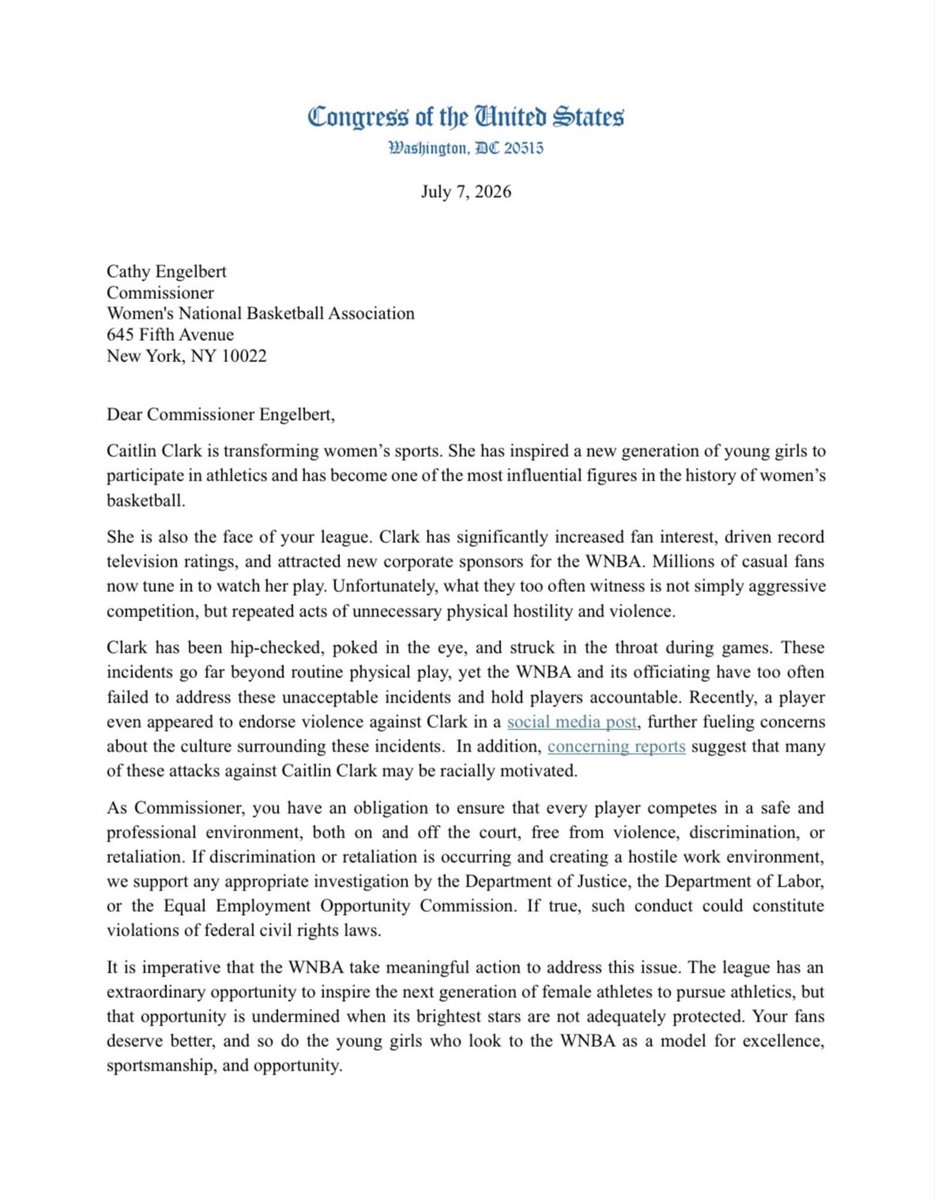
This should concern every WNBA fan... regardless of where you stand on Caitlin Clark.
The issue is no longer a missed foul, a flagrant, or social media arguments.
Members of Congress are now demanding answers from the league itself.
Whether you agree with the letter or disagree with it, one thing is undeniable:
The WNBA's leadership has allowed this situation to grow into something far bigger than basketball.
Serious organizations solve problems before Congress starts asking questions.
Anyone arguing that Caitlin Clark's style of play hurts the Indiana Fever is also unknowingly admitting that the Fever coaching staff is too inexperienced to coach the greatest offensive creator in basketball.
The Caitlin Clark Isolation Phase Has Begun
We told you to watch it before tipoff.
Not after the game.
Not after the Fever beat the Sparks by 24.
Not after the box score looked clean.
Not after the broadcast had time to polish the story.
Before.
We said the Indiana Fever’s first game without Caitlin Clark was not just a basketball game.
It was a Caitlin Clark narrative test.
And now we are here.
The Fever won 111-87. The offense looked smooth. The whistle looked friendlier. The free throws tilted Indiana’s way. The guards were allowed to play. The rotations looked cleaner. The coach looked more comfortable. The broadcast had a pretty box score. The media got exactly what it needed.
One clean night without Caitlin Clark.
Now watch what happens next.
Because this was never going to end with one game.
This is the beginning of the next phase.
The Caitlin Clark isolation phase.
That does not mean everyone is sitting in a room plotting every word. That is not the point.
The point is that the incentives all lined up perfectly.
The WNBA needed the controversy around Caitlin to cool down.
The Fever needed to look functional.
Stephanie White needed a cleaner night.
The media needed a way to discuss Indiana without admitting how badly the league has mishandled Caitlin Clark.
And the Caitlin skeptics needed one game they could use to softly suggest what they have wanted to say all along:
Maybe the Fever are calmer without her.
Maybe the ball moves better without her.
Maybe the team is happier without her.
Maybe the coach can breathe without her.
Maybe Caitlin Clark is not the solution.
Maybe she is the problem.
They will not say it that plainly.
They are too careful for that.
But listen to the language.
“They looked balanced.”
“They looked connected.”
“They played freer.”
“They trusted each other.”
“Stephanie White had them settled.”
“Tyasha Harris gave them poise.”
“The Fever showed they are more than Caitlin Clark.”
On the surface, all of that sounds harmless.
It is not.
That is how a narrative is built.
Not with one giant lie.
With a hundred little suggestions.
And last night gave them the perfect foundation.
Tyasha Harris started in Caitlin’s place and played well. Good for her. She deserves credit for being ready. She scored, she handled the moment, and she helped Indiana win.
But the way the moment is being framed matters.
After the game, Coach White’s tone around Harris was warm, proud, and trust-based. She talked about trusting her. She praised her readiness. She let the room celebrate her. The energy was relaxed, affirming, and emotionally open.
Again, that is fine.
Coaches should praise players who step up.
But Caitlin Clark fans are not crazy for noticing the contrast.
Because when Caitlin is discussed, the public tone too often feels different.
More correction.
More management.
More talk about what she needs to clean up.
More focus on control, decisions, pace, turnovers, emotions, learning, and maturity.
With Tyasha, the frame was simple:
We trusted you.
You were ready.
You delivered.
That is not a small difference.
Especially in this moment.
Because Caitlin Clark is not just out with an injury. She is out after one of the ugliest stretches of league failure we have seen around a star player.
She took dangerous contact to the throat area.
No foul was called live.
The league reviewed it after the fact, called it reckless, called it a non-basketball act, upgraded it to a Flagrant 2, and handed down one game and a $1,000 fine.
One game.
Then players defended the physicality.
Media voices minimized the outrage.
The commissioner said far too little.
The Phoenix Mercury posted a nasty graphic and deleted it after the backlash.
And Caitlin Clark, the player who has carried so much of the league’s growth, was left looking more isolated than protected.
That is the part people do not want to say out loud.
Caitlin looks like she is on an island.
Where is the loud, public support from the league?
Where is the clear line from the commissioner?
Where is the full-throated defense from the organization?
Where are the teammates saying enough is enough?
Sophie Cunningham has been one of the few willing to make it obvious.
Everyone else seems careful.
Quiet.
Managed.
Or missing.
And now, after all of that, Caitlin sits out and the Fever suddenly get the perfect “we are fine without her” game.
That is why this week matters.
Because this is going to get ugly.
The Caitlin Clark bashing session has already started online. It will get louder. The next few days will be filled with speculation about her injury, her future, her attitude, her fit, her coachability, her fans, and whether the Fever are secretly better when she is not on the floor.
They will pretend to care about her health while using her absence to build a case against her value.
They will say the team looks less chaotic.
They will say the vibes are better.
They will say the offense has more flow.
They will say Coach White can finally coach without everything being about Caitlin.
They will say Harris gave the Fever a steadier presence.
They will praise the locker-room energy.
They will frame the win as proof of growth.
And eventually, someone will get brave enough to say what the whole narrative has been nudging toward:
Maybe Caitlin Clark is too much.
Too much attention.
Too much pressure.
Too many fans.
Too much drama.
Too hard to coach.
Too big for the league.
No.
That is backwards.
Caitlin Clark did not make this league smaller.
She exposed how small it still is.
A serious league would have protected its star early.
A serious league would have controlled the physicality before it became a weekly debate.
A serious league would have demanded better officiating.
A serious organization would have built a stronger public wall around its franchise player.
A serious coach would understand that managing Caitlin Clark is not the same thing as empowering her.
And serious media would not use one clean game without her to pretend the last several weeks did not happen.
That is the danger now.
Not that Tyasha Harris played well.
Not that the Fever won.
Not that Stephanie White praised a player who deserved praise.
The danger is that all of it now becomes part of a larger effort to emotionally frame the Fever without Caitlin.
The game was not just played without her.
It was emotionally framed without her.
That is the line people need to understand.
The Fever did not just win a basketball game.
They got a version of the game Caitlin Clark rarely gets.
A friendlier whistle.
More breathing room.
Cleaner rotations.
Less defensive obsession.
A coach who looked relaxed.
A media environment ready to praise the calm.
And now the league gets to pretend that difference is about Caitlin’s absence, not the way everything around Caitlin changes when she is present.
That is the trick.
When Caitlin plays, she gets the pressure, the contact, the scrutiny, the weird whistle, the strange rotations, the lectures, the criticism, and the blame.
When she sits, everyone else gets space, praise, rhythm, and benefit of the doubt.
Then people compare the two environments and act like they are comparing the same thing.
They are not.
That is why our prediction matters.
We are not saying we know who planned what.
We are saying we told you exactly what to watch before tipoff, and the game unfolded almost perfectly along those pressure points.
The whistle changed.
The free throws changed.
The offensive rhythm changed.
The coaching optics changed.
The guard treatment changed.
The postgame tone changed.
The narrative door opened.
And now, the next phase begins.
This week will not be about basketball as much as it should be.
It will be about Caitlin Clark’s place in the league.
Her injury.
Her future.
Her attitude.
Her fanbase.
Her relationship with Stephanie White.
Her value to the Fever.
Her value to the WNBA.
Her willingness to keep absorbing a league culture that has taken everything she brought and still seems uncomfortable defending her.
And for the first time, I am not sure there is a clean path forward.
I used to believe the basketball people would eventually rise up.
The purists.
The coaches.
The former players who know what a generational guard looks like.
The analysts who understand spacing, gravity, pace, passing, shot creation, and the way one player can change the entire geometry of a floor.
I thought they would defend the game.
I thought they would defend the star who made more people care about it.
I thought they would eventually say enough.
But after the last several weeks, I am not so sure.
Because when Caitlin Clark was hit in the throat area, too many people looked for a way to minimize it.
When the league handed down a weak punishment, too many people shrugged.
When the Fever won without her, too many people immediately saw an opening.
And when Coach White praised the replacement guard with warmth and trust, it felt less like a normal locker-room moment and more like another piece of a larger emotional shift.
Maybe that is unfair.
Maybe it is all coincidence.
Maybe everyone is just doing their job.
Maybe Caitlin will return, the Fever will rally around her, the coach will empower her, the league will protect her, the officials will clean it up, and the media will stop pretending her greatness is an inconvenience.
Maybe.
But I would not bet on it.
Because the writing is starting to look pretty clear.
The next week is going to be brutal.
The Caitlin Clark era in the WNBA may not be ending tomorrow.
But the attempt to redefine it has already begun.
And if the people around her do not start defending her with the urgency this moment requires, then the question will no longer be whether Caitlin Clark can survive the WNBA.
The question will be whether she should keep trying.
We called the narrative test before the game was played.
Now we are calling the next phase before it gets fully underway.
The Caitlin Clark isolation phase has begun.
And everyone who cares about the future of women’s basketball should be paying attention.
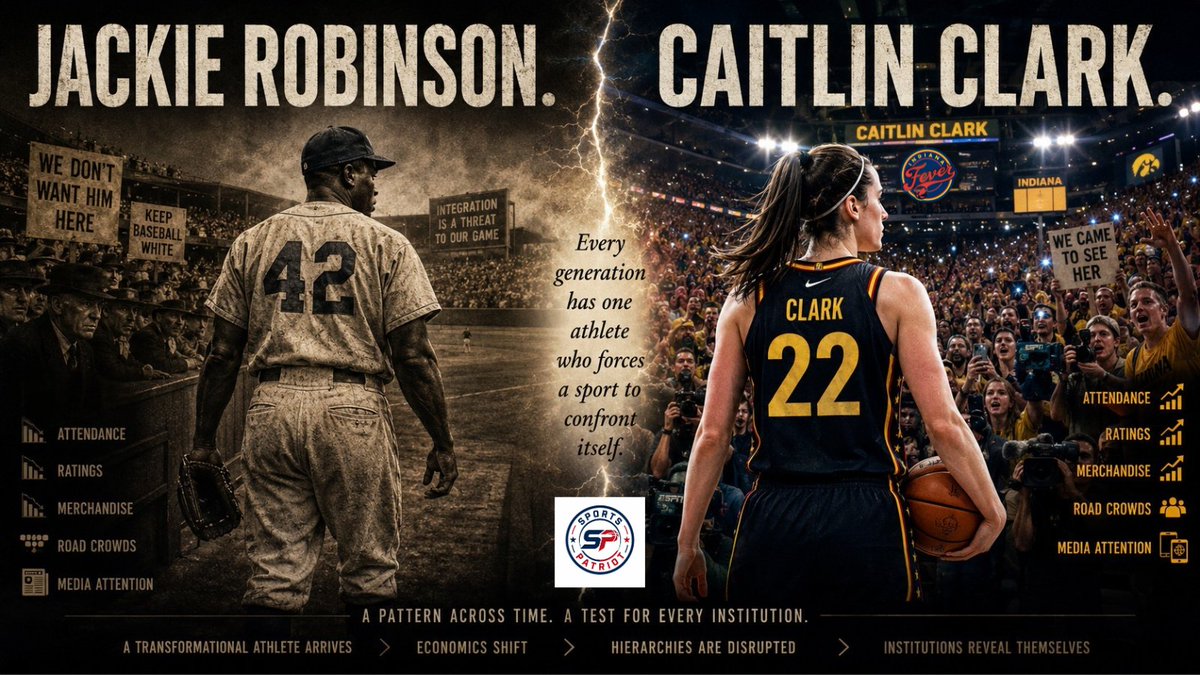
Every generation has one athlete who forces a sport to confront itself.
Not because they're simply great.
Because they become impossible to ignore.
Jackie Robinson did it to baseball.
Caitlin Clark is doing it to women's basketball.
When Jackie Robinson arrived, he didn't just challenge pitchers.
He challenged an established order.
The resistance wasn't merely about baseball.
It was about who belonged.
Who deserved the spotlight.
Who got celebrated.
Who controlled the story.
Now fast forward nearly eighty years.
The WNBA has never had a player who changed its business overnight the way Caitlin Clark has.
Attendance.
Television ratings.
Merchandise.
Corporate sponsorships.
Road crowds.
Media attention.
Every measurable business metric moved.
Yet something else moved too.
Resistance.
Not just from fans.
Not just from media.
From inside the sport itself.
Here's where the conversation becomes uncomfortable.
When we analyze Jackie Robinson, race is considered essential to understanding the reaction he faced.
When we analyze Caitlin Clark, many insist race should not even be discussed.
Why would we use two different standards?
No, the historical circumstances are not the same.
But why should race automatically be central in one conversation and automatically be forbidden in the other?
If Caitlin Clark were a different race or had a different sexual preference, would the conversation surrounding her treatment look exactly the same?
None of us can answer that with certainty.
But pretending the question itself is illegitimate is avoidance.
The interesting similarity between Robinson and Clark isn't the reason for the hostility.
It's the pattern.
A transformational athlete enters an established culture.
That athlete immediately becomes larger than the sport.
The economics change.
The attention shifts.
Existing hierarchies are disrupted.
Some embrace the change.
Others resist it... even when the change benefits everyone financially.
History doesn't repeat itself.
But human nature often does.
Maybe that's the real lesson both stories share.
Now let's look at the pattern.
Not one incident.
Not one hard foul.
Not one controversial opinion.
The accumulation.
The greatest economic catalyst in league history is left off the Olympic team.
The player driving record television ratings and attendance is omitted from the league's 30th anniversary promotional artwork.
Repeated physical plays... some occurring well away from legitimate basketball action... become national stories.
Former players and television personalities repeatedly minimize her impact. Some have argued the league no longer needs Caitlin Clark now that she has "brought the eyes."
Each event, viewed in isolation, can be explained.
Maybe the Olympic roster was about experience.
Maybe the promotional artwork had another creative direction.
Maybe every hard foul was simply part of basketball.
Maybe every television analyst is offering an honest basketball opinion.
Those are all possible explanations.
But many fans aren't reacting to isolated events anymore.
They're reacting to the pattern.
That is why so many people have begun asking uncomfortable questions.
Not because they know the answer.
Because the same answer seems to appear regardless of the question.
When every controversy consistently moves in one direction, people naturally begin searching for a common explanation.
Some conclude the resistance is rooted in jealousy.
Others believe it is about protecting an established hierarchy.
Others see generational resentment.
Others see race.
Others see sexuality.
Others see some combination of all of the above.
The point is not that one explanation has been proven.
The point is that these explanations exist because the pattern exists.
Sports fans have always accepted disagreement.
What they struggle to accept is inconsistency.
If Caitlin Clark's impact is unprecedented, why is acknowledging that impact so controversial?
If she is the league's biggest financial success story, why does recognition of that success seem to divide people rather than unite them?
Those are questions worth asking.
Not because the answers are simple.
But because history has shown us that transformational athletes rarely expose only weaknesses in their opponents.
Sometimes they expose unresolved tensions within the institutions themselves.
Every generation has one athlete who forces a sport to confront itself.
Not because they're simply great.
Because they become impossible to ignore.
Jackie Robinson did it to baseball.
Caitlin Clark is doing it to women's basketball.
When Jackie Robinson arrived, he didn't just challenge pitchers.
He challenged an established order.
The resistance wasn't merely about baseball.
It was about who belonged.
Who deserved the spotlight.
Who got celebrated.
Who controlled the story.
Now fast forward nearly eighty years.
The WNBA has never had a player who changed its business overnight the way Caitlin Clark has.
Attendance.
Television ratings.
Merchandise.
Corporate sponsorships.
Road crowds.
Media attention.
Every measurable business metric moved.
Yet something else moved too.
Resistance.
Not just from fans.
Not just from media.
From inside the sport itself.
Here's where the conversation becomes uncomfortable.
When we analyze Jackie Robinson, race is considered essential to understanding the reaction he faced.
When we analyze Caitlin Clark, many insist race should not even be discussed.
Why would we use two different standards?
No, the historical circumstances are not the same.
But why should race automatically be central in one conversation and automatically be forbidden in the other?
If Caitlin Clark were a different race or had a different sexual preference, would the conversation surrounding her treatment look exactly the same?
None of us can answer that with certainty.
But pretending the question itself is illegitimate is avoidance.
The interesting similarity between Robinson and Clark isn't the reason for the hostility.
It's the pattern.
A transformational athlete enters an established culture.
That athlete immediately becomes larger than the sport.
The economics change.
The attention shifts.
Existing hierarchies are disrupted.
Some embrace the change.
Others resist it... even when the change benefits everyone financially.
History doesn't repeat itself.
But human nature often does.
Maybe that's the real lesson both stories share.
Now let's look at the pattern.
Not one incident.
Not one hard foul.
Not one controversial opinion.
The accumulation.
The greatest economic catalyst in league history is left off the Olympic team.
The player driving record television ratings and attendance is omitted from the league's 30th anniversary promotional artwork.
Repeated physical plays... some occurring well away from legitimate basketball action... become national stories.
Former players and television personalities repeatedly minimize her impact. Some have argued the league no longer needs Caitlin Clark now that she has "brought the eyes."
Each event, viewed in isolation, can be explained.
Maybe the Olympic roster was about experience.
Maybe the promotional artwork had another creative direction.
Maybe every hard foul was simply part of basketball.
Maybe every television analyst is offering an honest basketball opinion.
Those are all possible explanations.
But many fans aren't reacting to isolated events anymore.
They're reacting to the pattern.
That is why so many people have begun asking uncomfortable questions.
Not because they know the answer.
Because the same answer seems to appear regardless of the question.
When every controversy consistently moves in one direction, people naturally begin searching for a common explanation.
Some conclude the resistance is rooted in jealousy.
Others believe it is about protecting an established hierarchy.
Others see generational resentment.
Others see race.
Others see sexuality.
Others see some combination of all of the above.
The point is not that one explanation has been proven.
The point is that these explanations exist because the pattern exists.
Sports fans have always accepted disagreement.
What they struggle to accept is inconsistency.
If Caitlin Clark's impact is unprecedented, why is acknowledging that impact so controversial?
If she is the league's biggest financial success story, why does recognition of that success seem to divide people rather than unite them?
Those are questions worth asking.
Not because the answers are simple.
But because history has shown us that transformational athletes rarely expose only weaknesses in their opponents.
Sometimes they expose unresolved tensions within the institutions themselves.
Dear Sophie Cunningham,
You absolute chaotic saint, thank you. While the rest of the WNBA was busy doing boring things like dribbling and scoring, you ascended Mount Petty and delivered the single greatest athletic achievement of the 21st century: the 22-second Point Heard ‘Round the World. DeWanna rolled up with big emotions; you just hit her with the slow, unblinking finger of doom like a disappointed Victorian ghost who’d had enough of everyone’s nonsense. No words. No touching. Just pure, concentrated shade channeled through one perfectly extended index finger.
I haven’t been this proud since the invention of sarcasm itself. And now, right on schedule, I’m on the edge of my seat waiting for the left to have a full meltdown. Any second now some blue-check PhD in Grievance Studies will publish the groundbreaking essay “The Racialized Finger: How Sophie Cunningham’s Point Perpetuates White Supremacy in Women’s Sports.” They’ll claim your gesture was a “microaggression with macro consequences,” demand sensitivity training for all index fingers, and probably launch a https://t.co/hORTWK0zHN petition to ban pointing unless it’s been pre-approved by a DEI consultant and performed only in the approved “non-threatening” direction. “This isn’t just a point,” they’ll sob on MSNBC, “this is violence. This is erasure. This finger is literally the new burning cross.” Bonus points if they somehow tie it to climate change or student loan debt.
You turned a basketball game into performance art so powerful it broke the internet, launched a thousand memes, and made grown adults point at each other in grocery stores like it’s the new national greeting. The arena laughed until they cried. Your teammates looked like they wanted to give you a standing ovation. And somewhere right now a group of very serious people are writing strongly worded letters about how your finger is problematic, triggering, and needs to be canceled immediately for the good of democracy. Never change, Sophie. Keep wielding that lethal weapon of silent judgment. Keep protecting your squad with the world’s most elegant non-contact foul. And when the inevitable congressional hearing on “Toxic Pointing” begins, just walk in, look every senator dead in the eye, and give them the treatment they so richly deserve. We’re all out here practicing in the mirror like idiots, rewatching the clip on loop, and loving every glorious second of the mayhem you unleashed. This point didn’t just go viral, it went legendary. With breathless, slightly unhinged admiration and oceans of affectionate sarcasm.
An Open Letter to WNBA Commissioner Cathy Engelbert
Dear Commissioner Engelbert,
This is no longer incompetence.
This is negligence.
You were handed the greatest gift the WNBA has ever received, and you are finding new ways to squander it.
For nearly 30 years, the WNBA has struggled to stand on its own merit. It has needed patience, protection, subsidies, excuses, advocacy, and endless goodwill. The league has been treated less like a professional sports product and more like a cause people were expected to support out of obligation.
Then Caitlin Clark arrived.
She was not just a star.
She was the lottery ticket.
She brought the audience. She brought the ratings. She brought the sold-out arenas. She brought fathers and daughters. She brought casual fans. She brought sponsors, road crowds, national television attention, and cultural relevance the WNBA had been chasing for decades.
She made people care.
And under your leadership, the WNBA has responded by acting uncomfortable with the very thing it begged the sports world to give it.
That is the failure.
You are not just mishandling Caitlin Clark.
You are mishandling the future of the league.
The WNBA wants her ratings but not her reality.
It wants her ticket sales but not her protection.
It wants her relevance but not her responsibility.
It wants the money she brings while acting annoyed by the fans she brought with her.
That is not leadership.
That is doubling down on stupid.
Let’s be very clear about what just happened.
A player made reckless, non-basketball contact to Caitlin Clark’s throat area while she was vulnerable on the floor.
The throat is not a shoulder.
It is not a hip.
It is not a forearm.
It is the airway. The larynx. The trachea. The structures that allow a person to breathe, speak, swallow, and get oxygen.
Contact to that area can become a medical emergency fast.
The WNBA got lucky.
That is the sentence.
The WNBA got lucky Caitlin Clark got up.
Because if that contact had caused a serious airway injury, a breathing emergency, a collapse, or something worse, nobody would be talking about “physicality” today.
They would be talking about how everyone saw this coming.
And they would be right.
You should have known better.
The league should have known better.
The officials should have known better.
The players should have known better.
The coaches should have known better.
And you, Commissioner, should have acted like the person responsible for making sure it never gets to that point.
Instead, the league reviewed the play, admitted enough to upgrade it, called it reckless, called it a non-basketball act, and responded with one game and a $1,000 fine.
One game.
For contact to the throat area of the most important player in your league.
That was an insult.
That was the WNBA admitting the act was dangerous, then punishing it like it was an inconvenience.
You did not send a message that player safety matters.
You sent a message that the WNBA will wait until something catastrophic happens before it grows a spine.
And if that day comes, the liability will not arrive quietly.
It will come with a very large “we told you so” attached to it.
Because fans have been telling you.
Basketball people have been telling you.
The video has been telling you.
The pattern has been telling you.
Caitlin Clark has been grabbed, bumped, shoved, poked, face-guarded, knocked down, crowded, tested, and hit while your league keeps hiding behind the word “physicality.”
Physicality is basketball.
Reckless contact is not.
Cheap shots are not.
A fist to the throat area is not.
And every time your league responds weakly, every time your officials miss it, every time your media partners minimize it, every time players mock the outrage, and every time your office stays too quiet, you are teaching the league exactly what it can get away with.
That is how standards collapse.
That is how trust dies.
That is how lawsuits are born.
You have an obligation to protect the players in your league.
Not just the players who fit the league’s preferred identity.
Not just the players the old guard approves of.
Not just the players whose fame makes everyone comfortable.
All of them.
Especially the player who has done more to grow the WNBA than anyone in its history.
This is not about Caitlin Clark needing special treatment.
This is about Caitlin Clark not receiving basic protection.
That distinction matters.
The WNBA does not protect stars because they are fragile.
Serious leagues protect stars because the product matters, player safety matters, and the future of the business matters.
The NBA understood this.
The NFL understands this.
Major sports leagues understand that when a generational athlete changes the economics of the sport, you do not allow resentment, weak officiating, cheap shots, and petty narratives to swallow the opportunity.
You are not protecting the game.
You are managing optics.
And you are not even doing that well.
The commissioner’s job is not to hide until the storm passes.
The commissioner’s job is to lead before the storm becomes a disaster.
Right now, the WNBA looks small, bitter, reactive, and unserious.
That is on you.
The officiating looks unprepared for the moment.
That is on you.
The discipline looks weak.
That is on you.
The league’s biggest star looks isolated.
That is on you.
The media narrative around Caitlin Clark has been allowed to become poisonous, dishonest, and dismissive.
That is on you.
The WNBA was handed the golden opportunity women’s basketball had been waiting on for decades, and instead of building around it with urgency, gratitude, and professionalism, the league keeps acting like Caitlin Clark is a problem it has to survive.
She is not the problem.
She is the proof of concept.
She proved the audience exists.
She proved the money is real.
She proved people will watch.
She proved women’s basketball can be mainstream, debated, emotional, commercial, and fun.
And your league is proving it may not be mature enough to handle what she proved.
That is the brutal truth.
Commissioner Engelbert, you are now on notice.
Not as a legal phrase.
As a public one.
The whole sports world can see this.
If Caitlin Clark gets seriously hurt because your league refused to establish a real standard, nobody gets to act surprised.
Nobody gets to pretend this came out of nowhere.
Nobody gets to say the warning signs were not there.
They are everywhere.
Fix the officiating.
Punish dangerous conduct like it is actually dangerous.
Stop letting players disguise reckless behavior as toughness.
Stop letting media voices gaslight fans who know exactly what they are watching.
Stop treating Caitlin Clark’s fanbase like a nuisance while cashing the checks her attention creates.
Stop hiding behind statements that say nothing.
And stop confusing silence with leadership.
The WNBA spent nearly 30 years asking to be taken seriously.
Caitlin Clark made that possible.
Now you have to decide whether you are going to protect the player who made the league bigger or keep letting the league act like she is the inconvenience.
Because if the WNBA cannot protect Caitlin Clark, it cannot be trusted with the future she brought it.
And if you continue to mishandle this, history will not remember you as the commissioner who inherited the Caitlin Clark era.
It will remember you as the commissioner who wasted it.
Sincerely,
A fan who is tired of watching the WNBA endanger its golden opportunity.