Interview w/ The Smartest Kid in the World: Deng Mingyang (邓明扬)
2nd year PhD student in MIT under He Kaiming (何恺明)
ICPC Gold medal 🥇 (1st place)
Putnam Fellow (Top 5)
IOI Gold Medal🥇 (1st place)
IMO Gold Medal🥇
Translated interview here: https://t.co/zKF3O826Lz
A new spider species from the genus Rathalos has been officially described from Java Island by the Species Obscura research team, including @KalaKemangga and Restu Dwikelana, and Prof. Purnama Hidayat from Plant Protection of IPB University.
*deep breath*
> When I was four, my mom had me trial the Stanford Marshmallow Experiment. You may have heard of it. From Wikipedia:
> The Stanford marshmallow experiment was a series of studies on delayed gratification in the late 1960s and early 1970s led by psychologist Walter Mischel, then a professor at Stanford University. In these studies, a child was offered a choice between one small reward provided immediately or two small rewards if they waited for a short period, approximately 15 minutes, during which the tester left the room and then returned. In follow-up studies, the researchers found that children who were able to wait longer for the preferred rewards tended to have better life outcomes, as measured by SAT scores, educational attainment, body mass index (BMI), and other life measures.
> My mom, who had read every child psychology book in the game, brought me to a quiet room, sat me down at a desk, and placed a lone marshmallow on a plate in front of me. She told me that I could eat the mallow immediately or I could wait fifteen minutes and receive another. She left the room and watched from a window outside.
> According to Dr. Mischel, there is tremendous variety in how children distract themselves from temptation. Some children "cover their eyes with their hands or turn around so that they can't see the tray, others start kicking the desk, or tug on their pigtails, or stroke the marshmallow as if it were a tiny stuffed animal." A few "can be brilliantly imaginative about distracting themselves, turning their toes into piano keyboards, singing little songs, exploring their nasal orifices."
> My mom says that when I took the Stanford Marshmallow Experiment I sat in my assigned chair, staring at the treat, not playing and not moving, for the fifteen minutes until she returned.
> The experiment is often touted as a test for "delayed gratification" or "willpower." In an interview with The Atlantic, Dr. Mischel is hesitant to endorse this interpretation.
> Q: Could waiting be a sign of wanting to please an adult and not a proxy for innate willpower? Presumably, even little kids can glean what the researchers want from them.
> Mischel: Maybe. They might be responding to anything under the sun.
> I'm not convinced that the Stanford Marshmallow Experiment tests for anything even remotely resembling "innate willpower," because waiting fifteen minutes for a single marshmallow is a stupid thing to do. The opportunity cost of wasting fifteen minutes is way greater than the utility of one marshmallow. My mom has a sweet tooth—it's not like the marshmallow was a rare treat in my otherwise Dickensian life—and I'm more of a Reese's peanut butter cup guy anyway. From The Atlantic:
> Mischel: ...in the studies we did, the marshmallows are not the ones presented in the media and on YouTube or on the cover of my book. They were these teeny, weeny pathetic miniature marshmallows or the difference between one tiny, little pretzel stick and two little pretzel sticks, less than an inch tall. It’s really not about candy. Many of the kids would bag their little treats to say, “Look what I did and how proud mom is going to be.”
> You could have all the willpower in the world and still decide that you don't want to wait around for a pretzel stick. Conversely, the experiment could have lacked any tangible reward and some kids still would have waited.
> That said, if the experiment predicts SAT scores then it's clearly testing for something. It's hard to tease out what that something is. Perhaps the delayed-gratifiers want to impress authority figures, perhaps they recognize the challenge and have some internal desire for achievement, perhaps they are simply used to doing as they are told. I'm going to sum all these motivations into The Desire To Pass Tests [1]. And it makes intuitive sense that TDTPT would predict SAT scores and number of degrees, because these are cultural tests of intelligence. It makes sense that TDTPT would predict BMI, because this is a cultural test of appearance. It makes sense that "preschool children who delayed gratification longer in the self-imposed delay paradigm were described more than 10 years later by their parents as adolescents who were significantly more competent," because parental approval is the oldest and most universal test there is.
> All of these seem like good things.
> But I think there's something ominous about a kid so eager-to-please that he sits perfectly still for fifteen minutes waiting for a marshmallow.
https://t.co/ef6DG8zuNc
One single still photo of a massive bird flock contains the full flapping animation of a single bird.
The flock is a statistical ensemble sampling every moment of the flap cycle ergodicity turns a snapshot into motion!
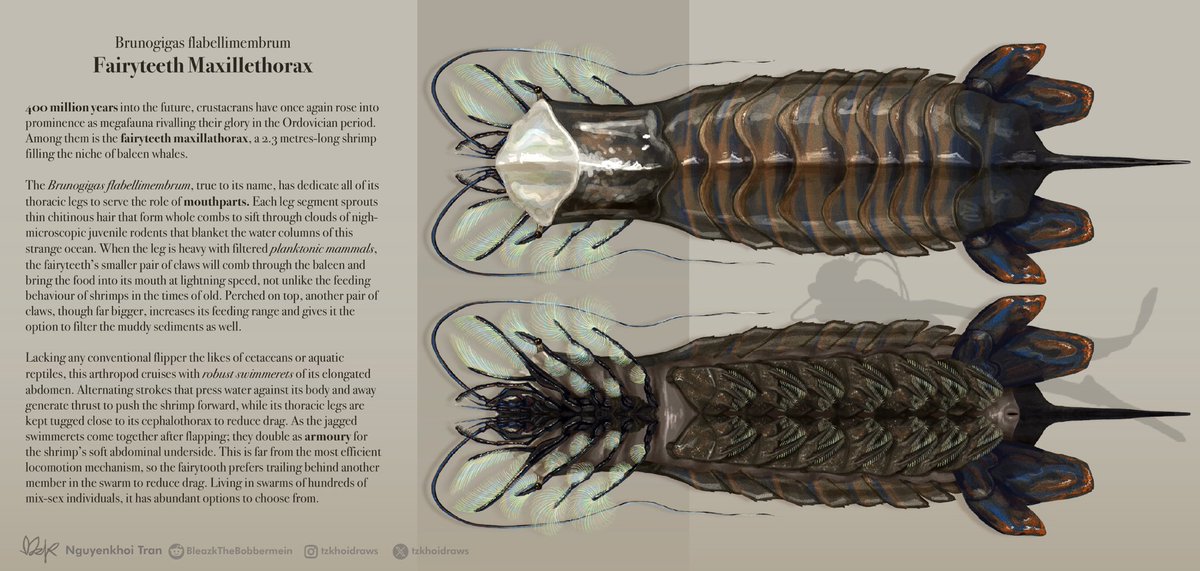
400 million years into the future, 2.3 metres-long oceanic shrimps filling the niche of baleen whales will scoop mouthfuls of planktonic rodents, marking the return of arthropod rule over the waters not seen since the Ordovician period. In this strange world, roles have reversed.
An amazing summary of electric fish diversity, showing species with marine and freshwater habitats, strong and weak electric discharges, South American and African distributions, pulse and wave type discharges, and the anatomical location of the electric organs. A masterwork.








![QiaochuYuan's tweet photo. *deep breath*
> When I was four, my mom had me trial the Stanford Marshmallow Experiment. You may have heard of it. From Wikipedia:
> The Stanford marshmallow experiment was a series of studies on delayed gratification in the late 1960s and early 1970s led by psychologist Walter Mischel, then a professor at Stanford University. In these studies, a child was offered a choice between one small reward provided immediately or two small rewards if they waited for a short period, approximately 15 minutes, during which the tester left the room and then returned. In follow-up studies, the researchers found that children who were able to wait longer for the preferred rewards tended to have better life outcomes, as measured by SAT scores, educational attainment, body mass index (BMI), and other life measures.
> My mom, who had read every child psychology book in the game, brought me to a quiet room, sat me down at a desk, and placed a lone marshmallow on a plate in front of me. She told me that I could eat the mallow immediately or I could wait fifteen minutes and receive another. She left the room and watched from a window outside.
> According to Dr. Mischel, there is tremendous variety in how children distract themselves from temptation. Some children "cover their eyes with their hands or turn around so that they can't see the tray, others start kicking the desk, or tug on their pigtails, or stroke the marshmallow as if it were a tiny stuffed animal." A few "can be brilliantly imaginative about distracting themselves, turning their toes into piano keyboards, singing little songs, exploring their nasal orifices."
> My mom says that when I took the Stanford Marshmallow Experiment I sat in my assigned chair, staring at the treat, not playing and not moving, for the fifteen minutes until she returned.
> The experiment is often touted as a test for "delayed gratification" or "willpower." In an interview with The Atlantic, Dr. Mischel is hesitant to endorse this interpretation.
> Q: Could waiting be a sign of wanting to please an adult and not a proxy for innate willpower? Presumably, even little kids can glean what the researchers want from them.
> Mischel: Maybe. They might be responding to anything under the sun.
> I'm not convinced that the Stanford Marshmallow Experiment tests for anything even remotely resembling "innate willpower," because waiting fifteen minutes for a single marshmallow is a stupid thing to do. The opportunity cost of wasting fifteen minutes is way greater than the utility of one marshmallow. My mom has a sweet tooth—it's not like the marshmallow was a rare treat in my otherwise Dickensian life—and I'm more of a Reese's peanut butter cup guy anyway. From The Atlantic:
> Mischel: ...in the studies we did, the marshmallows are not the ones presented in the media and on YouTube or on the cover of my book. They were these teeny, weeny pathetic miniature marshmallows or the difference between one tiny, little pretzel stick and two little pretzel sticks, less than an inch tall. It’s really not about candy. Many of the kids would bag their little treats to say, “Look what I did and how proud mom is going to be.”
> You could have all the willpower in the world and still decide that you don't want to wait around for a pretzel stick. Conversely, the experiment could have lacked any tangible reward and some kids still would have waited.
> That said, if the experiment predicts SAT scores then it's clearly testing for something. It's hard to tease out what that something is. Perhaps the delayed-gratifiers want to impress authority figures, perhaps they recognize the challenge and have some internal desire for achievement, perhaps they are simply used to doing as they are told. I'm going to sum all these motivations into The Desire To Pass Tests [1]. And it makes intuitive sense that TDTPT would predict SAT scores and number of degrees, because these are cultural tests of intelligence. It makes sense that TDTPT would predict BMI, because this is a cultural test of appearance. It makes sense that "preschool children who delayed gratification longer in the self-imposed delay paradigm were described more than 10 years later by their parents as adolescents who were significantly more competent," because parental approval is the oldest and most universal test there is.
> All of these seem like good things.
> But I think there's something ominous about a kid so eager-to-please that he sits perfectly still for fifteen minutes waiting for a marshmallow.
https://t.co/ef6DG8zuNc](https://pbs.twimg.com/media/HFqJ4gtaAAA69c5.jpg)