The SEND system is broke. Any teacher knows this.
Overdiagnosis
Inadequate training
Inconsistent provision
Insufficient alternative schooling places
Outdated language and perspectives
Nowhere near enough time or money
Hopefully @TomRees_77 and his team can start sorting it.
I’m hiring! Im looking for someone to help lead Robin Hood Academy on the next stage of our journey. If that sounds like you or you know anyone, please get in touch. https://t.co/qkUXw7uBe6
A short post about "Cold Call"
Cold Calling is a questioning strategy that I first read about in Teach Like a Champion 2.0. I used to use the term a lot when delivering training/INSET, but I tend to avoid it now for three reasons:
1. Some people are irrationally triggered by it as a term for political and ideological reasons
2. Lots of people think they understand it, but don't
3. TLAC includes a number of different variations, which makes it difficult to discuss and debate with people who haven't read it
For me, the key takeaways from reading and learning about Cold Call are
A. That the teacher is in complete control of who is being asked questions, and has a justification for why particular students are asked particular questions. I think there are simple rules of thumb that can help teachers make these decisions in the classroom. I wrote more about that, including the rules of thumb in these two blogs:
https://t.co/hiSOXKHPy9
https://t.co/QbD3S7W25M
B. That the teacher puts the name of the student at the end of the question, every time. This is to ensure all students are constantly paying attention, and know that they could be asked a question at any point. I wrote more about that here:
https://t.co/FKsAyoYLPQ
I'd encourage people to read TLAC and the blogs above if they have a problem with Cold Calling. It's a strategy designed to help teachers get the most out of their students in a range of lesson phases, and isn't particularly difficult to implement sensibly and sensitively. It's not rocket science, it isn't evil, and it's a guaranteed way to improve your questioning.
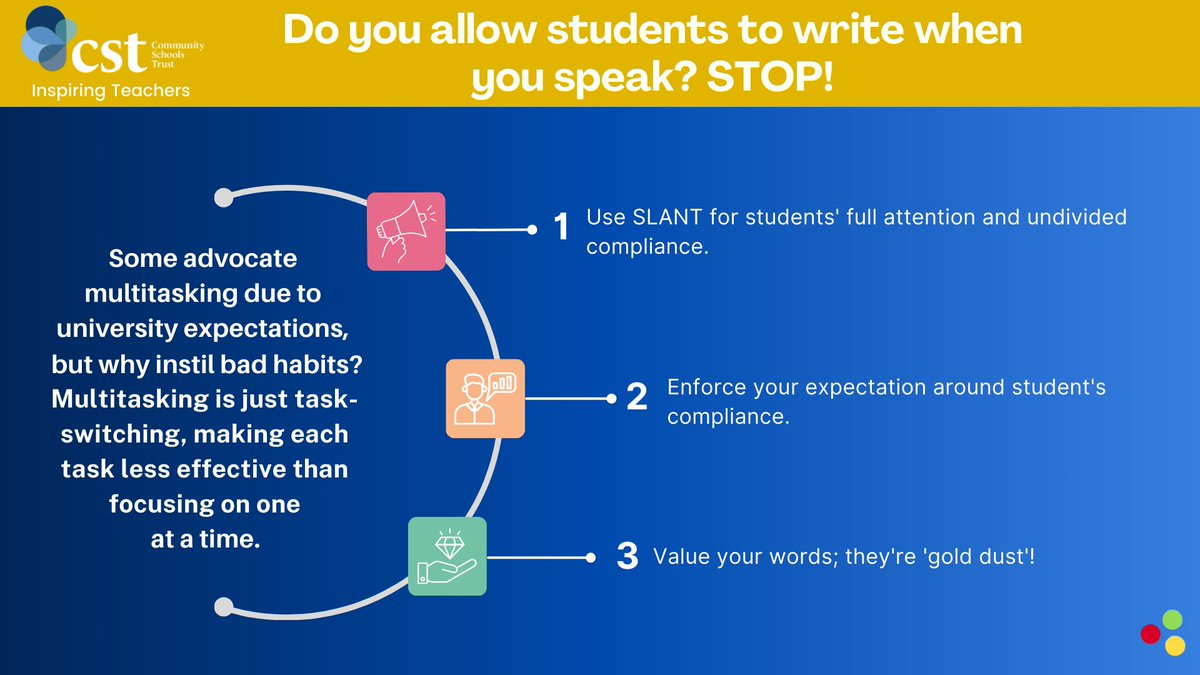
Do you allow students to write when you speak?
Yes? STOP!
Some advocate teaching multitasking due to university expectations, but why instil bad habits? Multitasking is just task-switching, making each task less effective than focusing on one at a time.
1. Use SLANT for students' full attention and undivided compliance.
2. Enforce your expectations around student compliance.
3. Value your words; they're 'gold dust'!
@CST_London
Robin Hood Academy blogs are back: https://t.co/8jCsVn5J02
Check out our blog pages for weekly updates and a snapshot of what is going on inside and outside the classroom. Parents/Carers and pupils can filter by class, teacher and activity.
“The natural response to stressful situations is not trauma but resilience. Most people are, by default, able to cope without suffering long-term consequences. This is important because assuming that people are traumatized when they aren't can actually risk traumatizing them.”
I’m speaking at the @TeachFirst Heads Forward Leadership Summit this weekend. I’m hosting a discussion about diving headfirst into school leadership in my session “new head, new school, new phase: taking the plunge”.
The parents' movement to roll back the phone-based childhood just launched, spontaneously, in the UK. Parents are fed up and linking up to solve the collective action problem:
https://t.co/PYTZm9M70R
In the past, I’ve been told to
“F**k off” for upholding a school mobile policy
I’ve been barged (twice) by the same student for upholding a school uniform policy.
I was told by a senior leader I was more consistent in applying the school policy compared to them.
Systems and routines are key to successful schools and they have to be followed consistently by ALL.
Letting a student off or turning the other way can have a big impact on other staff.
Visible leadership is also crucial to support the systems and routines.
In schools where smartphone use is already commonplace, total bans are almost always unenforceable. We need more than this guidance document, we need legislation. A tobacco style regulatory framework for smartphones for children would help!
I like idea of total ban but practically I don’t see how. Search ALL pupils? 600? 2000? If 10% refuse to hand over phones? Internal isolation? Where? How long? Who supervises? How long it take to search 2000 pupils? Even 600? Who does it? Once searched where kids go? Complex.
Although the Feb gov guidance on mobile phones in schools is a step in the right direction, it does not go far enough.
Smartphone addiction is harmful. We need a tobacco-style regulatory framework for smartphones.
The Government’s ‘ban’ on phones is logical. But will it tackle the key issue students, schools and parents face?
Sadly not; and here’s what they should do instead. Take a look.
The mobile phone ban in schools is the solution to the wrong problem https://t.co/CUBQPKbsM9
Smartphones are an amazing tool but unregulated access can be dangerous for the health of our young people. Our headteacher has therefore called on the government to take further decisive action to curb smartphone addiction for young people.
https://t.co/JcZDplcurN