i am not sure i completely follow the logic
it seems the purpose of prio fees is for the case of x asset popping 10 bps in one tick, the person who is able to hit the stale quotes first is able to extract 10 bps - taker fee (~1.7 bps). prio fees would allow that to be 10 bps - max prio fee (~8 bps - 100%) in this case and extract more surplus from the latency arbitrageur and pass it onto the venue. so i am not sure why the tam would be larger rather than smaller than the previous state. i also reject the idea that bidding in a mev search context is isomorphic to bidding in a latency arbitraging btc context. hidden for the former and known for the latter.
furthermore, with queue priority prio fees (maker) it seems the purpose is also just to extract more surplus from mms and pass it onto the venue. given the ratio of size at touch to median trade size (avg hl median ~$250k quote, ~$100 trade size), the utility of being second in queue is closer to last than first. in traditional fifo, being first in queue has utility in and of itself, because the option to hold your quotes until suboptimality > edge is discretionary, not forced. with queue prio bidding it allows players to bid this surplus to 0.
it seems the core purpose of these changes is to add quasi dynamic fees so maker/taker surplus is lower during volatility. so, i am not sure how this is well suited for ppl with mev backgrounds, or a surplus tam growth story. but i do not have much hl exp so i could be wrong.
i agree, but i would say a speedbump (~100ms) "lowers" adverse selection, but it doesn't remove it (1s-10s forecasting, ~fair is somewhat opaque etc). currently their revenue is a function of the maximum # they can extract from takers on the platform. however, when it comes to short term uninformed trades they ~generally are not hyperprecise about fill quality, and do a crude heuristic of ~fill vs mark which isn't fully representative of fill quality (lack of nbbo is a big factor here). this imprecision allows one to extract valuable ~tenth of bps that can provide non trivial topline revenue on high volume symbols. my core gripe is the misleading nature of stating one is making this decision for noble reasons, rather than it is neg ev long term for their revenue without some absurd speedbump (~1s). a basic case is looking at rpi vs non rpi markouts to see the ev of providing liq to api vs ui traders.
i completely disagree with this framing. you are defining "signal" in binary terms, when a more useful framing is the difficulty spectrum of extracting a signal (i.e. tarnished vs quality is a false binary). obviously, you cannot look at naive high level metrics to proxy product quality with a 0 fee venue. however, even a naive approach akin to just mapping the similarity in flow / maker behavior on your venue vs leading venues in the space would give you rich information even with high level metrics distorted. the "signal will be discretely tarnished if there are incentives" is purely a philosophy masquerading as reason.
maybe, but i would claim it is just a mistake. the perps infra of any perp dex that exists is more of a commodity than polymarket's current distribution. i would also claim that the most valuable flow has a very low bar you have to hit for quality before it is "good enough". on top of that it is easier for bigger mms to integrate when they take counterparty risk of only polymarket, not polymarket + some underlying dex.
@mattbcapital i would make the claim that wsb as we know it would not exist if you swapped 0dte with perps. if you were to make a gambling instrument from first principes, you would use convexity rather than levered linearity.
do you think hl is the final form factor of perps? it may seem pedantic, but hl is ~4000x slower than cme (~50 micros vs 200k micros hl per docs). there is really no path to sub-ms on a blockchain, and tradfi latency is non-stationary. within current paradigms, custom architectures could take us down to low micros, and new paradigms can take us to ~mid picos within this century (cme cloud stuff i have the same anti innovation critique)
is decentralization really worth worse performance than tradfi, essentially forever? and is decentralization even what people actually care about, or is it reflexive a post-ftx + reg arb landscape that we've just kind of landed in? is the core idea of hl decentralization or transparency if we had to do a lookback from beginning of mainnet to today?
looking out 100 years, is crypto fine with always having orders-of-magnitude worse performance? it feels anti-innovation to let something with fundamentally worse performance become the perceived end state, especially if you think of an exchange as a substrate to better enable capital efficiency across the world, rather than a gambling playground for group x to extract from group y. if you look around there are clear suboptimalities littered everywhere because of sunk costs and the imperfections of capitalism. ideally this wouldn't be another instance of that.
i'm pretty sure it's a bit more nuanced. $50b → therefore they can only trade ultra liquid doesn't quite make sense; ashler, surveyor, etc trade mid caps all the time (cit spin-offs like alyeska/holocene top pms run decent size compared to cit pods too), and cit/p72 have hundreds of pms/people running sleeves.
i think pure oil attribution is also a bit of a red herring because of surface area, most likely a factor degross / crowding and some multi managers were netted the wrong tilts. all whiplashes don't cause this type of performance, but tbf could be wrong
much of 10/10 was driven by "reckless" net exposures on a venue basis because one's global was hedged. there is an argument that being net x long on a venue is not reckless, but black swans will punish you either way (and it only takes one venue idiosyncrasy to cause the entire global view to collapse). moreover, top mechanical mms on btc/eth on top cexs had a much different experience than mms who quote lower tier alts, are further away from price discovery, and depend on liquidity porting.
it also seems as if ltrd's point is rather orthogonal to 10/10. his claim derived from looking at the top 10% of volatile days, seeing the collapsed metric was worse, and made the implication that mms should widen and step back during these periods more than they currently do. i would make the claim one can believe saying mms should pull back more during these periods is a logical fallacy and also believe that during the largest liquidation event ever one should pull.
i unequivocally disagree with the claim of "makers need to scale down, widen spreads, or step back during high-volatility periods … weekend should be free of some part of sophisticated, institutional traders and because of that, we can see better markouts."
lets define liquidity provider as anyone who has a limit order. under higher volatility, there is increased dispersion in edge, but adverse selection is ~boundless while liq provision edge is bounded. using a collapsed term gives you an extremely misleading view of these dynamics. the quoted argument seems to make the implication that the weaknesses of averaging every limit order aren't exaggerated with volatility, which is a strange assumption.
imagine the case of a 1s p1 mkout in low volatility of -5 bps vs a 1s p1 mkout in high volatility of -50 bps. if we assume the worse liquidity providers are the dominant receivers of adverse selection on the most extreme moves, the average of all becomes more misleading with higher volatility because they begin to dominate the sample in proportion to their economic relevance. there's also the reasonable extrapolation that getting filled for bigger size implies more adverse selection on average (e.g. if you sorted your fills from smallest to largest, the bottom 50% would be less adverse because on adverse moves you usually lose your entire quote). this causes worse liquidity providers to be overrepresented in volume and in markouts relative to their economic relevance during higher volatility. without decomposition of these factors one could make false implications about market making in high/low volatility periods.
moreover, i disagree with the framing of weekends having better markouts because of "less instis." the reason this collapsed metric becomes better on weekends is because the left tail becomes thinner. this thinness comes from weekends having less spillover from macro/major equity markets.
this isn't to say market making isn't hard, i believe it's very hard! but i believe it's hard because there aren't enough high volatility events, not because there are too many. (obv supply comes into play here too)
i would argue so, and i think the fallacy derives from thinking in linear space.
imagine the scenario where avg markouts for mechanical mms on btc/eth is +0.05 bps, a person who is a bit price insensitive and leaning their quotes to hedge could be -0.5 bps (10x impact per $), or a mid freq firm that has a longer term view could be -1 bps (20x impact per $), or manual traders using a terminal using chase limit to save on taker fees -4 bps (80x impact per $). a very small % of maker volume from these groups, such as 2%, could cause outsized impact on the conclusion one would make from looking at the data naively.
i may have been imprecise in my original critique, causing me to get grouped into more generic rfq critiques, and that is my mistake.
my core claim is that price discretion is the primary driver of tighter quoting, not porting cex liq
1: this is the exact mechanism where price discretion enables tighter spreads. imagine the case of an order with a slippage limit at 0, and they send an intent that would cause a toxic fill to the olp. the olp would be able to see this, give a worse price, and cause the intent to fail due to slippage params. this gives the liquidity provider a direct way to filter out toxic flow and quote tighter from discretion over price.
moreover, 0 slippage seems a bit like a straw man. while i don't have exact # on the distribution of slippage params used, if we assume 0.2 bps is a realistic slippage param people would use for majors, most mechanical mms on btc/eth entire profitability rests on +-0.2 bps. having discretion on that range would give mms much more confidence to quote tighter, much more so than having sourced cex liq.
2: this seems somewhat orthogonal. my critique is on accurate attribution, not a general critique of rfq
3: slippage transparency would be great, but i still believe attribution comes from price discretion. i think we can both agree it is incomplete framing to paint it as multi venue porting.
there is also another axis of "last look" type structures being more advantageous on non price discovery venues than price discovery ones. a liquidity provider has much lower accuracy / harder tradeoffs determining if a trade is toxic when they are providing liq on the leading venue.
i think it is completely fine to say we are able to provide tighter spreads through having complete price discretion on what we decide to provide/reject based on users' slippage params, but attributing it to porting cex liquidity is misleading.
the way you are arguing your viewpoint is completely logicless
you only need ~50 bps of 14d maker volume for maker rebates on hl, it isn't staking gated.
if you are a decent mm anywhere you can get a trial with binance, this isn’t some ~50m of capital gate.
(as a lighter bull) lighter is prob one the worst place to mm if you have a finite # of venue integrations because benefit given to mms are the lowest. it is honestly only taker speedbump, everything else makes it harder if you quote mechanically on majors.
i feel like there is a 0% chance that your single venue exchange calculated (iffy calc at that) is the sharpe you care about? that seems absurd.
also house edge is unarguably orthogonal to mm attractiveness. gto is extraction from takers and passing to makers, any deviation from that is increasingly suboptimal for the maker. which can be fine from a biz pov, but seems strange to conflate the retail fee <-> mm dynamic.
i generally disagree with both of the framings above and find it doesn't claim anything super useful.
mm pnl at competitive equilibrium is extremely episodic and driven by the delta of the top and lower tier mms. days to weeks of pnl are made in hours, so any specific sample can incorrectly weigh what you are trying to measure. moreover, another issue is that a large percentage (majority) of toxic fills come from other mms as takers, so defining profitability purely through the lens of making versus taking is somewhat misleading.
additionally, taking the markouts of all limit orders on a venue is an overly naive approach. mid freq firms with middling execution, fee sensitive but price insensitive limit orders, and low tier mms skew this extremely heavily. a simple mental model is: who do we think drives informed flow on btc/eth on a non binance venue? the vast majority is just latency arb based on a binance move, most of the losses in mm ... just comes from other mms.
obviously, mm isn't free lunch, but it seems none of the shorthands you guys proposed really justify that claim.
i generally disagree. proxying mm profitability is always somewhat crude from a single-venue pov, but longer-term markouts become more noisy because you’re assuming they’re holding deltas for longer and longer horizons.
at least with <15s markouts there’s some grounding in knowing you’re actually proxying flow quality.
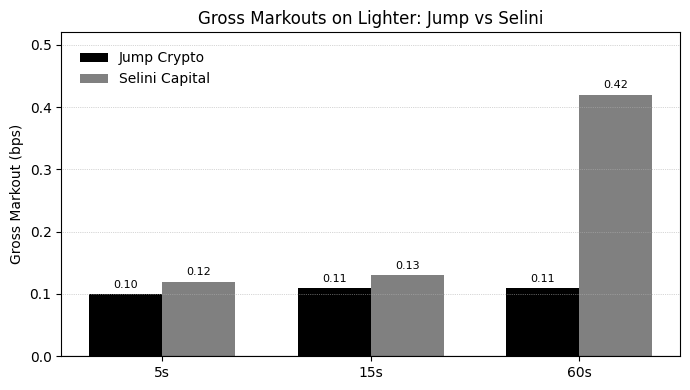
BTC markouts for Jump Crypto and Selini Capital from Jan 1st–5th on Lighter. Markout is defined as execution price to mid-price t seconds in the future. (1/6)
@max_holloway@Lighter_xyz@vnovakovski btc maker mid dec -> early jan
jump ~18.1%
selini ~12.4%
btc generally has the longest tail of mms of any symbol, so numbers are a bit less concentrated.
yeah makes sense. i don’t think they are completely neutral in any way. i just think it makes more sense to give out points deals rather than fee deals because if they give out fee deals the points will have no value due to lack of revenue. this is under the assumption they are hard-set on giving out deals to mms.