Evidence-Based Facts about SLEEP Everyone Should Know
Misconceptions about sleep are common. In this thread, I discuss evidence-based facts about sleep. Bookmark for future reference and repost for wider reach.
1/12
How much sleep do adults need?
✅Most adults need 7–9 hours of sleep per night.
🔸Some function well with slightly less or more, but regularly sleeping <6 hours or >9–10 hours is associated with adverse health outcomes.
@airtelindia@Airtel_Presence Also, in this age of optic fiber, Airtel continues to offer copper wire based broadband in my locality. Feels like stone age wrt Airtel when even local players offering optic fiber based broadband in my locality.
Hi @airtelindia . My wifi broadband 052224770635_dsl is out of order since 18th June. Service request 11032944408 is being assigned to a new person every day but problem not resolved yet. Highly unprofessional customer service.@Airtel_Presence
Dear @LMC_Lucknow Team. After every rainfall this season, my house is surrounded by rainwater overflowing from jammed naali outside. Already lodged 2 complaints with no. 250623154256772913, 250623153667509775 through LMC helpline. Request for quick action.
Dear @suez India team in Lucknow. Facing severe water logging issue around my house in Aliganj Lucknow for last many days due to blocked sewer. Lodged complaint C2024056090. Kindly attend to it urgently.
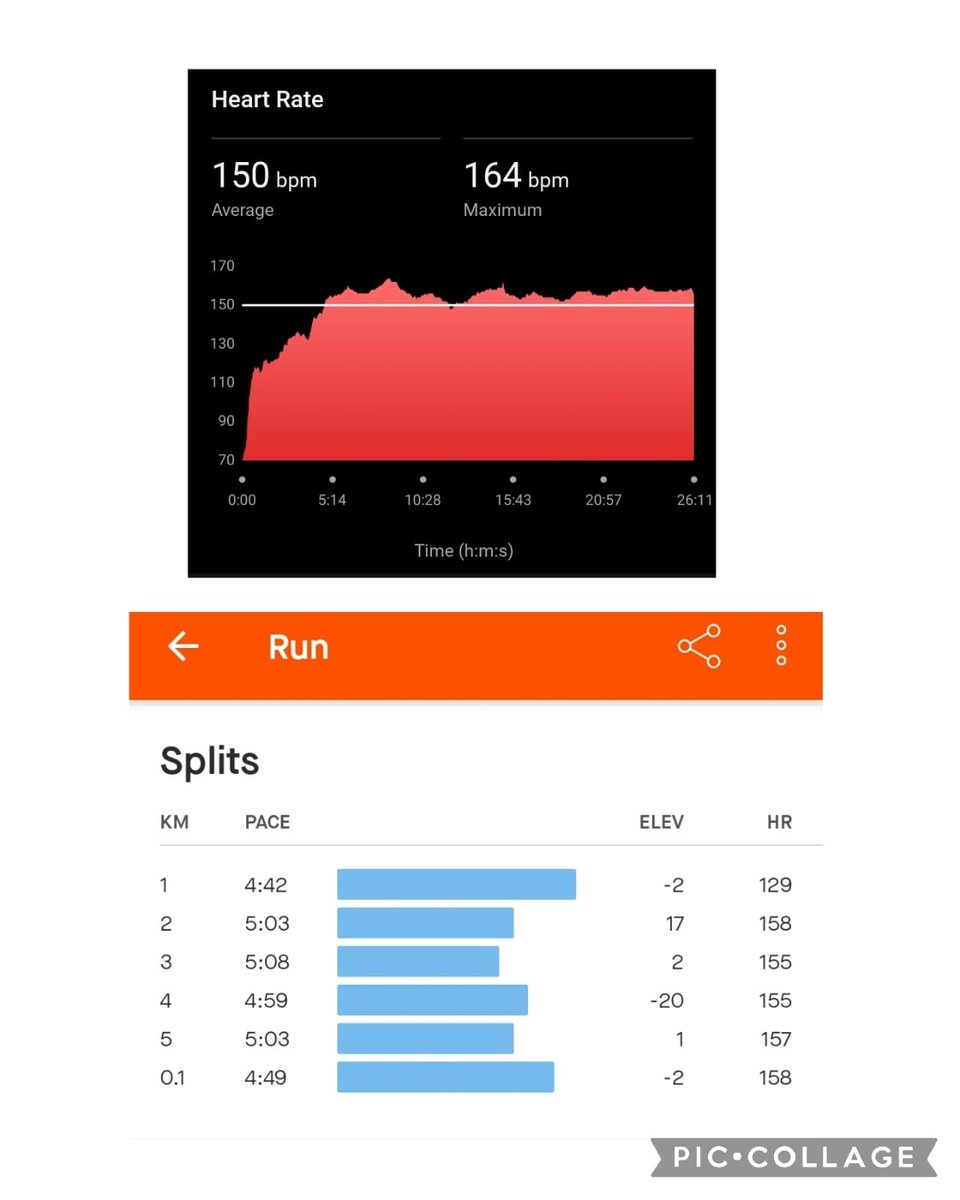
Enjoyed a 5k run this morning, organized by AINU hospital, Hyderabad to promote fitness among doctor community (along with the larger general community).
The icing on the cake was first prize (iphone 15) won by @rashmi_sudhir4 among women.
It was nice meeting a number of fellow runners.
#running #fitness @FitIndiaOff
Which Cooking Oils Should You Use?
I hope to untangle some confusion around something most of us probably use every day:oils
But what is the nutritional value of these oils&how does it affect/benefit health?
A🧵on different types of oils,their composition&how do u choose one👇
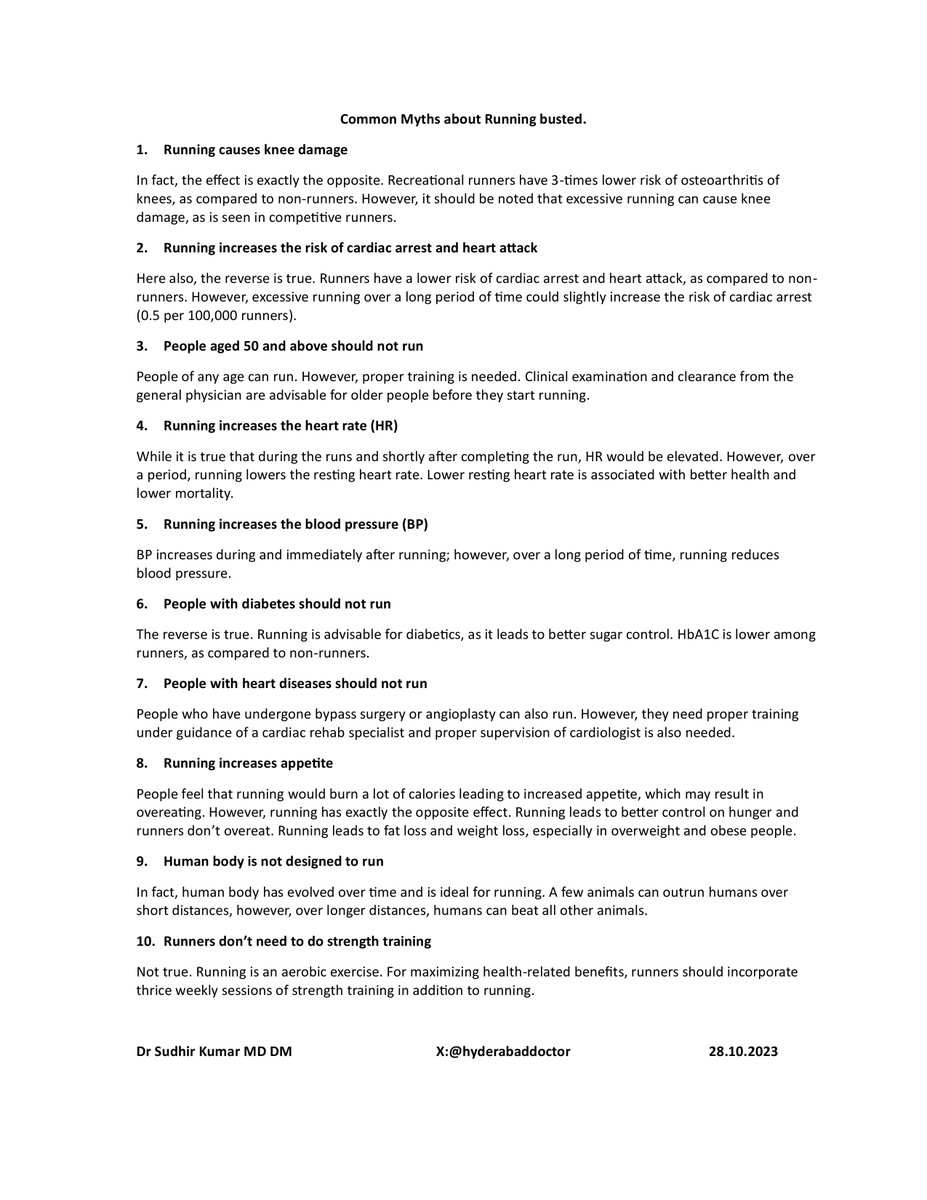
10 Common Myths about Running busted
1. Running causes knee damage
In fact, the effect is exactly the opposite. Recreational runners have 3-times lower risk of osteoarthritis of knees, as compared to non-runners. However, it should be noted that excessive running can cause knee damage, as is seen in competitive runners.
2. Running increases the risk of cardiac arrest and heart attack
Here also, the reverse is true. Runners have a lower risk of cardiac arrest and heart attack, as compared to non-runners. However, excessive running over a long period of time could slightly increase the risk of cardiac arrest (0.5 per 100,000 runners).
3. People aged 50 and above should not run
People of any age can run. However, proper training is needed. Clinical examination and clearance from the general physician are advisable for older people before they start running.
4. Running increases the heart rate (HR)
While it is true that during the runs and shortly after completing the run, HR would be elevated. However, over a period, running lowers the resting heart rate. Lower resting heart rate is associated with better health and lower mortality.
5. Running increases the blood pressure (BP)
BP increases during and immediately after running; however, over a long period of time, running reduces blood pressure.
6. People with diabetes should not run
The reverse is true. Running is advisable for diabetics, as it leads to better sugar control. HbA1C is lower among runners, as compared to non-runners.
7. People with heart diseases should not run
People who have undergone bypass surgery or angioplasty can also run. However, they need proper training under guidance of a cardiac rehab specialist and proper supervision of cardiologist is also needed.
8. Running increases appetite
People feel that running would burn a lot of calories leading to increased appetite, which may result in overeating. However, running has exactly the opposite effect. Running leads to better control on hunger and runners don’t overeat. Running leads to fat loss and weight loss, especially in overweight and obese people.
9. Human body is not designed to run
In fact, human body has evolved over time and is ideal for running. A few animals can outrun humans over short distances, however, over longer distances, humans can beat all other animals.
10. Runners don’t need to do strength training
Not true. Running is an aerobic exercise. For maximizing health-related benefits, runners should incorporate thrice weekly sessions of strength training in addition to running.
Dr Sudhir Kumar MD DM 28.10.2023
#running #myths #fitness
Impossible is Nothing. Still can't stop watching this continuously on loop and just be in awe of the inspiration that is #SheetalDevi, 16 yr old daughter of Shakti ji & Mann Singh Ji from a small village in Kishtwar, J&K.
Worlds first armless female archer to win a Gold. Truly incredible
Working 70 hours a week: Is it a recipe for success or failure?
Recently, Mr Narayana Murthy was in the news for advising youngsters to aim for working 70 hours or more per week. This amounts to 14 hours per day in people who work 5 days a week (or about 12 hours per day in people working 6 days a week).
Coming from a highly successful person, will his advice lead to success in people who follow this? Let us examine the published research on this topic.
Long working hours adversely affects health
Long working hours may lead to many health problems such as fatigue, headache, depression, myocardial infarction and stroke.
Long working hours leads to shorter sleep duration and sleep disorders. People working longer hours also report higher degree of stress and are more likely to engage in unhealthy behaviours such as smoking, drinking and eating junk food.
The risk of metabolic syndrome is higher by 2.2 times among workers (especially females) working ≥60 hours per week as compared to those who work 40-51 hours per week.
Long working hours reduces longevity
Long working hours increase the risk of death (overall as well as disease-specific). In a study, it was found that men in routine or semi-routine occupations who worked more than 55 hours per week had a 31% higher risk of all-cause death than men who worked 35–40 hours per week.
Lesser time for exercise & sleep
If a person were to work 14 hours a day, it is likely that he/she would miss on exercise and sleep. Regular exercise and normal sleep duration are vital to maintain good health. Lack of exercise and lesser sleep duration are associated with a higher risk of obesity, diabetes, hypertension, heart attack, stroke and death.
Lesser time with family and friends
Long working hours are responsible for reducing the time an employee can spend with family and friends. This not only increases stress levels but would also lead to relationship problems and higher divorce rate.
Longer working hours reduces productivity
Just because a person works for longer duration, it does not automatically mean an increase in productivity. Loss of productivity is more likely if the longer working hours are “forced upon” the employee or if the employee does not enjoy the work.
Take home message
There is a need to rationalize the working hours to 40 hours a week, and ensure that this time is effectively utilised with maximum productivity. (Not to forget that a significant amount of time is spent in commuting especially in bigger cities).
#WorkLifeBalance #worklifeharmony #NarayanaMurthy
(Dr Sudhir Kumar MDDM 29th Oct 2023)
Home cooked dinners are always beautiful.
In the plate - jawar bhakri, masoor usal, batata bhaaji, bhoplyacha bharit (pumpkin raita), bharli mirchi and singdana chutney.
Marry a tough girl -
-who doesn’t laugh at all your jokes
-who’s not scared to speak her mind or to over eat a few times
-who has the courage to pursue her own path
- and is willing to take some time off
A client asked me for marriage advice & this is what i sent him.