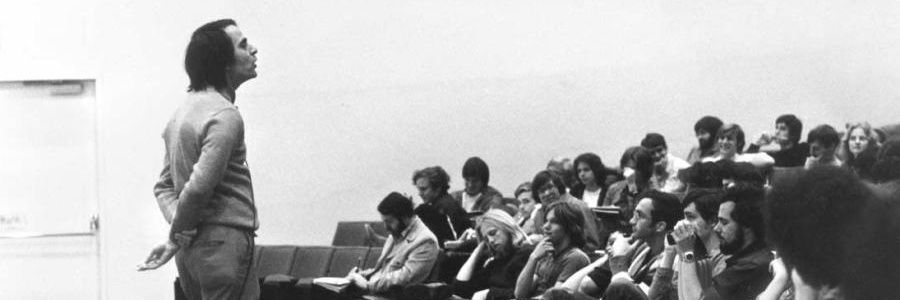
Cosmos: A Personal Voyage is a thirteen-part, 1980–81 television series written by Carl Sagan, Ann Druyan, and Steven Soter, with Sagan as presenter. It was executive-produced by Adrian Malone, produced by David Kennard, Geoffrey Haines-Stiles, and Gregory Andorfer, and directed by the producers, David Oyster, Richard Wells, Tom Weidlinger, and others. It covers a wide range of scientific subjects, including the origin of life and a perspective of our place in the universe. Owing to its bestselling companion book and soundtrack album using the title, Cosmos, the series is widely known by this title, with the subtitle omitted from home video packaging. The subtitle began to be used more frequently in the 2010s to differentiate it from the sequel series that followed.
The series was first broadcast by the Public Broadcasting Service in 1980, and was the most widely watched series in the history of American public television until The Civil War (1990). As of 2009, it was still the most widely watched PBS series in the world. It won two Emmys and a Peabody Award, and has since been broadcast in more than 60 countries and seen by over 500 million people. A book was also published to accompany the series.
Remembering the ones who always made us look up🤍✨
“Carl wanted us to see ourselves not as the failed clay of a disappointed Creator but as starstuff, made of atoms forged in the fiery hearts of distant stars. To him we were “starstuff pondering the stars; organized assemblages of 10 billion billion billion atoms considering the evolution of atoms; tracing the long journey by which, here at least, consciousness arose”. For him science was, in part, a kind of “informed worship”. No single step in the pursuit of enlightenment should ever be considered sacred, only the search was.”
Preface by Ann Druyan to The varieties of scientific experience. A personal view of the search of God | Carl Sagan
Every kid starts out as a natural-born scientist, and then we beat it out of them. A few trickle through the system with their wonder and enthusiasm for science intact.
We've arranged a global civilization in which most crucial elements profoundly depend on science and technology. We have also arranged things so that almost no one understands science and technology.
This is a prescription for disaster. We might get away with it for a while, but sooner or later this combustible mixture of ignorance and power is going to blow up in our faces.
Think of the rivers of blood spilled by all those generals and emperors so that, in glory and triumph, they could become the momentary masters of a fraction of a dot.
Arguments from authority carry little weight – authorities have made mistakes in the past. They will do so again in the future. Perhaps a better way to say it is that in science there are no authorities; at most, there are experts.