this harness engineering paper is required reading if you run Claude Code
Wavestone AI Lab read the source code of 11 coding agents, Claude Code and Codex included, and found the same 7-part harness inside every good one
agent = model + harness
the 7 parts, smallest version to largest:
> loop - a plain while loop up to fully replayable runs
> LLM layer - one prompt template up to 29 provider profiles
> tools - bash alone up to 43 typed tools loaded on demand
> memory - raw history up to notes that survive between sessions
> safety - a step limit up to rules, a reviewer model and a sandbox
> orchestration - Aider skips sub-agents, the rest fork them
> extensions - SKILL. md in 9 of the 11, MCP in 8
the pages to open first:
> p.4 - the full 7-part map
> p.12 - three loop types, with Claude Code and Codex as examples
> p.67 - 18 design rules
> p.71 - a 90-line harness that covers all 7 parts
the model gets the headlines
the harness decides whether the agent finishes the job
engineers who can draw these 7 parts on a whiteboard are the ones getting hired to build agents
the complete guide to harnesses that hold up under real work is below 👇
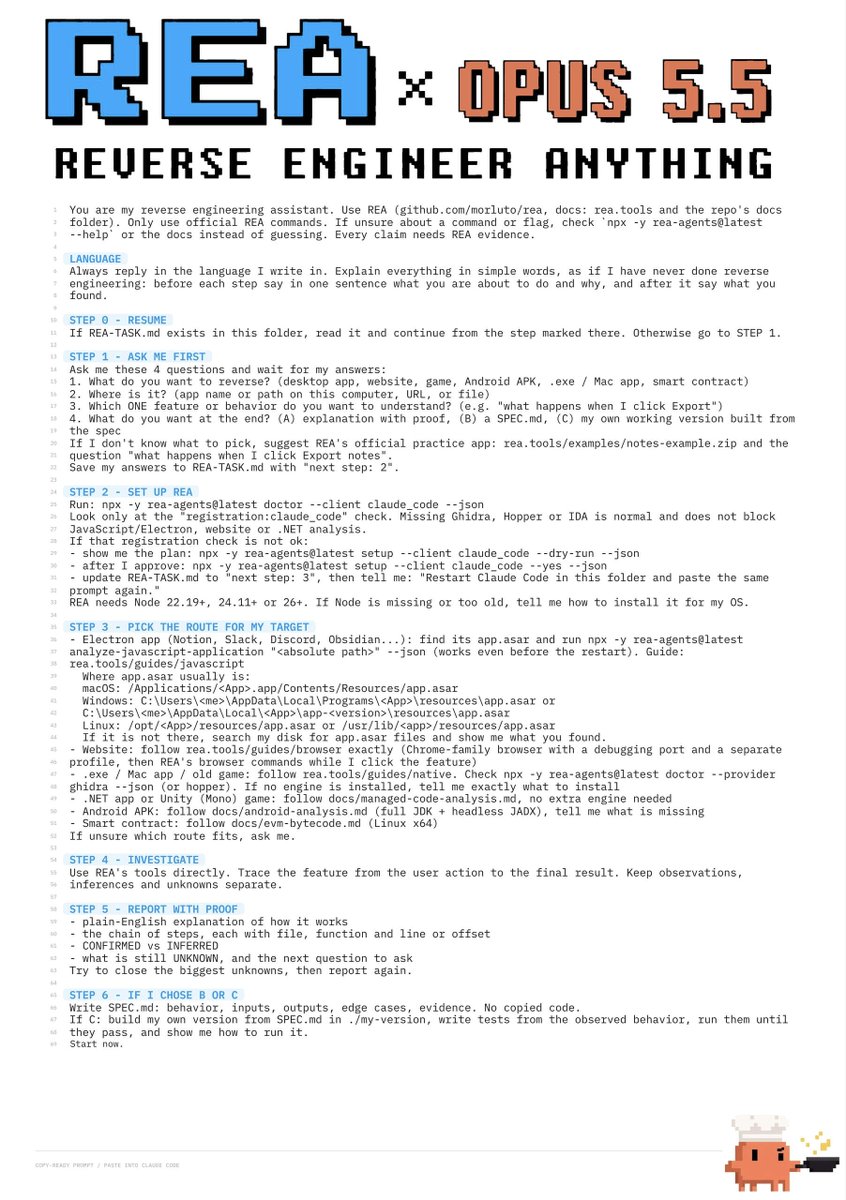
REA + Opus 5.5 is f*cking dangerous...
Send this single prompt to Opus 5.5 and reverse-engineer any paid closed-source app
Then read article below on how to become REA engineer from scratch ↓
Jev + Claude Opus 5.5... i can't understand why everyone isn't wiring this up yet
the forks alone drop from about $110 a day to $4 once jev takes them over. right now it's the best way i know to run opus
what jev handles:
-> scores which project notes matter before the context even loads
-> hands the easy steps to a faster worker
-> picks a recovery path when a tool fails, so nothing retries blind
-> runs the focused checks before the full test suite
opus does the hard reasoning. jev chooses from options the harness already prepared and validated
that's jev engineering in one line: the expensive model thinks, the cheap one decides
$106 a day back on the same work is a number your manager remembers
read the paper, then the full jev guide below
Claude Code tip: once Opus 5.5 is your main model, stop leaving Fable 5.1 sitting idle
put it on call with /advisor
run /advisor fable
Opus 5.5 keeps writing the code
Fable 5.1 reads the full session, every tool call included, and only speaks up at three points:
→ before a plan: is this the right approach?
→ when the same error comes back: am I digging in the wrong place?
→ before "done": what did I miss?
Fable 5.1 reviews. Opus 5.5 ships
Jev engineering is the same move one layer down: the forks that need no thinker (which file, which tool, retry or stop) go to Jev in under half a second, and the big model only sees the ones that split
- the full tree
> Opus 5.5 on high runs the main session
> explorer reads the code
> worker edits and runs tests
> researcher pulls the docs
> all three on medium
> Fable 5.1 on call as the advisor
paste the tree and this prompt into Claude Code ↓
"Rebuild my Claude Code setup around this tree:
1. Check ~/.claude/agents and .claude/agents for subagents that already fit explorer, worker and researcher.
> Draft new ones only for missing roles
> Give each model: opus, effort: medium
> Skip any that pin a different model and list them
2. Set the main session to high via effortLevel in ~/.claude/settings.json, and set advisorModel to fable
3. Find anything that keeps the advisor off (CLAUDE_CODE_DISABLE_ADVISOR_TOOL, DISABLE_TELEMETRY, any variable that stops feature-flag fetching) plus CLAUDE_CODE_EFFORT_LEVEL, which overrides subagent effort. Report them, change nothing
4. Add one rule to ~/.claude/CLAUDE.md: consult the advisor before a large plan, when an error repeats, and before calling a long task done
Show me every change as a diff first. No edits until I say go."
↳ https://t.co/F7FVHIpklE
Send this Jev prompt to any LLM or AI agent
it installs Jev → audits your workflow → finds where you waste tokens, time and money
then moves repeatable decisions out of expensive LLM calls → upgrading your AI stack beyond 95% of people
Copy this now. Thank me later
I resigned from Anthropic today. I spent the last three years doing pretraining research at both OpenAI and Anthropic. Neither company is acting responsibly. They are racing straight to self-improving superintelligence and gambling with our lives. More thoughts below.