I love that we’re the new Rome. Peace with Persia in the afternoon and a gladiator fight in the evening, all on the Emperor’s birthday. Another 1,000 years.
The world energy shock is coming — it will deepen inequality in ways we've seen before. Our new @newstatesman piece argues that without urgent government action, the Strait of Hormuz crisis will ripple through our economies and rip apart our societies. Here's why. 1/
@LughSpear Thanks, I tend to agree. We kinda forgot about it, but climate change may also limit somewhat the rollout of AI to the extent envisaged by tech gurus. It's the energy, stupid!
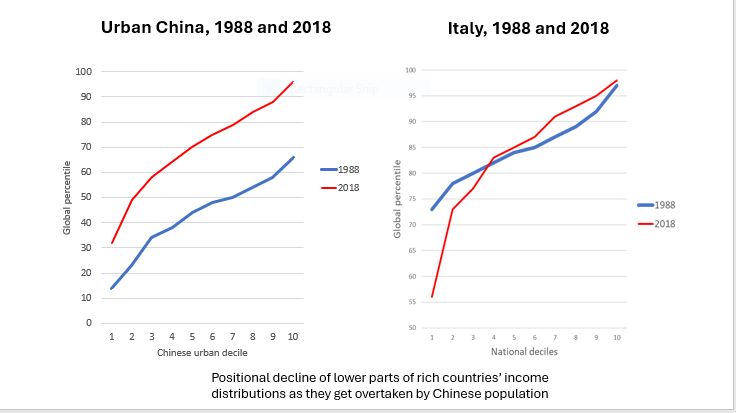
A couple of slides from my yesterday's book talk on GGT.
Positional decline of Western middle classes; here is the example of Italy. Lower parts of Italian icnome distribution were around the 70th global percentile in 1988; now they are at the 55th. (The reverse is true for China.)
“The hour of the barbarian is at hand. The modern barbarian. The American hour. Violence, excess, waste, mercantilism, bluff, conformism, stupidity, vulgarity, disorder.”—Aimé Césaire, 1950
AI is a game changer for economic research. We will look back and think: before and after.
The junior job market used to place enormous value on technical skills — and rightly so. We wanted to pass on the latest research methods to new PhD students. But the cost of mastering frontier solution techniques has dropped dramatically. I now find myself replicating papers and experimenting with frontier methods in an evening or a few days using Claude Code. That would have taken weeks before — which in practice meant I wouldn’t have done it at all.
So what does the new equilibrium look like? Some are pessimistic: ChatGPT can write PhD dissertations, they say. Maybe. But those dissertations won’t push the frontier or generate excitement.
I take the other side of that bet. We are in the business of figuring out how the world works and generating new knowledge. There is plenty we don’t understand, and no shortage of questions to answer. AI just accelerates the process.
The returns on conceptual thinking and original ideas are now relatively higher compared to the technical grunt work of debugging code and cleaning datasets. I think this is a great development.
My guess is it will also erode the monopoly that top US schools — and a handful of others — have long enjoyed. Part of that monopoly rested on access to knowledge that didn’t travel easily. Person-to-person transmission has always been far more efficient than learning from books or published papers — which are outdated by the time they appear, given publication lags.
Now knowledge transmission is nearly instantaneous. I find myself using techniques I understood in principle but could never justify the time to implement, because other methods were simply faster. That’s no longer true. The same goes for big data work.
One question keeps nagging me though: how should this change how we teach?
The problem is decidedly not the lack of talent. Many economists who do advanced degrees are prodigiously gifted or at least become very proficient in mathematics but waste their talents on hyper-stylised overly formal nonsense that is inappropriate to the object of study. Here, ‘rigour’ has become largely about in-group signalling and not epistemic necessity. It is therefore very telling but not at all surprising that much of this conversation is not about substance but about rank pulling based on degrees, grades and accolades.
Does Mr Trump have a right to help himself to Greenland? Of course he does not. Yes, he is right to say that Denmark’s only claim to Greenland is that some of its ships disembarked centuries ago there and took that land. But, how exactly did the Europeans take North America, Australia, New Zealand? Legally? It is never advisable for the pot to call the kettle black.
And now onto a delicious twist to the Greenland story:
Europeans claim that it is unprecedented and a violation of NATO's charter for the leader of a member-state of a defensive alliance to be threatening another NATO member-state. That NATO is about solidarity, about defending its members’ territory. Not so!
Since 1952, when Greece and Turkey entered NATO in tandem, successive Greek governments have been desperately struggling to get NATO to commit to coming to Greece’s defence if Turkey invades.
NATO has STEADFASTLY refused to make such a commitment. Why? The official answer has been that NATO is committed to defending member states from belligerent non-member states – but not from each other, not from other member states, like Turkey or, now, the... United States!
Want to know why Greece is perhaps the only member-state that consistently spent a lot more on weaponry than the bare minimum? That’s why! Because NATO has unwaveringly refused to defend its borders in case of a skirmish or war with Turkey.
So, Denmark welcome to the club – and remember your governments also argued that it is not NATO’s job to defend any member-state from another NATO member-state.
https://t.co/bRTY8iieMV
I have spoken with Secretary of State Marco Rubio and our Ambassador in Caracas. The EU is closely monitoring the situation in Venezuela.
The EU has repeatedly stated that Mr Maduro lacks legitimacy and has defended a peaceful transition. Under all circumstances, the principles of international law and the UN Charter must be respected. We call for restraint.
The safety of EU citizens in the country is our top priority.
It has become received wisdom in Brussels and Washington that there is a new “euro-sclerosis”: that the EU economy is lagging the US
This view is wrong
A little primer on the measurement of productivity – and why reports of the economic death of Europe are greatly exaggerated🧵
L'Italia si sfila dall'Ucraina perché ha un'altra guerra in corso
Niente soldati, niente armi, niente soldi: che ci pensi la Germania, la padrona della Ue, perché l'Italia a Est non tocca palla, ha un bilancio striminzito (anche il prossimo anno) e stipendi da fame. Secondo l'Istat tra il 2013 e il 2022 l'Italia ha perso 350mila giovani emigrati (un terzo laureati) ma la stima reale si aggira sul milione. In 20 anni si sono perse 3,5 milioni di persone sotto i 35 anni. Perdite simili a un conflitto armato.
So is Lagarde heading to Matignon, or will France somehow escape the technocratic reset?
Given her unquestionable loyalty to capital, she could even force the Zucman tax and still get the support of the French moneyed aristocracy...